Tencent has released Hy-MT3, a family of open translation models that covers 102 languages, up from 38 in Hy-MT2. There are three sizes, 1.8B, 7B and 30B-A3B, all under Apache 2.0, and each comes with an FP8 build and a GGUF build for llama.cpp. Tencent announced the release on X on 24 November and published a technical report on arXiv.
The headline claim is that the 30B-A3B model, which activates 3 billion parameters per token, is the best non-thinking system Tencent tested, ahead of Qwen3.8-Max, Kimi-K3.1-Pro and DeepSeek-V4.1-Flash. The margin over Qwen3.8-Max is half a point, on a scorer Tencent built and ran itself. This piece covers what was released, what the report supports, and what it leaves out.
102
languages, up from 38 in Hy-MT2
3B
parameters active per token in the 30B-A3B model
−74%
samples with omissions or additions against Hy-MT2, Tencent says
0.08%
game terminology errors, against 0.54% for Gemini 3.1 Pro
What was released
Each size ships as the standard weights, an FP8 build and a GGUF build, which makes nine repositories on Hugging Face, with ModelScope copies. The GGUF builds list IQ2, Q4_K_M and Q8_0 quantisations. The model card gives a maximum context of 8,192 tokens and says the models have no default system prompt. They need transformers 5.6.0 or later, or vLLM, SGLang or llama.cpp.
| Model | Size | Builds | Recommended sampling |
|---|---|---|---|
| Hy-MT3-1.8B | 1.8B | Standard, FP8, GGUF | Temperature 0.7, top_p 0.6, top_k 20, repetition penalty 1.05 |
| Hy-MT3-7B | 7B | Standard, FP8, GGUF | Same as the 1.8B |
| Hy-MT3-30B-A3B | 30B total, 3B active (mixture of experts) | Standard, FP8, GGUF | Temperature 0.7, top_p 1.0, top_k off, repetition penalty 1.0 |
Tencent also released training scripts for full-parameter and LoRA fine-tuning, with DeepSpeed ZeRO and LLaMA-Factory support, and its AngelSlim toolkit for quantisation. Hy4, Tencent’s flagship released a few days earlier, ships under a custom licence with revenue limits for hosted-model businesses, so Apache 2.0 here is a clear contrast. Sulat covered that release in an earlier post.
From 38 languages to 102
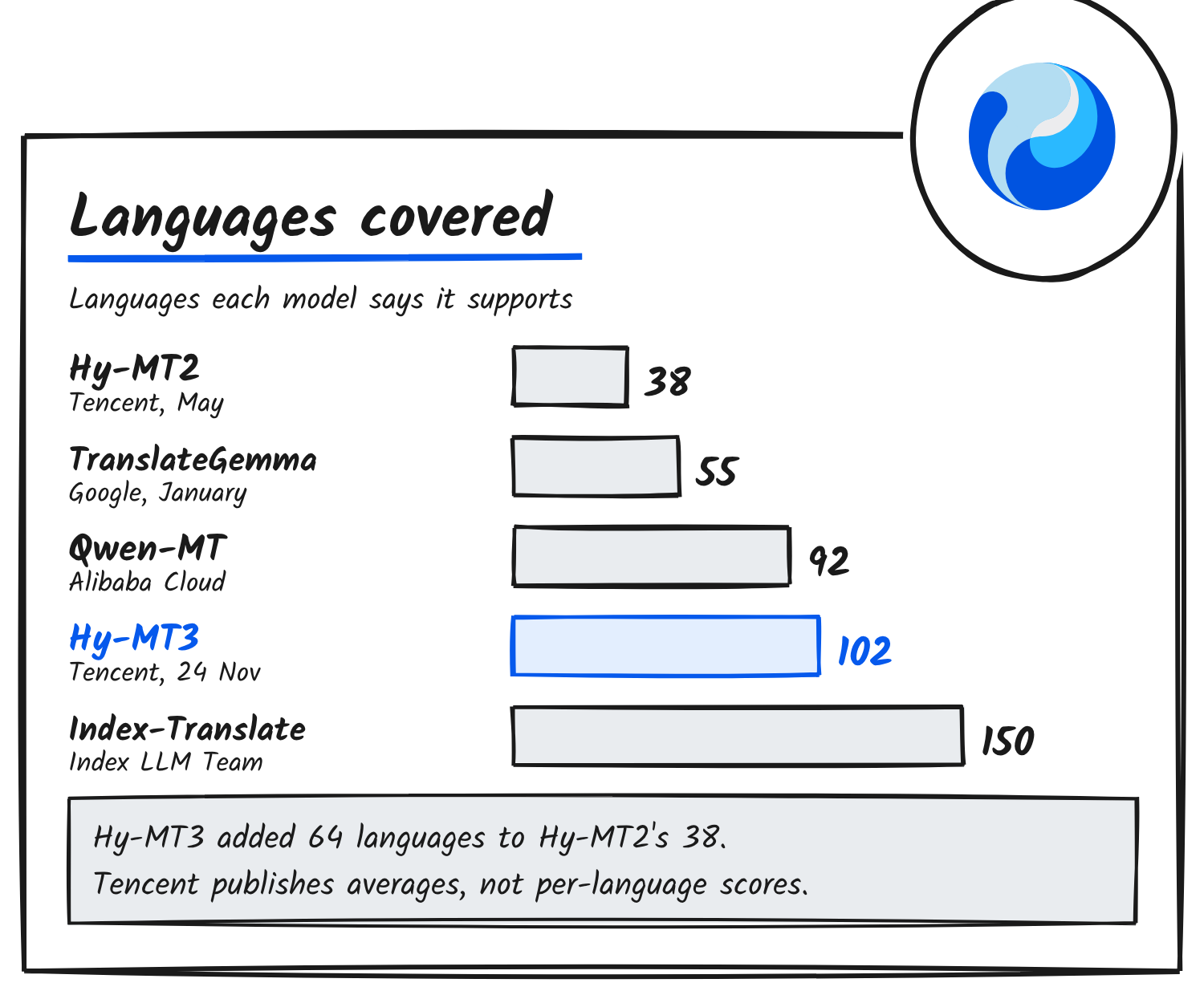
Hy-MT2, released on 21 May, covered 38 languages. Hy-MT3 adds 64 lower-resource languages for a total of 102. Tencent says the gain on the new group is large: for translation between Chinese and the 64, the 30B-A3B model’s TransRubric score rose from 63.89 to 91.52, and for English and the 64, from 67.75 to 92.74. On the English direction that is close to Qwen3.8-Max at 92.99. The 1.8B model went from 24.44 to 73.48 on the Chinese direction, which shows how thin the old model’s coverage was.
How the 102 languages break down
Tencent counts 33 general languages, five minority languages and varieties (Tibetan, Traditional Mongolian, Cantonese, Arabic-script Kazakh and Uyghur) and the 64 added lower-resource languages. The five minority languages are tested only against Mandarin. The Hugging Face model card lists 99 language codes, and three of the 102 (zh-TR, kk-Cyrl and mn-Cyrl) have no tag of their own. Tencent reports averages for each group, not scores for each language, so a reader can’t tell from the report which of the 64 are strong and which are weak.
Several open or hosted translation systems list more or fewer languages than Hy-MT3. The table below sets out the ones that matter most. Google Translate, DeepL and Meta’s Omnilingual MT are not in Tencent’s comparison tables, so their figures here come from a trade newsletter and are not scored against Hy-MT3.
| System | Maker | Languages | Access |
|---|---|---|---|
| Hy-MT3 | Tencent | 102 | Open weights, 1.8B / 7B / 30B-A3B, Apache 2.0 |
| Hy-MT2 | Tencent | 38 | Open weights, same three sizes |
| Qwen-MT | Alibaba | 92 | Alibaba Cloud API |
| TranslateGemma | 55 | Open weights, 4B / 12B / 27B, Gemma terms of use (15 January 2026) | |
| Index-Translate | Index LLM Team | 150 | Open weights, 2B / 9B / 35B-A3B (September 2026). One secondary source says Apache 2.0; Sulat could not verify the licence. |
| Google Translate | 247+ | Hosted service. Figure from Machine Translate’s May 2026 newsletter. | |
| DeepL | DeepL | 109 | Hosted service. Same source. |
| Omnilingual MT | Meta | 1,600 | Research system. Same source. |
What improved over Hy-MT2
The cleanest evidence in the report is the comparison with Tencent’s previous model. Tencent built WildMTBench-202611 from 5,000 real-world samples with unlabelled source languages, and scored Hy-MT2-30B-A3B and Hy-MT3-30B-A3B on it. The average score rose from 83.62 to 91.30. The share of samples rated perfect went from 25.5% to 40.6%, and the share rated poor fell from 7.4% to 2.2%. The average number of issues per sample dropped from 2.14 to 1.13, and Hy-MT3 won 58.9% of head-to-head samples against 15.5% for Hy-MT2.
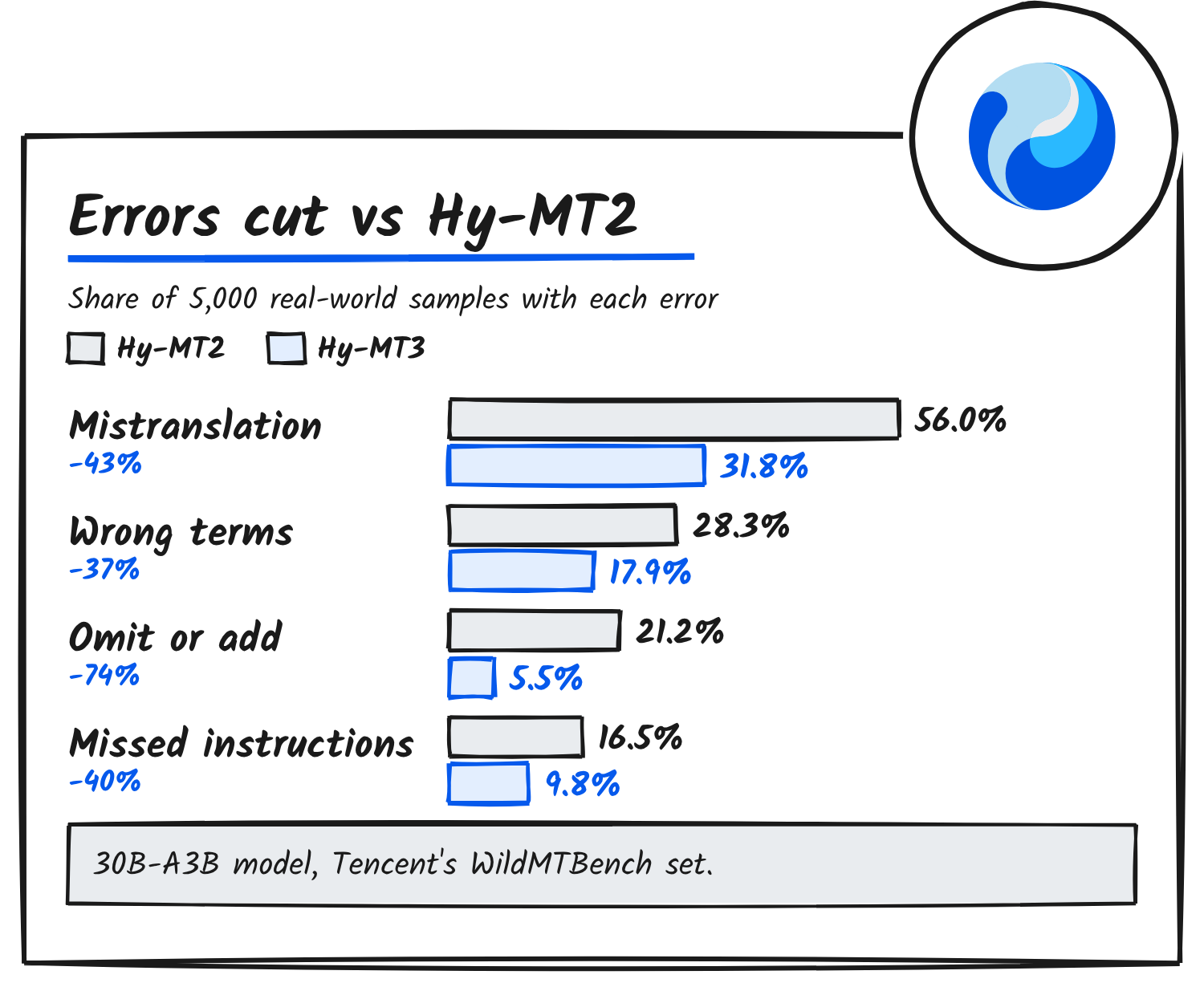
Most of the gain is in faithfulness. Tencent says the instruction-following improvement comes mainly from the model no longer completing or extending the source text on its own, and from better handling of formatting tags. The paper’s case studies show what that looks like.
| Case | Hy-MT2 | Hy-MT3 |
|---|---|---|
| A Chinese headline naming 夏雨雨 | Read the name as “summer rains”: “The summer rains touched the hearts of countless Chinese people” | Transliterated it: “Xia Yuyu Moved Countless Chinese People” |
| A university hockey headline in English | Dropped “Chippy Exhibition” and translated it as a narrow win | Kept it as 对抗激烈的表演赛 (a hard-fought exhibition game), with the inline tags intact |
| A journal reference to translate into Chinese | Translated the author names and the journal title | Left the author list and “Biomolecules” in their original form, as citation convention requires |
The scoreboard, and its small print
On Tencent’s general translation average, which covers FLORES-200, FLORES-200 low-resource, WMT26 and Mandarin-to-minority tests, the 30B-A3B model scores 88.50 on TransRubric and 81.87 on GEMBA. Qwen3.8-Max scores 88.02 and 81.08, Kimi-K3.1-Pro 86.01 and 81.47, and DeepSeek-V4.1-Flash 84.27 and 78.98. The 7B model, at 86.12 and 80.39, also beats DeepSeek-V4.1-Flash on TransRubric and every translation-specialist model in the table, including Index-Translate-35B-A3B at 78.75 and 79.24. The 1.8B model, at 75.05 on TransRubric, beats iFlytek Translator (73.26), Microsoft Translator (71.09) and Qwen-MT-Flash (67.00).
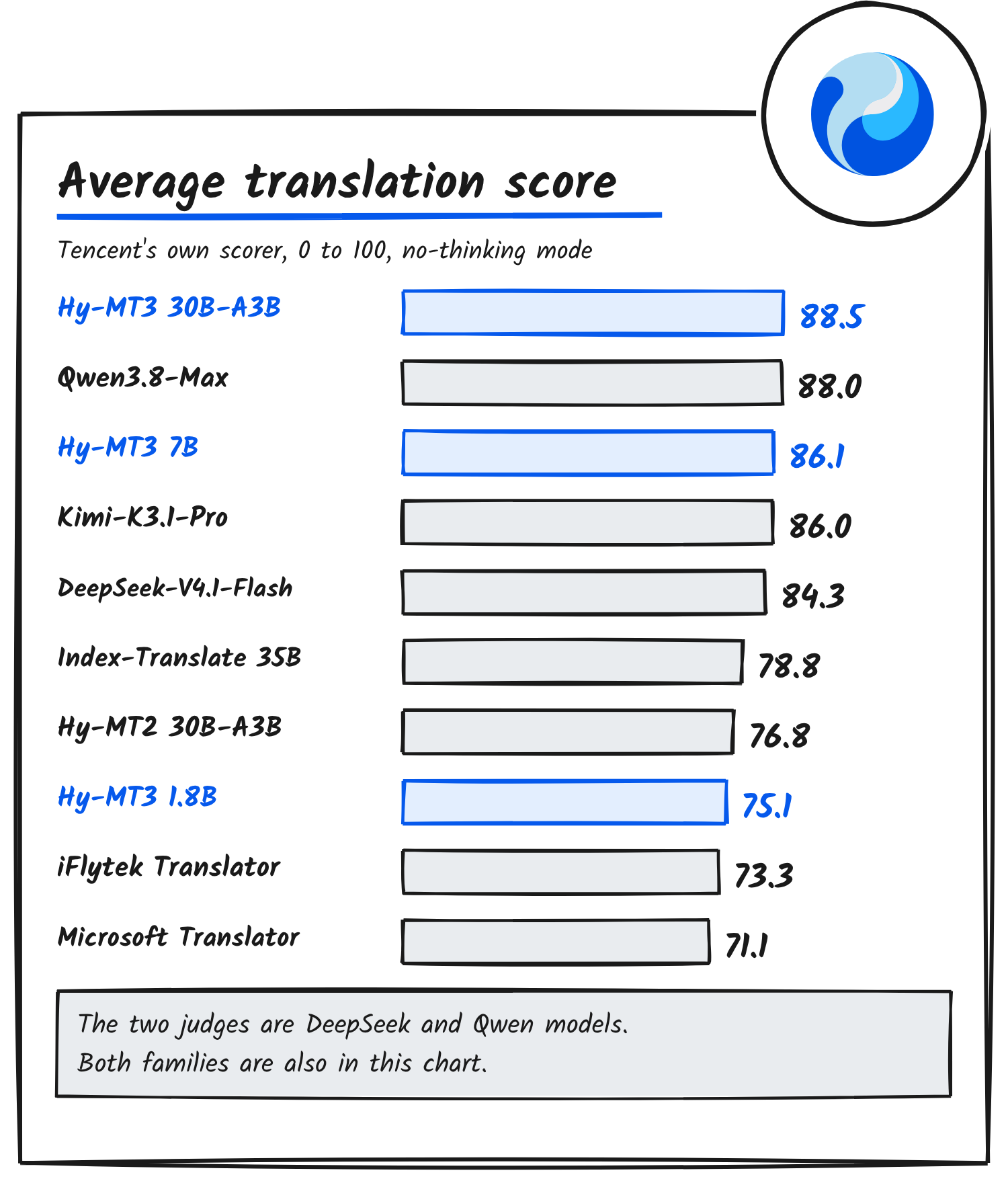
Hy-MT3-30B-A3B achieves the best overall performance among all evaluated models in non-thinking mode.
Hy-MT3 model card, Hugging Face
“Non-thinking mode” is doing a lot of work in that sentence. The same table scores the rivals with reasoning switched on, and they come out ahead.
| Model | Mode | TransRubric average | GEMBA average |
|---|---|---|---|
| Hy-MT3-30B-A3B | Non-thinking | 88.50 | 81.87 |
| Qwen3.8-Max | Non-thinking | 88.02 | 81.08 |
| Kimi-K3.1-Pro | Non-thinking | 86.01 | 81.47 |
| DeepSeek-V4.1-Flash | Non-thinking | 84.27 | 78.98 |
| DeepSeek-V4.1-Flash | Thinking | 94.09 | 82.68 |
| Kimi-K3.1-Pro | Thinking | 92.13 | 82.77 |
| Claude-Opus-5.5 | Thinking | 91.84 | 83.25 |
| Qwen3.8-Max | Thinking | 91.45 | 82.56 |
| Gemini-4-Argon | Thinking | 89.92 | 82.23 |
Tencent’s answer is compute. Its figure of under 1 TFLOP per sample for the 30B-A3B model rests on an estimate of two times the active parameters times the tokens generated, thinking tokens included. Tencent says that puts it ahead of models that use more than 30 times as much. That is a fair framing for cost, but it is a different claim from being the best translator, and the closed models’ sizes are undisclosed, so their compute is a guess.
Tencent also lists where it loses. On HardMTBench, a set of hard, knowledge-heavy Chinese and English cases, the 30B-A3B model scores 88.93 on TransRubric against 92.30 for Qwen3.8-Max and 92.04 for Kimi-K3.1-Pro. On the complex subset of IFMTBench, which tests multi-constraint instruction following, it scores 79.74 against 82.84 for Qwen3.8-Max. In sports, a domain Tencent stresses, it scores 90.17 against 91.14. On WildMTBench it leads, at 91.30 against 90.94 for Qwen3.8-Max and 90.23 for Kimi-K3.1-Pro.
Who marks the work
Tencent ran every benchmark itself, and no independent lab has reproduced the results. The scorer is also Tencent’s. TransRubric is a rubric-based judge that builds a checklist for each sample, finds issues by type and severity, and gives a score out of 100. Tencent’s score is the mean of two judge models, DeepSeek-V4.1-Flash and Qwen3.5-397B-A17B, and empty outputs count as zero.1 Two of Hy-MT3’s comparison models therefore come from the same families as its judges, which is a conflict of interest a reader should weigh.
Tencent does back the scorer with outside tests. On the segment-level task of the WMT26 shared task on translation quality evaluation, TransRubric scored 0.744 on PDP and 0.832 on average correlation, against 0.736 and 0.830 for the top official entry, Gemini-3.6-Flash, which used the same underlying model. Against 10 professional annotators on 651 Chinese and English translations, TransRubric’s scores varied by 3.31 points across 10 runs, against 15.57 across the humans, and its pairwise accuracy of 59.91% was higher than seven of the 10 annotators. Tencent released TransRubric on GitHub with rubrics for FLORES-200, WMT26 and HardMTBench, so outsiders can inspect it.
Game localisation, built with Tencent’s own studio
The most distinctive part of the release is game text. Tencent built a game-translation dataset and an evaluation set with the Honor of Kings team at its TiMi studio, a game Tencent publishes. The test covers text length, rich text and placeholders, and long, term-heavy passages from MOBA and open-world games. Four errors are counted: output in the wrong language, broken placeholders, broken rich-text tags and wrong in-game terms, any of which can break a game client.
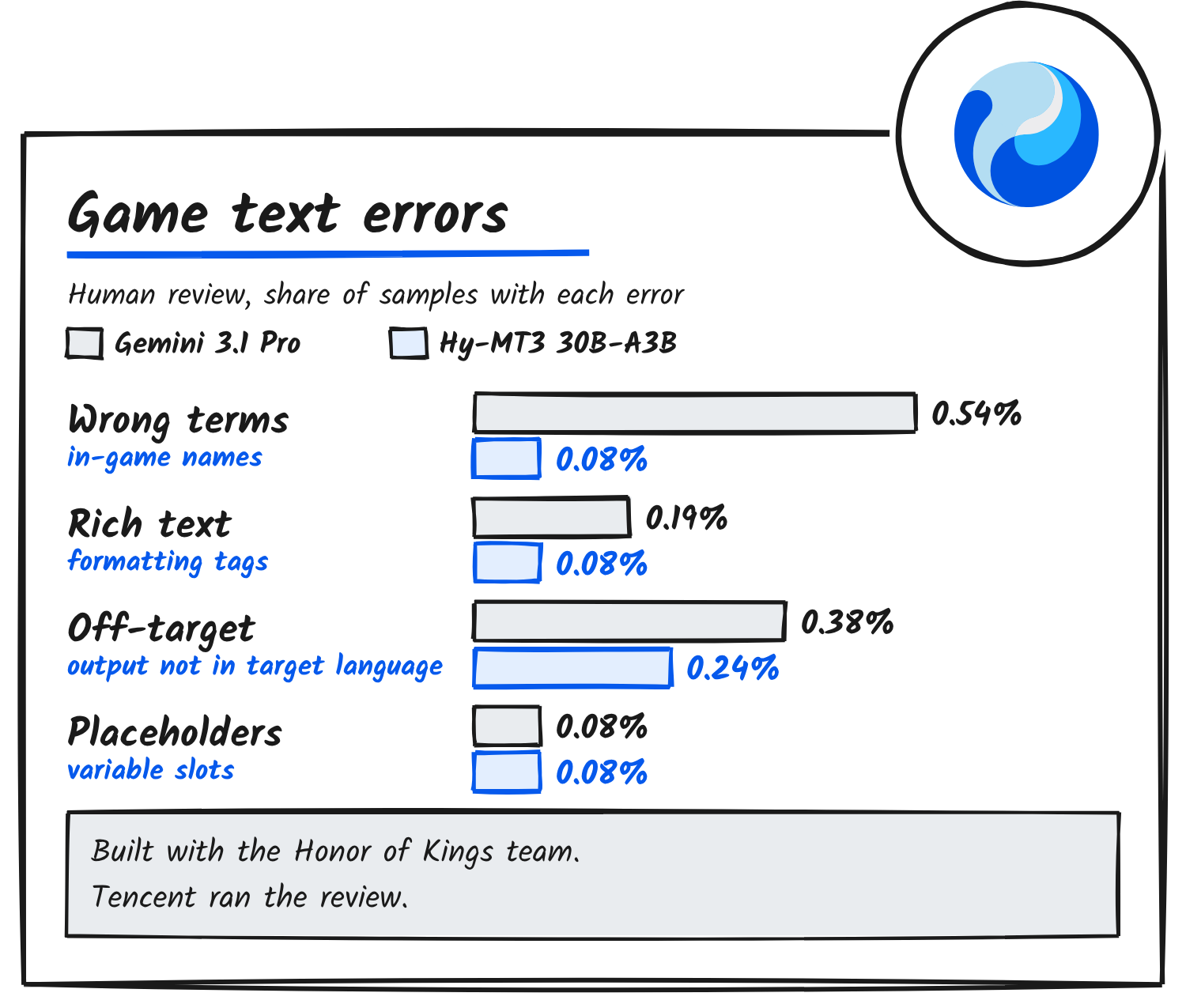
| Model | Wrong language | Placeholder | Rich text | Terminology | Human-rated total |
|---|---|---|---|---|---|
| Hy-MT3-30B-A3B | 0.24% | 0.08% | 0.08% | 0.08% | 89.6 |
| Gemini 3.1 Pro | 0.38% | 0.08% | 0.19% | 0.54% | 88.7 |
| DeepSeek-V4-Pro (thinking) | 0.65% | 0.12% | 0.46% | 0.54% | 88.3 |
Hy-MT3 has the lowest error rate on all four counts, tied with Gemini 3.1 Pro on placeholders. The total-score gap to Gemini is 0.9 of a point, so the lead is narrow. It was also measured on a test Tencent’s own game team helped design.
The Honor of Kings team open-sourced the toolchain that wires the model into game builds, TiMiHOKGameTranslator, under Apache 2.0. It includes a translation chain, the evaluation set, capture and restore plugins for Unity and Unreal Engine, and a Django web platform for language quality checks. The idea is to capture one Chinese baseline of the game’s text and restore it in any target language. Its README still says the Hy family covers 33 languages, a sign it predates the 102-language release.
Image translation, with a catch
Tencent also claims the best result among models of comparable size on VISTA-Bench for image translation: 45.73 for the 30B-A3B model, against 45.46 for Gemma4-26B-A4B, 43.63 for Index-Translate-35B and 42.84 for GLM-5.3 in thinking mode. The margin over Gemma is 0.27 points. Hy-MT3 never sees the image. Tencent runs OCR first with PaddleOCR and passes only the extracted text to the model, which means Hy-MT3’s job is to cope with OCR mistakes. TranslateGemma and Index-Translate, by contrast, can read images directly.
Running it
The model card asks for full language names in the prompt, in Chinese for Chinese prompts and English for English ones, and gives templates for terminology lists, style, delimiters and structured data. The default prompt and the vLLM command for the 30B-A3B model are below.
# Default translation prompt (English version from the model card)
Translate the following text into {target_lang}. Note that you should only output the translated result without any additional explanation:

{source_text}

# Serve the 30B-A3B model with vLLM built from source
vllm serve tencent/Hy-MT3-30B-A3B --tensor-parallel-size 1
Hugging Face lists no inference provider for the models at the time of writing, and the model card links a Tencent AI Studio chat page and not an API. The Tencent AI account says Hy-MT3 is coming soon to its Chrome and Edge browser extension, which runs local models offline in one click.
How Tencent got here
| Date | Release | What changed |
|---|---|---|
| 1 September 2025 | Hunyuan-MT-7B | Tencent says it placed first in 30 of 31 categories at WMT25 |
| 30 December 2025 | HY-MT1.5 | 1.8B and 7B models |
| 21 May 2026 | Hy-MT2 | 1.8B, 7B and 30B-A3B; 38 languages; a 1.25-bit 1.8B build of 440MB; IFMTBench released |
| 24 November 2026 | Hy-MT3 | 102 languages, game toolchain, TransRubric released |
What is still missing
- No independent reproduction. Every figure in this article comes from Tencent’s own runs.
- No per-language scores for the 102 languages, only group averages.
- No training data or method. The report does not say what data the 64 new languages came from.
- An 8,192-token context limit, which caps long-document translation without chunking.
- No scores for Google Translate or DeepL, the services most users actually compare against.
Terms used in the report
- TransRubric
- Tencent’s rubric-based LLM judge. It writes a checklist for each sample, lists issues by type and severity, and scores from 0 to 100.
- GEMBA
- A second, LLM-based quality score. Tencent macro-averages it across directions.
- FLORES-200
- A multilingual translation test set. Tencent uses 33 languages in all pairs and 64 lower-resource languages against Chinese and English.
- WMT26
- The 2026 shared tasks of the Conference on Machine Translation. Hy-MT3 is tested on its general translation set, and TransRubric on its quality-evaluation task.
- WildMTBench-202611
- 5,000 real-world samples with unlabelled source languages, scored without reference translations.
- HardMTBench
- Hard, knowledge-heavy, long Chinese and English cases in both directions.
- IFMTBench
- Tencent’s test of instruction and constraint following in translation, with 7,344 cases in a Simple and a Complex subset.
- 30B-A3B
- A mixture-of-experts model with 30 billion parameters, of which about 3 billion are active for each token.
- Tencent’s paper says the TransRubric score is the mean of two judge models, DeepSeek-V4.1-Flash and Qwen3.5-397B-A17B, with unscored samples counted as 0. DeepSeek-V4.1-Flash is also one of the models Hy-MT3 is compared against. ↩︎
Discover more from Sulat AI & Tech News
Subscribe to get the latest posts sent to your email.