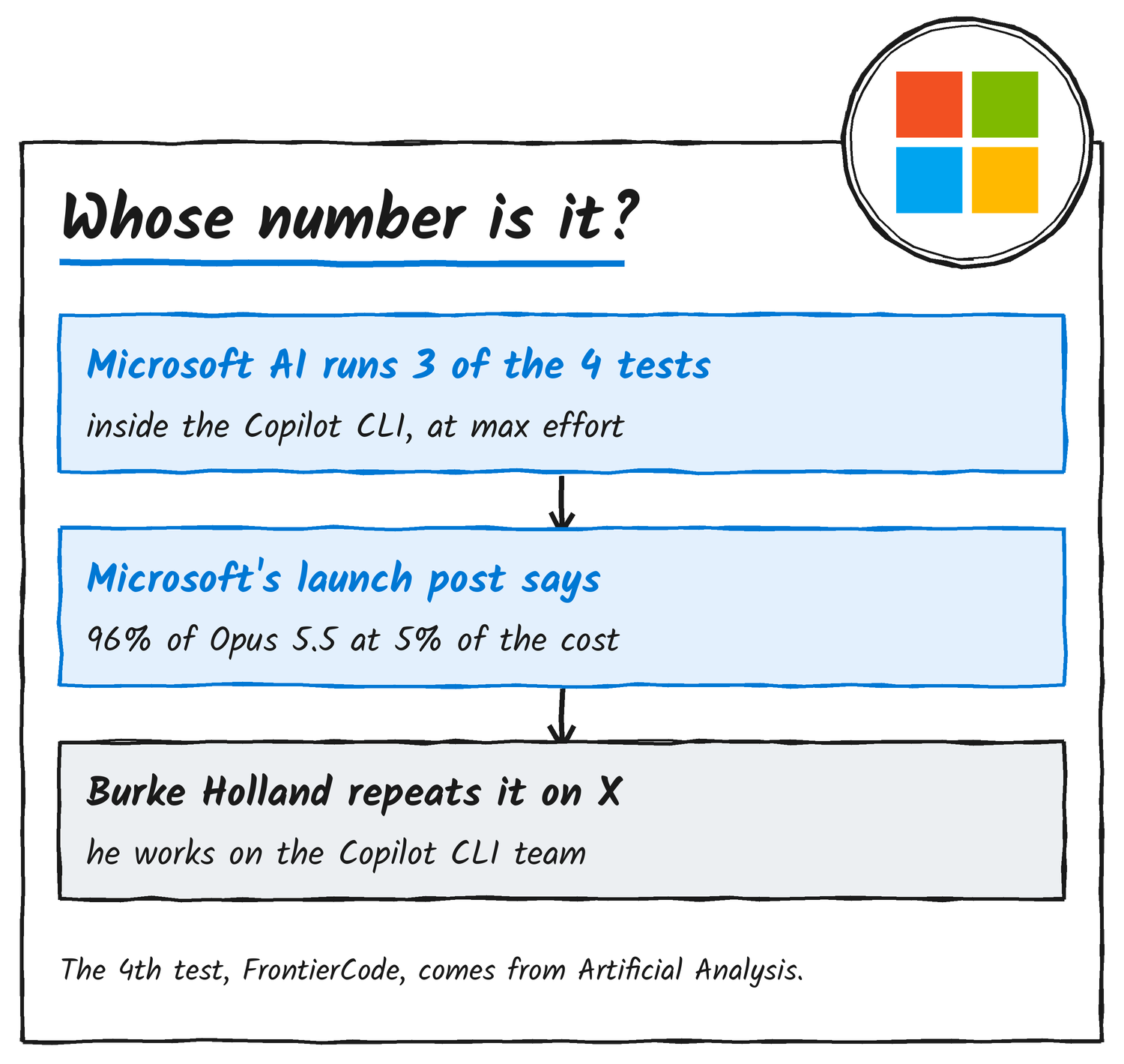
Burke Holland, who works on the Copilot CLI team at Microsoft, said on X that he’s using MAI Code 2 exclusively this week. “MAI Code 2 delivers 96% of the performance of Opus 5.5 at only 5% of the cost,” he wrote. “Crazy. Using MAI Code 2 exclusively this week. Will report back.”
Both figures are Microsoft’s. They come from its launch post of 17 November, and the chart attached to Holland’s post is the one from that launch. The launch itself is covered in Microsoft says MAI Code 2 reaches 98% of GPT-6.1 Sol’s coding quality at 40% of the price.
Who’s saying it
Holland’s own site says he works with the Copilot CLI team at Microsoft, and his résumé lists him as a Principal Developer Advocate there since 2017. That tool matters here. Microsoft ran three of its four benchmarks through the GitHub Copilot CLI, and the model card says MAI Code 2’s reinforcement learning ran directly in the Copilot CLI and VS Code agent harnesses.
So the post isn’t a test. It repeats Microsoft’s average and attaches Microsoft’s chart. In January Holland wrote on his blog that Opus 4.5 was going to change everything, and now he’s testing a cheaper model against that benchmark. He said he’ll report back.
What the 96% averages
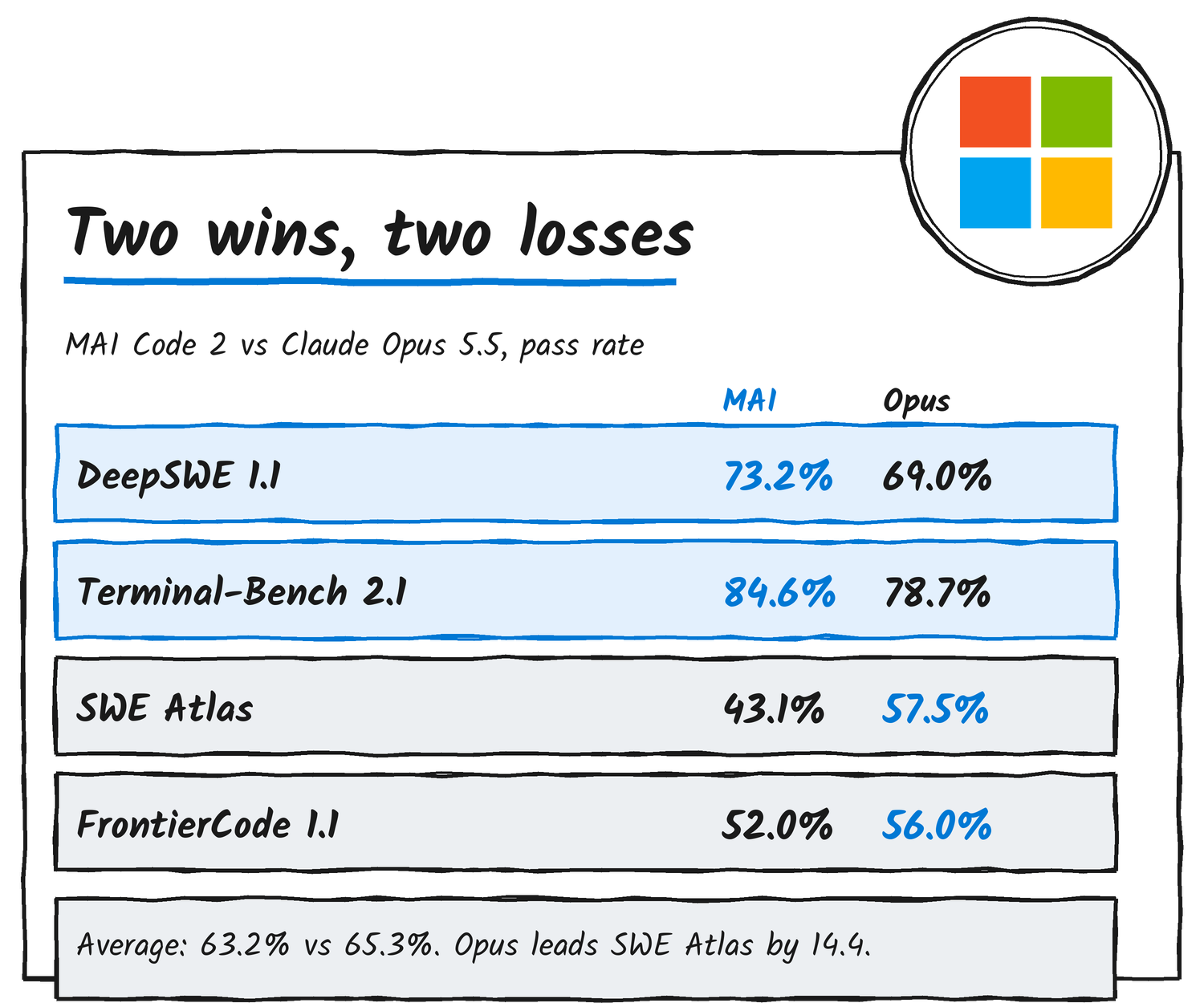
Microsoft averaged four benchmarks at maximum reasoning effort: DeepSWE 1.1, Terminal-Bench 2.1, SWE Atlas and FrontierCode v1.1. MAI Code 2 averages 63.2%, and Claude Opus 5.5 averages 65.3%. The average hides a split. MAI Code 2 leads on two tests, and Opus 5.5 leads on the other two, by 14.4 points on SWE Atlas and 4.0 on FrontierCode.
| Benchmark | MAI Code 2 | Claude Opus 5.5 | Gap |
|---|---|---|---|
| DeepSWE 1.1 | 73.2% | 69.0% | MAI +4.2 |
| Terminal-Bench 2.1 | 84.6% | 78.7% | MAI +5.9 |
| SWE Atlas | 43.1% | 57.5% | Opus +14.4 |
| FrontierCode v1.1 | 52.0% | 56.0% | Opus +4.0 |
SWE Atlas, where Opus 5.5 leads widest, covers codebase questions, test writing and refactoring, according to the model card. Microsoft ran the first three benchmarks on MSBench, its internal platform, in the Copilot CLI with subagents switched off. The FrontierCode scores and costs come from Artificial Analysis.
The price behind the 5%
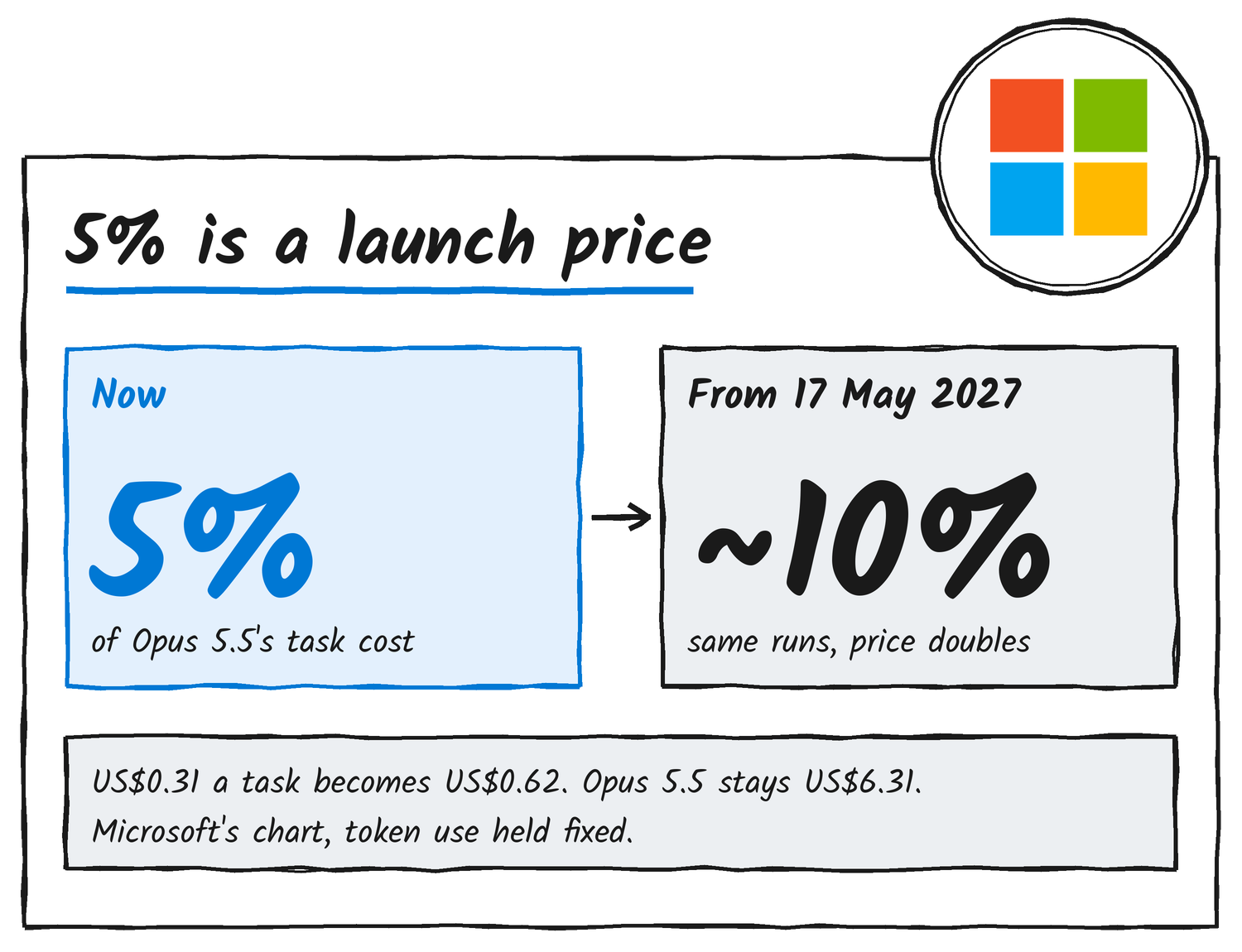
Microsoft’s chart puts the average cost per task at US$0.309 for MAI Code 2 and US$6.306 for Opus 5.5. It shows MAI Code 2 at a 50% promotional price. GitHub’s pricing page says the promotion runs until 17 May 2027, when MAI Code 2 goes from US$0.50 input and US$2.50 output per million tokens to US$1.00 and US$5.00.
The same runs at the standard price would cost about US$0.62 a task, roughly 10% of Opus 5.5’s. That holds token use fixed, and Microsoft doesn’t publish token counts. The 20-to-1 gap in task cost is wider than the 8-to-1 gap in token prices (US$4 input and US$20 output for Opus 5.5), so Opus 5.5 also spent more tokens per task in Microsoft’s runs.
| Model | Input | Output | Average pass rate | Average cost per task |
|---|---|---|---|---|
| MAI Code 2 (promo) | US$0.50 | US$2.50 | 63.2% | US$0.309 |
| Claude Opus 5.5 | US$4.00 | US$20.00 | 65.3% | US$6.306 |
| MAI Code 2 Flash (promo) | US$0.05 | US$0.25 | 61.0% | US$0.052 |
| Claude Haiku 5.5 (up to 100K input) | US$0.10 | US$0.50 | 53.9% | US$0.319 |
Flash’s promotion ends the same day, and its standard price of US$0.10 input and US$0.50 output matches Haiku 5.5’s list price.
What MAI Code 2 is
The model card describes a sparse mixture-of-experts model with a vision encoder: about 2.8 trillion parameters in total, 77 billion active, and a context window of 1,050,000 tokens. Microsoft pre-trained it from scratch on roughly 50 trillion tokens between August and November 2026. Microsoft says it’s tuned for everyday enterprise coding and not yet for fundamental science research or very long-horizon agentic work.
The card lists the limits plainly. In long agentic sessions the models can repeat tool calls, drift from instructions or stop before verifying their work, and at release the model is optimised for English only. It rates both models High risk for CBRN weapons help and offensive cyber operations, and says they ship with classifiers and abuse monitoring.
Where you can run it
The model card names GitHub Copilot as the channel for MAI Code 2 and Microsoft Foundry, in limited preview, for Flash. GitHub’s changelog lists MAI Code 2 for Copilot Pro, Pro+, Max, Business and Enterprise on annual plans. Microsoft’s launch post lists OpenRouter, Vercel, Hermes, OpenCode and Kilo as coming “soon”.
Microsoft’s wider push
MAI Code 2 is one of seven MAI models Microsoft released at Ignite. It also derived MAI Work Flash from Code 2 Flash to run inside Microsoft 365 and Fabric IQ, and The Decoder reports that Microsoft is replacing outside models in its own products with cheaper in-house ones. InfoWorld calls the coding models part of Microsoft’s effort to reduce reliance on its partners.
Holland hasn’t said which tasks he’ll use it for, and the post gives no date for his report.
Discover more from Sulat AI & Tech News
Subscribe to get the latest posts sent to your email.