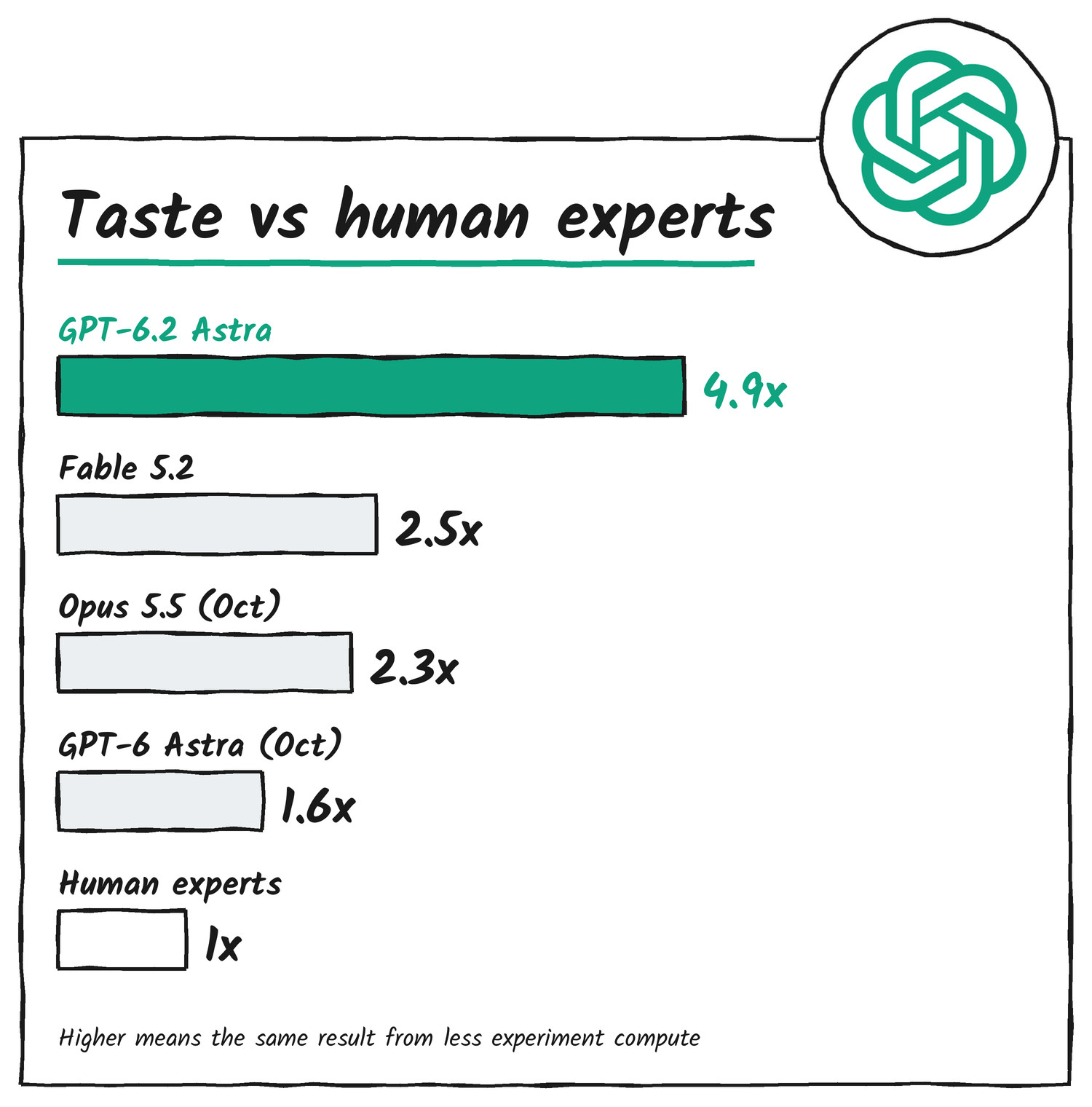
P-Zero Research, a lab that measures how well AI models do AI research, says OpenAI’s GPT-6.2 Astra has 4.9 times the experimental research taste of its best human experts on its TasteVal benchmark, the highest score it has measured. It puts Anthropic’s Fable 5.2 at 2.5 times.
P-Zero posted the figures on X on 24 November NZ time. OpenAI president Greg Brockman shared the post with the line “GPT-6.2 Astra for research taste.”
4.9x
GPT-6.2 Astra against the best human experts
2.5x
Fable 5.2 on the same scale
3.0 months
Doubling time of frontier taste since December 2025
What 4.9x means
TasteVal scores a model on compute efficiency rather than a pass mark. A model that reaches the experts’ result with half the experimental compute has twice their experimental research taste, so 4.9x means Astra needs about a fifth of the compute an expert does.
P-Zero’s paper gives a worked example: if an expert reaches a score in 40 GPU-hours and a model reaches it in 20, the model scores 2x. On the same numbers, Astra would need about eight hours and Fable 5.2 about 16.
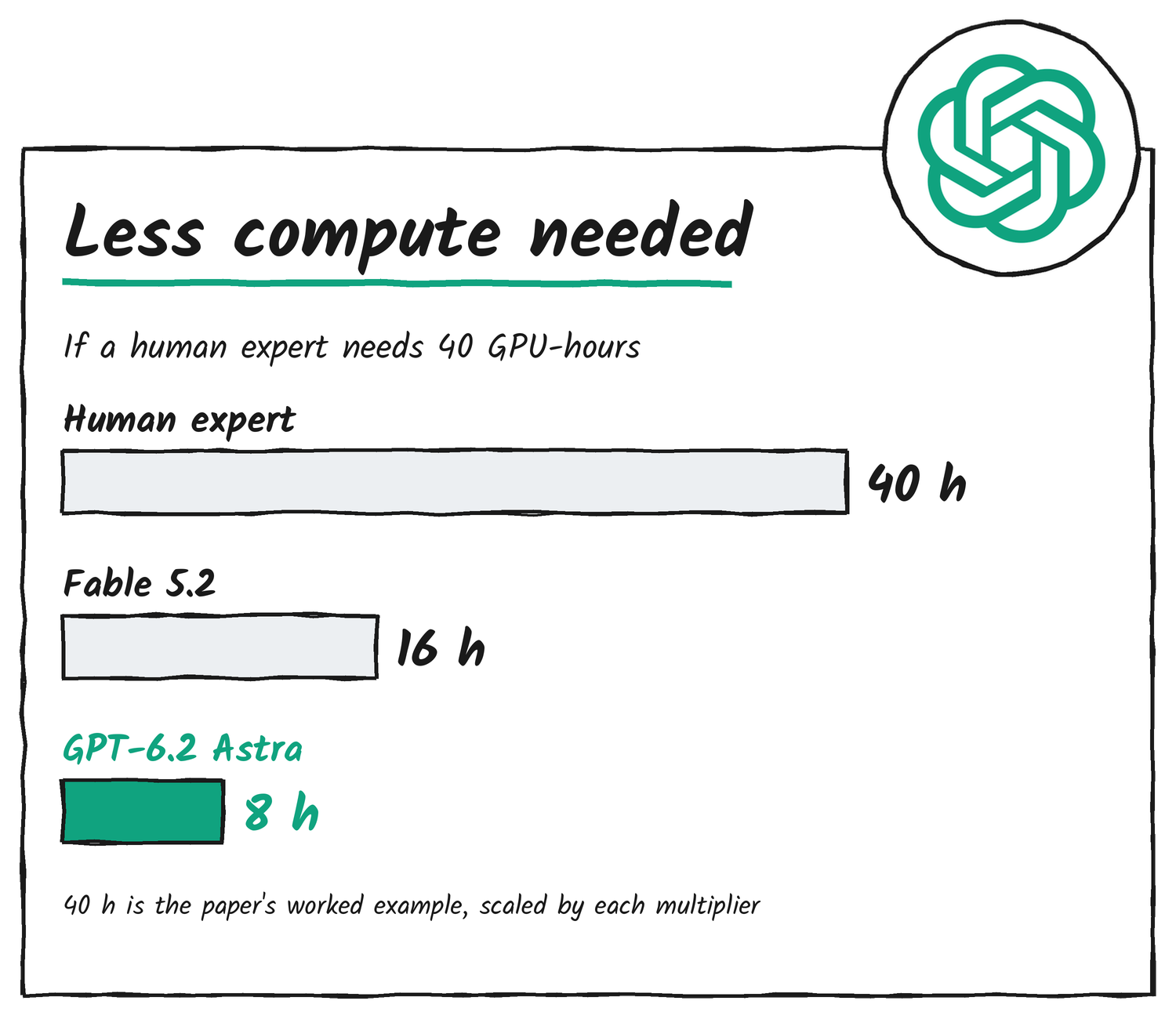
The budget is serial. Each run gets one H100 and runs one experiment at a time, so a 2x multiplier means half the time on the same hardware, not half the hardware.
How TasteVal is built
The benchmark splits research into two jobs. The model being tested acts as the Researcher: it sees the task instructions and the training and validation data, picks the next experiment and reads the results. A fixed Coder, Opus 4.8, writes the code, runs it on the H100 and reports back. The Researcher never sees the test set, so coding skill stays out of the score and what’s measured is how well a model chooses and interprets experiments.
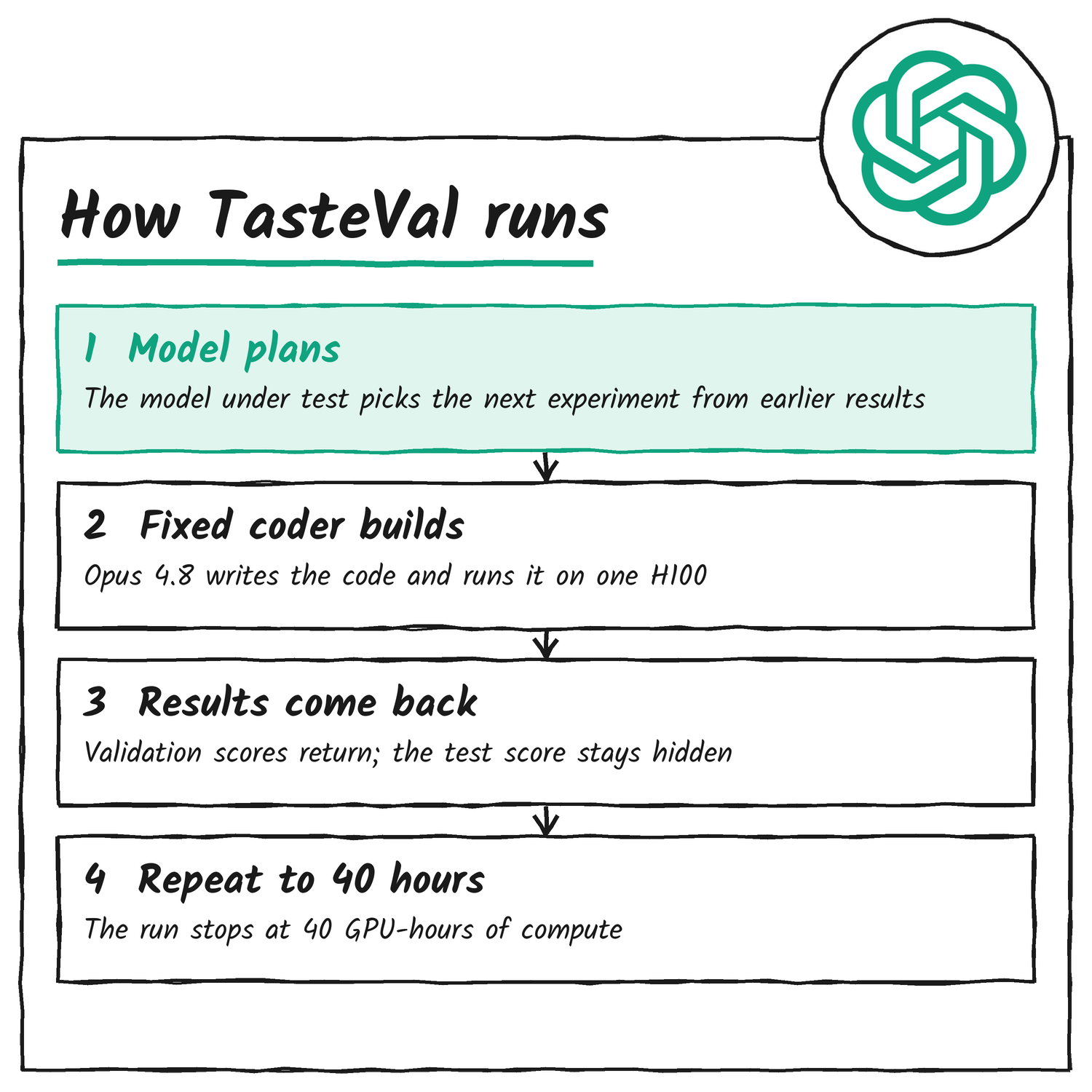
TasteVal has eight tasks, spanning pretraining data curation, pretraining and fine-tuning language models, preference modelling and robustness to adversarial prompts. P-Zero keeps the tasks private so they stay uncontaminated. A run ends at 40 H100-hours of compute or 120 hours of wall-clock time.
The human baseline is the best expert attempt on each task, taken from 24 experts, at least two per task, who have recently worked at organisations including OpenAI, Google DeepMind, NVIDIA, Microsoft Research and the University of Oxford. The experts weren’t allowed AI help in designing experiments or reading results.
How a compute multiplier is calculated
A single reference can only measure models within a limited range. P-Zero compares each model with the nearest of three references, GPT-4, the expert baseline and Opus 5.0 at max reasoning, then chains the ratios to express every score in expert units. Release dates decide the nearest reference, and the expert baseline takes the release date of Opus 4.8.
Where the other models sit
The paper, by Oliver Jaffe and Dane Sherburn, came out on 5 October and covers 20 models. It predates both Astra and Fable 5.2, so the 4.9x and 2.5x figures come from P-Zero’s post rather than the paper.
| Model | Maker | Compute multiplier | Source |
|---|---|---|---|
| GPT-6.2 Astra | OpenAI | 4.9x | P-Zero post |
| Fable 5.2 | Anthropic | 2.5x | P-Zero post |
| Opus 5.5 | Anthropic | 2.30x | October paper |
| Fable 5.1 | Anthropic | 1.72x | October paper |
| GPT-6 Astra | OpenAI | 1.60x | October paper |
| Opus 4.8 | Anthropic | 0.84x | October paper |
| GLM 5.3 | Z.ai | 0.59x | October paper |
| Kimi K3 | Moonshot AI | 0.45x | October paper |
Astra’s new figure is about three times the 1.60x P-Zero measured for GPT-6 Astra in October and roughly double Fable 5.2’s. In the paper, the best model was Opus 5.5 at 2.30x, with a 95% interval of 1.15x to 4.37x. The error bar on Astra’s point in P-Zero’s chart runs from about 2x to about 11x.
P-Zero also said earlier in November that Fable 5.2 is the best model it has tested at predicting experiment results, with a score of 0.36.
Why P-Zero measures taste
P-Zero’s reasoning comes from the AI Futures Model, where experimental compute becomes the main bottleneck once coding is automated. The time to superintelligence then depends mostly on how fast research taste improves.
The paper found that the compute multiplier of frontier models has doubled every 3.0 months since December 2025, with a 95% interval of 1.7 to 5.0 months, up from every 14 months between 2023 and December 2025. The trend breaks at the release of GPT-5.2 on 11 December 2025.
P-Zero ran a naive extrapolation on the October data. If taste keeps improving at the measured rate per unit of general capability, the chance of a taste-only singularity in the AI Futures Model rises from 51% to 88%, and the model’s median arrival date for superintelligence moves from mid-2030 to late 2028. P-Zero calls that an extrapolation rather than a forecast.
Price separates models and people too. Opus 5.5 at max reasoning averaged US$282 per run in the paper, against US$9,123 for the expert baseliners, a figure that includes salary at US$119 an hour. P-Zero says it spent about a thirtieth as much per attempt on its best model as on its experts.
What the score covers
P-Zero lists its own limits. The research problem is fixed, so TasteVal doesn’t measure a model’s ability to choose which problems are worth working on. The tasks are quick and cheap to verify, and the expert baseline doesn’t include top researchers.
Astra’s week
Astra launched on 18 November with its API prices cut 20%. Since then it has taken first place on Design Arena’s Game Dev board and fifth on Arena’s Alignment Index, where OpenAI holds the top seven places. OpenAI chief scientist Jakub Pachocki has also published pretraining perplexity numbers for its base models up to Astra.
P-Zero takes TasteVal evaluations from model makers at [email protected].
Sources
- P-Zero Research on X, 24 November 2026 NZ time
- Introducing TasteVal, P-Zero Research
- TasteVal: Measuring the Experimental Research Taste of AI Systems Against Human Experts, arXiv 2610.06824
Disclosure: I’m an OpenAI, Firecrawl and Devin ambassador.
Discover more from Sulat AI & Tech News
Subscribe to get the latest posts sent to your email.