OpenAI chief scientist Jakub Pachocki has published how well OpenAI’s base models, from GPT-3.5 to GPT-6.2 Astra, predict text, and proposed that frontier labs report the same number and agree limits they won’t pass until safety monitoring catches up. The essay, “Perplexity and Intelligence”, is dated 22 November on openai.com.
The metric is perplexity, a score for how well a model guesses the next token in text it hasn’t seen. Lower is better. Pachocki writes that he’s arguing for it “as a metric to compare between model developers and inform shared safety standards”, and that publishing OpenAI’s own numbers is a first step.
Publishing our internal perplexity measurements took some consideration; it gives competitors a clearer picture of where we stand, but that concern is outweighed by the urgency of establishing shared safety measures across the industry.
Jakub Pachocki, OpenAI chief scientist
Sam Altman posted nine minutes later. He called the essay “the most important thing OpenAI has published in awhile” and wrote that he hopes labs can agree to common limits, which he thinks would be “very wise and help ensure safety and control”.
What perplexity measures
Pachocki describes a modern model as a compressor: it’s trained on a very large body of text to predict what comes next, and the best predictor doesn’t necessarily remember what it was trained on. Perplexity scores that prediction. A model that spreads its guesses across many words gets a higher number, and one that puts its weight on the right word gets a lower one.
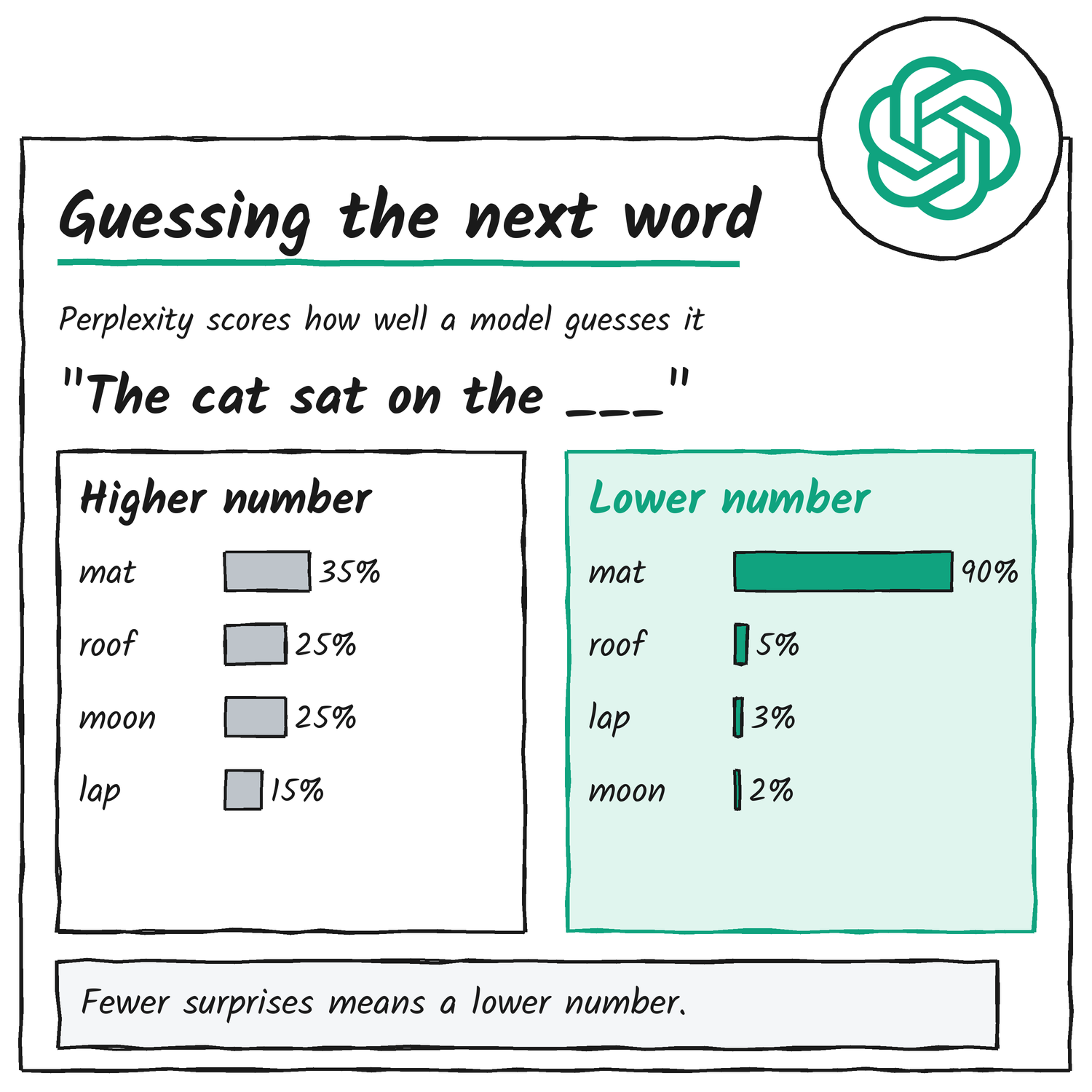
In practice OpenAI tracks the log of perplexity, also called cross-entropy loss, on a held-out dataset it has kept since GPT-3.5.1 He calls it the main way OpenAI measures progress on what he describes as the “intelligence substrate”, and says that approach has stayed “remarkably constant over the years”.
What OpenAI’s chart shows
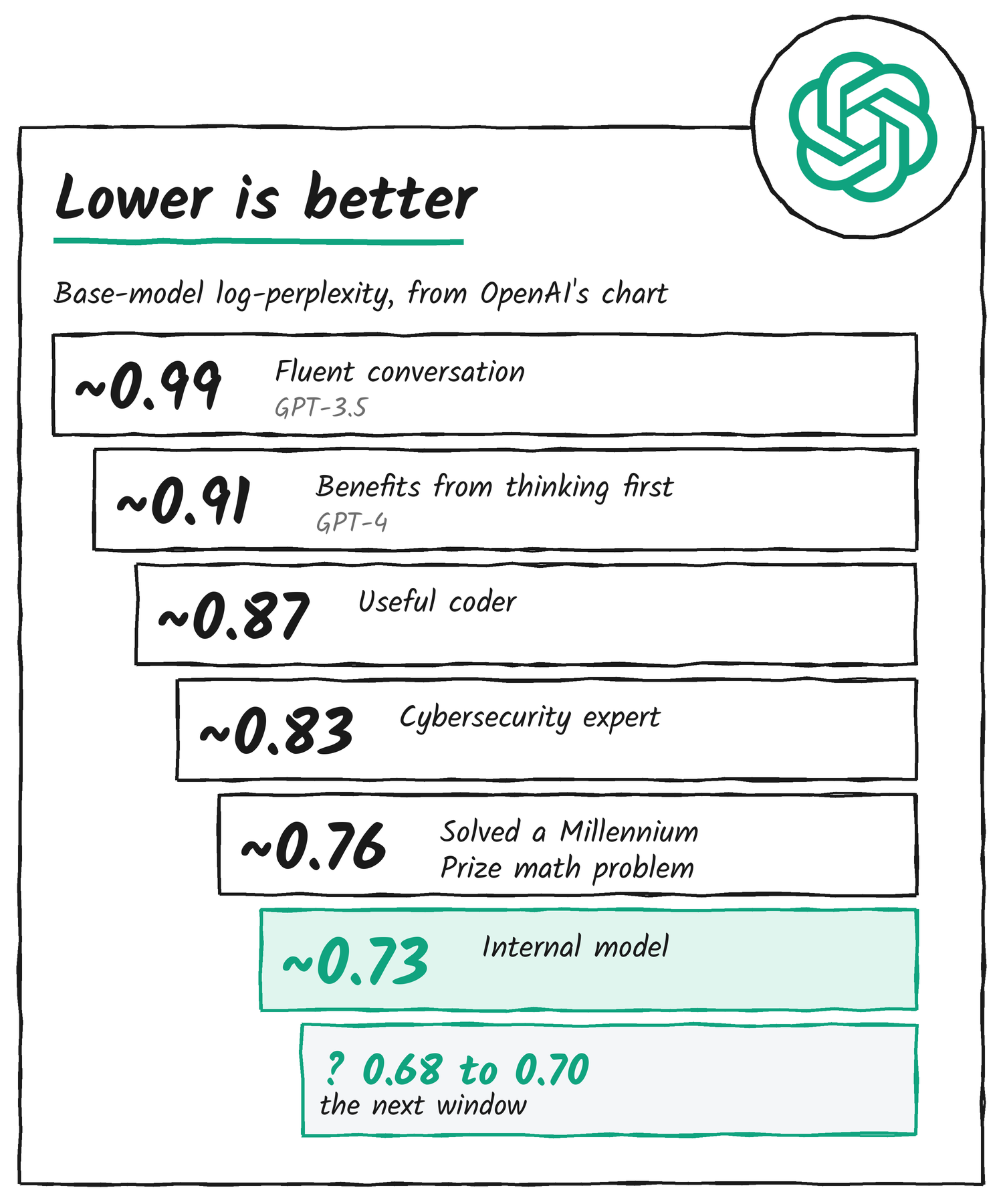
The chart opening the essay plots base-model log-perplexity from GPT-3.5 to GPT-6.2 Astra, with dotted lines marking capability milestones. He ties GPT-3.5 to fluent conversation and the original ChatGPT, and GPT-4 to productive chain-of-thought reasoning. He says transformative capabilities in cybersecurity and mathematics appeared once losses dropped below 0.8.
~0.99
GPT-3.5, where fluent conversation arrived
~0.91
GPT-4, where chain-of-thought reasoning paid off
~0.76
GPT-6.2 Astra on the chart, on the maths-milestone line
~0.73
an internal model, plotted below GPT-6.2 Astra
How I read the chart
The essay’s text gives about 0.99 for GPT-3.5, about 0.91 for GPT-4, below 0.8 for the cybersecurity and maths jump, about 0.76 for the model behind its maths results, and a 0.68 to 0.7 window ahead. The other figures here, including about 0.73 for the internal model and the milestone lines near 0.87 and 0.83, come from where the points and dotted lines sit against the chart’s axis.
The chart’s dotted line at 0.76 is labelled “Solved a Millennium Prize math problem”. In the text, Pachocki says OpenAI has posed open maths problems to its models for more than a year, and that “Once we upgraded to a model of log-perplexity ~0.76, it started producing groundbreaking results.” OpenAI’s 8 September post on the Navier–Stokes problem said the proof came from an internal model “significantly more capable than GPT‑6 Astra”.
Below 0.7 the chart shows a shaded band with a question mark. Pachocki writes that “we should expect further transformative capabilities as we enter the ~0.68-0.7 log-perplexity window”, and that he doesn’t know what they’ll be.
Why he ties it to safety
Pachocki’s case is that new capabilities arrive as the predictor improves, so the number is a shared yardstick for general intelligence however much of the work is automated. He singles out pretraining research as the part where AI help could change the pace, and writes that “as soon as 2027 we could conceivably see a similar avalanche of fundamental pretraining advancements”. Footnote five credits the steep drop in 2026 mostly to long-term research and compute investment, and a smaller part to automation.
He also expects current ways of auditing alignment to degrade further. The essay links to a 10 November study from OpenAI’s alignment team, which found that lower base-model perplexity and some architecture changes improve a model’s reasoning without a visible chain of thought. That bears on chain-of-thought monitoring, one of OpenAI’s main safety checks.
The proposal
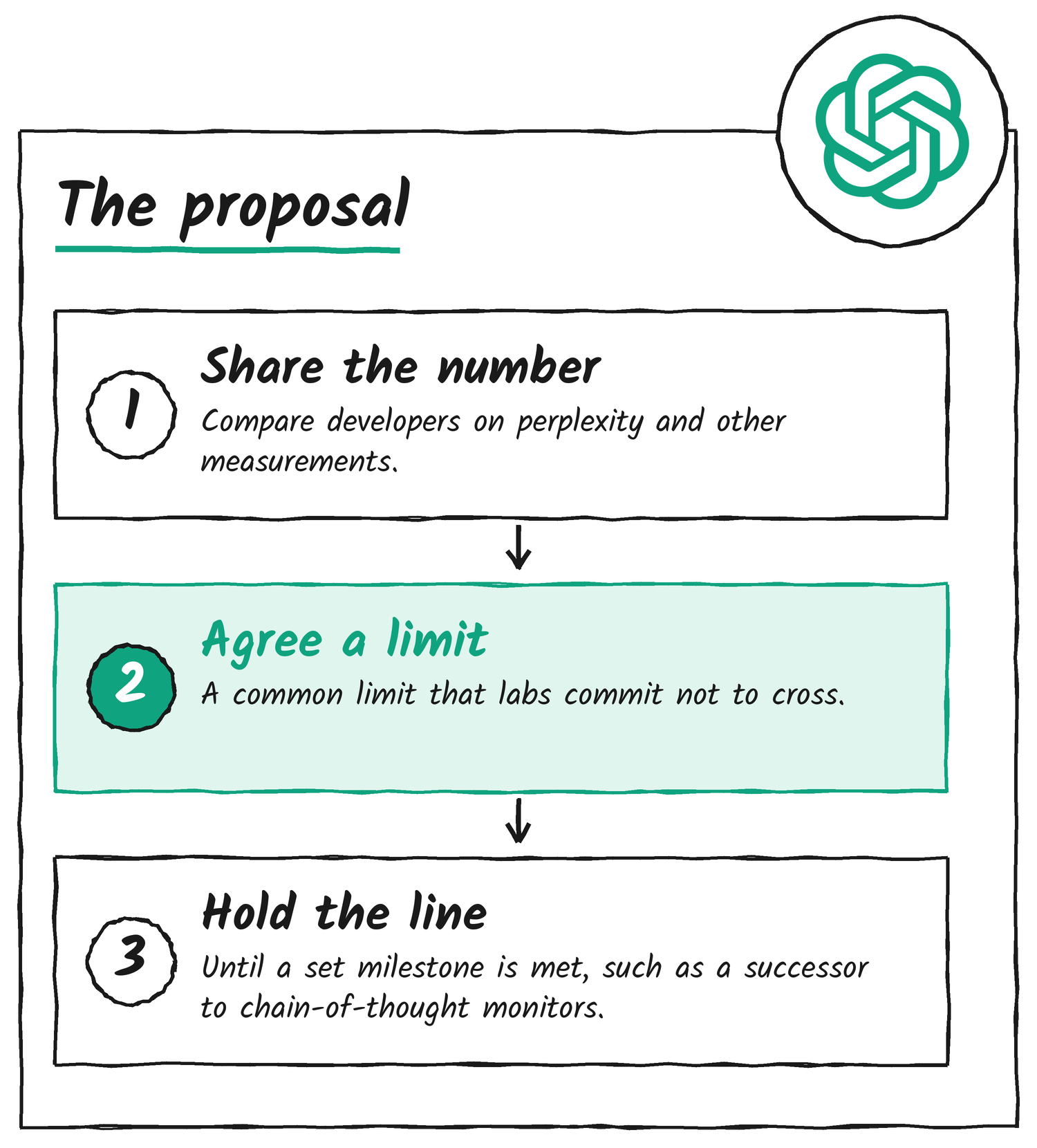
Pachocki wants frontier developers to “jointly endeavour to establish shared norms for how to evaluate such models and red-team safety cases for them by the time they are first used, including shared transparency standards”.
a first limit on development, measured by some key metric we can track across labs
Jakub Pachocki, “Perplexity and Intelligence”
The limits would be commitments not to cross a line, set on perplexity and other measurements, until the industry can understand and monitor AI behaviour to a concrete standard, such as a successor to chain-of-thought monitors. He hopes that leads to a common framework for setting successive limits and pacing further development.
Where it sits among OpenAI’s recent posts
The essay is the fifth in a run of OpenAI posts on pacing and monitoring since September.
| Date | OpenAI post | What it did |
|---|---|---|
| 6 September | An Alien Mind | Pachocki called for voluntary slowdowns until shared safety bars exist. |
| 8 September | On the Navier–Stokes Millennium Prize Problem | OpenAI shared a proof from an internal model it said was significantly more capable than GPT‑6 Astra. |
| 10 November | What affects chain-of-thought monitorability | OpenAI’s alignment team linked lower base-model perplexity to stronger reasoning without a visible chain of thought. |
| 18 November | Managing frontier AI risk | OpenAI described pacing its releases, including pausing training and holding back GPT‑6.1 Astra. |
| 22 November | Perplexity and Intelligence | Pachocki publishes the perplexity chart and proposes common limits. |
The four challenges he lists
He names four challenges for perplexity as a shared metric himself:
- Labs use different evaluation datasets and data mixtures, so comparing them takes work.
- Perplexity doesn’t correspond directly to a task people care about.
- Chain-of-thought reasoning raises capability without lowering perplexity.
- The floor is unknown, and gains on the number should slow as models approach it.
He still argues perplexity “has stood the test of time” and hopes to see more transparency about it across the industry.
- The held-out data comes from OpenAI’s internal codebase, and the numbers in the essay are for a fixed snapshot, according to Pachocki. ↩︎
Disclosure: I’m an OpenAI, Firecrawl and Devin ambassador.
Discover more from Sulat AI & Tech News
Subscribe to get the latest posts sent to your email.