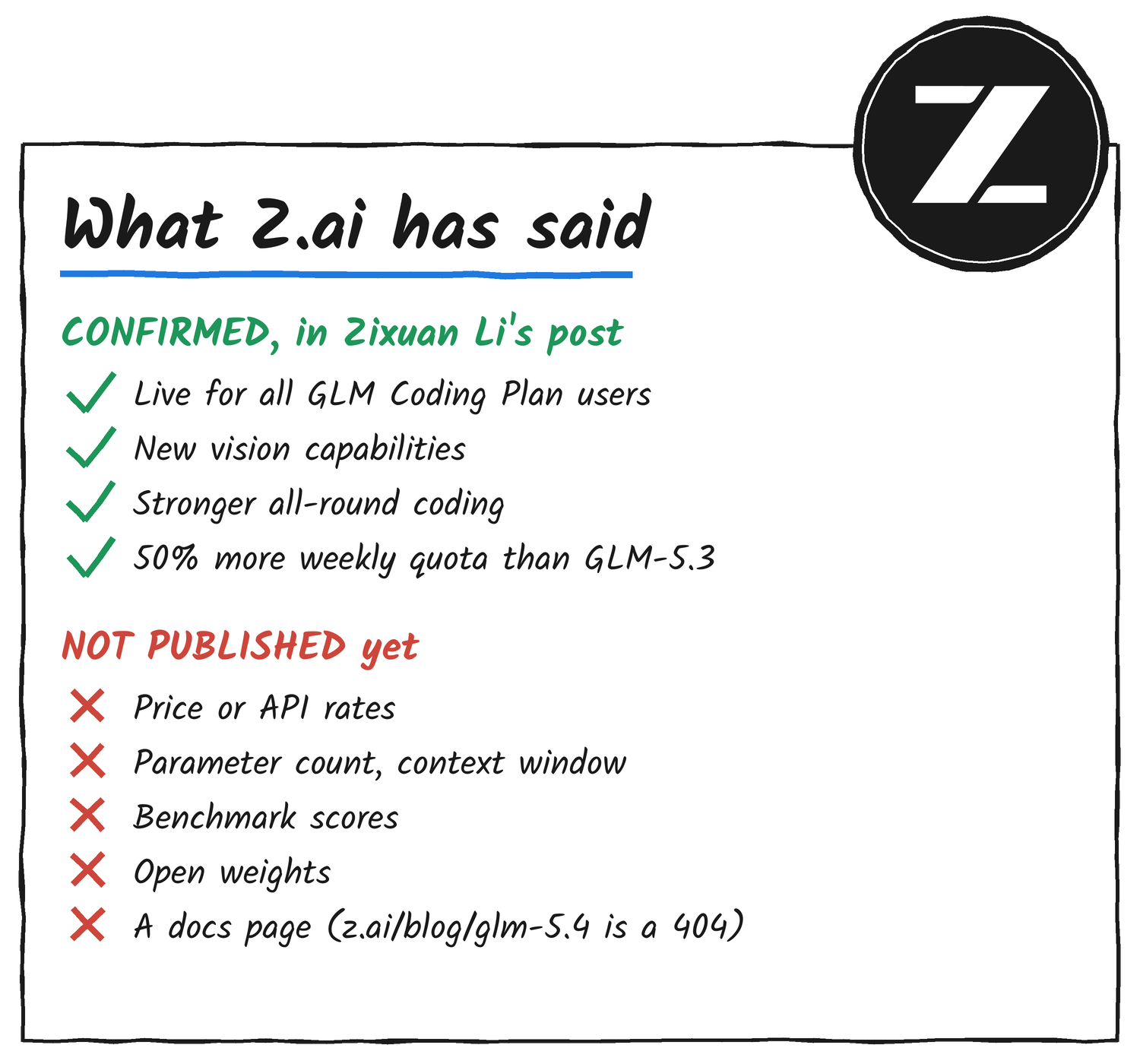
Zixuan Li, the head of Z.ai, said on X at 5:18pm NZDT today that GLM-5.4 is live for every GLM Coding Plan user. His post claims new vision capabilities, stronger all-round coding and 50% more weekly quota than GLM-5.3.
GLM-5.4 is now available to all GLM Coding Plan users. New vision capabilities and stronger all-round coding performance. For users with weekly quotas, GLM-5.4 now comes with 50% more quota compared to GLM-5.3.
Zixuan Li, Head of Z.ai, on X, 23 November 2026
Z.ai hasn’t put a model page behind the post. The GLM-5.4 pages on its blog and docs site both returned 404 when I checked shortly after it went up, and the Coding Plan docs still list GLM-5.3 and GLM-5.3-Flash as the supported models. Price, parameter count, context window, benchmarks and weights aren’t published yet.
- What Z.ai has said
- What 50% more quota means in credits
- Why vision matters here
- Where GLM-5.4 sits in the family
- How the plan compares with its peers
- Open weights
- The company behind it
- What’s reported about GLM-5.4 and GLM-5.5
- Terms used in this piece
What Z.ai has said
Li’s LinkedIn profile says he leads Z.ai’s global product, API platform, partnerships and model releases, so the post is the company’s own announcement channel. It makes four claims: GLM-5.4 is on every Coding Plan tier, it adds vision, it codes better across the board, and weekly quotas are 50% bigger than they were on GLM-5.3. Nothing else in it is a number.
What 50% more quota means in credits
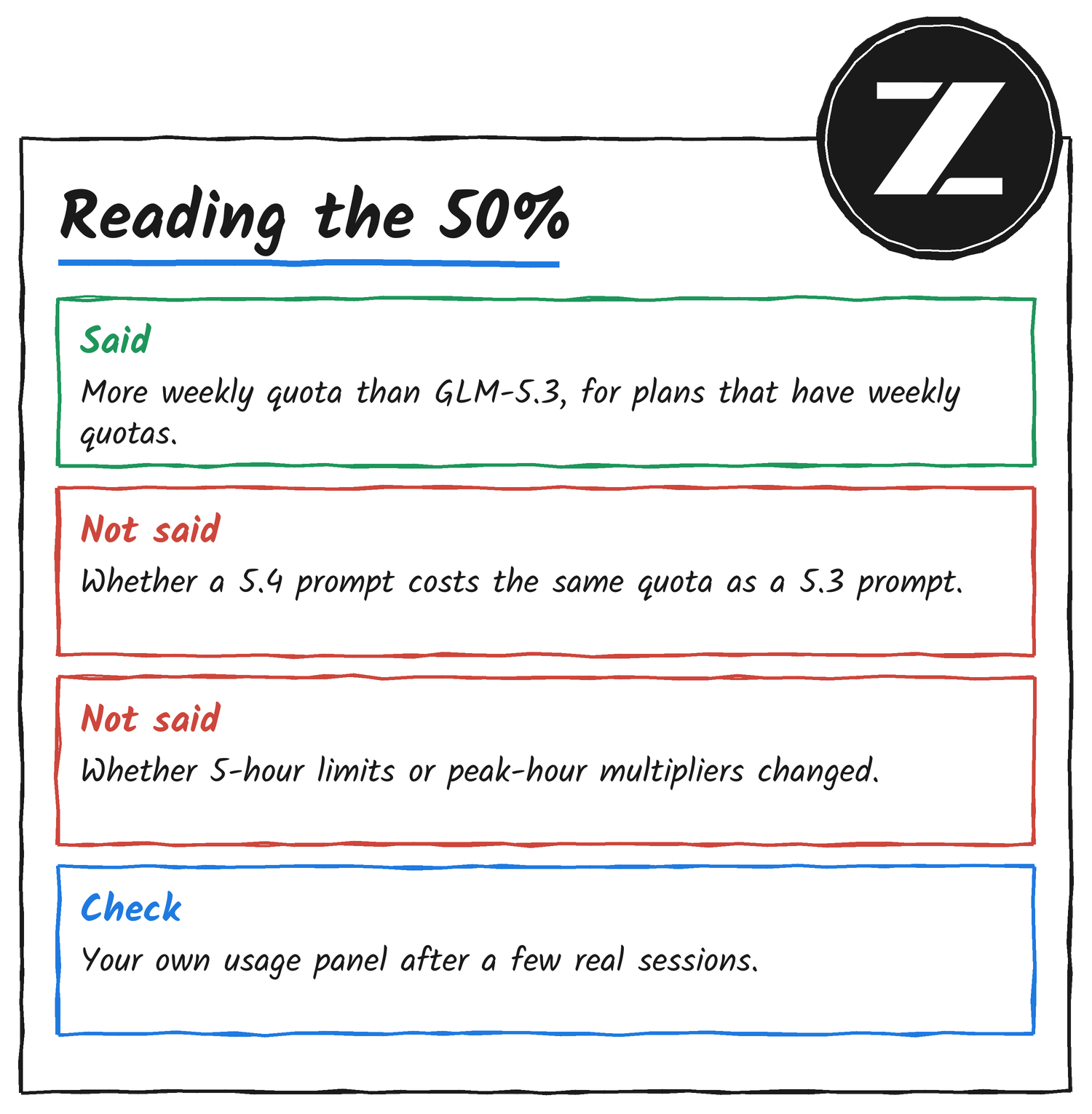
The Coding Plan runs on credits. Each tier has a rolling 5-hour pool and a weekly pool, and when either runs dry you wait for the reset. Z.ai’s pricing page lists Lite at 10,000 weekly credits, with Pro at six times that and Max at 14 times. Li’s post mentions the weekly quota only. It says nothing about the 5-hour limit.
| Plan | Monthly price | 5-hour credits | Weekly credits now | Weekly at +50% |
|---|---|---|---|---|
| Lite | US$18 | 2,000 | 10,000 | 15,000 |
| Pro | US$80 | 12,000 | 60,000 | 90,000 |
| Max | US$168 | 28,000 | 140,000 | 210,000 |
+50%
weekly quota against GLM-5.3, per Li
15,000
Lite weekly credits at +50%, our arithmetic
7pm to 11pm
weekday peak window in NZDT, when credits cost double
Z.ai defines peak as Monday to Friday, 14:00 to 18:00 Singapore time, in its 30 July plan notice. Singapore doesn’t change its clocks, so that’s 7pm to 11pm in New Zealand while daylight saving lasts, and 6pm to 10pm after it ends in April. Calls outside the window, including all of Saturday and Sunday, cost half the credits.
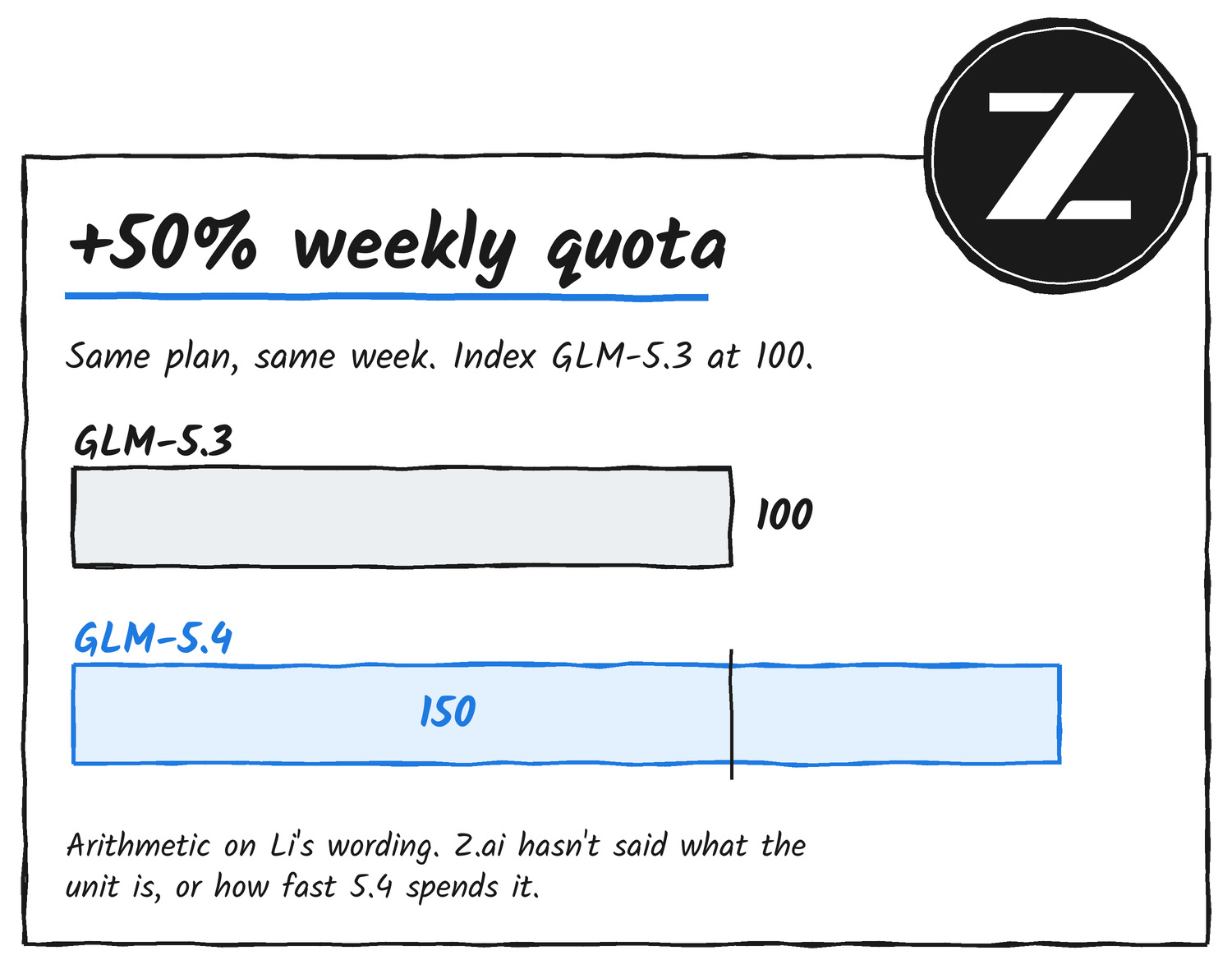
A bigger pool only helps if a GLM-5.4 request costs about what a GLM-5.3 one did. Z.ai charges credits by tokens, with a different multiplier for each model, and it hasn’t published GLM-5.4’s. If the new model spends credits faster, the extra 50% runs out faster too.
How Coding Plan credits are worked out
Bigolab’s summary of Z.ai’s documentation gives the formula: credits equal input tokens times the input rate, plus cached tokens times the cached rate, plus output tokens times the output rate, all divided by 10,000. For GLM-5.3 the rates are 6.9, 1.7 and 24. For GLM-5.3-Flash they’re 2.3, 0.56 and 8. Search, web-reader and repository tools count the call, multiplied by 1.2.
As an example on GLM-5.3, a turn with 100,000 input tokens and 10,000 output tokens costs 93 credits at the standard rate and about 46 off-peak. A Lite week of 10,000 credits covers roughly 107 such turns at peak and about 215 off-peak. Those rates are for GLM-5.3. The GLM-5.4 rates aren’t published.
Why vision matters here
Z.ai’s GLM-5.3 page says the flagship takes text only, with a 1M-token context window and 128K of output. The only native multimodal model in the GLM-5 series so far is GLM-5.3-Flash, which accepts images, video and files and has 320B total parameters with 18B active. Z.ai gives Coding Plan users 3 times the GLM-5.3 quota on it.
That split has forced a choice: the stronger model couldn’t see a screenshot, and the model that could was the cheaper one. Z.ai has also shipped a Vision MCP server for Coding Plan users that routes image and video questions through GLM-5.3-Flash. Li’s post says GLM-5.4 has new vision capabilities. It doesn’t say whether they’re native to the model or how they compare with GLM-5.3-Flash’s.
Where GLM-5.4 sits in the family
Z.ai says GLM-5.3 gained 50% over GLM-5.2 on its own Z.ai Code Bench, and lifted Terminal-Bench 3.0 from 4.6 to 28.3 and DeepSWE v1.1 from 46.2 to 66.9. Those are the numbers GLM-5.4 has to beat. The Coding Plan also routes older model names forward, so requests for GLM-5.2 and GLM-5.1 already land on GLM-5.3, according to Inference Hub.
| Model | Input | Context | API price per million tokens (in / out) | On the Coding Plan |
|---|---|---|---|---|
| GLM-5.2 | Text | Not in the docs I read | US$1.40 / US$4.40 | Routed to GLM-5.3 |
| GLM-5.3 | Text only | 1M | US$1.40 / US$4.40 | Yes |
| GLM-5.3-Flash | Image, video, file, text | 1M | US$0.15 / US$0.50 | Yes, with 3 times the quota |
| GLM-5.3-FlashX | Image, video, file, text | 1M | US$0.37 / US$1.25 | Not yet |
| GLM-5.4 | Vision, per Li | Not published | Not published | Yes, per Li |
How the plan compares with its peers
GLM-5.3’s API price of US$1.40 in and US$4.40 out sits in the middle of the open-weight pack. Kimi K3.1 Pro costs US$2 and US$10, according to Convika’s November comparison, and Qwen4-Max, released on 16 November without open weights, costs US$1.50 and US$4.50. DeepSeek V4.1 Flash is the cheap end at US$0.30 and US$1.20 at peak, and half that off-peak. Third-party hosts undercut Z.ai: I’ve covered OpenCode’s 60% cut that puts GLM 5.3 at US$0.56 and US$1.76.
| Model | Price per million tokens (in / out) | What sets it apart |
|---|---|---|
| Z.ai GLM-5.3 | US$1.40 / US$4.40 | 1M context, open-weight family, text input only |
| Kimi K3.1 Pro | US$2 / US$10 | 3T-class parameters and 1M context, per the Kimi Code notes at Jiegec’s knowledge base |
| Qwen4-Max | US$1.50 / US$4.50 | Released 16 November, no open weights |
| DeepSeek V4.1 Flash | US$0.30 / US$1.20 at peak | Half price off-peak |
| GLM 5.3 on OpenCode’s Console | US$0.56 / US$1.76 | Same model through a third-party host |
On quality, the only head-to-head figures are Z.ai’s own. Its GLM-5.3 page says that at High effort the model scores 31.4% on its agentic coding test using about 50K output tokens, against Claude Opus 4.8’s 29.5% at 120K. It also says GLM-5.3 trails Claude Fable 5, which reaches 39.5% at Max effort. Independent results for GLM-5.4 don’t exist yet.
Open weights
Open weights are the core of Z.ai’s pitch to developers. In a talk at the AI Engineer conference on 27 September, Li argued that releasing near-frontier models lets enterprises and governments run them on their own servers, lets companies fine-tune for law, finance and security, and lets customers shape where the models go next. Z.ai hasn’t published GLM-5.4 weights. The GLM-5.3 page calls the model state of the art among open-source models, so the lab’s habit is to release them.
The company behind it
Z.ai is the international brand of Zhipu, listed in Hong Kong as Z.AI Co., Ltd. (2513). StockAnalysis puts its 2025 revenue at RMB724.3 million, up 131.9%, with a loss of RMB1.92 billion, 37.6% bigger than in 2024. The shares closed at HK$408.40 on 13 November, down 10.04% on the day, according to Yahoo Finance, and were off 32% over the month and 64% over six months. Bloomberg reported that Zhipu and MiniMax each fell more than 5% on 17 November after Washington set new curbs on China’s access to compute. Morningstar showed HK$359.80 on 19 November.
RMB724.3m
2025 revenue, up 131.9%
−RMB1.92bn
2025 loss, 37.6% wider than 2024
−64.5%
share price over six months to 13 November
The chip rule is the live pressure. The Commerce Department’s interim final rule of 16 November restricts data centres anywhere from supplying large volumes of advanced compute to companies headquartered in China. Z.ai’s GLM-5.3-Flash page says it serves that model on Chinese AI chips, which are limited by memory capacity and bandwidth at 1M-token contexts. I’ve covered the rule and the House report on Chinese open-weight models in federal systems.
What’s reported about GLM-5.4 and GLM-5.5
IT Times, a Chinese tech outlet, reported on 22 November that Zhipu would release GLM-5.4 the following week, after a gap of close to 100 days. It says GLM-5.4 is the lightweight model of more than 700 billion parameters that investment bank research notes had described, with a preview in small-scale testing, and that it’s meant to replace GLM-5.3 as the main model and fill the multimodal gap. It also says a flagship GLM-5.5 above 3 trillion parameters is expected in December. Zhipu hasn’t confirmed the parameter count or GLM-5.5. Li’s post confirms the release timing and the vision claim, and nothing more.
Terms used in this piece
- GLM Coding Plan
- Z.ai’s subscription for using GLM models inside coding tools such as Claude Code, OpenCode and Z.ai’s own ZCode. It doesn’t cover direct API calls from your own app.
- Credits
- The unit the plan meters usage in. Each request spends credits based on its input, cached and output tokens and the model’s multiplier.
- Peak and off-peak
- Peak is Monday to Friday, 14:00 to 18:00 Singapore time. Credits cost half as much outside it, including all weekend.
- Flash
- Z.ai’s smaller, cheaper model tier. GLM-5.3-Flash is the first native multimodal GLM-5 model.
Sources
- Zixuan Li on X, 23 November 2026
- Z.ai pricing, Coding Plan overview and 30 July plan notice
- Z.ai docs: GLM-5.3, GLM-5.3-Flash and Vision MCP server
- IT Times via Tencent News, 22 November
- Inference Hub, Z.ai pricing in 2026 and Bigolab, GLM Coding Plan credits
- Convika, DeepSeek vs Qwen vs Kimi for coding and Jiegec’s knowledge base, AI coding plans
- StockAnalysis, Yahoo Finance and Morningstar on Z.AI Co., Ltd. (2513)
- Bloomberg, 17 November and Latham & Watkins on the Commerce rule
- AI Engineer speaker page for Zixuan Li
Discover more from Sulat AI & Tech News
Subscribe to get the latest posts sent to your email.