The US Commerce Department’s Bureau of Industry and Security (BIS) has issued a rule that limits how overseas data centres can rent advanced AI chips to companies headquartered in China, and requires export licences for advanced chips going to Indonesia, Malaysia, Singapore, Thailand and Brazil. BIS released the interim final rule, a rule that takes effect before public comments are in, on 16 November US time. The text says it takes effect when the Federal Register publishes it, and the public inspection copy shows that’s scheduled for 19 November.
BIS’s release says the Treasury Department and the National Security Council wrote the rule and directed its issue. It says the aim is to make sure existing restrictions on access to sensitive American technology can’t be “circumvented through remote computing arrangements involving data centers in third countries”. The rule and the release say “super intelligence” where earlier rules said AI, citing Executive Order 14434.
I’ve covered the gap this rule targets, Southeast Asian data centres renting Nvidia servers to Chinese firms, and the New York Times’ report on a narrower draft rule. Earlier today I covered the push to bring Jensen Huang back as Nvidia’s chief executive.
What the rule does
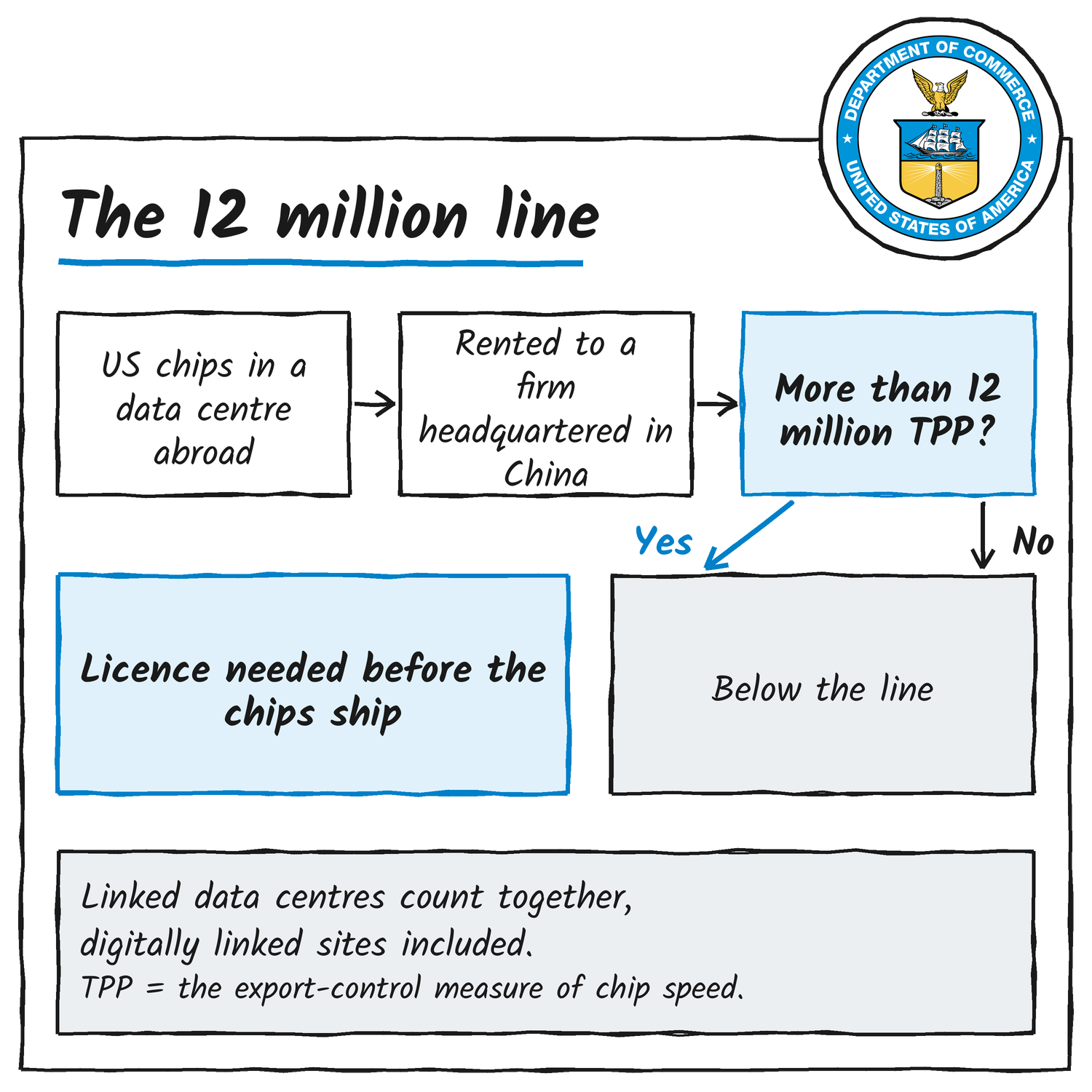
The new section 744.24 bars knowingly exporting covered chips to a data centre, anywhere in the world, that provides more than 12 million “aggregate TPP” of computing power to companies headquartered in Macau or Country Group D:5. TPP is total processing performance, the export-control measure of a chip’s speed. D:5 is the US arms-embargo list, which includes China. The threshold counts one data centre or several linked ones, including sites linked digitally that share resources as one system.
It also reaches a customer outside those countries when the exporter knows that customer is training models for, or providing models to, a company headquartered in D:5 or Macau. Data centres have to check who owns and controls their customers. The rule says a data centre that declines to provide the information needed to verify compliance is a red flag that presumptively gives the exporter knowledge.
Data centres already serving those customers have 90 days from the effective date to get a licence. Licence applications are reviewed case by case. Computing used only for commercial recommender systems, the kind online retailers and social media companies run, is exempt if the reporting requirements are met.
| Change | What it covers | Exemption | Timing |
|---|---|---|---|
| Remote-access limit | Chips going to data centres that provide more than 12 million TPP to firms headquartered in Macau or Country Group D:5 | Commercial recommender systems, with reporting | Existing services need a licence within 90 days of the effective date |
| Five-country licence | Advanced chips going to Indonesia, Malaysia, Singapore, Thailand and Brazil | US-headquartered customers, if the exporter reports | Effective on Federal Register publication |
| AI Diffusion Rule | Biden-era regulations, including model-weights controls | None | Formally rescinded; BIS announced the rescission in May 2025 |
Five countries, and a US exemption
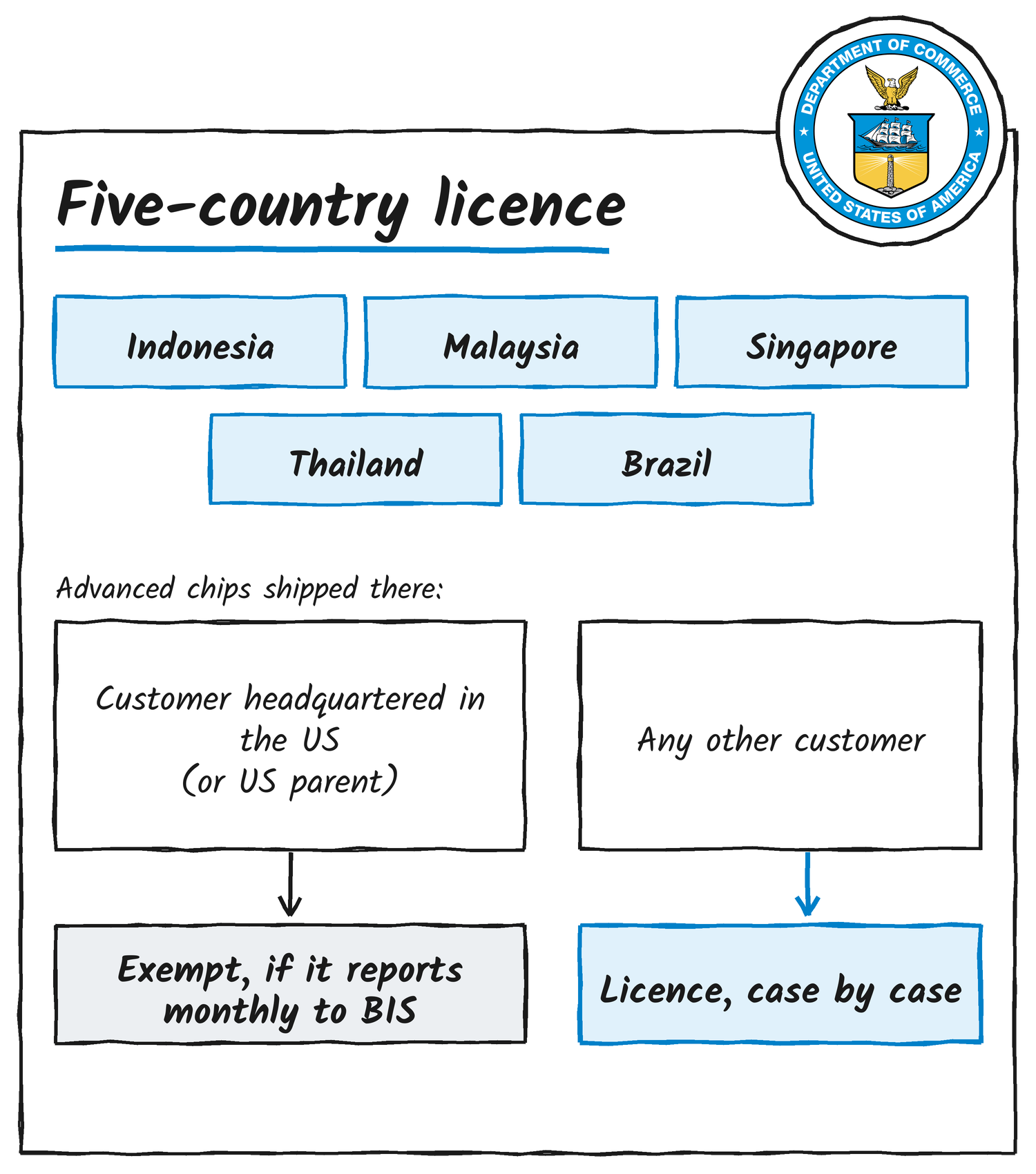
Separately, advanced chips now need a licence to go to Indonesia, Malaysia, Singapore, Thailand or Brazil, which the rule says carry a higher-than-normal risk of diversion. The Commerce Secretary can add countries. The requirement doesn’t apply when the customer, or its ultimate parent, is headquartered in the US, provided the exporter files the reports BIS requires, due by the first business day of the month after each transaction. Licence applications for these five are reviewed case by case.
BIS says it will monitor for countries that tolerate evasion, and lists possible consequences: import restrictions, new licence requirements, a downgrade in the country’s export-control status, and Entity List designations for the foreign persons involved.
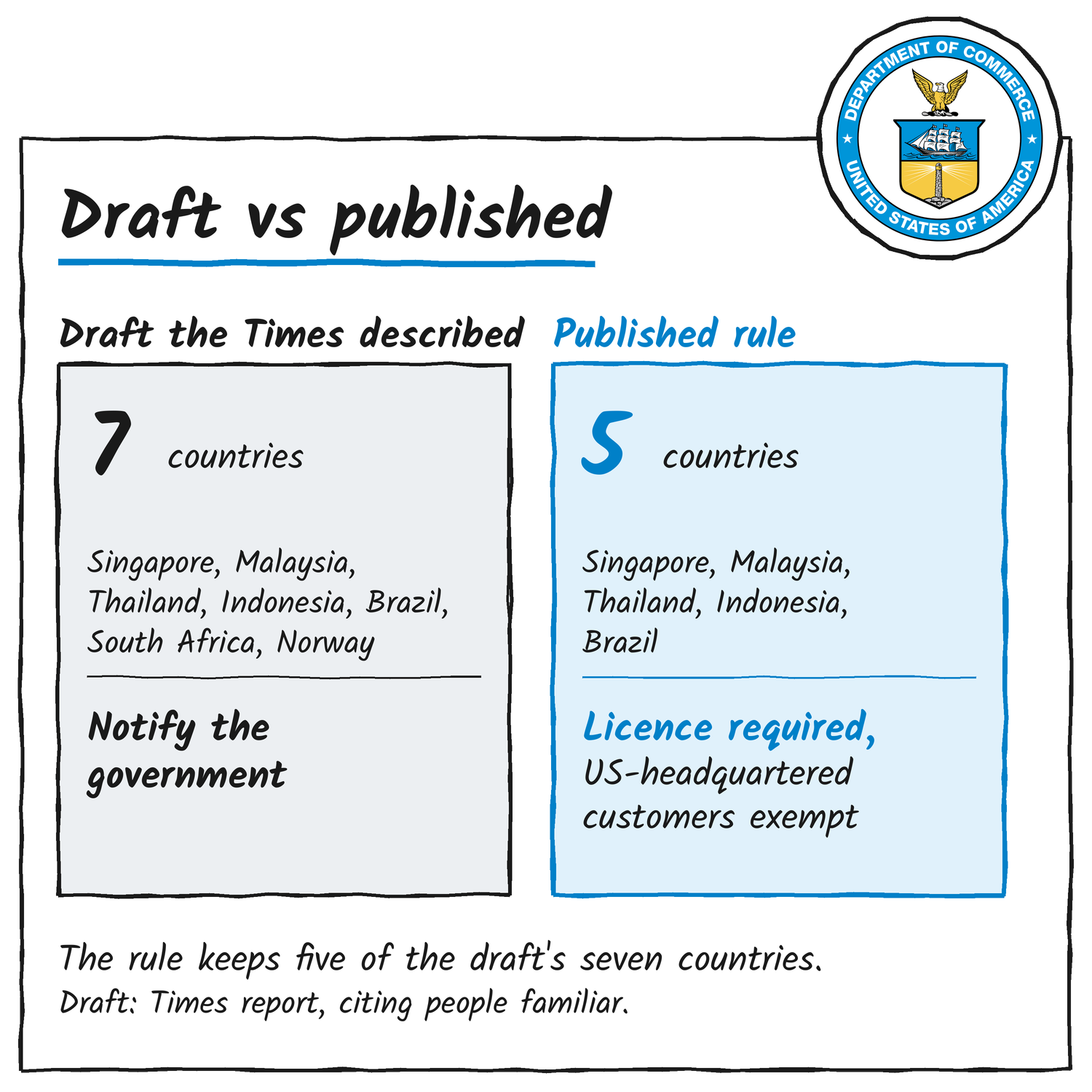
The Times reported on 15 November, citing people familiar with the talks, that the Commerce draft covered seven countries, adding South Africa and Norway to these five, and asked for notification instead of a licence. The published rule names five and requires a licence, with US-headquartered customers exempt if they report.
The rule also formally rescinds the Biden administration’s AI Diffusion Rule, including its controls on model weights. BIS says that rule was never enforced.
What Commerce and Justice say about Megaspeed
The Commerce and Justice departments issued a joint statement on 16 November about Megaspeed, the Singapore company they say has drawn significant public attention over the past week. They say Commerce opened an export-control investigation into Megaspeed in 2024, after proactive monitoring flagged suspicious activity. In May 2025, Commerce investigators asked Nvidia for records of direct or indirect sales to Megaspeed, and in June 2025 Nvidia put Megaspeed on its “no sell” list. That month, BIS agents and Singaporean law enforcement officials made an on-site end-use check at Megaspeed and interviewed its CEO, Alice Huang. Justice then took the lead on the criminal investigation.
The statement says it addresses “inaccurate information circulating in public reporting” and doesn’t name the reports. It announces no charges against Megaspeed. It says the departments will “bring the full extent of the law against Megaspeed for any criminal conduct that may have occurred”, and that 17 defendants across six investigations have been charged under the Trump administration in cases involving smuggled semiconductors.
Singapore’s Ministry of Home Affairs has given its own account. It says Singapore police and customs began investigating Megaspeed and its controllers in February 2025 over suspected false declarations in server purchases, and that the US check on 24 June 2025 was the first time Singapore learned of US interest in Megaspeed and Huang. It says Huang, a Hong Kong resident, wasn’t investigated for espionage. Police concluded in February 2026 that there wasn’t enough evidence on the declarations, but gave her a stern warning and barred her from re-entering Singapore for giving police information they assessed she knew was inaccurate.
Singapore also says Supermicro, a US server supplier, gave limited cooperation, and that its repeated requests to the US Justice Department and the FBI for help have brought limited information or assistance. Its investigation into Megaspeed and six other individuals is ongoing.
What happens next
The rule takes effect when the Federal Register publishes it, scheduled for 19 November. BIS takes comments for 60 days after that, which means 18 January 2027 if publication goes ahead on that date, through regulations.gov under docket BIS-2026-0628. On the same date, data centres already serving covered customers would have until 17 February 2027 to hold a licence.
Discover more from Sulat AI & Tech News
Subscribe to get the latest posts sent to your email.