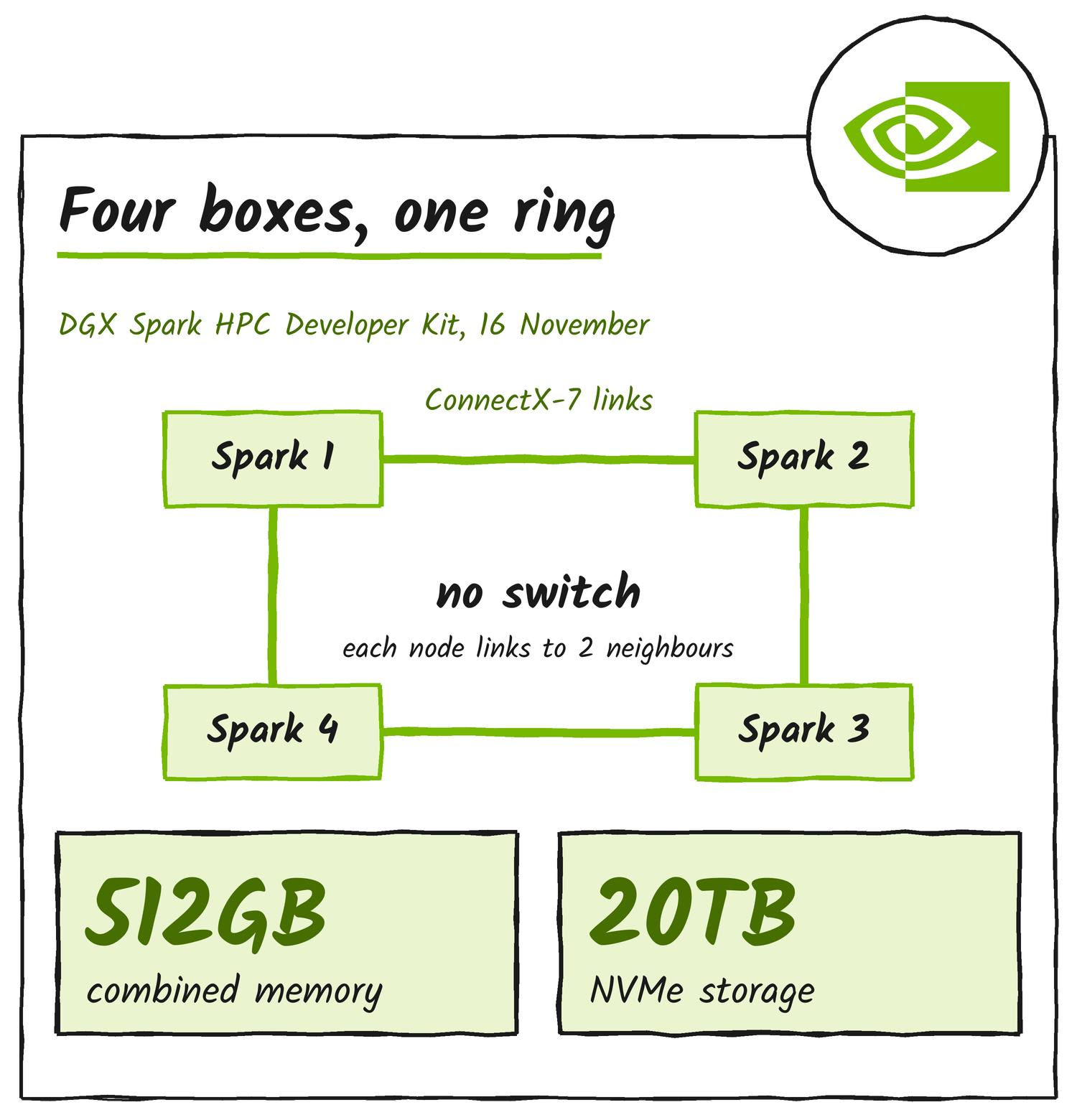
Nvidia introduced the DGX Spark HPC Developer Kit at the SC26 supercomputing conference in Chicago on 16 November, which was 17 November in New Zealand. Nvidia’s blog post describes the kit as four DGX Spark systems, each linked directly to its two neighbours in a ring, with 512GB of combined memory and 20TB of NVMe storage. Nvidia says the kit is on display at SC26 and available for sale.
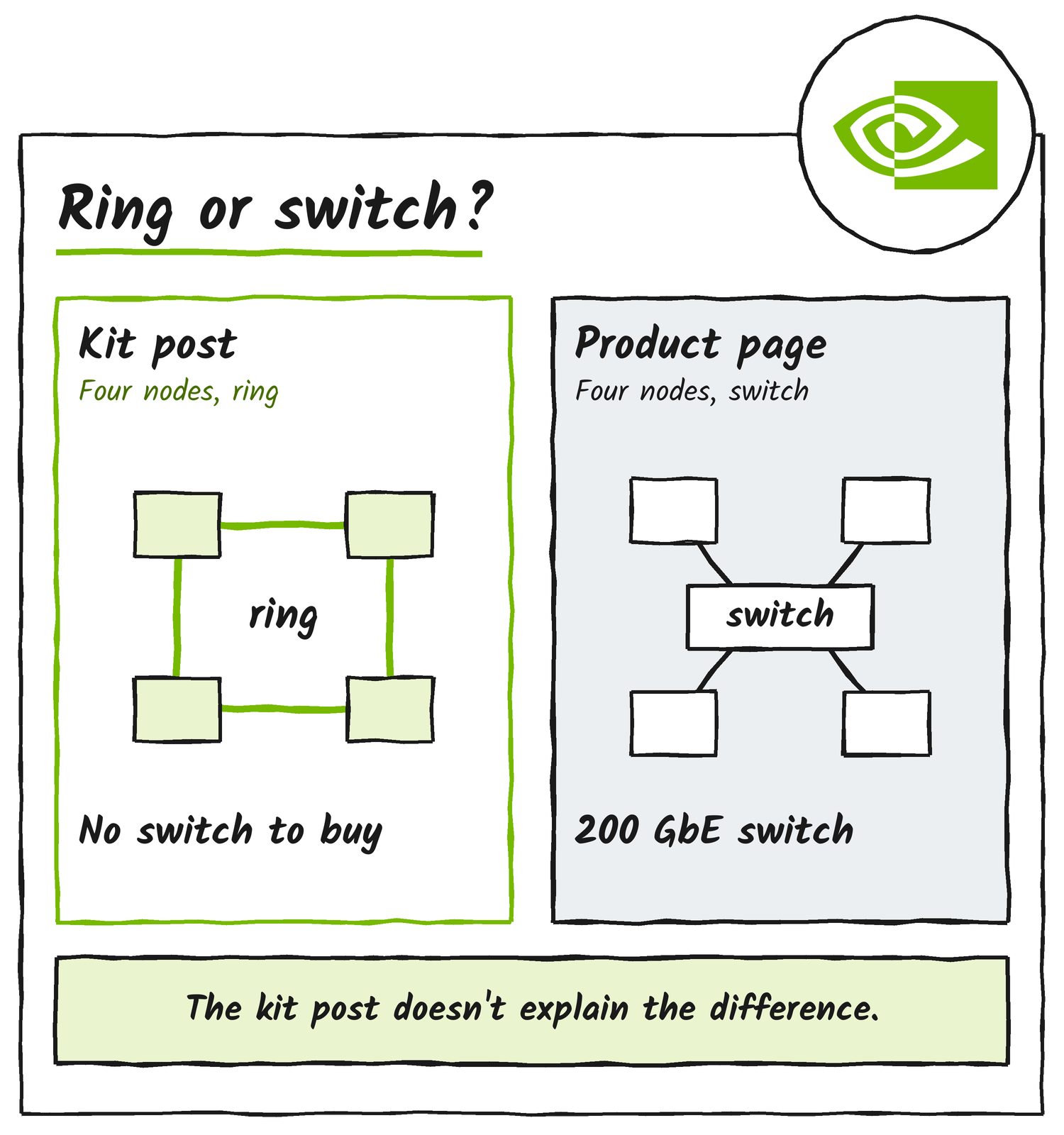
Each system is built on Nvidia’s GB10 Grace Blackwell Superchip. Nvidia says the kit scales from one system, or node, to four, linked over ConnectX-7 networking with no network switch to buy or set up. The pitch is that a researcher with a fixed server allocation can develop and debug at their desk instead of queueing for every job, keep shared server hours for production runs, and keep unpublished results and proprietary datasets on premises.
What the kit runs
With NVFP4, Nvidia’s 4-bit number format for model weights, Nvidia says the four systems can host models of up to 700 billion parameters locally, and it names DeepSeek V4.1 as an example. Nvidia says a playbook for its HPC SDK is coming soon. It will bring GPU-accelerated C, C++ and Fortran compilers, libraries and MPI tools to the cluster. MPI is the standard way programs on separate machines pass data to each other. Nvidia says teams will be able to build and test scientific applications across the four nodes, check how computation and data are distributed, and debug communication problems before moving to a larger system. The post gives no date for the playbook.
Nvidia says it has demonstrated LAMMPS with Kokkos, a materials simulation code, and NAMD, a molecular dynamics code, on four systems. It says the wider DGX Spark community has validated GROMACS for molecular dynamics, OpenFOAM for fluid dynamics and WRF for weather modelling, along with the NIM microservices OpenFold3 and Boltz-2, which predict biomolecular structures. Nvidia also says new open dataset and post-training recipes for Nemotron 3.5 Super VL, running on DGX Spark, help researchers adapt that model for life sciences and chemistry.
What early users report
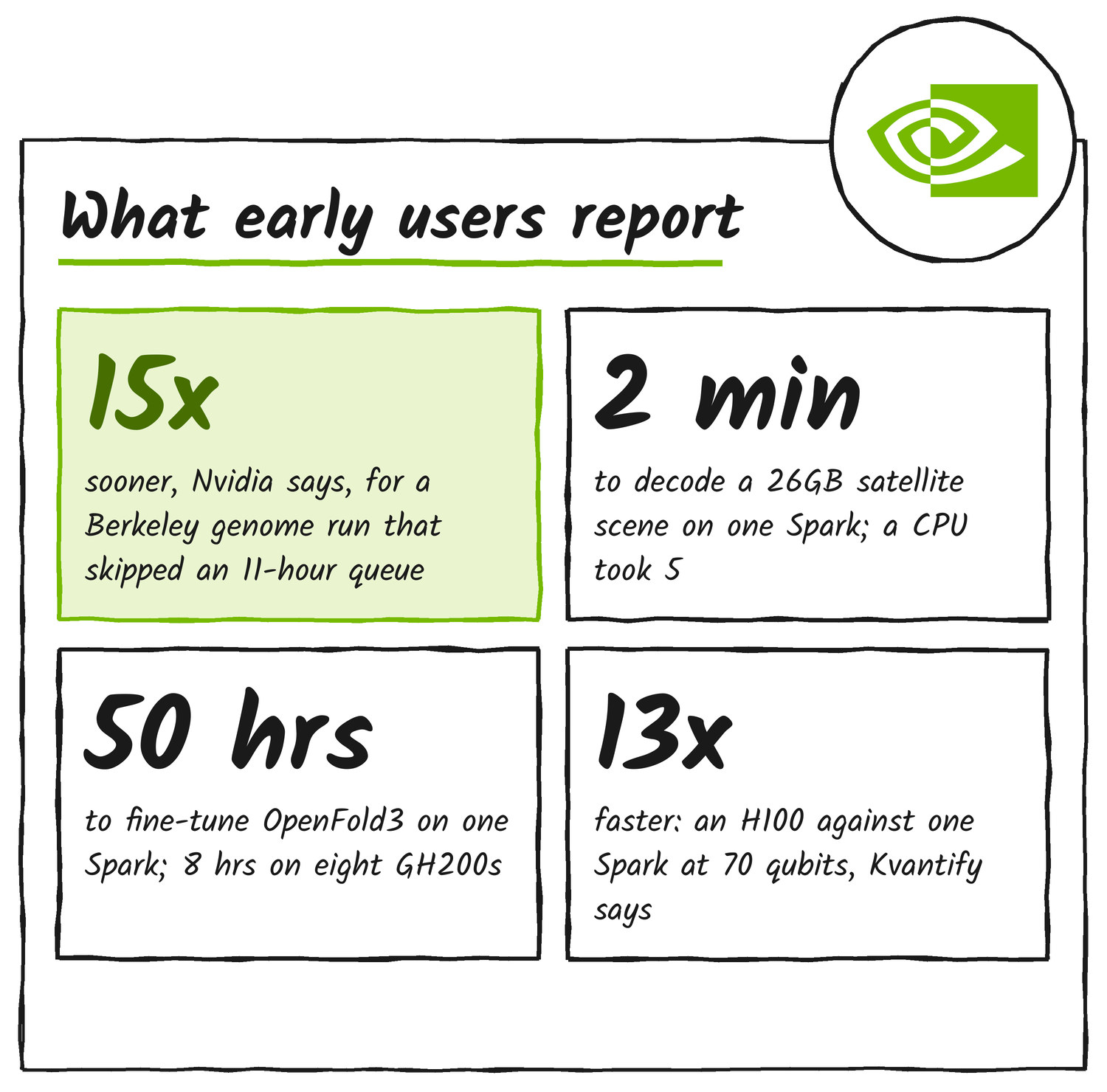
The post lists five users, and the table below sets out what each reports.
| User | Workload | Reported result |
|---|---|---|
| Kvantify | Tensor-network simulation of quantum-chemistry circuits | Up to 70 qubits and 975 gates on one Spark, per Nvidia |
| CYRAN AI | JPEG 2000 decoding of satellite images | A 26GB scene in just over two minutes, against over five on a CPU |
| OpenFold | Fine-tuning OpenFold3 | About 50 hours on one Spark, about eight on eight GH200 GPUs |
| Rubin Lab, UC Berkeley | Predicting bacterial traits from genomes with Evo 2 | 15x sooner, with no 11-hour queue, per Nvidia |
| Hartwig Group, UC Berkeley | LoRA fine-tuning of Nemotron 3 Super 120B-A12B | Eight- to 24-hour training fits back to back on one Spark, per Nvidia |
Two of those results come with a counterweight in the sources. OpenFold’s own post puts the same fine-tune at about eight hours on eight GH200 GPUs, against roughly 50 hours on a single Spark, so the desk machine is the slower option there. Kvantify’s post says an H100 runs its 70-qubit simulation 13 times faster than a DGX Spark, and that memory runs out on both beyond 70 qubits. The 15x figure for the Rubin Lab comes from Nvidia’s post, and the lab’s research page doesn’t carry it.
What the post doesn’t say
The post gives no price for the kit and no benchmark of the four-node cluster running LAMMPS or NAMD. It lists no link speed for the ConnectX-7 connections.
The wiring also differs from Nvidia’s earlier material. Its DGX Spark product page says two or three systems connect with direct cables but four need a 200 GbE switch, and its user guide says the cluster assistant supports up to three systems on direct cables and up to four with a switch. The kit post describes four systems in a ring with no switch and doesn’t explain the difference.
Nvidia announced Rubin HPC, a data centre GPU due in 2028, at the same conference. The Spark kit is the product on sale now.
Sources: NVIDIA, “NVIDIA DGX Spark Developer Kit Turns a Desk Into a Supercomputing Lab”, NVIDIA, DGX Spark product page, NVIDIA, DGX Spark user guide, Kvantify, OpenFold, NVIDIA, CYRAN AI case study.
Discover more from Sulat AI & Tech News
Subscribe to get the latest posts sent to your email.