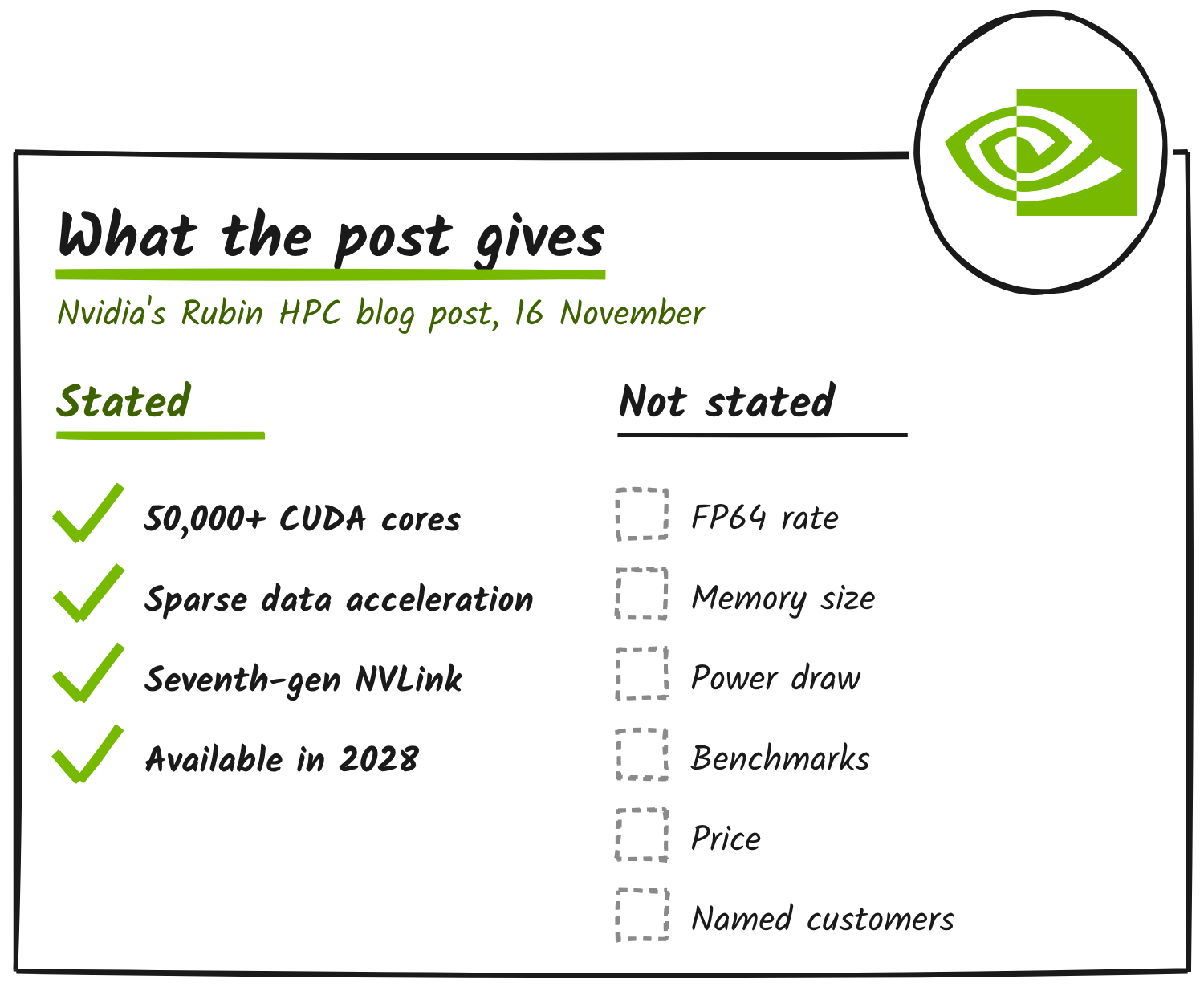
Nvidia announced Rubin HPC at the SC26 supercomputing conference on 16 November, which was 17 November in New Zealand. Nvidia’s blog post describes it as a new GPU in the Vera Rubin platform for simulation and data processing in science, engineering and analytics. Nvidia says it carries more than 50,000 CUDA cores on a single GPU, a record, and expects it to be available in 2028.
Ian Buck, Nvidia’s vice president of hyperscale and high-performance computing, said in the post: “For agents tackling science and engineering, faster simulation means faster discovery.” Nvidia says agents help scientists and engineers explore more candidate materials, molecules and designs, and that those teams rely on simulations to test the ideas. A CUDA core is one of the small arithmetic units on a GPU.
How Nvidia says the chip is built
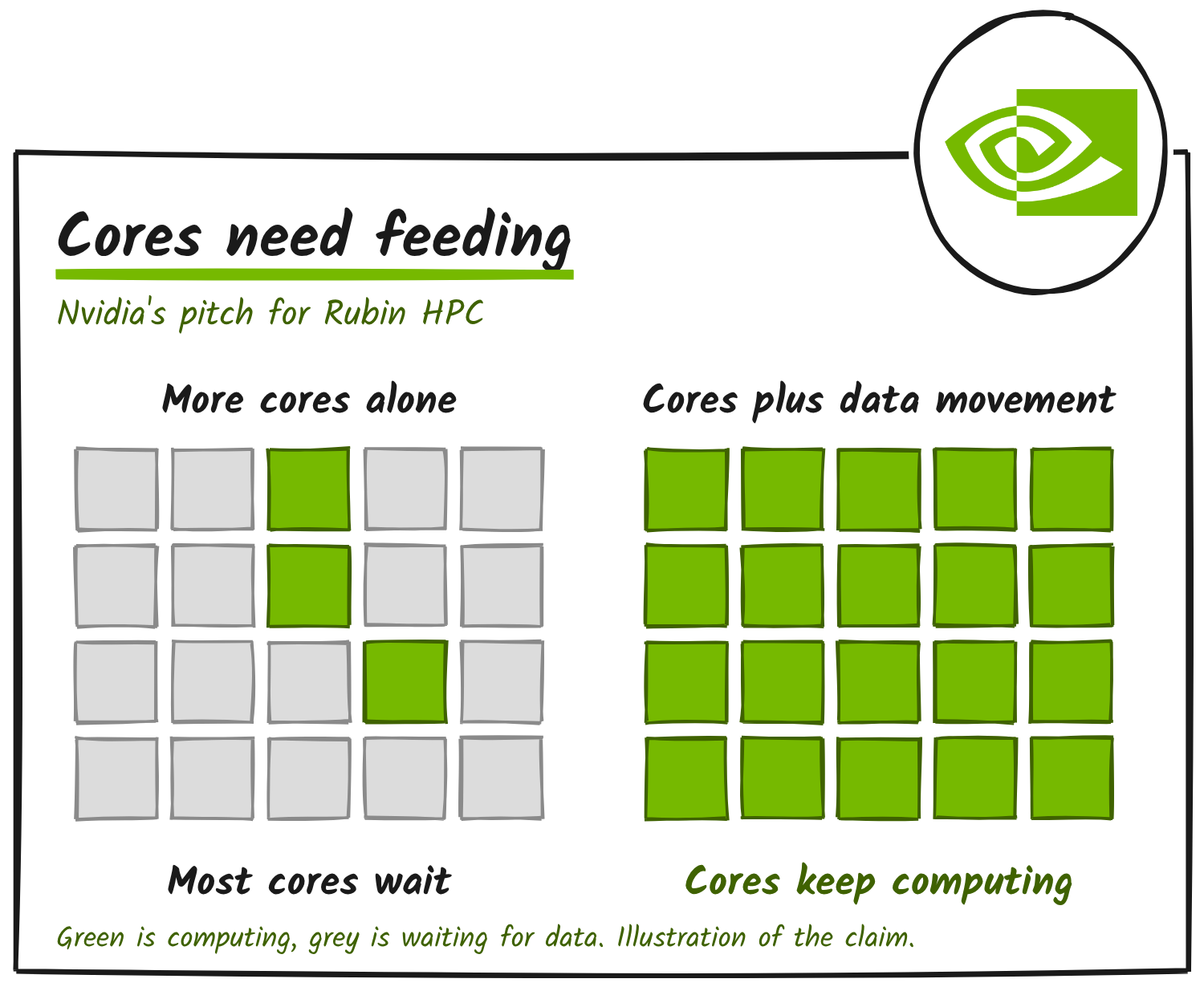
Nvidia says scientific computing workloads across climate models, engineering simulations, genomic analysis and financial risk share one shape: an application reaches into an immense dataset, gathers a handful of scattered values, calculates a result and repeats that on an enormous scale. Nvidia says Rubin HPC scales data movement and compute together rather than adding compute alone, so the cores spend their time calculating instead of waiting for data.
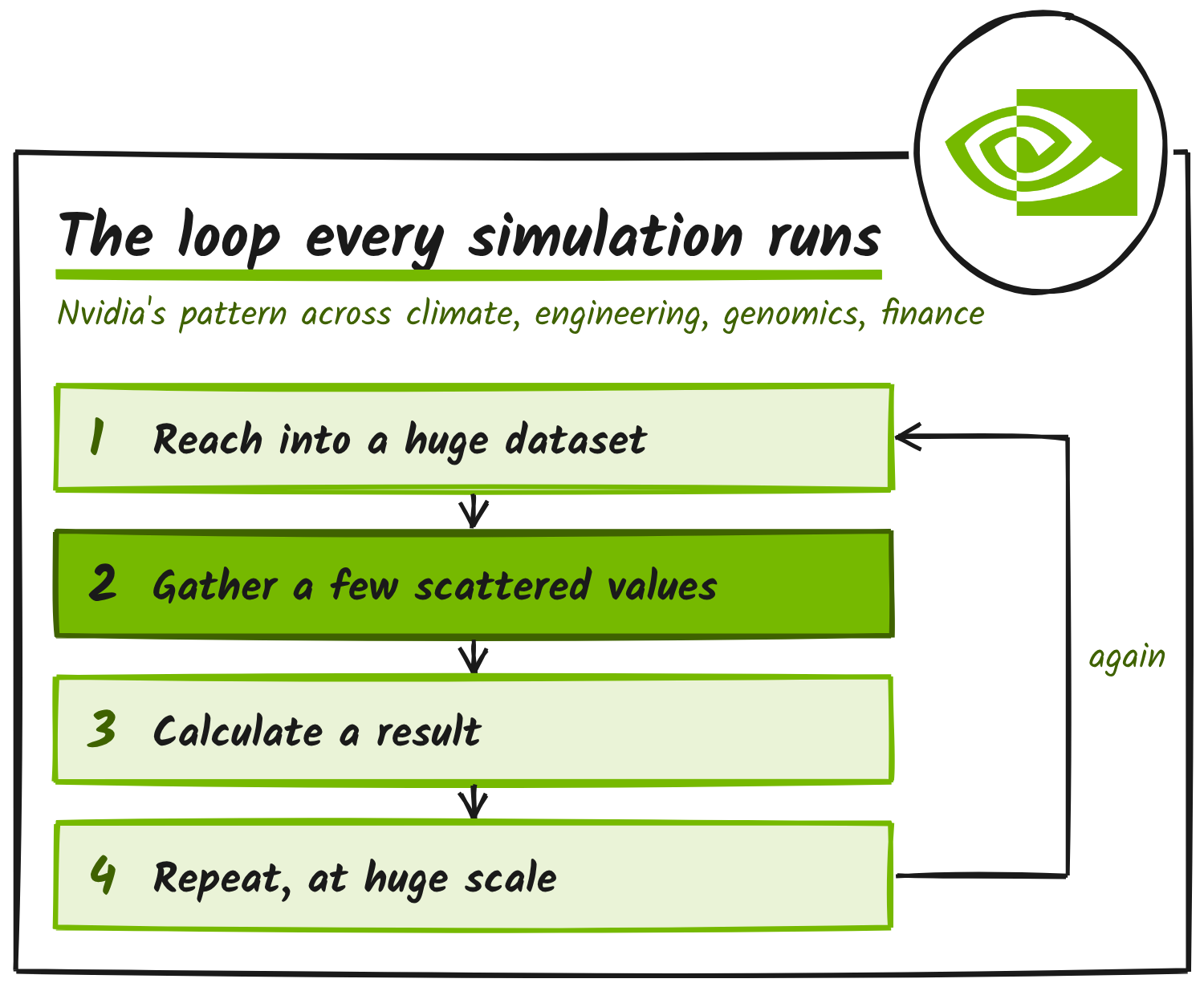
Two features do that work, according to Nvidia. A sparse data acceleration capability keeps the cores fed with data; sparse data is data where most entries are empty. Seventh-generation NVLink, Nvidia’s interconnect between GPUs, accelerates GPU-to-GPU connectivity. Nvidia says the balance speeds up recurring patterns in simulation workloads: sparse matrix operations, stencil computations, where each point in a grid is updated from its neighbours, and sorting and reductions, which collapse many values into one, such as a sum.
Nvidia says its CUDA-X libraries, a growing set of optimised implementations of complex algorithms for agents to use, include those most relevant to simulation and analytics. It says faster simulations shorten the loop of hypothesis, simulation and refinement, so researchers and engineers can choose next steps sooner and point lab work at the most promising candidates.
What the post doesn’t say
The post lists no FP64 rate, memory type or capacity, power draw, benchmark result or price for Rubin HPC, and it names no customers or system builders. FP64 is 64-bit double-precision arithmetic, the number format scientific simulation leans on for accuracy. Nvidia says only that the GPU is expected in 2028.
The named supercomputers come from an earlier announcement. At ISC in June, Nvidia said Vera Rubin systems would power the Leibniz Supercomputing Centre’s Blue Lion, due online in 2027, the Doudna system at the National Energy Research Scientific Computing Center, built by Dell Technologies, and Los Alamos National Laboratory’s Mission, Vision and Veritas systems, built by HPE. That release covers Vera Rubin, with native FP64 and up to 144 GPUs per rack, and it doesn’t mention Rubin HPC.
Sources: NVIDIA, “NVIDIA Announces Rubin HPC”, NVIDIA, “NVIDIA Vera Rubin Delivers World-Class Supercomputers for Science”.
Discover more from Sulat AI & Tech News
Subscribe to get the latest posts sent to your email.