Perplexity has launched Frontier Research, a research effort that aims to build what its launch post calls an “automatic research scientist”, an AI system that conducts research on its own. Perplexity says the work will be supported by more than 10,000 GPUs, the specialised chips that train and run AI models, and that it will publish papers, models, data and benchmarks.
Today we’re launching Perplexity Frontier Research.
November 16, 2026
The goal of Perplexity Frontier Research is to create a system that can perform autonomous research.
The work will focus on multi-agent orchestration, reinforcement learning, continual learning, systems, and pre-training.
We will develop algorithms, models, and evaluations, released openly, and tested in Perplexity products. Our work will be supported by more than 10,000 GPUs.
The Frontier Research team will regularly publish papers, models, data, and benchmarks.
We’re actively hiring researchers and engineers for Perplexity Frontier Research in San Francisco, Palo Alto, New York, and London.
research.perplexity.ai
Perplexity announced the effort on X on 16 November. Its post names five areas of focus, multi-agent orchestration, reinforcement learning, continual learning, systems and pre-training, and says the algorithms, models and evaluations will be “released openly, and tested in Perplexity products”. CEO Aravind Srinivas added in his own post that Perplexity is “committing at least 10,000 GPUs” to multi-agent orchestration and continual learning systems.
Announcing Perplexity Frontier Research. We are committing at least 10,000 GPUs to work on multi-agent orchestration and continual learning systems with the goal of building an automated researcher. We will publish evals, papers, blogs and open source our models and tooling. We’re actively hiring!
November 16, 2026
The research loop
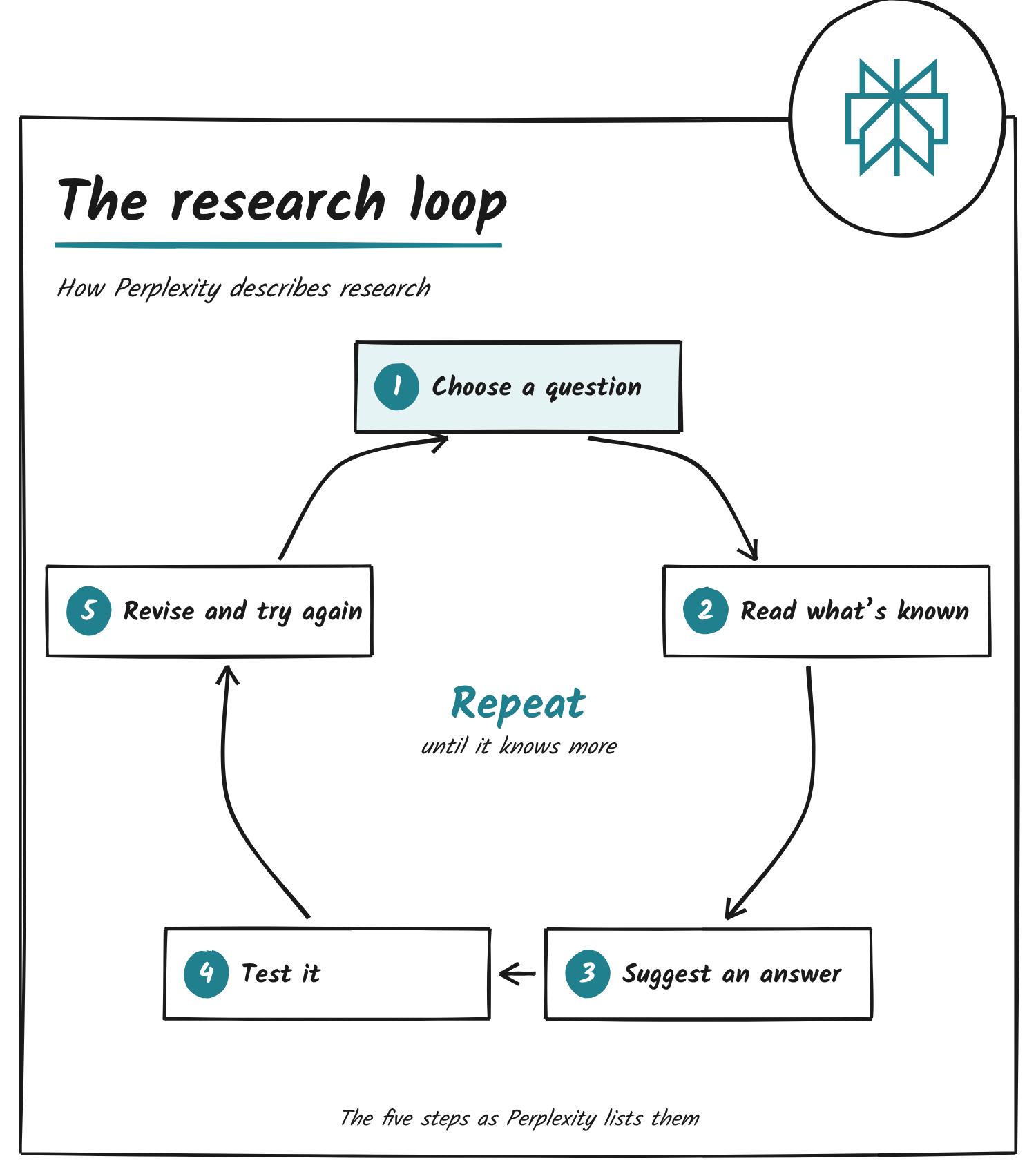
Perplexity’s research page describes research as a cycle: choose a question, read what’s known, suggest an answer, test it, then revise and try again. It says the next big advances will come from working out how to automate scientific research, and that the goal is “scientifically interpretable insights” rather than black-box predictions.
The page pictures a system of agents with different jobs. Some search wide across thousands of sources, some go deep on one thread, and others propose experiments, critique or form hypotheses. Perplexity says that system needs models that generate their own training signal, keep learning after release, spend compute where information is worth the most and coordinate across devices and datacentres as one system. It also says the work needs new evaluations that test for discovery, and not just recall.
Six areas of work
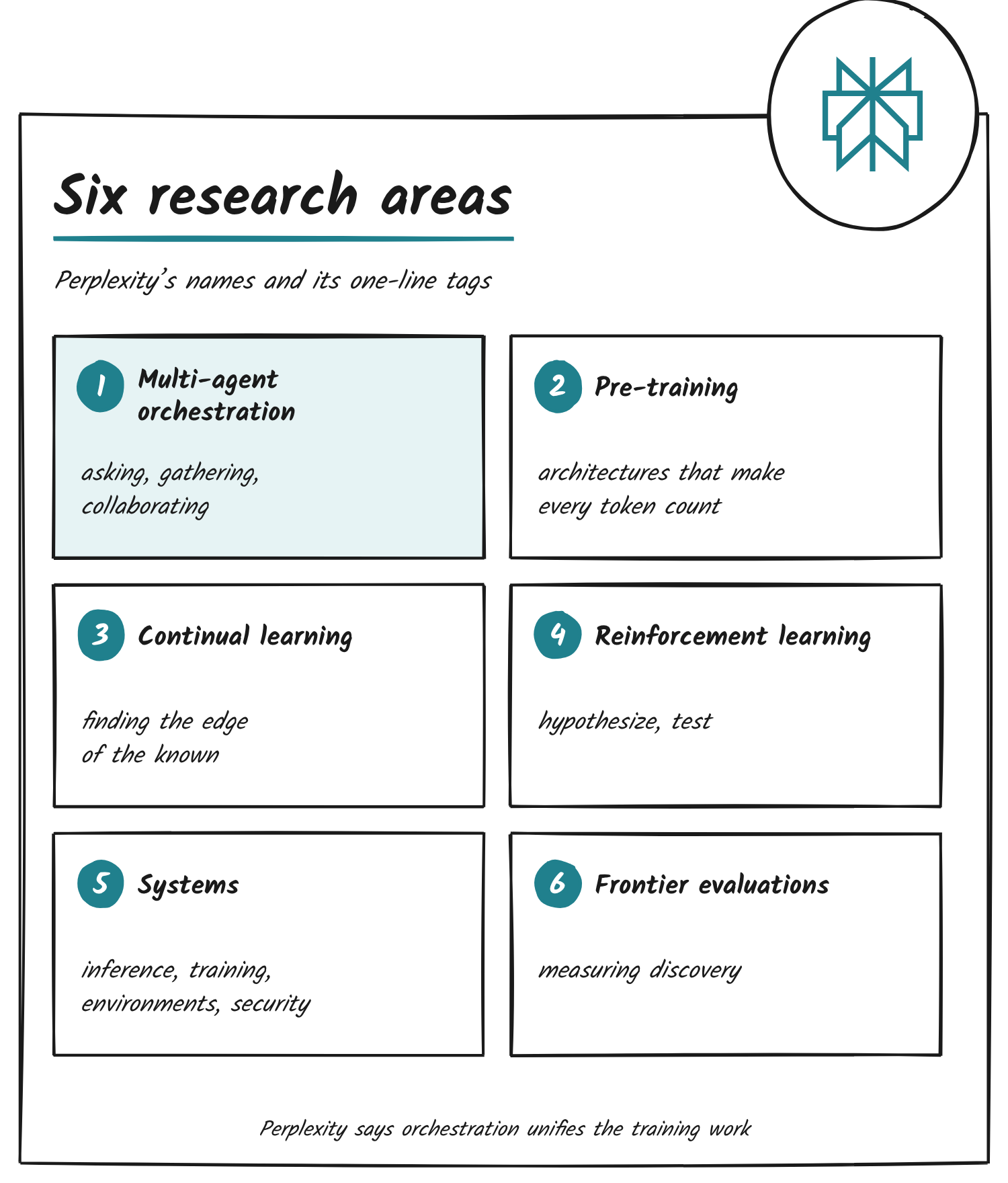
The page sorts the work into six areas: multi-agent orchestration, pre-training, continual learning, reinforcement learning, systems and frontier evaluations. Perplexity says pre-training, continual learning and reinforcement learning are integrated efforts, unified by multi-agent orchestration.
For orchestration, Perplexity gives the example of advisor escalation, where a small on-device model asks a larger model for help only when that’s worthwhile. It says this can deliver high-quality output at a small fraction of the cost. Its pre-training section asks whether synthetic data can be more valuable than real data and says Perplexity pre-trains open-weight models that are efficient and specialised.
Denis Yarats, Perplexity’s co-founder and CTO, said a big part of the work is large-scale reinforcement learning. He wrote that Perplexity is scaling it to train large models across 10,000-plus GPUs, using synthetic data and environments built from how people use Perplexity.
today we’re launching Perplexity Frontier Research, a new effort focused on building systems capable of autonomous research.
November 16, 2026
a big part of this is large-scale RL. we’re scaling RL to train large models across 10k+ GPUs, using synthetic data and environments built from how people actually use Perplexity. we’re a full-stack AI company: we build the entire infra layer in house, from search and inference to training and sandboxes. this lets us move fast, and everything we build gets tested in products used by millions of people. we’re hiring researchers and engineers. if this sounds interesting, DM me or apply: research.perplexity.ai
The systems section covers how models move data between chips and where agents run code. Perplexity points to its fabric-lib GPU communication work and to SPACE, which provides isolated environments that can preserve and resume an agent’s work. The evaluations section says Perplexity wants tests that separate reasoning from memorisation and measure whether a system produces understanding, not only accurate predictions.
Open releases and hiring
Perplexity says results will ship as papers, blog posts, model weights and open repositories. The research page already links open releases from earlier work: the Decider v1.2 27B model, two embedding models on Hugging Face, and code that includes SPACE, mixture-of-experts dispatch and combine kernels, an Apple silicon inference engine and the WANDR benchmark for research agents.
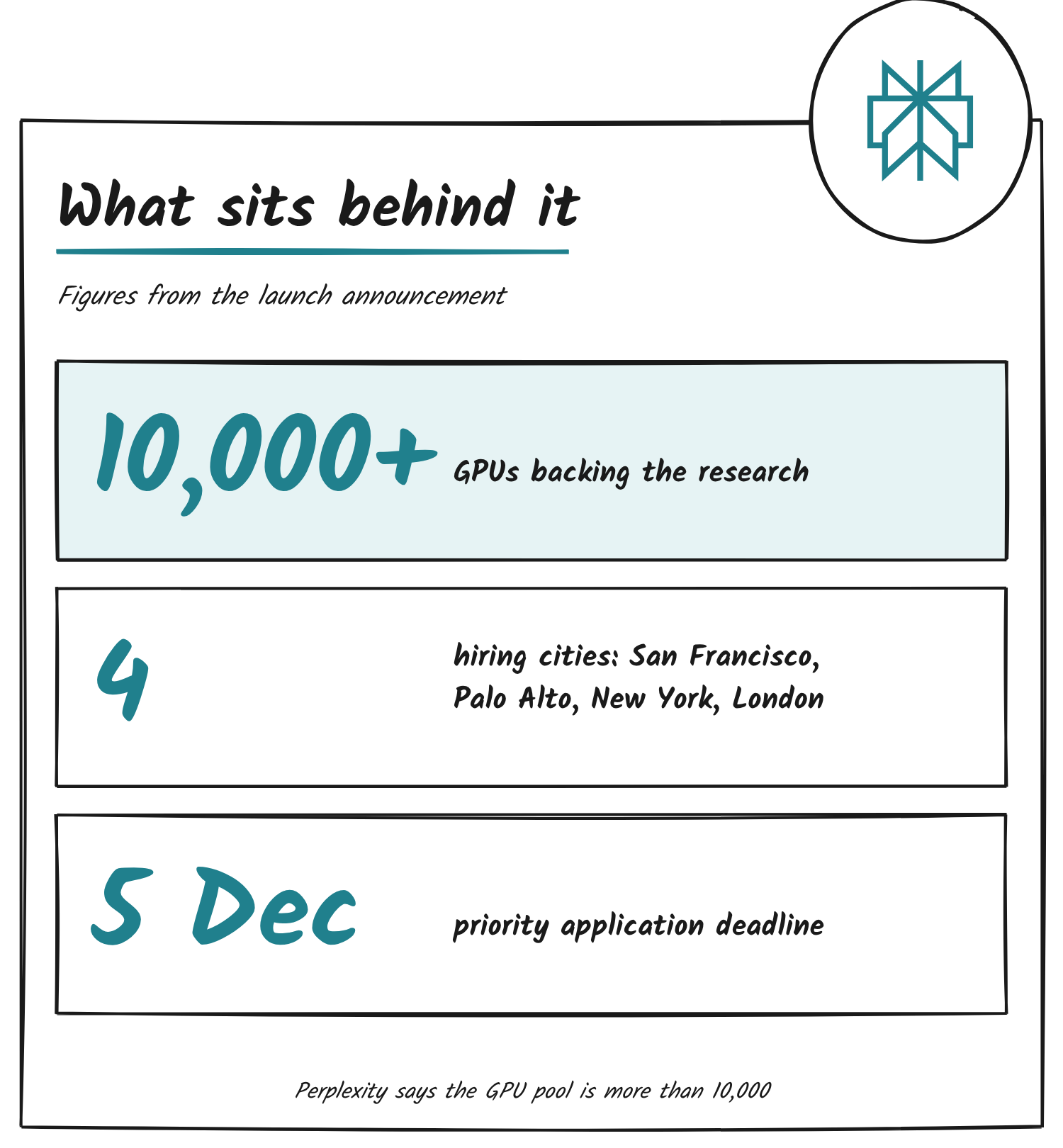
Perplexity is hiring researchers and engineers for Frontier Research in San Francisco, Palo Alto, New York and London. The priority application deadline is 5 December, and a separate research fellowship covers predoctoral and postdoctoral tracks. The page lists Andrew Gordon Wilson as research lead.
The announcement doesn’t name the GPUs or say where they run, and it gives no date for the first Frontier Research release. Perplexity says new papers will appear on its research blog.
Discover more from Sulat AI & Tech News
Subscribe to get the latest posts sent to your email.