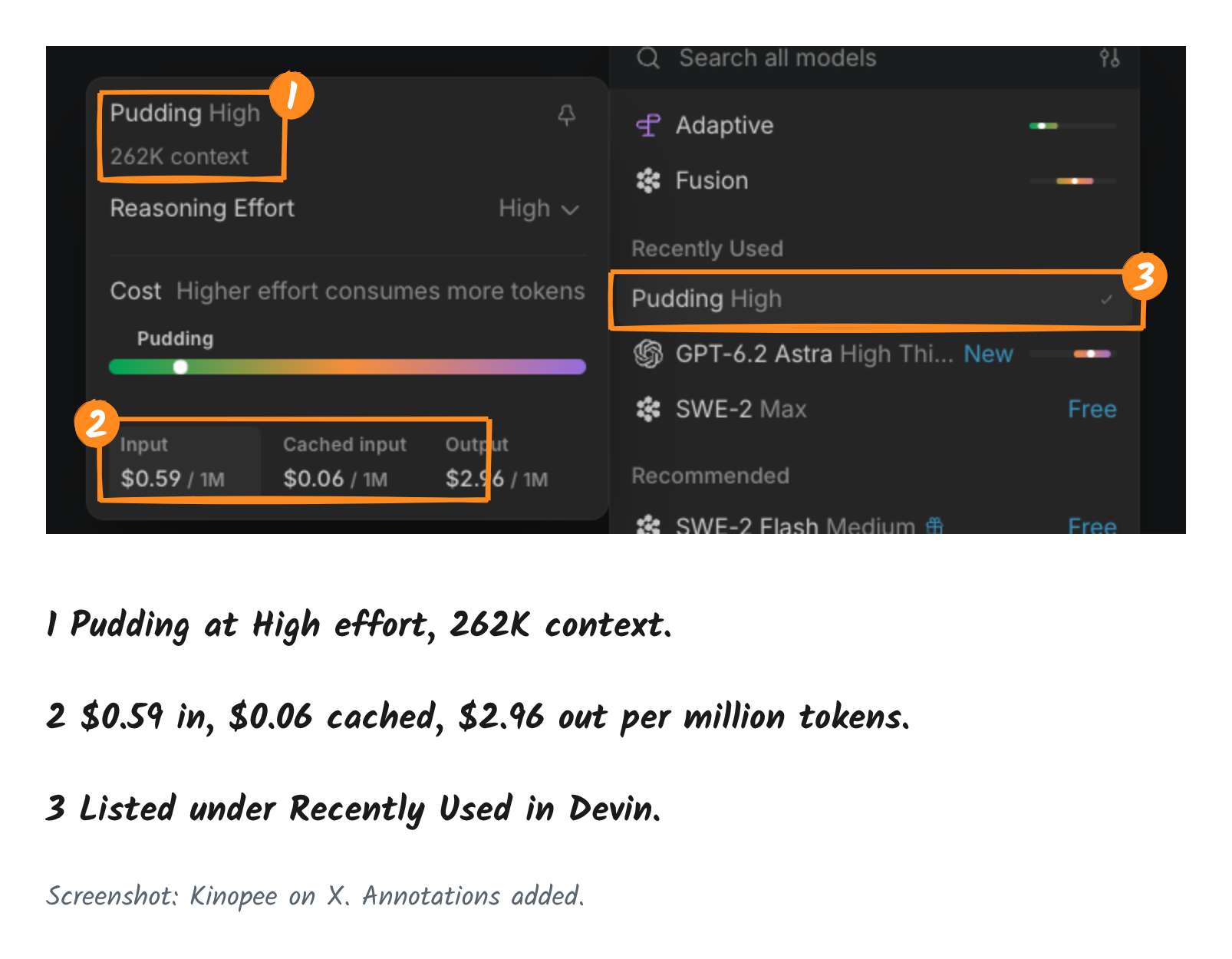
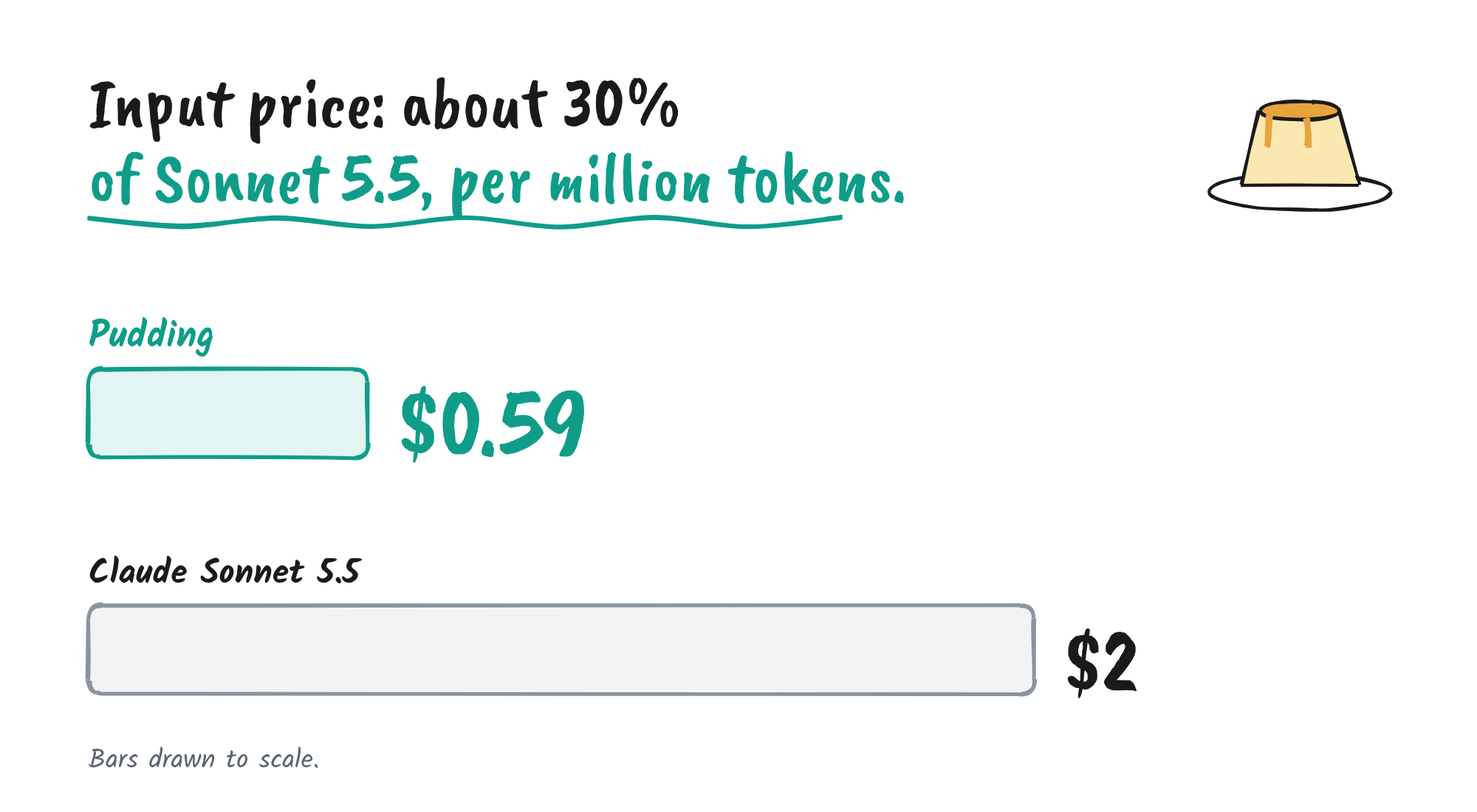
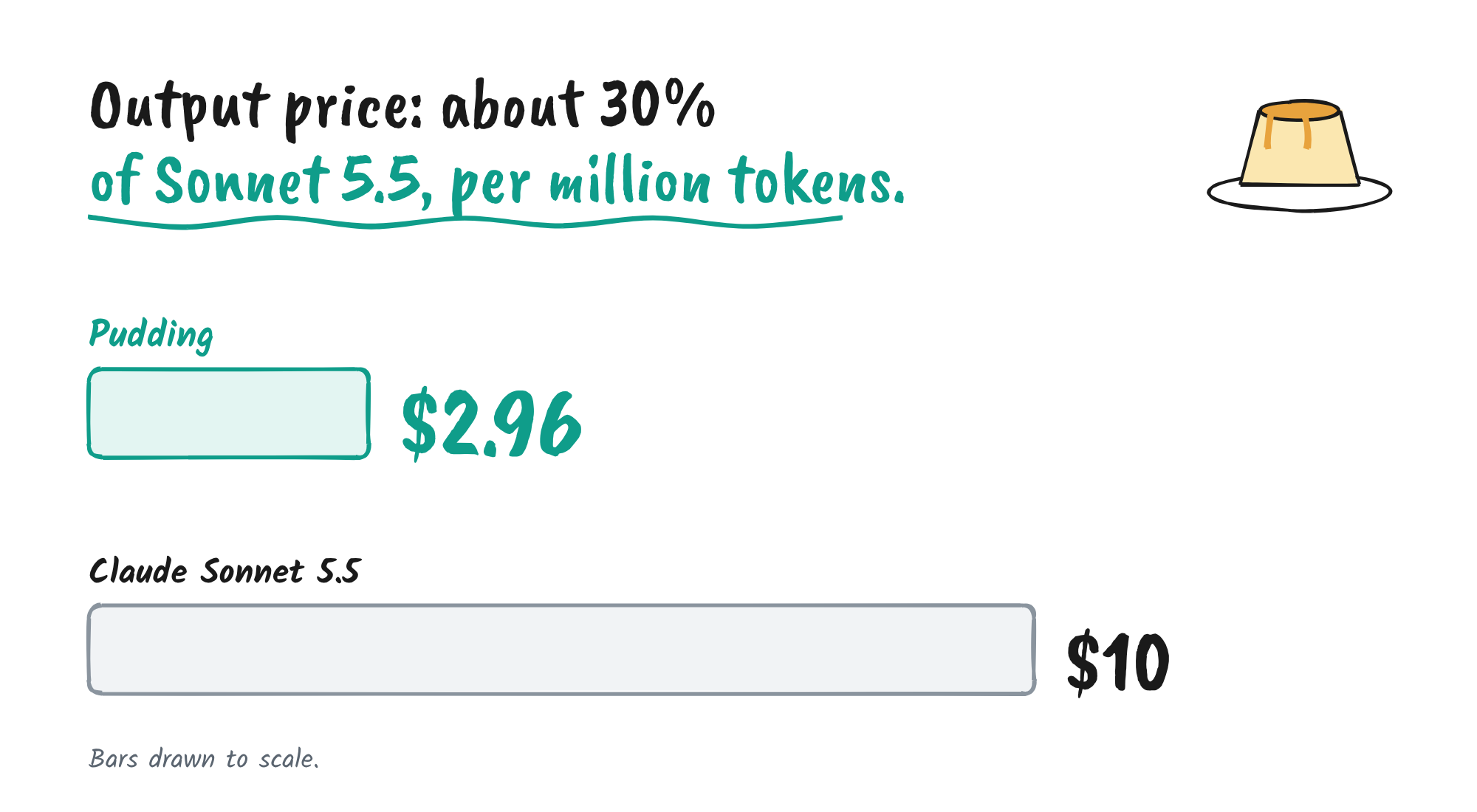
A model called Pudding has turned up in Devin’s model picker at US$0.59 per million input tokens and US$2.96 per million output tokens, according to a screenshot posted on X on 23 November 2026 by Kinopee (@kinopee_ai), a Japanese developer and Devin ambassador. That’s under a third of what Anthropic charges for Claude Sonnet 5.5, which is US$2 in and US$10 out. I’ve since tested Pudding first-hand through Devin, and the short version is that it earns its place in the picker.
Kinopee calls Pudding a stealth model that has appeared in Devin CLI and Devin Desktop. In my translation of the Japanese post, they say it’s low cost, but fairly good at agentic coding, the style of work where the model plans, edits files and runs commands on its own. On the coding tasks in my small battery it was better than fairly good: everything I asked it to write or fix passed every test I had for it.
What the picker shows
The screenshot shows the entry for Pudding at High reasoning effort. It lists a 262K-token context window and three rates per million tokens: US$0.59 for input, US$0.06 for cached input and US$2.96 for output. A note under the cost bar says higher effort consumes more tokens. In the model list, Pudding High sits under Recently Used, above GPT-6.2 Astra High, which carries a New label, and SWE-2 Max, which is marked Free.
The figures check out against what Devin serves for the model. Pudding answers at four reasoning efforts — low, medium, high and max — inside a 262,144-token context window, at US$0.592 per million input tokens, US$0.059 cached and US$2.96 output. It reads images as well as text, and it accepts tool definitions and calls them when it should.
How it did in my tests
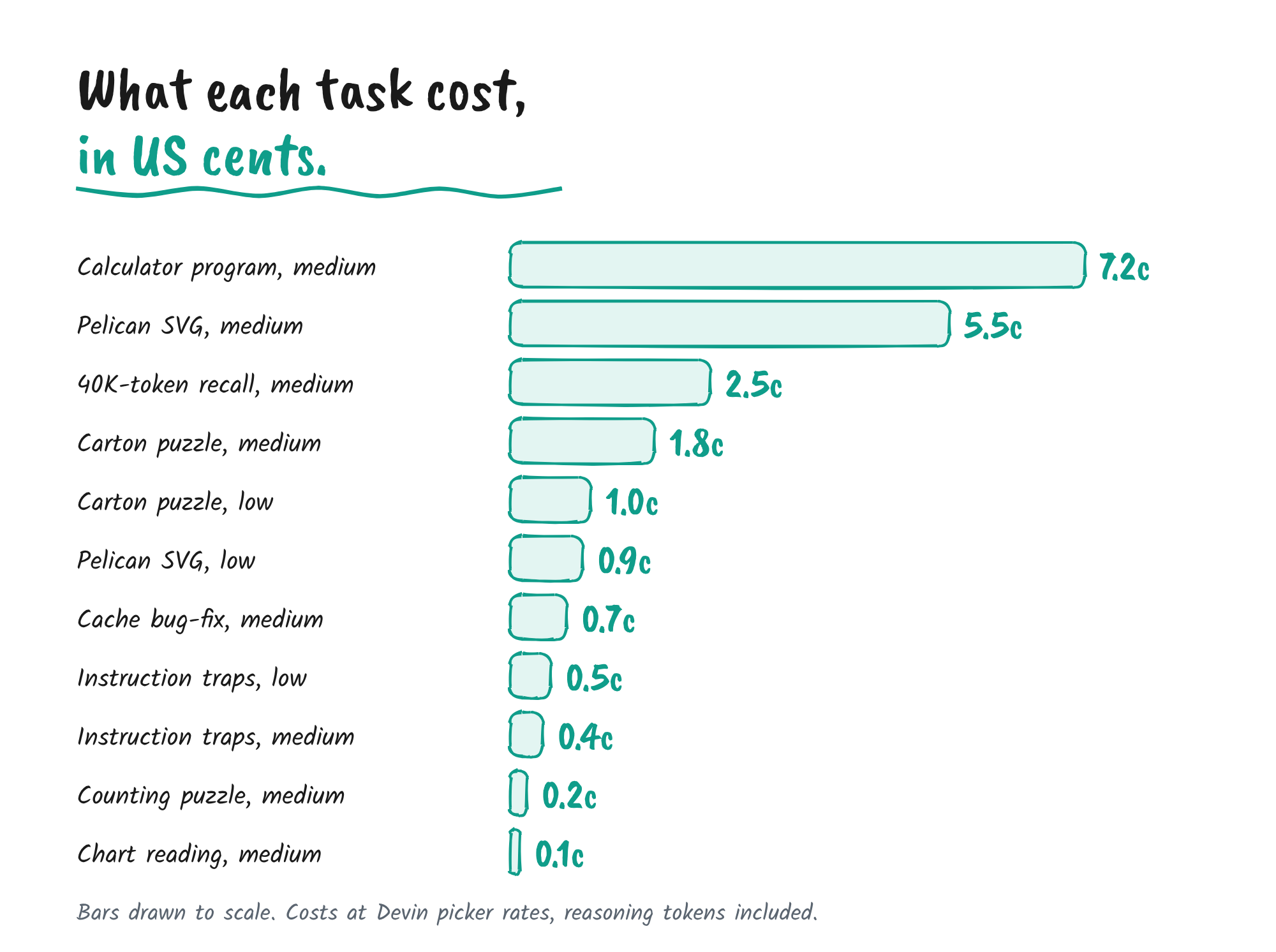
I put Pudding through a dozen or so tasks through Devin, at low and medium reasoning effort: drawing, instruction following, maths with answers I checked independently, coding whose output I actually ran, image reading and a long-document recall test. It answered every prompt. The completed battery cost less than 25 US cents at the picker prices, output counting both its answers and the reasoning behind them.
First, Simon Willison’s benchmark for image models that aren’t: generate an SVG of a pelican riding a bicycle. At low effort Pudding took 29 seconds and produced a pelican with its webbed feet on the pedals. At medium effort it took four minutes and turned in the best scene of the lot: a helmet, a properly jointed frame, spoked wheels, motion lines and a shadow. Claude Sonnet 5.5, at more than three times the output price, drew a clean but minimal bird that never touches the bike. Cognition’s own SWE-2 Flash drew a strong flat pelican, though its bicycle is missing a seat and handlebars.




For instruction following I set six traps at once: answer in strict JSON only, a headline of exactly five words, a body of 40 to 60 words, the word “kererū” exactly twice, no letter z anywhere, and the body ending with the exact phrase “Pre-order Friday.” Pudding scored six out of six at low effort, and six out of six again at medium. This is the medium-effort answer, character for character:
{"headline":"Tui brings calm like kererū","body":"Tui is our first noise-cancelling headphone, tuned for deep calm in loud streets, long flights, and busy rooms. A soft seal, forty-hour battery, clear beamforming mics, and warm sound keep kererū song crisp while the world fades. Feel light, hear more, and carry quiet everywhere. Pre-order Friday."}For maths I picked problems I could brute-force in advance. How many integers from 1 to 1000 are divisible by neither 3, 5 nor 7? Pudding answered 457 with textbook inclusion–exclusion in six seconds, which is correct. A harder one: eggs sold only in cartons of 8, 13 and 27, what’s the largest impossible count? It answered 57 at low effort, and again at medium with a proper impossibility proof by contradiction. Correct both times; the answer really is 57.
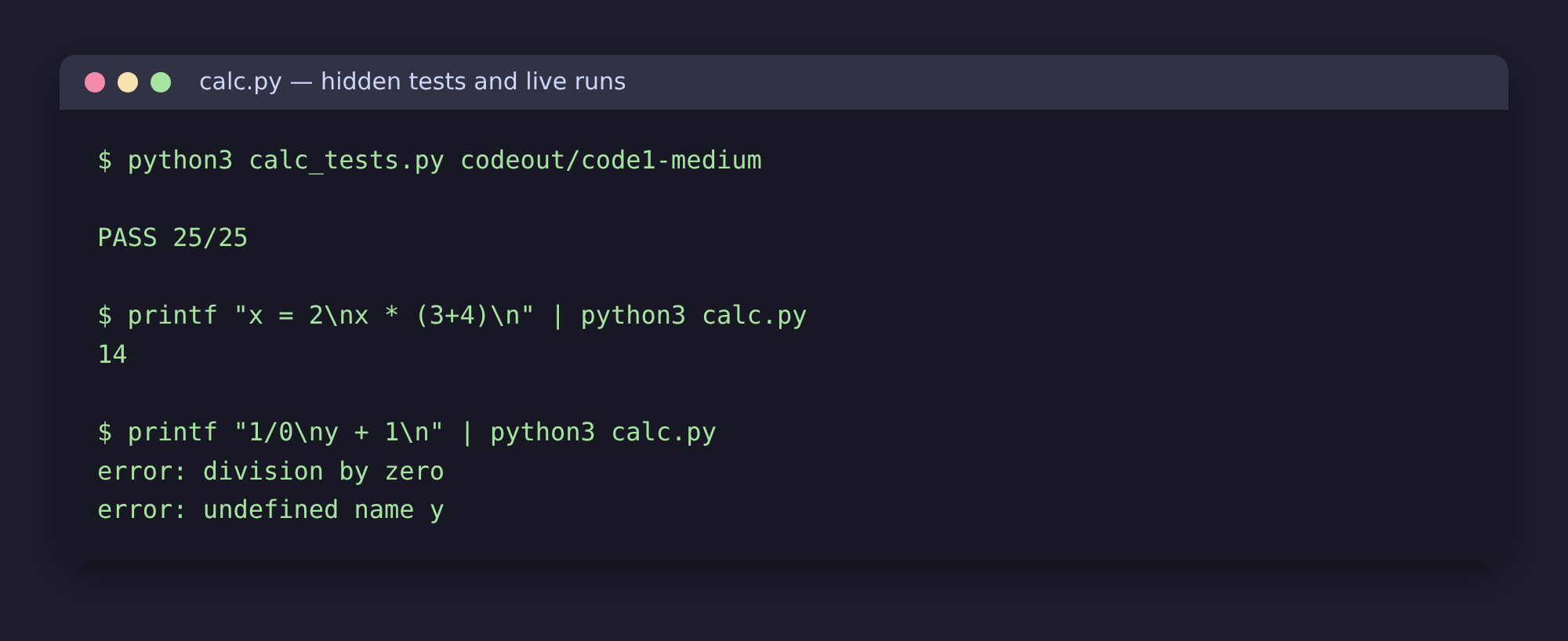
For coding I asked for a complete calculator program in Python — tokenizer, parser and evaluator written by hand, exact error messages specified — and ran it against a hidden suite of 25 tests covering operator precedence, unary minus, division by zero, undefined variables and whitespace. It passed all 25. Then I handed it a cache implementation with three planted bugs and a failing test file; the fix passed all eight of my hidden tests, including the ones exercising each bug. Both at medium effort.
It sees, too. Shown a bar chart of invented monthly sales, it read exact values off the bars — 9.8 for February, 22.6 for May — and named June as the peak, in a second and a half. Shown its own pelican drawing, it correctly named both objects and described the scene. And in the long-document test I hid three facts inside a 40,000-token warehouse log — a part code, an invoice prefix and a certificate expiry — and asked four questions. It returned all three facts exactly and, for the fourth, correctly said the document doesn’t mention the safe’s alarm code instead of inventing one. That took 3.8 seconds. The window is rated for six times that length; I only tested a sixth of it.
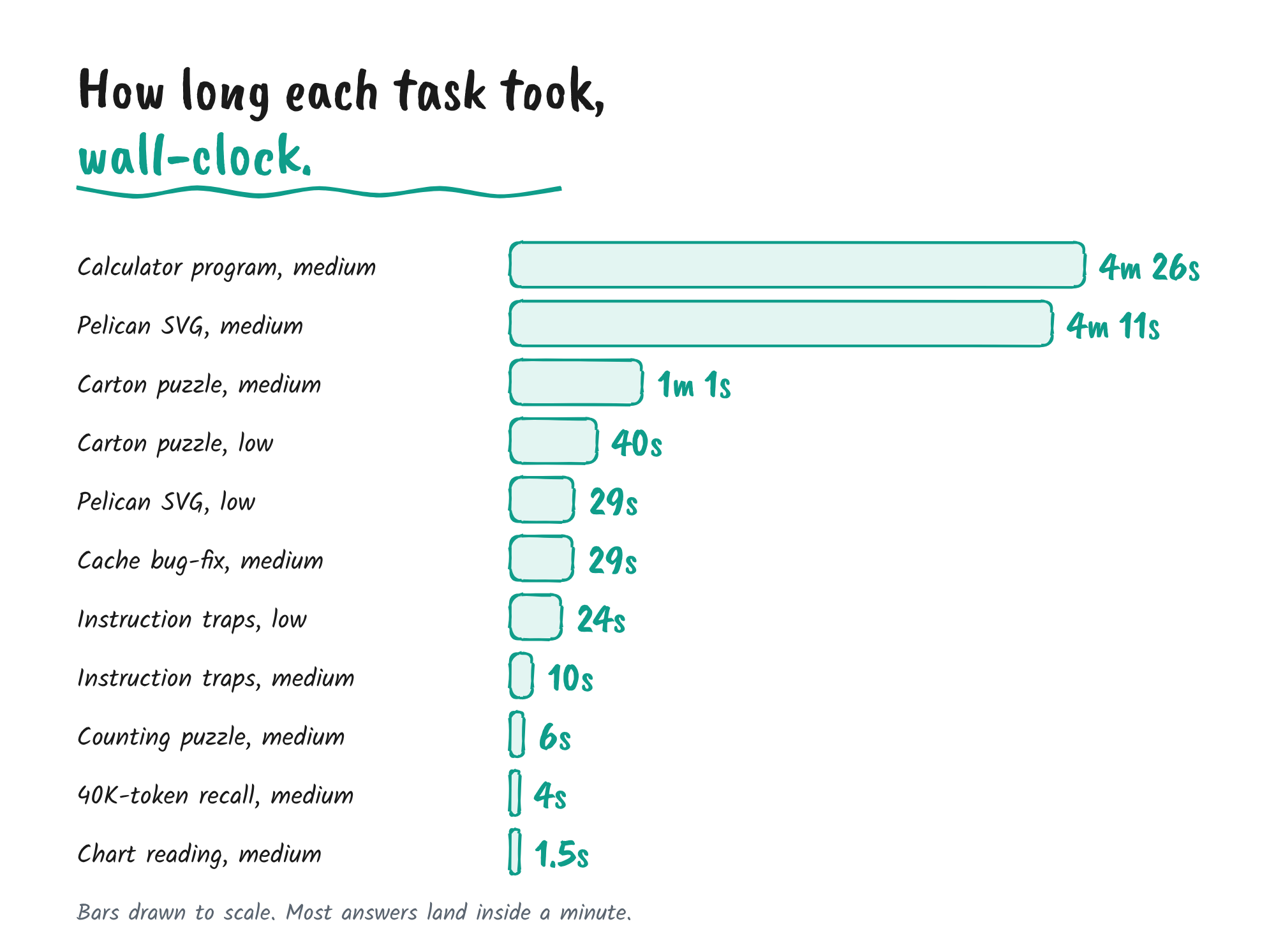
| Task | Effort | Output tokens | Time | Cost (US$) | Result |
|---|---|---|---|---|---|
| Pelican SVG | low | 3,146 | 29.3s | 0.0094 | Strong, feet on pedals |
| Pelican SVG | medium | 18,417 | 4m 11s | 0.0546 | Best scene of the lot |
| Six instruction traps | low | 1,505 | 23.6s | 0.0046 | 6/6 |
| Six instruction traps | medium | 1,215 | 10.2s | 0.0037 | 6/6 |
| Counting to 1,000 | medium | 777 | 6.0s | 0.0024 | 457, correct |
| Egg carton puzzle | low | 3,242 | 40.1s | 0.0097 | 57, correct |
| Egg carton puzzle | medium | 5,889 | 1m 1s | 0.0175 | 57, plus proof |
| Calculator program | medium | 24,127 | 4m 26s | 0.0717 | 25/25 hidden tests |
| Cache bug-fix | medium | 2,173 | 28.9s | 0.0069 | 8/8 hidden tests |
| Chart reading | medium | 174 | 1.5s | 0.0013 | All values correct |
| 40K-token recall | medium | 251 | 3.8s | 0.0249 | 4/4, no invention |
The practical lesson matches the picker’s warning that higher effort consumes more tokens, but in the good direction: low effort is enough more often than you’d think. It drew a respectable pelican, scored perfectly on the instruction traps and cracked the carton puzzle at low effort, in seconds and for about a cent or less. Medium effort thinks longer and writes more carefully — its pelican is the one with the helmet — so save it for work worth the wait. Nothing in this battery needed high or max.
One small battery can’t settle what a model is. But as first impressions go: at this price, Pudding is going to get a lot of use.
How the price compares
Anthropic’s pricing page lists Claude Sonnet 5.5 at US$2 per million input tokens, US$10 per million output tokens and US$0.10 for cache hits. Pudding’s input rate is about 30% of that, its output rate is about 30%, and its cached rate is 60%.
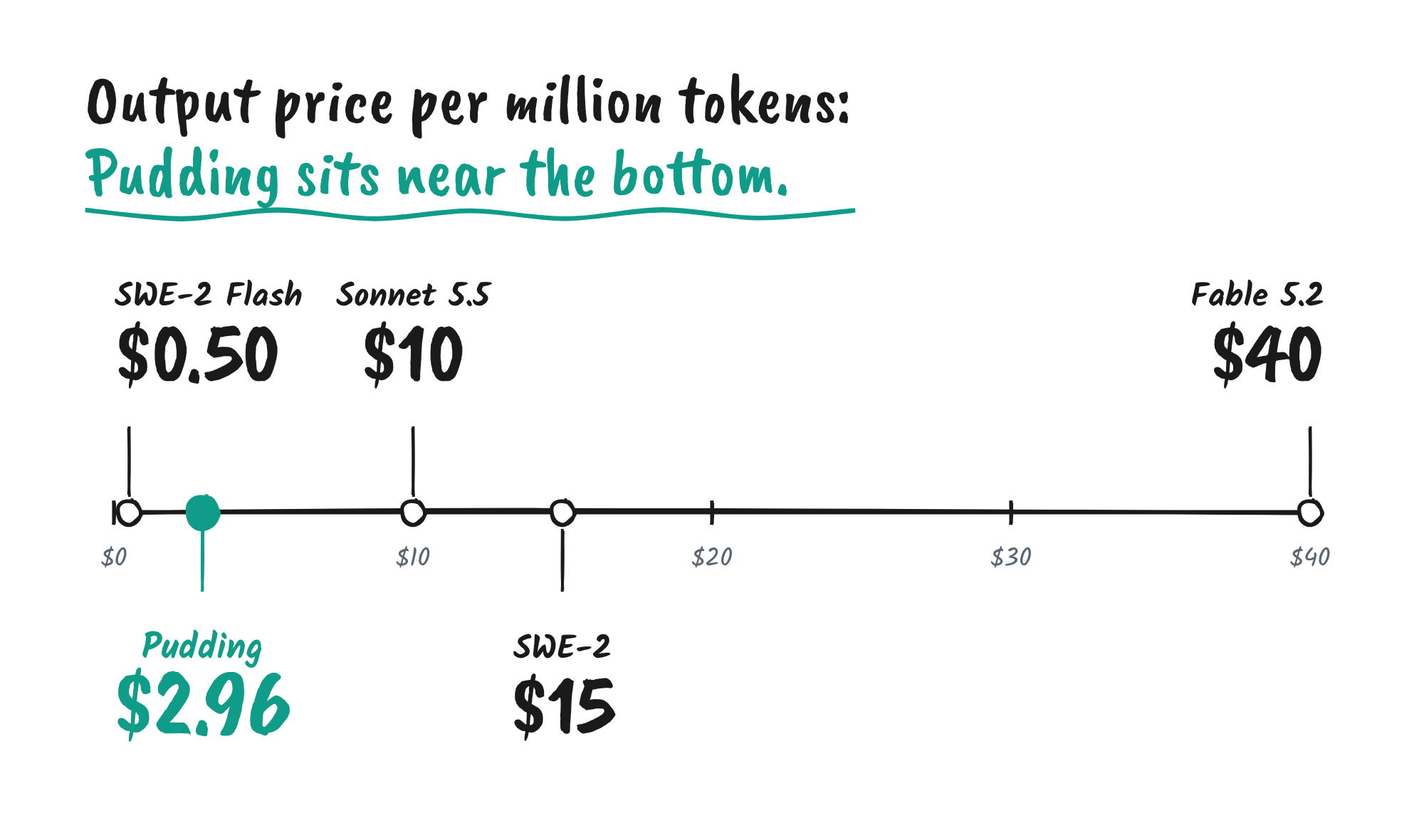
Closest to home are Cognition’s own models. Devin’s pricing docs, dated 9 November, list SWE-2 Flash at US$0.10 input and US$0.50 output once its free period ends on 4 December at 18:00 UTC. SWE-2, Cognition’s larger model, is free on self-serve plans in Devin Desktop and Devin CLI through 30 November, then lists at US$3 input and US$15 output. Claude Fable 5.2 is US$8 and US$40. On output price, Pudding lands between SWE-2 Flash and Sonnet 5.5.
Why the price is on show
Devin’s CLI changelog says the model picker was redesigned in August for price transparency, with per-model rates, reasoning effort and a legend for new, promotional and beta models. That’s why a model’s cost shows up the moment someone selects it, and why a screenshot like Kinopee’s carries the numbers.
Cognition keeps coming back to cost. Its Fusion mode pairs a frontier lead model with a cheaper sidekick that does the exploring, file reads and test runs. Devin says Fusion with Claude Fable 5.1 cost US$7.90 a run on Artificial Analysis’s Coding Agent Index 1.5, against US$12.36 for Claude Code with the same model, at scores of 61.7 and 62.2. When Fortune covered Devin Bots on 17 November, Cognition’s Scott Wu said Bots pick faster, cheaper models for routine code, and that Cognition trains its own models to do software engineering and code review at lower cost than frontier models.
How to see your own prices
Prices depend on your plan, so the picker is the source for what you’d pay. In Devin CLI, run /model to open it, search for a model and read its rates. Devin’s docs also list a List Models API, currently in alpha, that returns the models and prices available to your account. It needs a Devin service user API key with Devin Desktop access and the Windsurf admin permission.
Disclosure: I’m an OpenAI, Firecrawl and Devin ambassador.
Discover more from Sulat AI & Tech News
Subscribe to get the latest posts sent to your email.