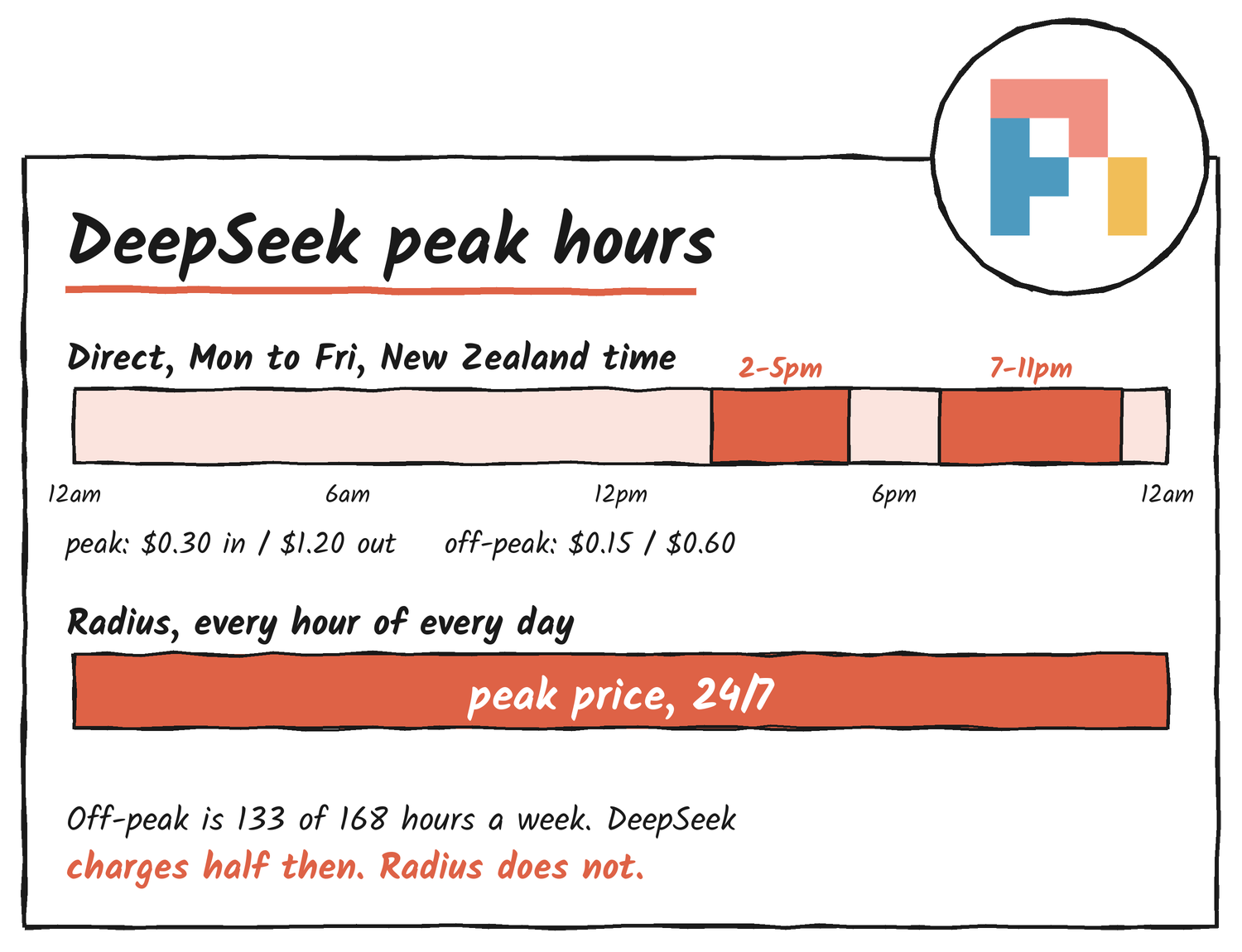
Radius is not cheaper than going direct. Earendil’s new model gateway for the Pi coding agent lists most models at the vendor’s own price, then adds a payment processing fee it doesn’t publish. On one row it costs more outright: DeepSeek V4.1 Flash is billed at DeepSeek’s peak rate in every hour of the week, double what DeepSeek charges off-peak.
I read Radius’s public model catalogue at 3:07pm NZDT on 23 November 2026 and checked each row against the vendor’s own pricing where I could. I haven’t opened a Radius account, so I haven’t seen the processing fee at checkout. Everything below is the catalogue and the vendors’ published rates, and I label opinion as opinion.
- What Radius is
- Radius against direct prices
- The DeepSeek peak-rate problem
- Other gateways and plans
- Who is behind it
- What an author-run gateway means
- Where your prompts go
- Who should use it
What Radius is
Radius is a closed-source gateway that Earendil runs on Cloudflare. It speaks Pi’s native message format only, so it is not a general endpoint you can point another tool at. The inference itself is powered by OpenRouter. You sign in from inside Pi with /login radius or set RADIUS_API_KEY.
What Radius sells is control, not price. Radius offers virtual models such as cheap, balanced and precise, plus your own, each with routing rules written in JavaScript that get 50 ms of CPU and never fall back silently to another model. Rewrite rules can trim noisy tool output from commands like git and grep before the model sees it. There are also budgets, groups, analytics, an MCP server, Artifacts and a Parallel-powered web search.
| Web search tier | Price per search | Zero data retention |
|---|---|---|
| Free | $0 | No |
| Fast | $0.001 | Yes |
| Advanced | $0.005 | Yes |
Radius calls itself early alpha. Its terms, dated 2 November 2026, promise no uptime guarantee, say the service may be discontinued, make credits expire a year after purchase and non-refundable, and reserve the right to change prices for future usage. The default virtual models point at models that Radius says it may change.
How to sign in
pi auth login radius
# or, inside Pi
/login radius
# or set an environment variable
export RADIUS_API_KEY=your-key
Radius against direct prices
For the rows I could verify, Radius charges what the vendor charges. Radius isn’t marking tokens up, and it isn’t discounting them. Prices are US dollars per million tokens, input then output.
| Model | Radius | Direct | Result |
|---|---|---|---|
| Claude Fable 5.2 | $8 / $40 | $8 / $40 | Same |
| Claude Opus 5.5 | $4 / $20 | $4 / $20 | Same |
| Claude Sonnet 5.5 | $2 / $10 | $2 / $10 | Same |
| Claude Haiku 5.5 | $0.10 / $0.50 | $0.10 / $0.50 | Same, including the tier above 100k tokens |
| GLM-5.3 | $1.40 / $4.40 | $1.40 / $4.40 | Same |
| GLM-5.3 Flash | $0.15 / $0.50 | $0.15 / $0.50 | Same |
| Kimi K3 | $3 / $15 | $3 / $15 | Same |
| Grok 4.7 | $2 / $6 | $2 / $6 | Same, including the tier above 200k tokens |
| Mistral Large 4 | $0.70 / $2.10 | $0.70 / $2.10 | Same |
| Gemini 4 Argon | $2 / $10 | $2 / $10 to 30 Nov, then $4 / $20 | Same today, rise due 1 Dec |
| Gemini 3.8 Flash | $0.75 / $3.75 | $0.75 / $3.75 to 31 Dec, then $1.50 / $7.50 | Same today, rise due 1 Jan |
| DeepSeek V4.1 Flash | $0.30 / $1.20 | $0.15 / $0.60 off-peak, $0.30 / $1.20 peak | Radius charges peak rates all the time |
Two gaps in that check. I could not confirm MiniMax M3, MiniMax M3.1 Flash, Kimi K3.1 Pro or Gemini 4 Neon and Hydrogen against a vendor page, so treat those as catalogue prices only. Radius also lists ten OpenAI models, which I haven’t compared. And the Gemini rows will matter in a week: Google’s own prices roughly double from 1 December and 1 January, and Radius’s docs don’t say whether it will follow.1
The DeepSeek peak-rate problem
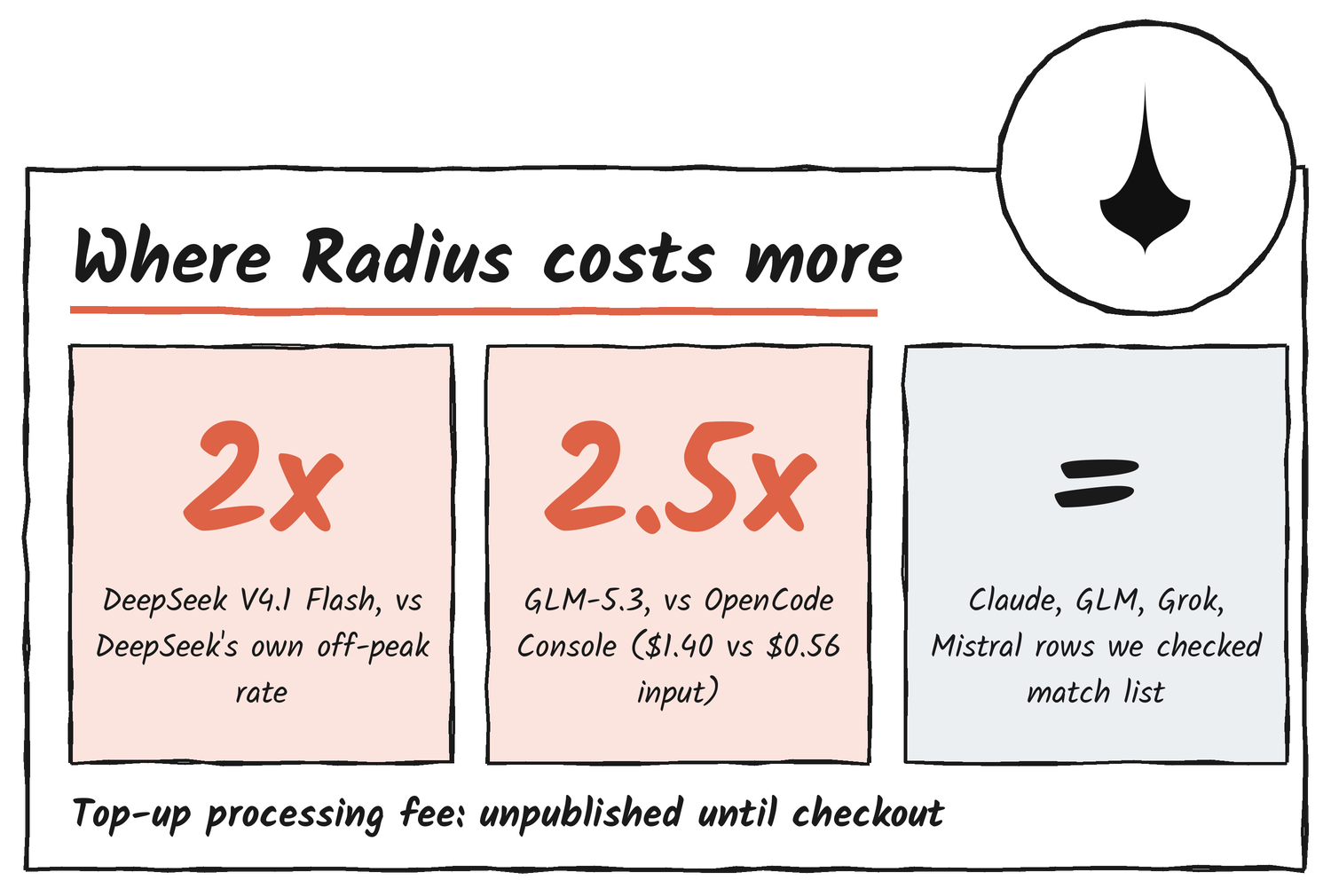
DeepSeek runs two prices. Its peak window is 01:00 to 04:00 and 06:00 to 10:00 UTC, Monday to Friday, except Chinese public holidays. In New Zealand that is 2pm to 5pm and 7pm to 11pm NZDT. Those are 35 of the week’s 168 hours, about 21 per cent, and DeepSeek halves its price for the rest.
Radius lists DeepSeek V4.1 Flash at $0.30 input, $1.20 output and $0.006 for cache reads. Those are DeepSeek’s peak figures, and Radius applies them around the clock. Availability at any hour is real, but you pay the busiest-hour rate for it.
Take an agent session with 5 million cache-read tokens, 0.5 million fresh input tokens and 0.2 million output tokens, a typical shape for a long coding run.
| Route | Cost for that session |
|---|---|
| Radius, any hour | $0.42 |
| DeepSeek direct, peak | $0.42 |
| DeepSeek direct, off-peak | $0.21 |
| OpenCode Console, any hour | about $0.17 |
If your usage were spread evenly across the week, a direct DeepSeek account would average about 60 per cent of the peak price, so Radius would cost roughly 1.66 times as much. The sting is smaller if you work in New Zealand evenings, because then you hit DeepSeek’s peak window anyway. It is largest for anyone coding on a weekend or during the New Zealand morning.
The comparison with OpenCode’s price cut is harsher. OpenCode Console lists DeepSeek V4.1 Flash at $0.12 input and $0.48 output, and GLM-5.3 at $0.56 and $1.76. Radius charges 2.5 times that for GLM-5.3. Pi already supports OpenCode Zen and Go as providers, so the cheaper route is one login away.

Other gateways and plans
Each gateway earns its money somewhere different, and the table shows where, as each publishes it.
| Route | Token markup | Fees | Notes |
|---|---|---|---|
| Radius | None on verified rows | Card processing fee on top-ups, size unpublished | Pi format only. Alpha |
| OpenRouter | None | 5.5% on credit purchases ($0.80 minimum), 8% on Business, 5% crypto | Bring-your-own-key is free up to $25k a month, then 5% |
| Vercel AI Gateway | None | Payment processing fees on top-ups | Add-ons are metered |
| Cloudflare AI Gateway | None | 5% on Unified Billing credits, so $100 of credit costs $105 | Core features free |
| OpenCode Console | Below list on some models | Card fee of 4.6% plus $0.31, per a secondary source | Pay as you go |
| LiteLLM | None | Free to self-host under MIT, you pay for hosting and upkeep | Enterprise by quote |
Radius’s own FAQ puts its fee plainly:
We charge you the fees we have with our payment processor on top of the list prices.
Radius FAQ, read 23 November 2026
The fee itself is shown before you pay and is not in the docs, so it can’t be compared with OpenRouter’s 5.5 per cent until someone tops up and reports it. Business customers can bring their own keys, and auto top-up goes up to $10,000.2
Then there is the subscription route. A flat plan can beat any pay-as-you-go gateway if you use it heavily; that is the argument in our look at subscription multipliers. The plans that work with Pi or similar agents:
| Plan | Price | What it buys |
|---|---|---|
| OpenCode Go | $10 a month | Open models including DeepSeek V4 Pro and Qwen3.8 Max, neither on Radius. Pi is a validated client |
| Z.ai Coding Plan Lite | $18 a month | GLM models for coding agents |
| Claude Code Pro and Max | $20, and from $100 | Claude models inside Anthropic’s own tool |
| Amp Individual | $20 a month | Provider API prices with no markup for individuals |
| Cursor Premium | From $30 a month | Third-party models at API list price from prepaid credit |
Our OpenCode 2.0 report covers the other end of that market.

Who is behind it
Earendil Inc. is a public benefit corporation founded in 2025 by Armin Ronacher and Colin Daymond Hanna. On 8 April 2026 it acquired Pi, the MIT-licensed open-source coding agent written by Mario Zechner. Zechner became a major stakeholder and joined the team. Earendil also makes a product called Lefos.
Pi 1.0 shipped on 1 October 2026 with Pi Durable, Codemode and cache warming for Anthropic models. Until now Pi handled models the way most open agents do: you log in or paste a key for one of more than fifteen providers. The list runs from Anthropic, Google, Azure and Bedrock to Mistral, Groq, Cerebras, xAI and DeepSeek, and includes the gateways OpenRouter, Vercel AI Gateway, Cloudflare AI Gateway and OpenCode Zen. Radius is the first route run by the company that owns Pi itself.
What an author-run gateway means
This section is analysis, not reporting. Three things follow from the company that makes the agent also selling the model access.
First, defaults. In a gateway the author controls, cheap and balanced are whatever the author says they are, and Radius says it may change them. That is useful when a better model arrives and a risk when it quietly changes your bill. A virtual model that swaps the answering model also swaps the price.
Second, the real saving may not be in the price per token at all. Rewrite rules that trim bulky git and grep output cut the input you send on every turn, and that could matter more than a few cents on the list price. I haven’t measured it, and Earendil hasn’t published numbers, so this is a hypothesis worth testing, not a claim.
Third, lock-in is mild but real. Radius only speaks Pi’s format. If you build routing and rewrite rules there, you can’t take them to another agent, though your Pi setup still works against any provider you already log in to.
Where your prompts go
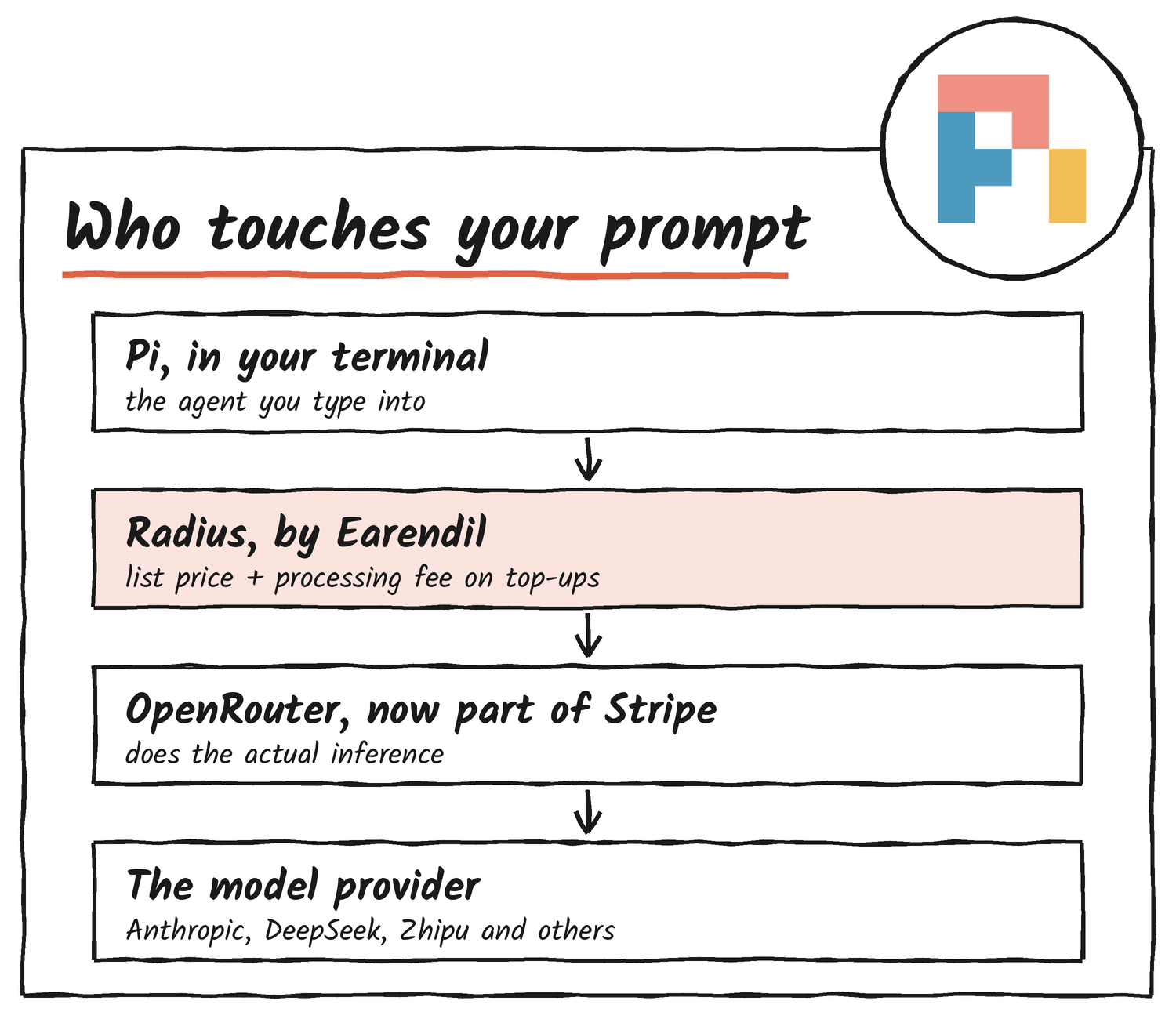
The route is Pi, then Radius, then OpenRouter, then the model provider. OpenRouter is now part of Stripe: the deal was agreed on 19 August and closed on 10 November, and the price has not been officially disclosed. OpenRouter has pledged neutrality. Our report on the acquisition has the detail.

The catalogue lists data handling per row, and it is not uniform.
| Models | Retention | Trains on your data |
|---|---|---|
| Anthropic and OpenAI rows | Up to 30 days | No |
| Google rows | Up to 90 days | No |
| Open-weight rows (GLM, Kimi, MiniMax, DeepSeek, Mistral and others) | Zero data retention | No |
| Recursive Flint (free) | Not stated | Yes |
Gateways have had trust problems this month. OpenRouter emailed customers that links hidden in prompts to MiniMax models were opened 40 to 130 hours later. It off-boarded three providers and removed 125 endpoints from zero-data-retention eligibility, as we reported on 21 November. Radius’s docs and terms, which I read, do not mention that episode, and since Radius sends traffic through OpenRouter it is fair to ask how it screens the endpoints it uses.

Who should use it
My view: Radius earns a look if you run Pi across a team and want budgets, groups and rules in one place, or if you want an MCP server and web search wired in without extra accounts. Early alpha, no uptime guarantee and credits that expire are fair trade-offs for that.
It is a poor fit if your goal is the cheapest tokens. Go direct for Claude, GLM, Grok or Mistral and you pay the same without the processing fee. Use OpenCode for GLM-5.3 and DeepSeek Flash. Keep a DeepSeek account for off-peak work. And if you do want Radius’s DeepSeek route, know that you are paying peak prices for convenience.
Three things would change that verdict: a published processing-fee figure, off-peak pricing for DeepSeek, and a measured saving from the rewrite rules. I’ll update this piece if Earendil publishes any of them.
Sources
- Radius model catalogue, read 23 November 2026
- Radius FAQ and terms, dated 2 November 2026
- DeepSeek API documentation, pricing and peak hours
- Vendor pricing pages: Anthropic, Z.ai, Moonshot, xAI, Mistral and Google
- Our reporting on OpenCode, OpenRouter and Cloudflare AI Gateway, linked above
- Google’s pricing page lists Gemini 4 Argon at $2 / $10 through 30 November 2026 and $4 / $20 from 1 December, and Gemini 3.8 Flash at $0.75 / $3.75 through 31 December and $1.50 / $7.50 from 1 January 2027. ↩︎
- OpenCode’s card fee of 4.6% plus $0.31 comes from a secondary source dated 17 November 2026 and was not checked with OpenCode. ↩︎
Discover more from Sulat AI & Tech News
Subscribe to get the latest posts sent to your email.