
Starlink’s cheapest US home plan now costs US$55 a month. In October 2020 the public beta cost US$99 a month plus a US$499 dish. That’s US$44 a month less, but only on the entry tier. The top plan costs more than the beta did, and since late October the price of the same plan depends on your address.
Engadget made the 2020 versus 2026 comparison for US customers. I checked its figures against Starlink’s own price data and the original 2020 to 2022 reports, then added New Zealand, Australia and the rivals.
−US$44
Entry plan per month against the 2020 beta (US$55 against US$99)
+US$31
Top plan at the May 2026 list price (US$130 against US$99)
−US$150
Standard dish list price (US$349 against US$499)
How the US price moved
| When | Monthly plan | Dish | What changed |
|---|---|---|---|
| Oct 2020 | US$99 | US$499 | Public beta, with 50 to 150 Mbps promised and occasional outages |
| Mar 2022 | US$110 | US$599 (US$549 for deposit holders) | Starlink said the increase kept pace with inflation |
| 2023 | US$120 in limited-capacity areas, US$90 where capacity was spare | US$599 | First split by local capacity |
| 2024 | Unchanged | US$499 or US$299 by region, then US$349 from October | Standard dish list price settles at US$349 |
| Mar 2025 | US$80 (new Lite tier) | US$349 | Cheaper, slower tier added |
| Early 2026 | US$50 (new 100 Mbps tier) | US$349 | Lite becomes the 200 Mbps tier |
| May 2026 | US$55, US$85 and US$130 | US$349 | Rises of US$5, US$5 and US$10, reaching existing customers from 18 June |
| Jun 2026 | Same | US$10 a month to rent | Rental fee added, then waived for some new orders from July |
| Late Oct 2026 | US$44 to 66, US$68 to 102 and US$104 to 156 by address | US$349, or a rented dish | Demand-based pricing, effective for existing customers from 30 November |
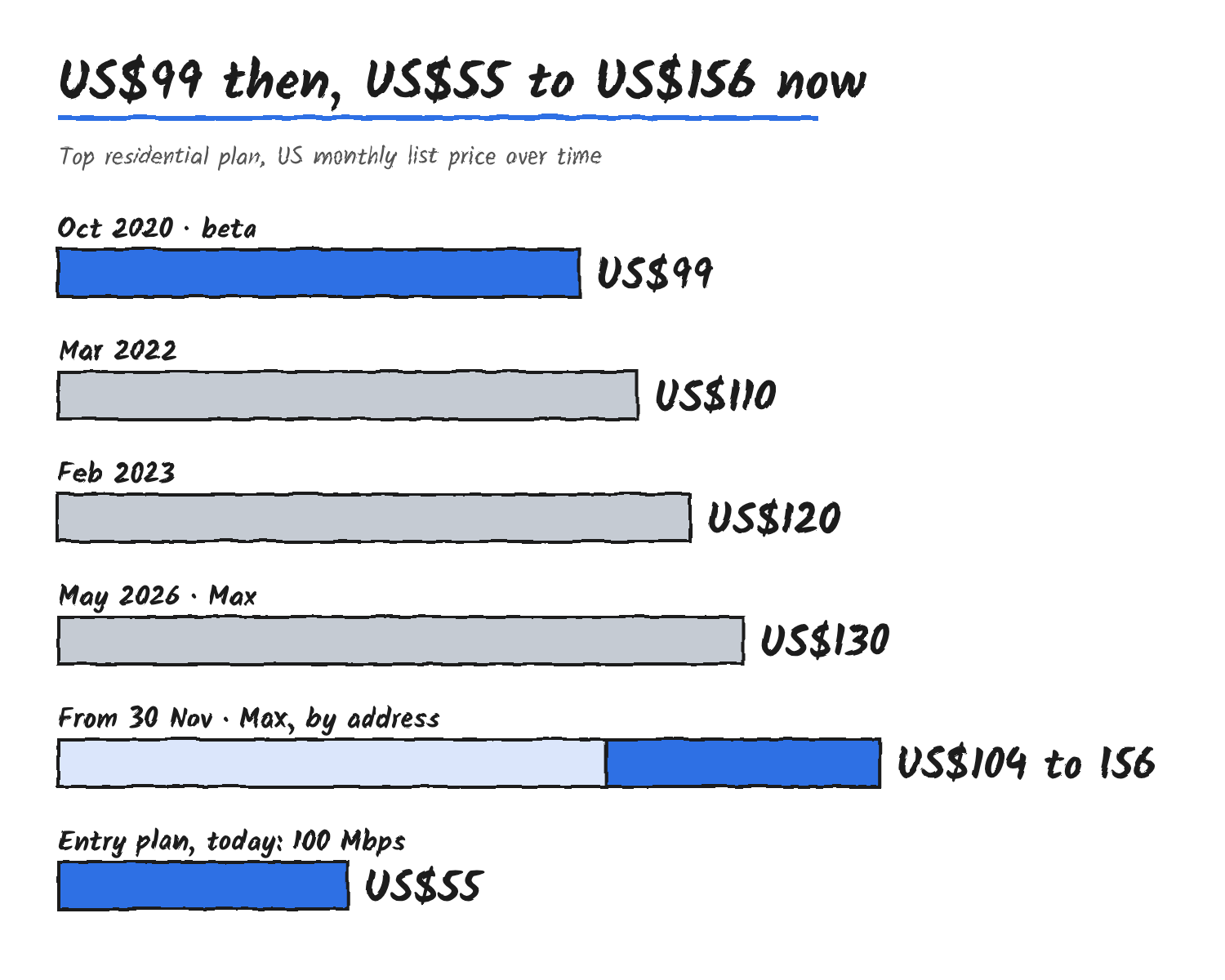
The pattern runs both ways. Dish prices fell from US$599 in 2022 to a US$349 list price, and Starlink now rents one at no upfront cost in select areas. Monthly prices on the original plan rose in steps, while new cheaper tiers pulled the entry price down to US$55.
Why two neighbours can pay different bills
Around 29 October, Starlink began telling Residential customers in parts of Kansas, Missouri and Nebraska that their price was now set by local demand. PCMag reported the email, which said prices are reviewed roughly quarterly. The change has since spread: customers in Virginia, Louisiana, North Carolina, Washington and Alaska have reported notices, and Starlink’s site shows 20% higher rates for addresses in Portland, Spokane and Lafayette.
Starlink prices are dynamic, based on supply of capacity and demand from customers.
Starlink email to customers, quoted by SatelliteInternet.com
PCMag reports the code on Starlink’s site limits the swing to 20% either side of list. It found Residential Max at US$156 in Rolla, Missouri, US$117 in Kansas City and US$104 in Marysville, Kansas. The new prices reach existing customers from their first billing cycle on or after 30 November. Areas with spare capacity get cuts instead, and PCMag spotted 30% and 50% offers for new customers in New York City, San Francisco and Boston.
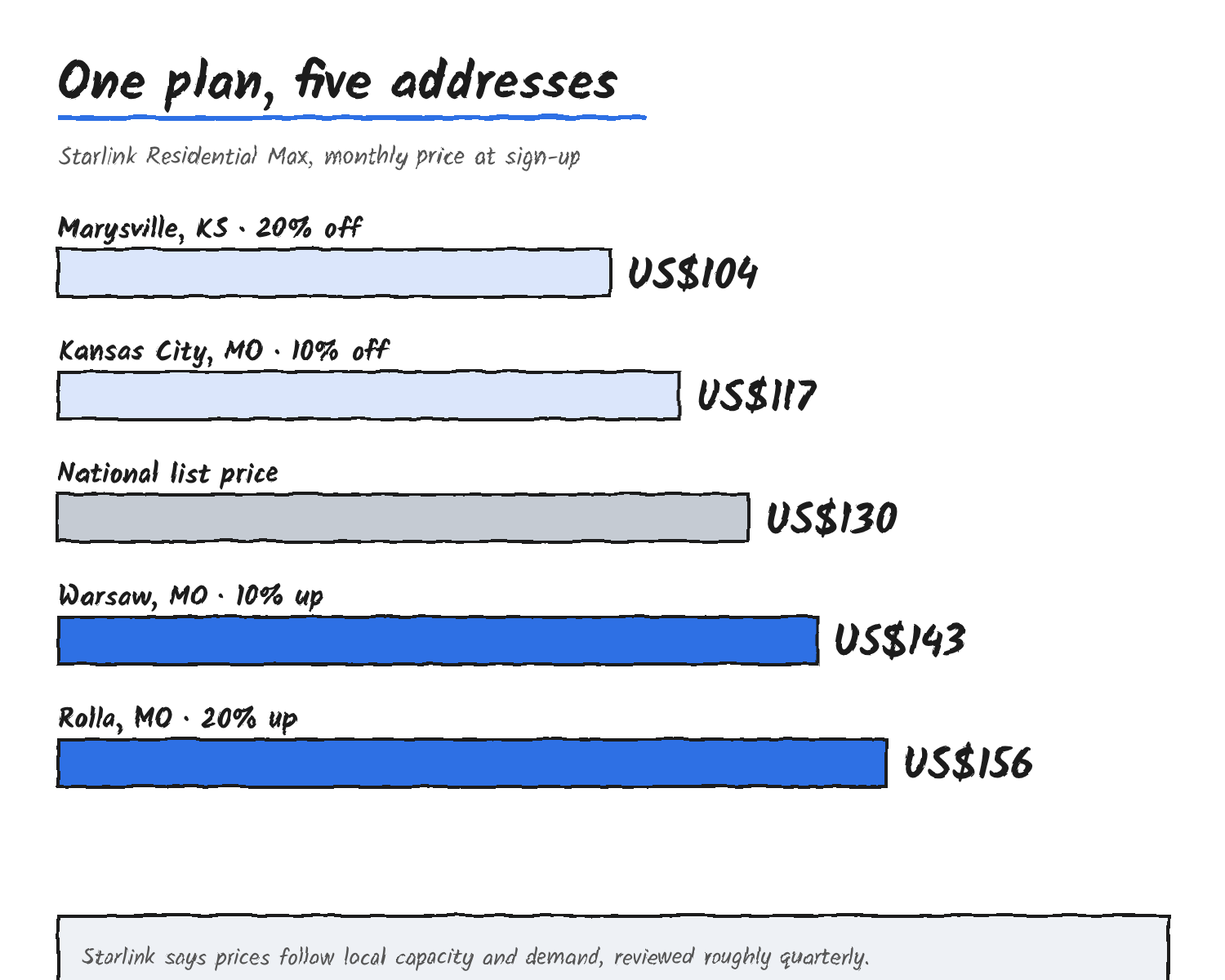
Upfront costs vary too. CNET’s Joe Supan was quoted a US$500 demand surcharge at his Seattle address in May, and some Australian addresses carry a one-off A$145 congestion charge, according to WhistleOut. Rented dishes stay Starlink’s property. The kit goes back within 30 days of cancelling, or you pay its retail price.
New Zealand and Australia
Both markets got Starlink pricing in February 2021. Pre-orders opened at NZ$159 a month plus NZ$799 for the dish and NZ$114 shipping in New Zealand, and at A$139 a month plus A$709 and about A$100 shipping in Australia, according to BusinessDesk and iTnews. Both now start well below that.
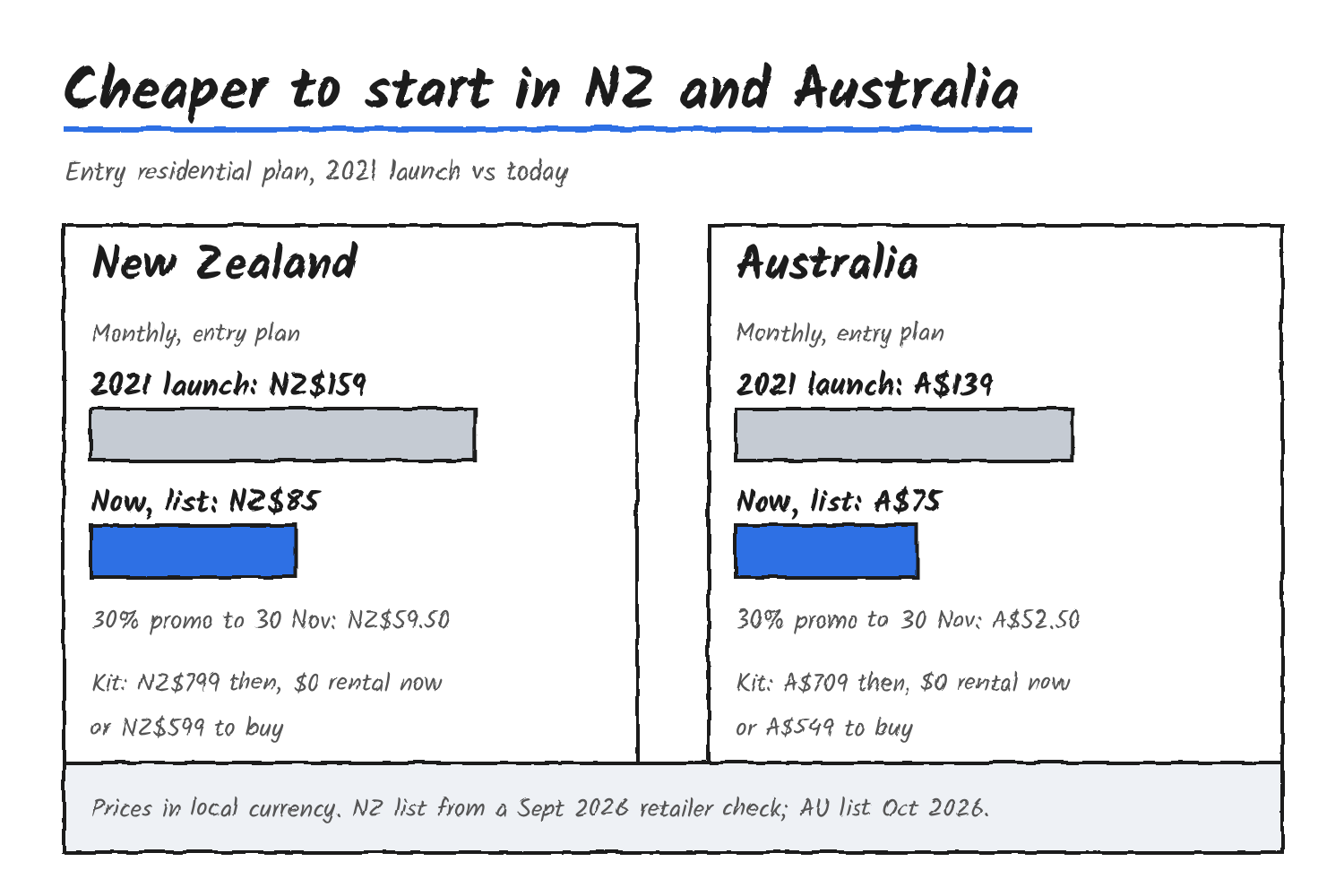
| Plan | NZ list | NZ, 30% off | Australia list | Australia, 30% off |
|---|---|---|---|---|
| Residential 100 Mbps | NZ$85 | NZ$59.50 | A$75 | A$52.50 |
| Residential 200 Mbps | NZ$125 | NZ$87.50 | A$110 | A$77 |
| Residential Max | NZ$170 | NZ$119 | A$150 | A$105 |
In New Zealand the list prices come from retailer Nicegear’s September check. Starlink’s NZ page shows the discounted figures above, and its NZ price data lists a rented dish at NZ$0, a Standard dish to buy at NZ$599 (NZ$419.30 during the promotion) and a Mini at NZ$349 (NZ$244.30). Roam is NZ$100 for 100 GB and NZ$235 unlimited.
In Australia the list prices are from Better Rate Mate’s 10 October check. Starlink’s Australian page shows A$52.50 for the entry plan until 30 November, and WhistleOut lists A$77 and A$105 for the other two with the same 30% off.
How the rivals compare
| Service | Type | US price | The catch |
|---|---|---|---|
| Starlink Residential | Low orbit | US$44 to 156 by address | No contract, unlimited data, price can change |
| Viasat | Geostationary | US$39.99, 69.99 or 109.99 for 12 months | Rises to US$69.99, 99.99 or 179.99, plus a US$15 monthly equipment lease |
| HughesNet | Geostationary | US$39.99 to 94.99 for 12 months | 100 to 200 GB of priority data |
| T-Mobile 5G Home Internet | Cellular | From US$35 with AutoPay and a voice line | Five-year price guarantee on Rely and Amplified |
| Amazon Leo | Low orbit | No consumer price published | Enterprise preview, consumer launch planned by end of 2026 |
| Eutelsat OneWeb | Low orbit | Negotiated through partners | No consumer price list |
Starlink is the only low-orbit provider with public consumer prices. Amazon hasn’t published Leo consumer prices, and Eutelsat OneWeb sells through partners at negotiated rates.
Geostationary providers look cheaper on the first bill, then climb. Viasat’s prices rise by US$30 to US$70 after 12 months. Latency separates the two orbits too: the independent guide Satellite Internet puts low orbit at 25 to 60 ms and geostationary at 600 ms or more. Starlink has no price lock, while T-Mobile guarantees its Rely and Amplified plans for five years.
Starlink’s growth has pulled its average bill down. Inside Deep Tech reports SpaceX’s filings show revenue per consumer subscriber at US$69 a month in the third quarter of 2026, down from US$83 a year earlier, as it expanded internationally and added cheaper plans. CNET counted about 2.7 million US customers in May, nearly double the August 2024 figure.
What a first year costs, then and now
| Setup | First-year cost (US$) |
|---|---|
| 2020 beta, bought dish (US$499 + 12 × US$99) | US$1,687 |
| Residential 100 Mbps, rented dish, list price | US$660 |
| Residential 100 Mbps, rented dish, by address | US$528 to US$792 |
| Residential Max, bought US$349 dish, list price | US$1,909 |
| Residential Max, bought US$349 dish, by address | US$1,597 to US$2,221 |
The tiers aren’t like for like. The beta promised 50 to 150 Mbps, and Residential 100 Mbps is capped at 100 Mbps.
Before you order
- Enter your address on Starlink’s site. The price, any promotion, the dish options and any surcharge show only there.
- Sign-up promotions in the US, New Zealand and Australia end on 30 November. Starlink says certain discounts last while the subscription stays active, and changing plans during a promotion can end the discount.
- Return a rented dish within 30 days of cancelling, or pay the retail price.
- Plans run month to month, so you can leave. Starlink says it reviews prices roughly quarterly.
Discover more from Sulat AI & Tech News
Subscribe to get the latest posts sent to your email.