The National Security Agency’s classified internal network, NSANet, went offline on Tuesday 17 November, US time, and Director of National Intelligence Jay Clayton said patching for the PHP2Shell flaws caused it. CBS News reported on 18 November that multiple sources linked the outage to the urgent PHP patching. The NSA’s own statement points only to “scheduled routine maintenance” and doesn’t mention PHP.
NSANet is the network the agency uses to store and share classified information. When it dropped out, the NSA staggered arrival times at its Fort Meade, Maryland, headquarters. By Friday 20 November a staff voicemail described “normal conditions, with exceptions”, according to The Record. All times here are US time. Most of Tuesday in Washington was already Wednesday 18 November in New Zealand.
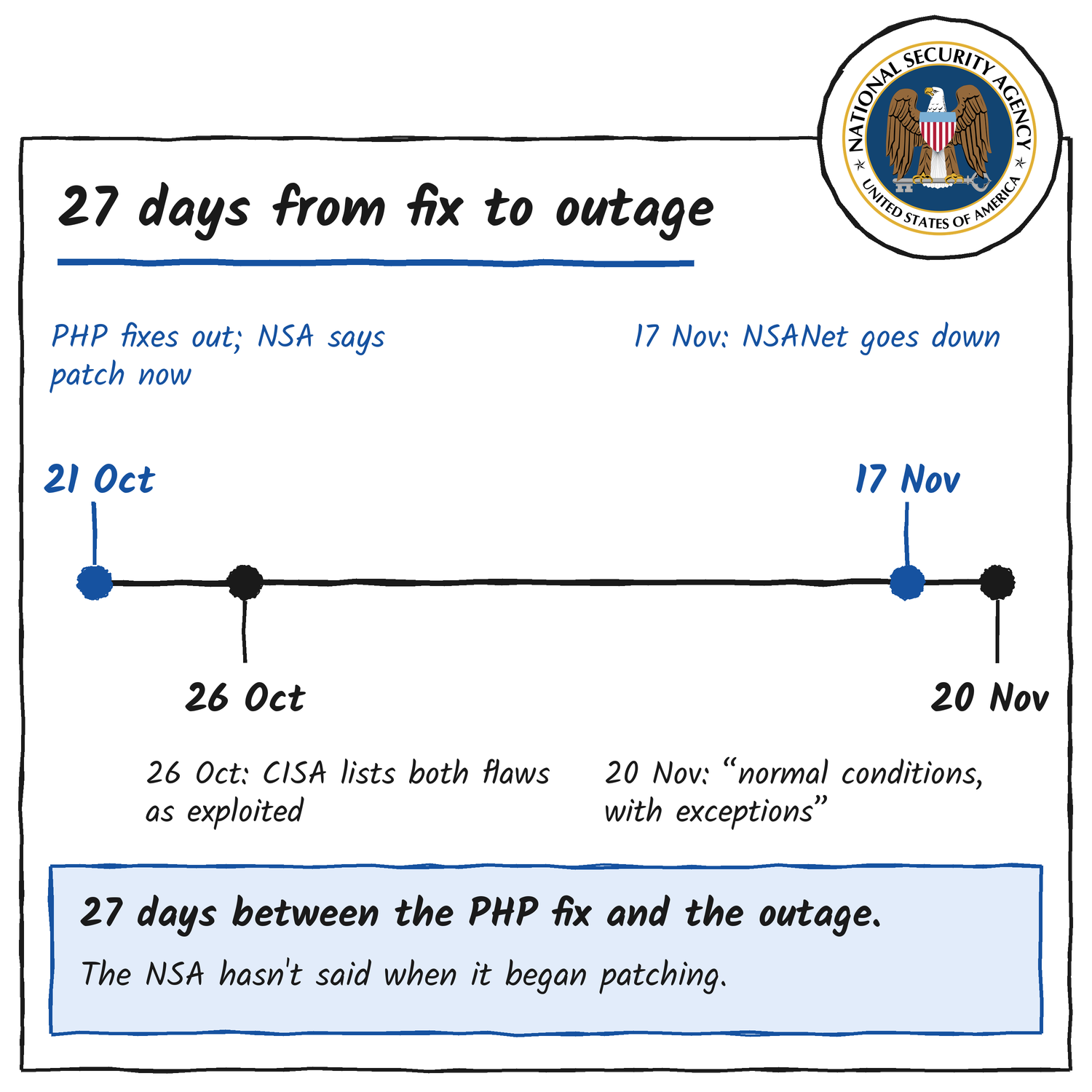
27 days
between the PHP fixes on 21 October and the outage on 17 November
3 days
of NSANet disruption, according to The Record
72 hours
the NSA’s last big network outage, in January 2000
- What happened
- Two accounts of the cause
- What PHP2Shell is
- Who else runs PHP
- How others handled it
- The NSA’s earlier outages
- The week of outages around it
- If you run PHP
- What the reporting doesn’t show
What happened
The sequence below leans on the NSA’s, CISA’s and the PHP Foundation’s own statements where they exist, and on press reports where they don’t.
| When (US time) | What happened | Source |
|---|---|---|
| Wed 21 Oct | PHP releases fixes for two critical flaws. The FBI, NSA and CISA tell organisations to patch immediately. | CISA, NSA |
| Mon 26 Oct | CISA adds both CVEs to its Known Exploited Vulnerabilities catalogue. | CISA |
| Tue 17 Nov | NSANet goes offline. Arrivals at Fort Meade are staggered. The NSA issues its statement, and Clayton speaks to Fox Business. | CBS News, The Record |
| Wed 18 Nov | Two sources tell CBS News that NSANet is back up and running. | CBS News |
| Fri 20 Nov | A staff voicemail says “normal conditions, with exceptions”. Some facilities stay under “Code Orange” for non-essential staff. | The Record |
CNN reported on 18 November that officials at NSA Georgia, a facility focused on Middle East intelligence, couldn’t use NSANet to talk to colleagues deployed in the region and fell back on workarounds and backup systems. The Record’s two sources said intelligence operations at that facility weren’t negatively affected. The accounts differ in emphasis, but neither says intelligence work stopped. CNN has the Georgia detail.
Two accounts of the cause
The NSA’s statement on Tuesday afternoon said it “experienced temporary degradation during scheduled routine maintenance” and that “mission-critical capabilities remain fully operational”, as CNN quoted it. The agency added that its infrastructure has multiple layers of redundancy.
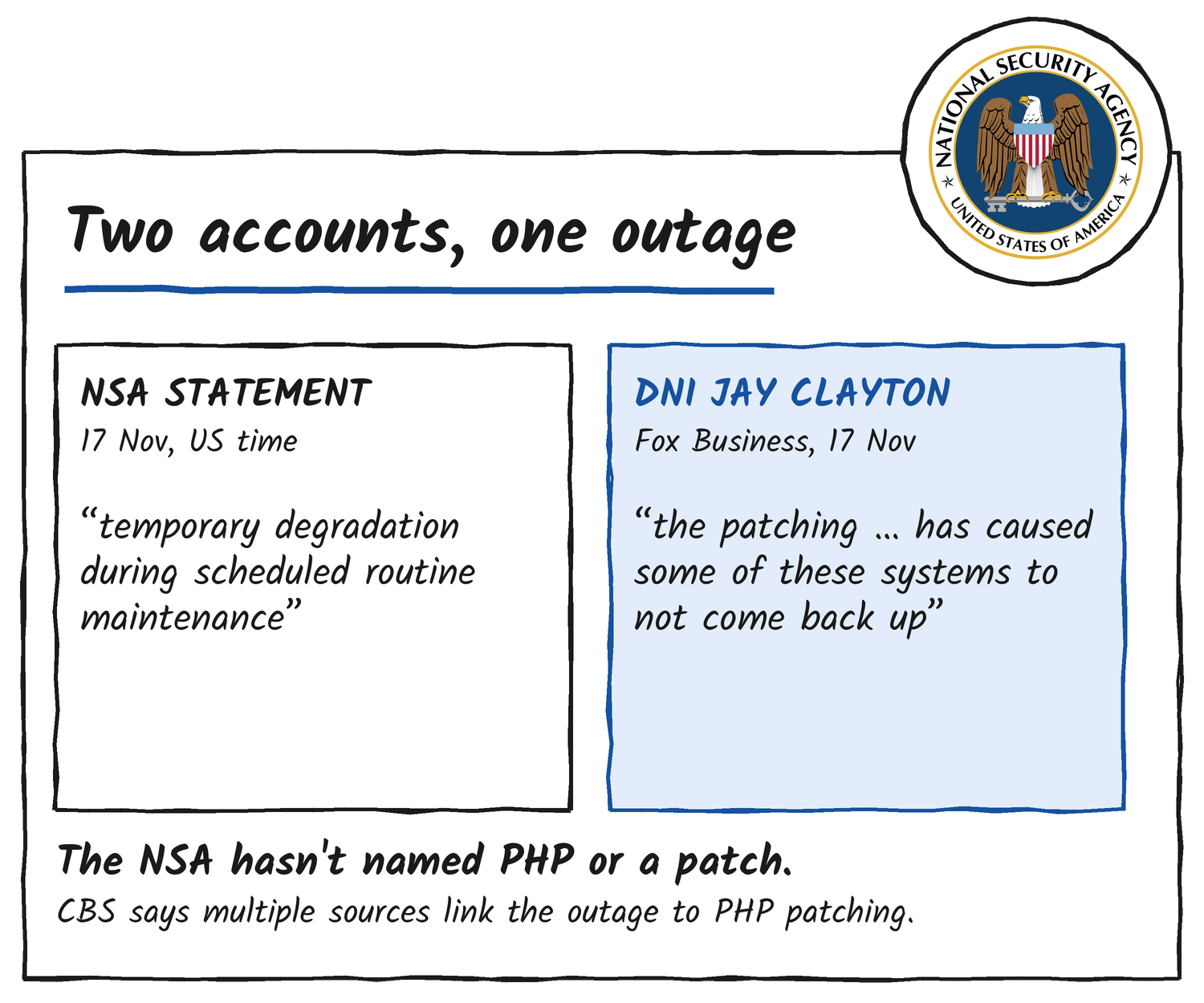
Clayton went further the same afternoon on Fox Business. CBS quotes him:
If you go back about 10 days ago, we had what was labeled as PHP, an update to a web interface system. And the patching that has gone on following that has caused some of these systems to not come back up when you patch them as expected. That is what has happened at the NSA today.
DNI Jay Clayton, Fox Business, 17 November, as quoted by CBS News
Two things don’t line up cleanly. The PHP fixes came out on 21 October, 27 days before the outage, not about 10 days. Clayton didn’t say which patching he meant, and the NSA hasn’t said when it started its own. One source also told The Record that NSANet had been unstable for weeks. That’s a single account, and the NSA hasn’t addressed it.
Other outlets have partial accounts. The Guardian reported that the Wall Street Journal, citing one person, said the outage stemmed from a software update to patch the system and would be temporary. AP’s defence official source repeated the agency’s “routine maintenance” description. Clayton also said there was no evidence of a cyberattack, as The Record reports. Sen. Mark Warner, the Democratic vice chairman of the Senate Intelligence Committee, said in a statement on Tuesday, quoted by CNN:
AI is making it possible to identify vulnerabilities across enormous numbers of systems at unprecedented speed, creating enormous pressure on companies and government agencies to patch those vulnerabilities immediately, often all at once, putting tremendous strain on systems that weren’t built to handle that pace of change.
Sen. Mark Warner, statement on 17 November, as quoted by CNN
What PHP2Shell is
PHP2Shell is the nickname for two PHP flaws that shipped with fixes on 21 October. CVE-2026-109618 is memory corruption that can follow a request hitting PHP’s memory limit at the wrong moment. On Apache with mod_php, an unauthenticated request can trigger it before any application code runs, the PHP Foundation says. CVE-2026-109619 leaves internal state pointing at memory from a previous request, so a later request handled by the same worker can reuse freed memory. Both allow remote code execution, and the Foundation puts the severity score at 9.2.
The fixed releases are PHP 8.5.12, 8.4.27, 8.3.36 and 8.2.35. CISA added both CVEs to its Known Exploited Vulnerabilities catalogue on 26 October. The NSA’s own advisory calls them “flaws in PHP itself, not in the hosted application or its configuration” and says the risks “are serious enough to require immediate patching across United States Government departments and agencies”. The agency’s own advice covered its own systems.
The Record reports that researchers used AI tools to help find the flaws. PHP shipped further security fixes on 19 November, after the NSA outage, in 8.5.13, 8.4.28, 8.3.37 and 8.2.36. Our report on that release covers each flaw.
Who else runs PHP
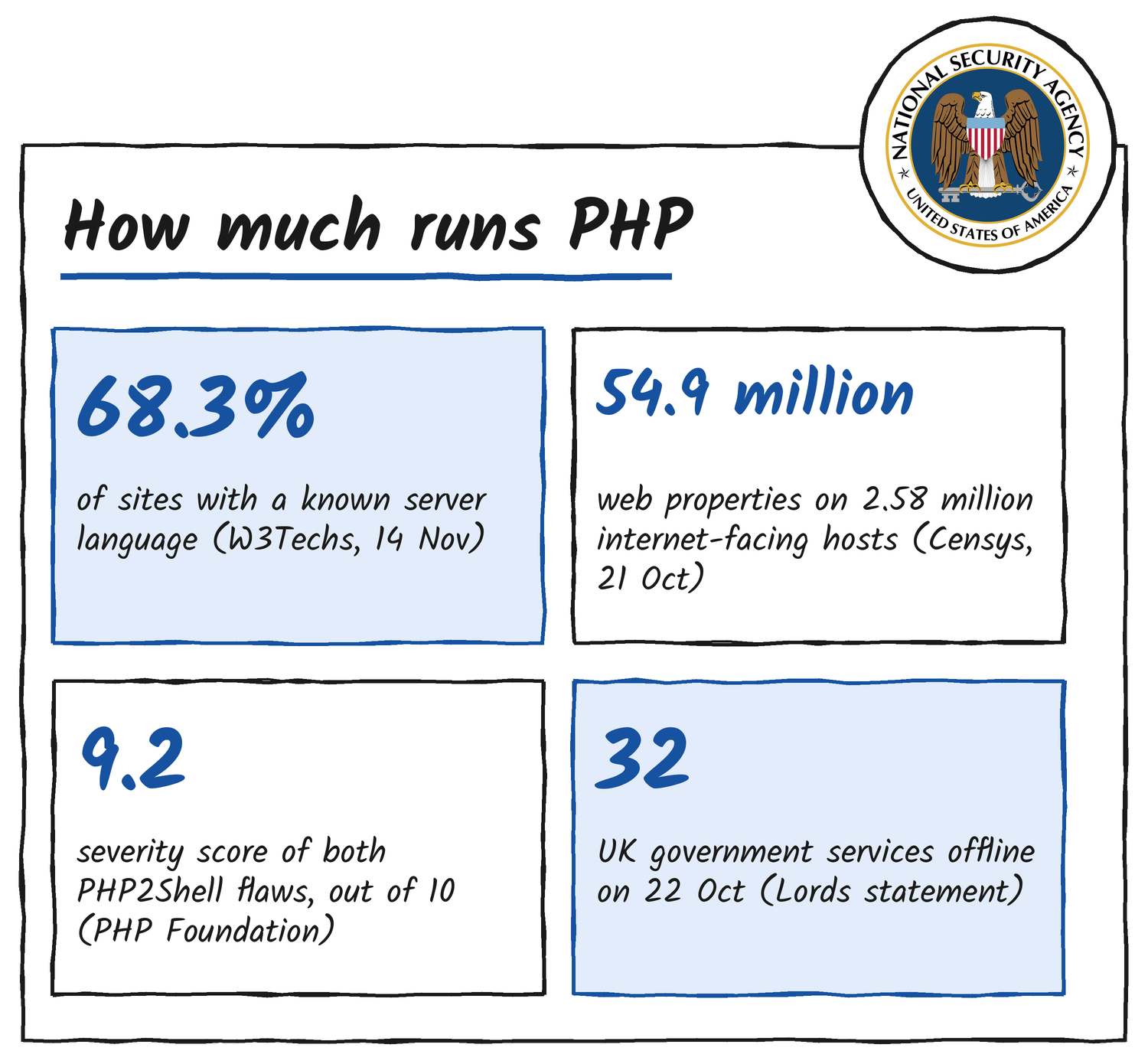
W3Techs says PHP runs 68.3% of the websites whose server-side language it knows (14 November). Censys, as Krebs on Security reported, counted about 2.58 million internet-facing hosts and 54.9 million web properties running PHP. Computer Weekly, citing Qualys, reports hundreds of millions of PHP installations, almost three quarters of them on internet-facing assets.
The fixes cover PHP 8.2 and newer, Computer Weekly says. W3Techs puts 32.6% of PHP sites on versions 7, 5 or 4, which sit outside that range, and CISA says anyone on 8.1 or earlier should take PHP-based systems offline until they can move to a supported release. Those sites can’t patch in place. They have to upgrade.
PHP also turns up where nobody looks for it. CISA’s alert says PHP is often a component of other software, so its presence “may not be directly observable”. Our report on a chained PHP2Shell exploit that rooted 25 servers involved PAN-OS firewalls, which are not websites. The NSA hasn’t said where PHP sits in its own estate.
How others handled it
Governments and vendors moved within a day of the 21 October release, and many pulled services offline as a precaution.
| Who | What they did | Source |
|---|---|---|
| UK government | 32 services unavailable and four partly unavailable on 22 October, mostly as a precaution while updates went on. | The Register, quoting Baroness Lloyd of Effra in the Lords |
| Germany, France, Belgium, Finland, Netherlands | Government websites taken offline as a precaution. | The Register |
| Australia | The cyber agency’s own website taken offline. | The Register |
| Cloudflare | Firewall rules for all plans live at 03:02 UTC on 21 October. | Krebs on Security, citing Cloudflare |
| Cayman Islands | Reviewing systems. Says its main government platform doesn’t use PHP. | gov.ky, 22 October |
| United States | NSA urged organisations to patch or disconnect. No US website shutdowns publicly confirmed as of 22 October. | The Register; NSA advisory |
Those were precautions taken in October. The NSA’s outage came 27 days later and during patching, which is what sets it apart. Its own advisory had offered organisations two options: patch, or take the system offline until it was fully mitigated.
The NSA’s earlier outages
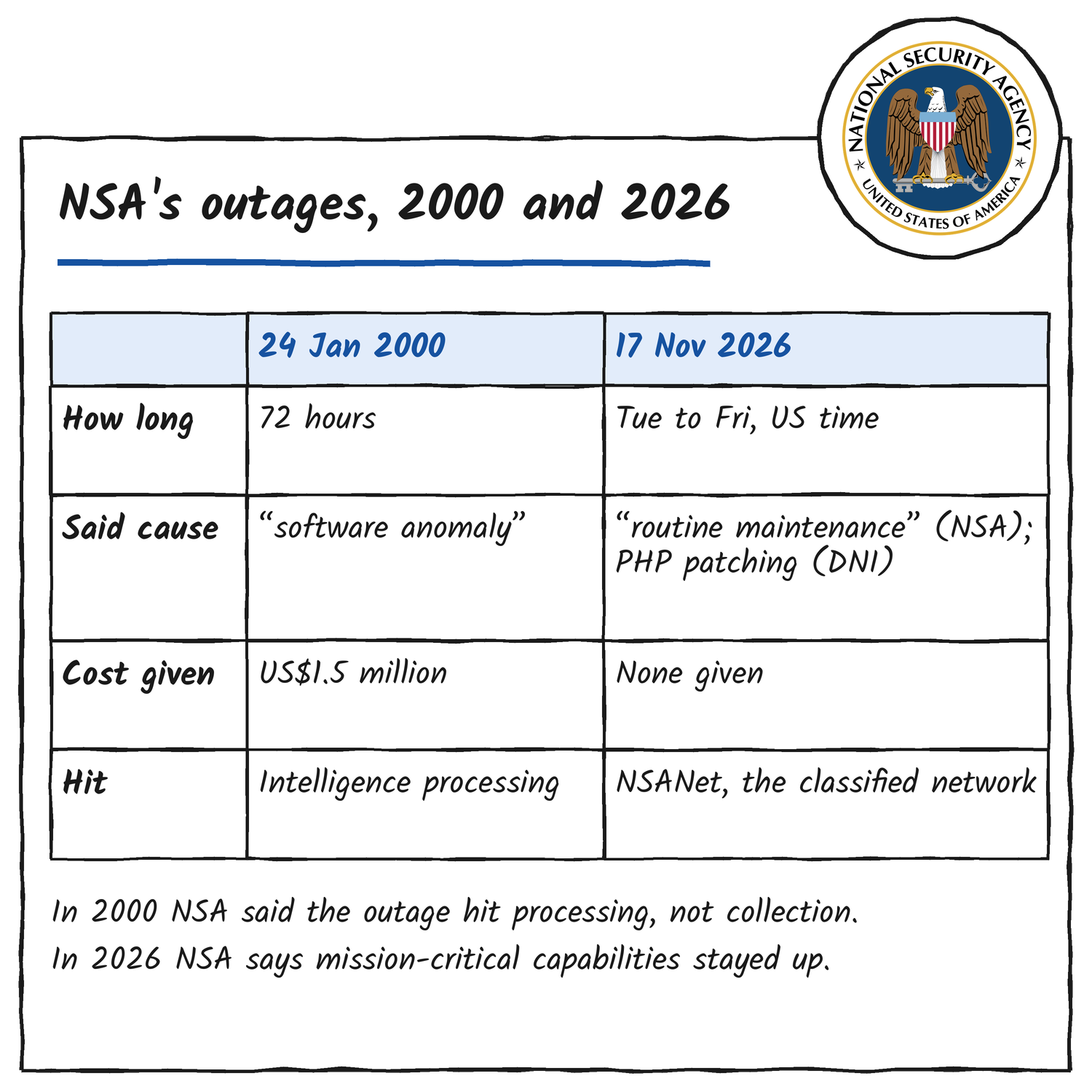
The closest precedent is January 2000. The NSA said its headquarters suffered a serious computer problem at 7pm EST on Monday 24 January that didn’t affect intelligence collection but did affect processing. Then-director Michael Hayden told an American University audience on 17 February that “a software anomaly” had taken down ageing infrastructure for 72 hours, and that recovery took “thousands of man-hours and $1.5 million”. The speech and the NSA’s message to staff are public.
A preliminary NSA assessment, released in 2012 and heavily redacted, names a lack of dollars and manpower as the fundamental root cause. It says the agency would consolidate IT functions into one organisation by 1 March 2000.
In October 2013 NSA.gov went down for several hours. The agency said an internal error during a scheduled update caused it, and rejected claims of a denial-of-service attack. That was the public website, not a classified network.
Other US agencies have tripped on routine work too. The FAA said its January 2023 NOTAM outage, which halted departures nationwide, began when contract personnel unintentionally deleted files while correcting synchronisation between a live and a backup database. It found no evidence of a cyberattack.
The week of outages around it
NSANet wasn’t the only thing down that week. The Record lists a day-long Microsoft outage that a senior company official put down to a months-old bug, and a nationwide FAA ground stop on Friday 13 November that the agency traced to a single router in Arkansas. Administration officials insist the NSA’s problems weren’t a cyberattack and aren’t connected to the other incidents, according to The Record.
We tracked the run in Eight US outages in six days. WIRED says rushed patching is behind the outages; the record backs it for only the NSA tests the patching claim against primary records, and our report on the congressional briefing covers what officials said.
If you run PHP
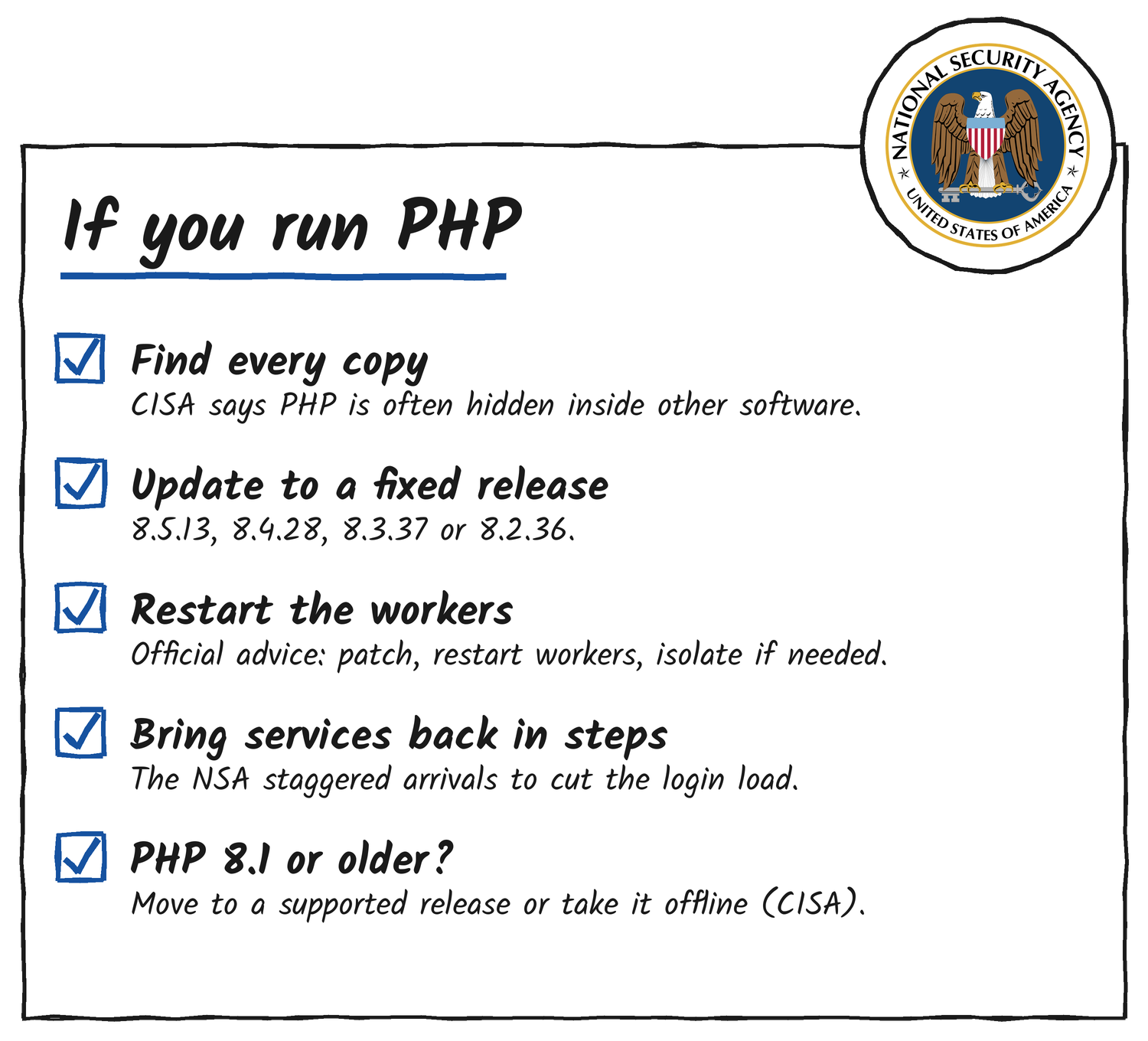
CISA’s list is to inventory every system running PHP, patch internet-facing ones first, take PHP-based systems offline if you can’t update or run 8.1 or earlier, and watch for PHP worker processes launching shells or downloading tools. A web application firewall may protect you until you’ve patched, CISA says.
The NSA’s week adds one practical point. Clayton said patched systems failed “to come back up”, so a patch that works on one box can still leave a fleet down. Patch a small slice first, confirm it restarts and serves traffic, then widen, and bring users back in stages the way the NSA staggered arrivals. That’s my advice, not the NSA’s or CISA’s.
Check which PHP version you run
Run this on the server. The command-line PHP can differ from the one your web server uses, so check that one too.
php -vWhat the reporting doesn’t show
- The NSA hasn’t named PHP or a patch. Its statement says routine maintenance, and the link to PHP comes from Clayton and CBS’s sources.
- Nobody has said when the NSA began patching, which systems failed to restart, or what recovery cost.
- CBS’s sources are unnamed, and the “unstable for weeks” account comes from one person speaking to The Record.
- Officials say there’s no evidence of a cyberattack. No public report says PHP2Shell was exploited on NSANet.
- Accounts differ on when NSANet came back. CBS’s two sources said it was running on Wednesday, while The Record’s Friday voicemail still listed exceptions.
Sources
- NSA Advisory: Critical Patches Recommended for PHP Vulnerabilities
- CISA: Critical Vulnerabilities in PHP Require Immediate Patching (last revised 26 October)
- PHP Foundation: Today’s PHP Security Release, 21 October
- CVE records: CVE-2026-109618 and CVE-2026-109619
- FAA NOTAM statement, January 2023
- Michael Hayden’s address to American University, 17 February 2000, and the NSA’s declassified message to staff and preliminary assessment
- Cayman Islands Government statement, 22 October
- W3Techs: PHP usage statistics, 14 November
- CBS News: National Security Agency network outage linked to software vulnerability, 18 November, and NSA’s classified internal network goes down, 17 November
- The Record: disruptions caused by software patch, DNI says, and NSA resumes normal operations, 20 November
- CNN: network goes down, 17 November, and NSA Georgia workarounds, 18 November
- AP and The Guardian, 17 November
- The Register, Computer Weekly and Krebs on Security on the October response
Discover more from Sulat AI & Tech News
Subscribe to get the latest posts sent to your email.