Intel has laid off more staff, this time in its global IT workforce, Business Insider reported on 18 November (NZ time). An Intel spokesperson didn’t say how many people were affected or which teams were hit. Intel’s filings put its total headcount at 81,100 on 26 September, 39% below the 131,900 it had at the end of 2022.
The size of this round is the one number nobody has published. Everything around it is on the record, so I’ve pulled it together: the earlier cuts, the quarter that came before this one, who’s paying for the turnaround, what the foundry has won so far, and how AMD, Nvidia, TSMC, Qualcomm and Samsung compare.
- What Intel and Business Insider say
- The rounds so far
- Headcount
- The quarter behind the cuts
- Who’s paying for the turnaround
- The foundry bet
- How the peers compare
- What we still don’t know
What Intel and Business Insider say
Business Insider’s Alice Tecotzky and Shubhangi Goel reported that employees posted on social media this week about being affected by layoffs in Intel’s global IT workforce. Calcalist’s Ctech, citing employee accounts, said the cuts began on 16 November and that their scale and reach were unclear.
As part of our broader strategy to become a more focused and efficient company, we continually assess our workforce to ensure priorities and resources are appropriately aligned.
Intel spokesperson, in a statement to Business Insider, 18 November 2026
Intel hasn’t put a number on it. A layoff tracker run by Employees First Labor Law lists four California WARN notices dated 16 November, covering 57 workers at four Santa Clara sites, and counts 13 Intel filings covering 279 workers in California this year.1 That’s one state’s paperwork. It can’t tell us the global IT figure.
Business Insider says CEO Lip-Bu Tan has described the restructuring as a way to lower expenses, reduce management layers and move resources away from lower-priority work. Ctech’s reading of Intel’s latest quarterly filing is that most of the 2025 plan’s measures were finished last year, with the remaining actions due by the fourth quarter of 2026.
The rounds so far
| Date | Round | What was said | Source |
|---|---|---|---|
| 1 Aug 2024 | Gelsinger plan | More than 15% of the workforce, about 17,500 people, and the dividend suspended from Q4 | Reuters |
| 24 Jul 2025 | Tan plan | A 15% cut from the 96,400 reported at the end of June, with a year-end target of 75,000, the rest through attrition and “other means” | Reuters |
| Jul 2026 | Data Center Group | Intel confirmed layoffs inside the group; the reports I’ve seen give no count | Business Insider |
| 16 Nov 2026 | Global IT | Employee posts, then Business Insider; Intel gave no numbers or teams | Business Insider |
Headcount
81,100
total employees on 26 September 2026
−39%
since the end of 2022, when it was 131,900
76,500
at Intel itself, plus 4,600 at Mobileye and other subsidiaries
−4,000
since the end of 2025, when it was 85,100
The September figure comes from Intel’s third-quarter release, which lists employees in thousands: 76.5 at Intel and 4.6 at Mobileye and other subsidiaries. A year earlier the total was 88.4. The earlier year-end totals, 124,800 for 2023 and 108,900 for 2024, are from Ctech’s tally of Intel’s filings.
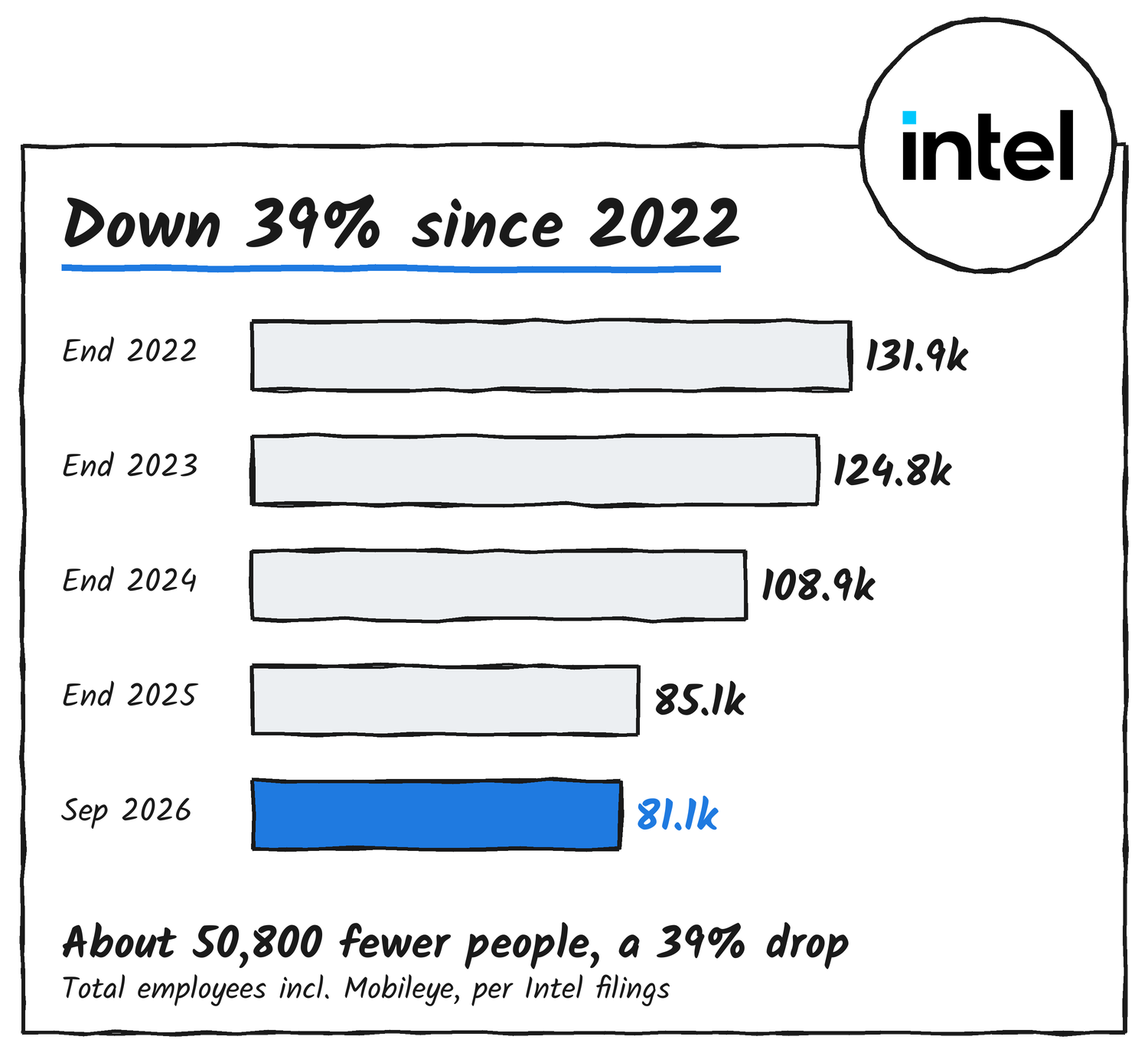
Not all of that fall is layoffs. Ctech notes that some of it reflects disposals and changes in what Intel consolidates. Even so, the count of employees at Intel itself dropped from 99,500 at the end of 2024 to 76,500 in September, about 23%.
The quarter behind the cuts
The top line isn’t shrinking. Third-quarter revenue was US$16.5 billion, up 21% on a year earlier, and the company beat its own guidance on revenue, margin and earnings.
| Measure | Q3 2026 | Q3 2025 |
|---|---|---|
| Revenue | US$16.5 billion | US$13.7 billion |
| Gross margin (non-GAAP) | 44.1% | 40.0% |
| Earnings per share (non-GAAP) | US$0.52 | US$0.23 |
| Net income attributable to Intel (GAAP) | US$3.3 billion | US$4.1 billion |
| Restructuring and other charges | US$54 million | US$175 million |
We delivered another solid quarter. Revenue, gross margin and earnings per share exceeded guidance, including our strongest data center revenue growth in 15 years.
David Zinsner, Intel CFO, in the third-quarter results release
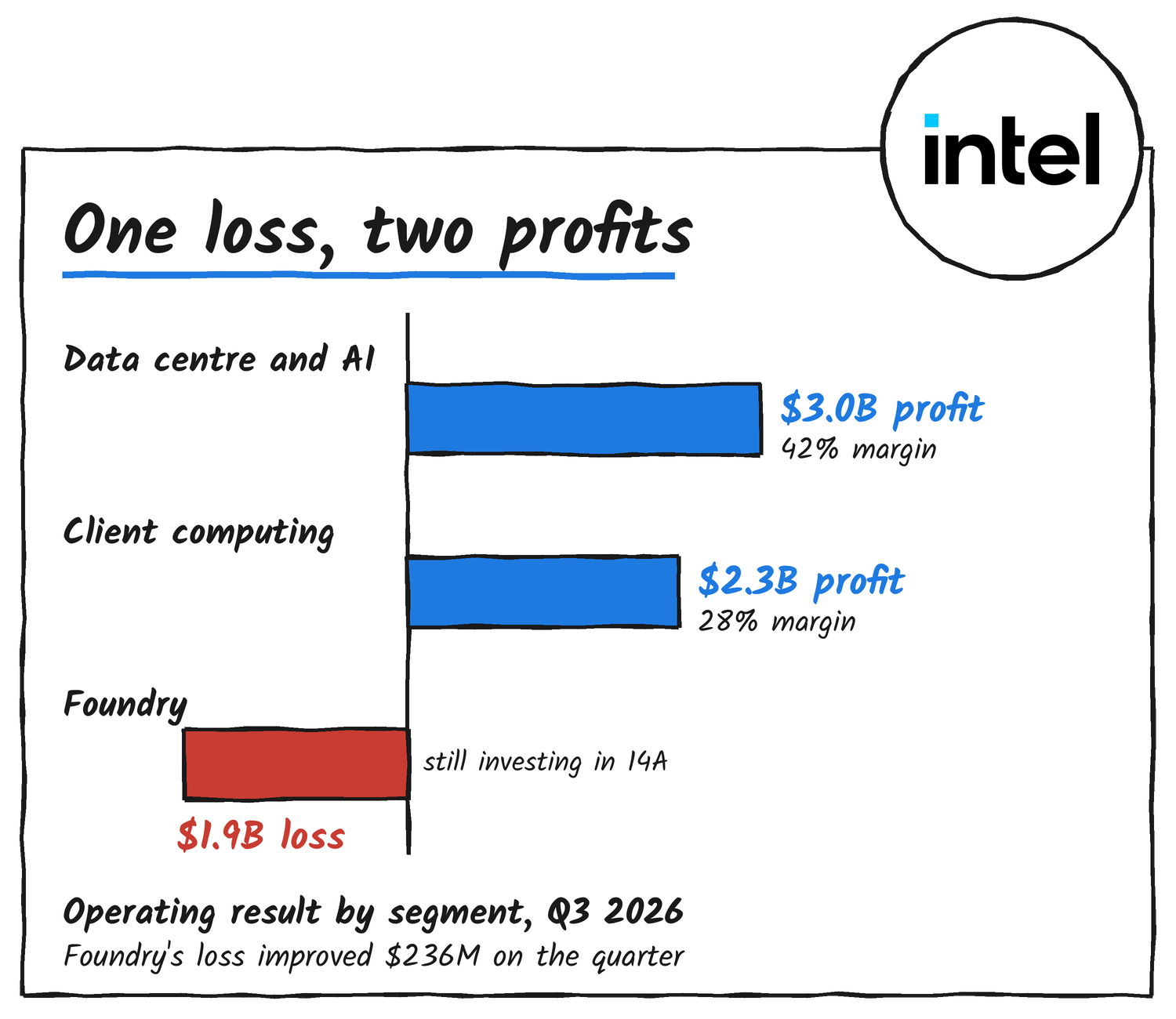
The profit isn’t spread evenly. Data centre and AI made US$3.0 billion in operating profit on US$7.3 billion of revenue, a 42% margin, with revenue up nearly 80% on the year. Client computing made US$2.3 billion on US$8.1 billion, down 5% in revenue. Intel Foundry lost US$1.9 billion, US$236 million better than the quarter before, according to the CEO and CFO’s prepared remarks.
The fourth quarter looks weaker. Intel guided to US$15.0 billion to US$16.0 billion in revenue and a 38% non-GAAP gross margin. That guidance includes roughly US$300 million of lost revenue and 200 basis points of margin from an accident that shut its Fab 28 plant in Israel, which hits 10nm server chips. It also expects client revenue to fall by more than 20% from the third quarter as PC makers cut inventory, with the 2026 PC market down about 12% on the memory shortage.
Investors didn’t like it. Intel’s shares fell 28.6% on 30 October, and shareholders have since filed a proposed class action against the company, Tan and CFO Dave Zinsner, CFO Dive reports. The suit alleges they didn’t properly disclose how far weaker PC demand would hit results. Those are allegations, not findings.
Spending is going the other way. Intel’s gross capital spending for 2026 is on track for US$20 billion, and Zinsner said 2027 will be up strongly. On the earnings call, per the transcript, he said next year is “an investment year” and that Intel probably won’t have positive free cash flow in it.
Who’s paying for the turnaround
Four sources of money sit behind that spending, and the newest is by far the biggest. In its 10-Q, Intel says it issued about 242 million shares on 12 August in a public offering, with net proceeds of US$22.6 billion. It ended the quarter with about US$54 billion in cash and short-term investments, plus US$15 billion of borrowing capacity.
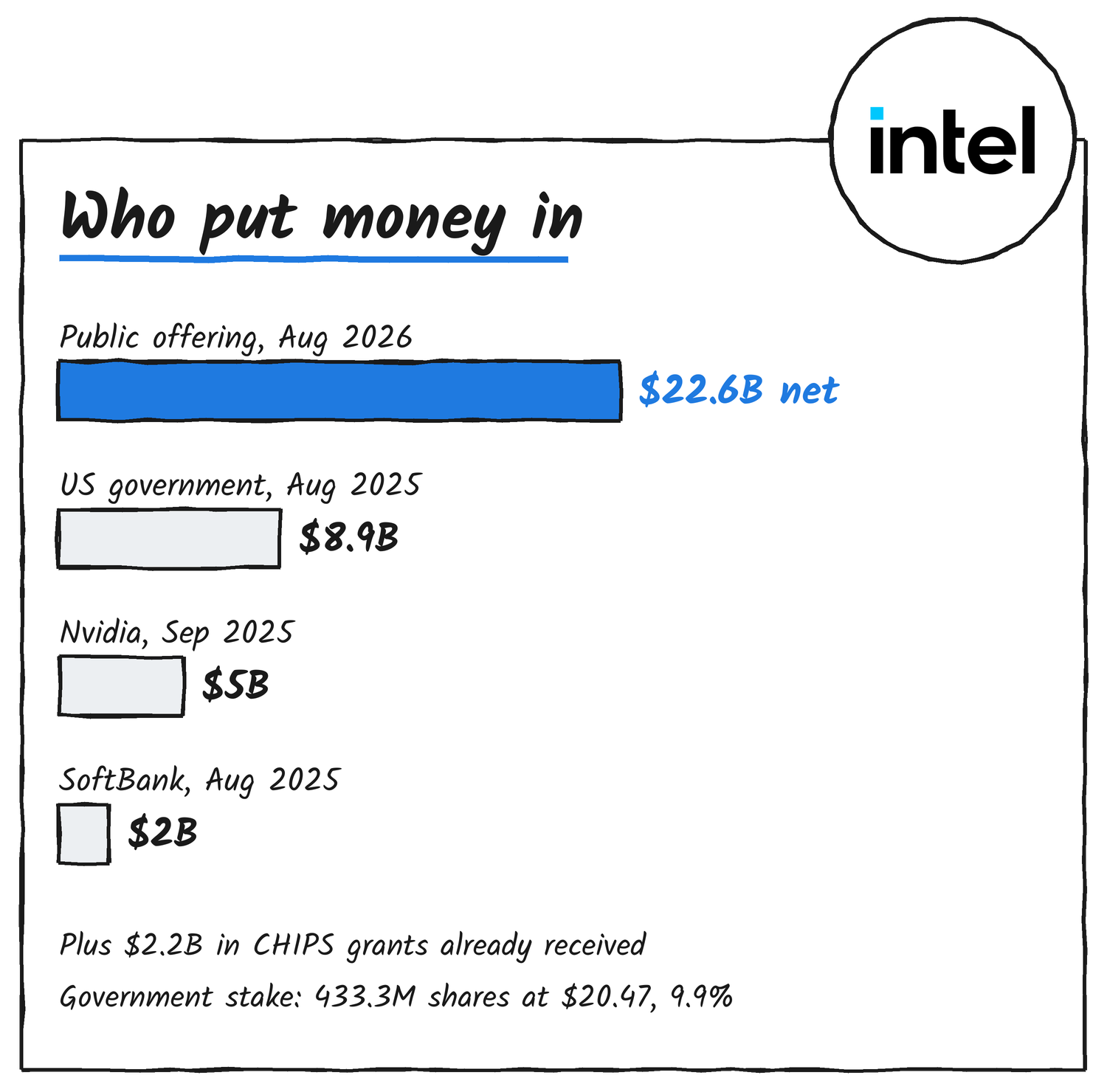
The earlier backers came in during 2025:
- US government. It agreed to buy 433.3 million shares at US$20.47 each, US$8.9 billion for a 9.9% stake, Intel said in August 2025. With US$2.2 billion of CHIPS grants already received, Intel put the government’s total at US$11.1 billion. Intel’s 10-Q says some of those shares are still held in escrow.
- Nvidia. It put in US$5 billion in September 2025 at US$23.28 a share. Its latest 13F shows 161.1 million Intel shares at 30 September, down 25% from 214.8 million at 30 June, per MLQ.2
- SoftBank. It agreed to invest US$2 billion in Intel common stock, and its latest 13F lists 86,956,522 Intel shares.
The foundry bet
All of that money is chasing one thing: getting outside customers onto Intel’s factories. The 10-Q says substantially all of Intel Foundry’s work still supports Intel’s own products. Intel says it wants a more significant external business and that how fast it builds depends on committed demand for its next node, 14A.
The manufacturing numbers are moving the right way. Intel says 18A wafer costs are down about 40% since the first quarter, Intel 3 costs are down about 15%, and 18A yields have reached “industry standard levels” ahead of its own projections. Tan told a conference this week that yield was “horrible” when he took over and is now at 70%, though that figure comes from Tom’s Hardware relaying a post on X, not from an Intel document.
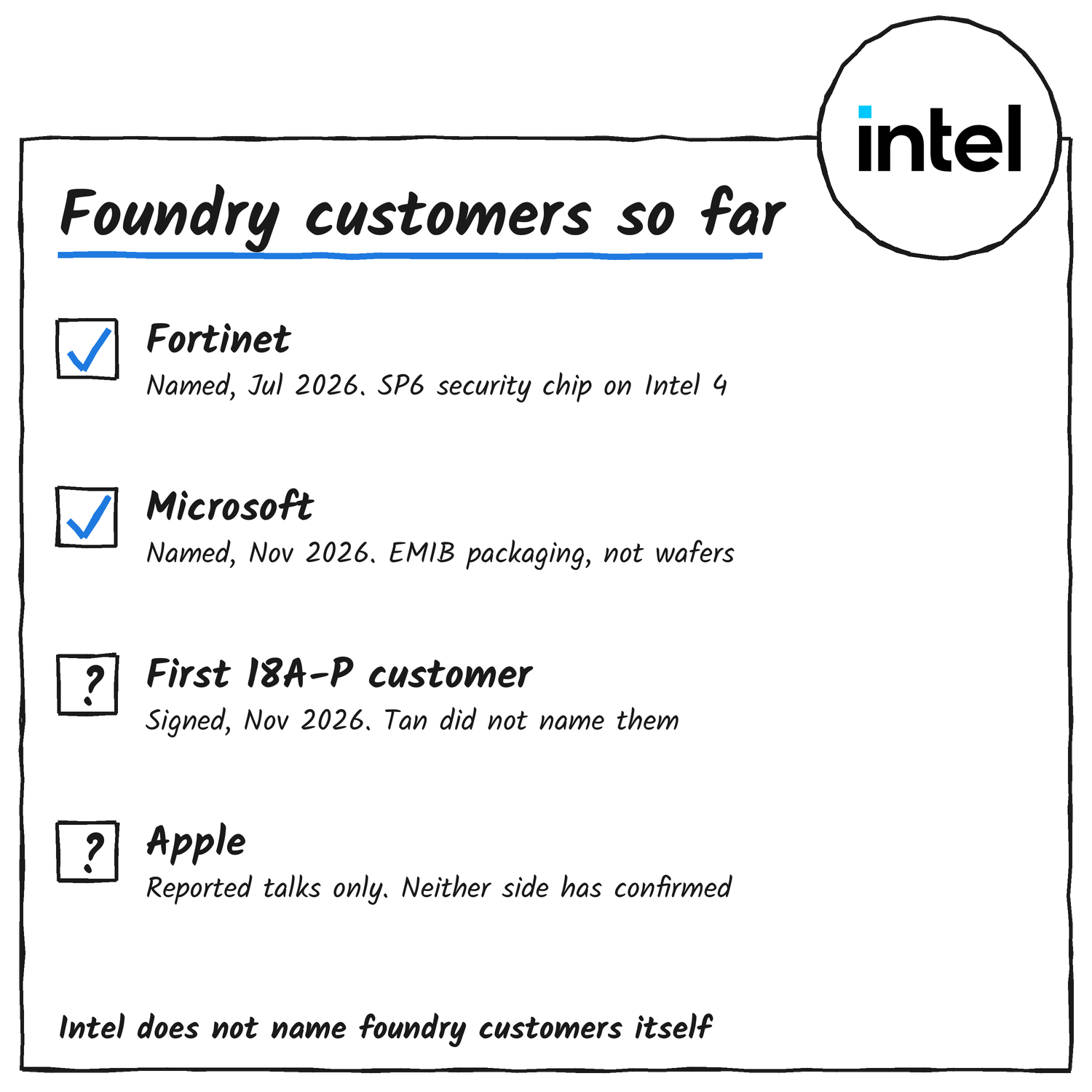
Fortinet will make its SP6 security chip on Intel 4, the two companies announced in July, CNBC reports. Microsoft has agreed to use Intel’s EMIB advanced packaging for its in-house silicon and to secure Xeon supply, which is packaging and CPUs rather than wafers. On 18 November in Austin (19 November NZ time), Tan said Intel had signed its first external customer for 18A and didn’t name it. Intel’s CTO, Pushkar Ranade, later said on X that the customer chose 18A-P, according to Data Center Dynamics. The same report notes the Wall Street Journal earlier reported Intel and Apple were working on a deal. Neither company has confirmed one.
How the peers compare
Intel’s rivals are in very different places, and only some of them are cutting. I’ve kept to what each company or a news agency has published. The columns don’t line up perfectly, because the companies report different things on different dates.
| Company | Latest figures | Source |
|---|---|---|
| Intel | 81,100 employees; Q3 non-GAAP gross margin 44.1%; foundry loss US$1.9 billion | Intel results release |
| AMD | Q3 revenue US$13.4 billion; gross margin 54% (56% non-GAAP); data centre revenue up 97% | AMD results release |
| Nvidia | About 42,000 employees at 25 January 2026, up from about 36,000 | Bebop, summarising Nvidia’s 10-K |
| TSMC | 90,557 employees at the end of 2025 | TSMC annual report |
| Qualcomm | A “performance-focused reduction” announced 20 October, with notifications from November; global workforce about 57,000 | Reuters, The Hindu |
| Samsung | Record Q3 operating profit of KRW 107.4 trillion; foundry still at a loss, with 2nm orders from AI customers | Samsung, Reuters |
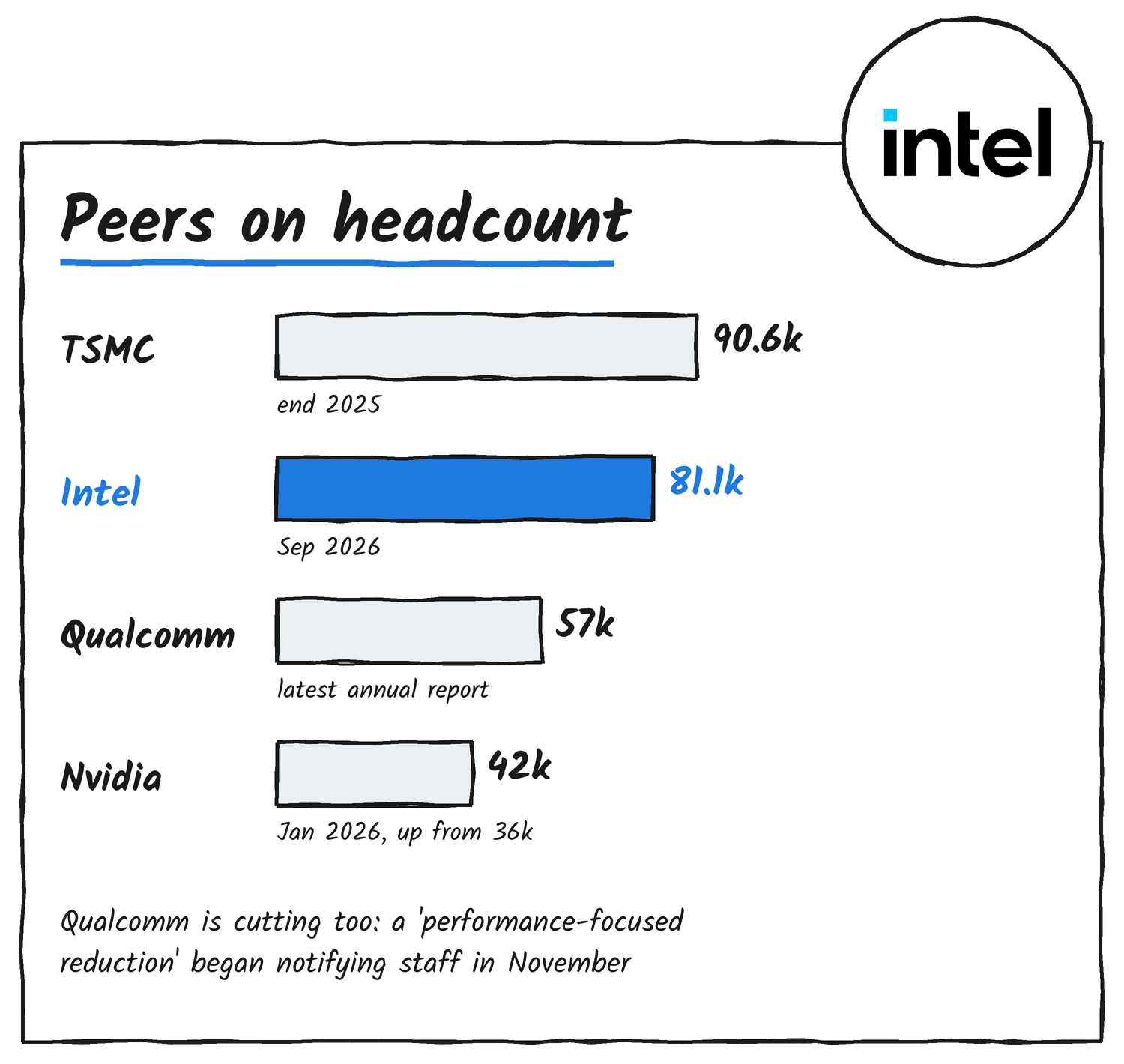
On margin, Intel’s 44.1% sits 12 points under AMD’s 56%, both on a non-GAAP basis, and AMD is spending on growth too: it recently closed its US$8.2 billion World Labs acquisition. On headcount, Nvidia added roughly 6,000 people in a year while Intel shed about 4,000 in nine months, and Qualcomm is the only other name on the list with a cut under way. TSMC is expanding its own bets too, with a US$500 million fund for chip startups and suppliers. Samsung’s foundry also still loses money, according to analysts quoted by Reuters, so Intel isn’t the only one carrying a loss-making foundry.
What we still don’t know
- How many people were cut and in which teams. Intel hasn’t said, and the California notices cover one state only.
- Whether more rounds are coming. Intel hasn’t described any beyond the actions its filing says finish in the fourth quarter.
- Who the first external 18A customer is, and whether Apple is in talks. Intel says it won’t name foundry customers itself.
- How the shareholder suit ends. It was filed this month and nothing has been decided.
One thing the cuts probably don’t touch is product supply. IT is an internal function, and Intel says demand for its server chips and its Wildcat Lake client chip is running ahead of what it can make. Tan has said the priority is unlocking more supply.
How to check Intel’s headcount yourself
- Open Intel’s latest quarterly results release on intc.com.
- Scroll to “Other information” under the income statement. Employees are listed in thousands, split between Intel and Mobileye and other subsidiaries.
- Compare the latest quarter with the prior quarter and the same quarter a year earlier. Annual figures are in the 10-K.
Sources
- Intel, third-quarter 2026 results release, 29 October 2026
- Intel, CEO and CFO prepared remarks for Q3 2026
- Intel, Form 10-Q for the quarter ended 26 September 2026
- Intel, agreement with the US government, 22 August 2025
- Intel and SoftBank, US$2 billion investment, August 2025
- Reporting: Business Insider, Ctech, CFO Dive, CNBC, Reuters
- WARN notices are advance filings that employers make before large layoffs at a site. The tracker’s count covers California only and doesn’t say the four notices are the IT cuts Business Insider describes, so 57 is not the size of the round. ↩︎
- A 13F is a snapshot of holdings at quarter end. The fall from 214.8 million shares to 161.1 million doesn’t show when Nvidia sold, or whether it hedged any of the position. ↩︎
Discover more from Sulat AI & Tech News
Subscribe to get the latest posts sent to your email.