Microsoft has become the first company to say publicly that it will use Intel Foundry’s EMIB advanced packaging for its own chips. In a joint release on 18 November (US time), Microsoft and Intel said Azure’s first-party silicon will use EMIB, alongside a multi-year deal for Intel Xeon supply. DigiTimes reports that Google is also turning to EMIB as cloud providers look for a way round TSMC’s CoWoS capacity limits.
The release is short on detail. It doesn’t name the chip, the process, the volumes, the schedule or the value. So I’ve put the announcement next to what EMIB is, why the alternative is so tight, who holds it, what the Google reports say and where Intel Foundry’s money stands. Intel’s foundry customers also come up in my piece on Intel’s headcount and finances.
- What Microsoft and Intel announced
- What EMIB is and how it differs
- Why CoWoS is tight and who holds it
- The Google reports
- Which Microsoft chips
- What it means for Intel Foundry’s money
- Where the peers package
- What isn’t public
What Microsoft and Intel announced
The joint release says Microsoft is “the first company to announce use of Intel Foundry’s EMIB (Embedded Multi-die Interconnect Bridge) advanced packaging technology for Azure first-party silicon.” The same agreement confirms multi-year Xeon supply capacity, including instances of the next-generation server CPU codenamed Diamond Rapids. Microsoft’s own copy of the release carries a 17 November dateline. Intel’s and PR Newswire’s say 18 November.
The release also covers work on Xeon with Compute Express Link (CXL) memory, Intel QuickAssist (QAT) and confidential computing. Microsoft cites up to 2.3x the performance on Azure M-series v4 virtual machines with CXL memory and up to 2.5x faster SQL backups on QAT-enabled VMs. Converge Digest points out that both comparisons used different configurations: the CXL VM had 76 vCPUs and 1,764 GB of memory against 64 vCPUs and 1,007 GB for the DRAM-only one.
Our longstanding collaboration with Intel brings together advanced packaging, custom compute, memory and security capabilities to support Azure compute and continued innovation across Azure.
Saurabh Dighe, corporate vice president, Azure System and Architecture, Microsoft
Through use of our advanced packaging capabilities with EMIB to scale future generations of Azure infrastructure, Intel and Microsoft can combine the flexibility of heterogeneous integration with the manufacturing scale required for the AI era.
Naga Chandrasekaran, EVP, chief technology and operations officer and general manager of Intel Foundry
“First” means first to confirm. Tom’s Hardware notes it doesn’t make Microsoft the first outside company to use EMIB, only the first to say it will for its own silicon. Intel says EMIB has been in volume production since 2017, with both Intel’s own and outside silicon.
18 Nov
joint Microsoft and Intel release, US time
2017
year EMIB entered volume production, per Intel
8x+
reticle sizes Intel says EMIB-T packages reach in 2026
US$1.9B
Intel Foundry’s operating loss in Q3 2026
What EMIB is and how it differs
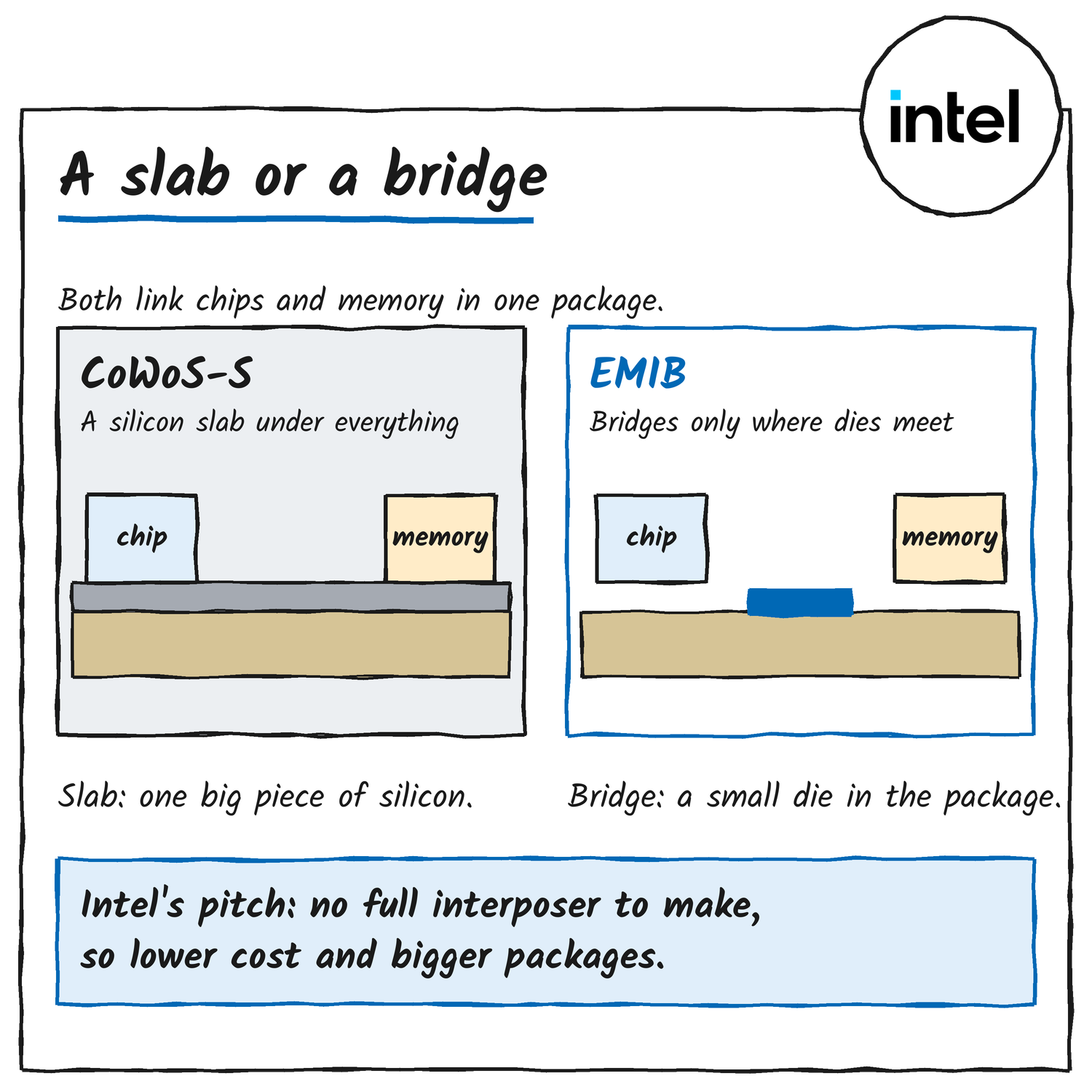
Modern AI chips are several dies in one package: compute dies, plus stacks of high-bandwidth memory (HBM). Packaging is how they talk to each other. Intel’s EMIB technology brief describes EMIB as the first 2.5D interconnect to use silicon bridges embedded in the substrate. A small bridge sits only where two dies meet, so the package doesn’t need a full silicon interposer under everything. EMIB-M adds capacitors to the bridge for steadier power. EMIB-T adds through-silicon vias (TSVs) so power can pass straight up through the bridge to HBM, and Intel says it lets designs convert from other packaging technologies with minimal redesign. The joint release says “EMIB” and doesn’t name a variant.
| Technology | Maker | How it links chips | Where it stands |
|---|---|---|---|
| EMIB, EMIB-T | Intel Foundry | Small silicon bridges embedded in an organic substrate; EMIB-T adds through-silicon vias | EMIB in volume since 2017; Intel shows EMIB-T packages above 8x reticle size in 2026 |
| Foveros | Intel Foundry | Stacks chiplets on a base die; Foveros Direct 3D bonds copper to copper at under 10 µm | Foveros-S in volume since 2019; Intel combines it with EMIB as EMIB 3.5D |
| CoWoS-S, CoWoS-L | TSMC | -S puts all dies on a silicon interposer; -L embeds bridge dies in the interposer, per TrendForce | Used by Nvidia, AMD and Broadcom, as well as cloud companies’ own chips, per Reuters |
| I-Cube, X-Cube | Samsung | 2.5D side-by-side placement, and 3D stacking | Samsung lists both on its packaging page |
| Outsourced packaging | ASE (SPIL), Amkor | Assembly and test firms; CoWoS-type work can be outsourced to them | SPIL is expanding with Nvidia funding; Amkor is building a US$12 billion Arizona campus |
EMIB isn’t a drop-in match yet. SemiAnalysis, writing up Intel’s papers at the ECTC packaging conference, says EMIB-T narrows the gap but Intel is still catching up to TSMC’s CoWoS ecosystem, which has been in volume for years. TrendForce says CoWoS-L’s maturity and yield should keep it the mainstream choice for AI chips through 2028, and that EMIB’s lower cost comes with a limit on routing density in the substrate.
Why CoWoS is tight and who holds it
On TSMC’s July earnings call, an analyst asked about EMIB-T gaining traction. Chairman and CEO C.C. Wei, in the transcript, answered: “Well, let me say that our packaging capacity is so tight that now it limits my customers’ growth.” He went on to say TSMC welcomes the extra flexibility in the market and hopes the new option takes some of the load, which helps its front-end wafer business.
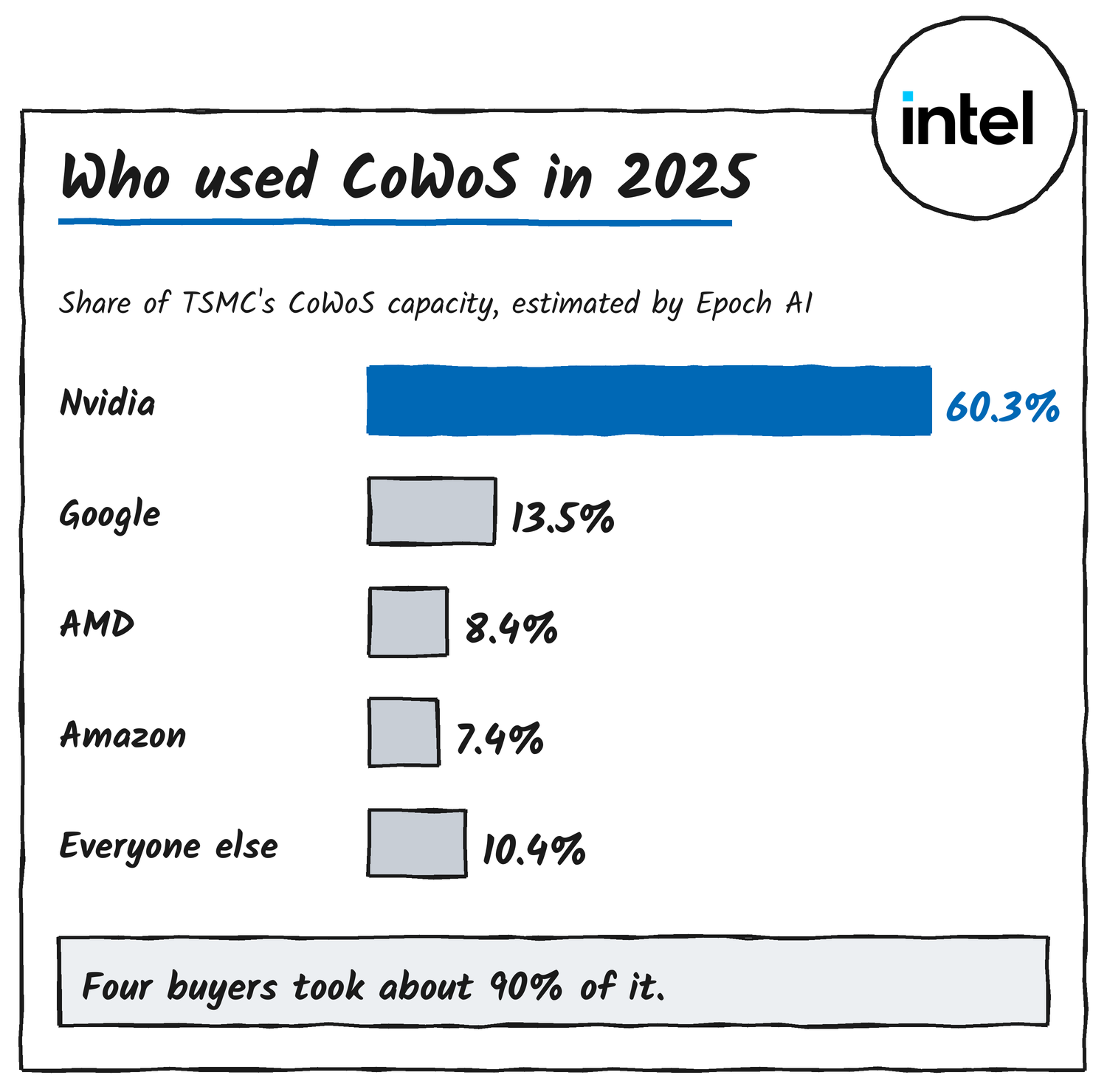
TSMC doesn’t publish its CoWoS capacity. Industry estimates reported by TrendForce, as summarised by Nash & Vance Research, put it at about 130,000 wafers a month at the end of 2026 and 260,000 by the end of 2028. The same summary says ASE, Amkor and other outside firms add the equivalent of about 110,000 CoWoS wafers a month by the end of 2028. Demand is concentrated. Epoch AI estimates Nvidia used 60.3% of all CoWoS capacity in 2025.1
The squeeze is pushing money into other suppliers. On 17 November Nvidia said it is backing Amkor’s Arizona and South Korea packaging expansions with agreements worth nearly US$3 billion, and expanding with SPIL in Taiwan, with contracted capacity for Nvidia rising by mid-2029. Amkor lifted its planned Arizona investment to about US$12 billion in September.
Counterpoint Research told EE Times in August that Nvidia and AMD have shown no inclination to diversify away from TSMC, while Google, with design partner MediaTek, is looking to. That is the gap Intel is selling into.
The Google reports
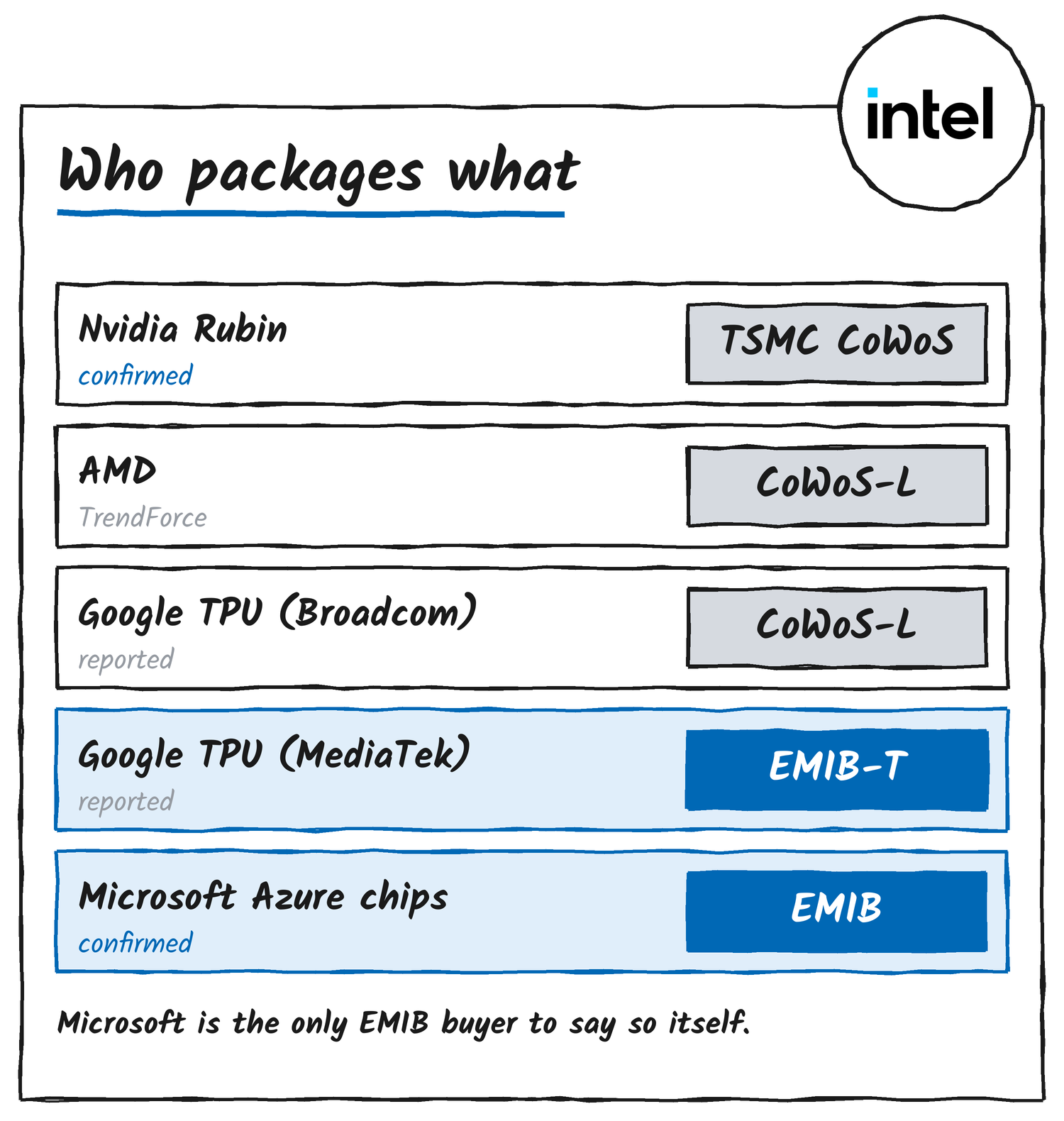
DigiTimes, whose report is the source for the Google claim, says Microsoft and Google are both turning to EMIB. Google hasn’t announced anything, and Microsoft is the only company to have done so. The DigiTimes claim matches a run of earlier reports from analysts and trade press:
- July. Tom’s Hardware relayed SemiAnalysis: Google plans to use EMIB-T for its next TPU, codenamed Humufish.
- August. Counterpoint’s channel checks, reported by EE Times, point to Google and MediaTek using EMIB-T for the TPU v9 variants.
- September. TrendForce says Google is expected to adopt EMIB-T in 2027 and AWS is testing EMIB.
- October. TrendForce reports three TPU v9 variants. Broadcom’s WhaleFish is slated for CoWoS-L in the second half of 2027. MediaTek’s HumuFish relies on EMIB-T for mass production in the first half of 2028, and TriggerFish also plans EMIB-T, in the second half of 2028 or later.
The same TrendForce report puts EMIB-T substrate yields at around 35% in the third quarter, short of a 50% year-end target, and says a possible January 2027 tape-out for HumuFish could push shipments to the first quarter of 2028. Those are industry-source figures. Intel hasn’t published EMIB-T yields.
Which Microsoft chips
Microsoft designs Maia AI accelerators and Cobalt server CPUs for Azure. The release names neither. Converge Digest’s reading is that the first product disclosure will show where Microsoft puts Intel’s packaging in its roadmap. In October, KeyBanc Capital Markets reported orders from six companies for Intel Foundry’s advanced packaging, and, as Joho no Todai summarises it, said Microsoft had effectively secured EMIB-M packaging for Cobalt 400. Neither company has confirmed that.
Microsoft isn’t leaving TSMC. TrendForce expects Microsoft’s Maia 200 to stay on CoWoS-S, and expects AWS and Microsoft to move to CoWoS-L in 2027. Packaging is also separate from the wafers. The release doesn’t say which fab makes the dies that EMIB connects. In February 2024 Microsoft CEO Satya Nadella said Microsoft had chosen a chip design it planned to build on Intel’s 18A process, which is a wafer deal, not a packaging one.
What it means for Intel Foundry’s money
Intel Foundry lost US$1.9 billion in the third quarter, and Intel’s 10-Q says substantially all of its work still supports Intel’s own products. Microsoft is the first customer Intel can publicly name for its packaging, and Tom’s Hardware calls it a significant commercial development for Intel Foundry in terms of publicity. It can’t be sized yet, because no value, volume or schedule was disclosed.
The scale gap with TSMC is large. Investor estimates reported by TrendForce put Intel’s CoWoS-equivalent capacity at 15,000 to 20,000 wafers a month in 2027 and 40,000 to 45,000 in 2028, against TSMC’s roughly 130,000 at the end of 2026. Intel says it wants a more significant external business, and that how fast it builds depends on committed demand for its 14A node. On 18 November CEO Lip-Bu Tan said Intel had signed its first outside customer for 18A, and didn’t name it.
Where the peers package
| Company | Packaging | Source |
|---|---|---|
| Nvidia | TSMC CoWoS for Vera Rubin NVL72 and Vera, with Amkor and SPIL capacity added | Nvidia |
| AMD | CoWoS-L; CEO Lisa Su told Reuters in October that CoWoS and advanced packaging are “super important for our high-performance computing going forward” | Reuters, TrendForce |
| Broadcom | CoWoS-L for Google’s WhaleFish TPU variant | TrendForce |
| Google with MediaTek | EMIB-T for HumuFish and TriggerFish, as reported | TrendForce, SemiAnalysis, Counterpoint |
| Amazon (AWS) | Testing EMIB; expected to adopt CoWoS-L in 2027 | TrendForce |
| Microsoft | EMIB for Azure first-party silicon, chip unnamed; Maia 200 expected to stay on CoWoS-S | Joint release, TrendForce |
| Meta | MTIA 400 already on CoWoS-L | TrendForce |
What isn’t public
- Which Azure chip will use EMIB, which EMIB variant, and which fab makes its dies. The release names none of them.
- The value, volumes and schedule of the agreement.
- Whether Google will confirm EMIB-T for its TPUs. Google hasn’t announced it, and the figures above come from analysts and trade press.
- EMIB-T yields. Intel hasn’t published any.
Sources
- Intel and Microsoft, joint release, 18 November 2026 (also Microsoft Source and PR Newswire)
- DigiTimes Asia, 23 November 2026 (UTC)
- Intel Foundry EMIB technology brief; Intel Foundry packaging page; Intel Foundry HPC and AI brief
- TSMC, second-quarter 2026 earnings call transcript, 16 July 2026
- Nvidia, supply chain commitments, 17 November 2026; Amkor, Arizona phase 2, 8 September 2026; Samsung packaging technologies
- Reporting and research: Tom’s Hardware, Data Center Dynamics, Converge Digest, Reuters, EE Times, TrendForce, SemiAnalysis, Chip Supply Chain, citing Epoch AI, Nash & Vance Research, Joho no Todai, Credence Research
- Epoch AI’s shares are estimates built from public data, not TSMC figures. Epoch puts Google at 13.5%, AMD at 8.4% and Amazon at 7.4% for 2025, and the four together at about 90%. ↩︎
Discover more from Sulat AI & Tech News
Subscribe to get the latest posts sent to your email.