Bloomberg reports that Washington’s new chip rules, brought in after the Nvidia leadership crisis, are squeezing a multibillion-dollar cloud business that helps power Southeast Asia’s data centre boom. The rules are the Commerce Department’s interim final rule on remote access to advanced chips, in force since 19 November.
Bloomberg’s Big Take, by Mackenzie Hawkins, Saritha Rai, Kari Soo Lindberg, Philip Heijmans and Gabrielle Ng, opens at 3am in Jakarta. The chief executive of one of Indonesia’s largest data centre operators had spent hours refreshing the Commerce Department’s website until the new chip export rules appeared. A call to a top lieutenant followed, then an order for a damage assessment, then a red-eye flight to Singapore to meet Nvidia’s team there. The rest of this piece draws on the rule text, government statements and published analyst notes.
What the rule changes
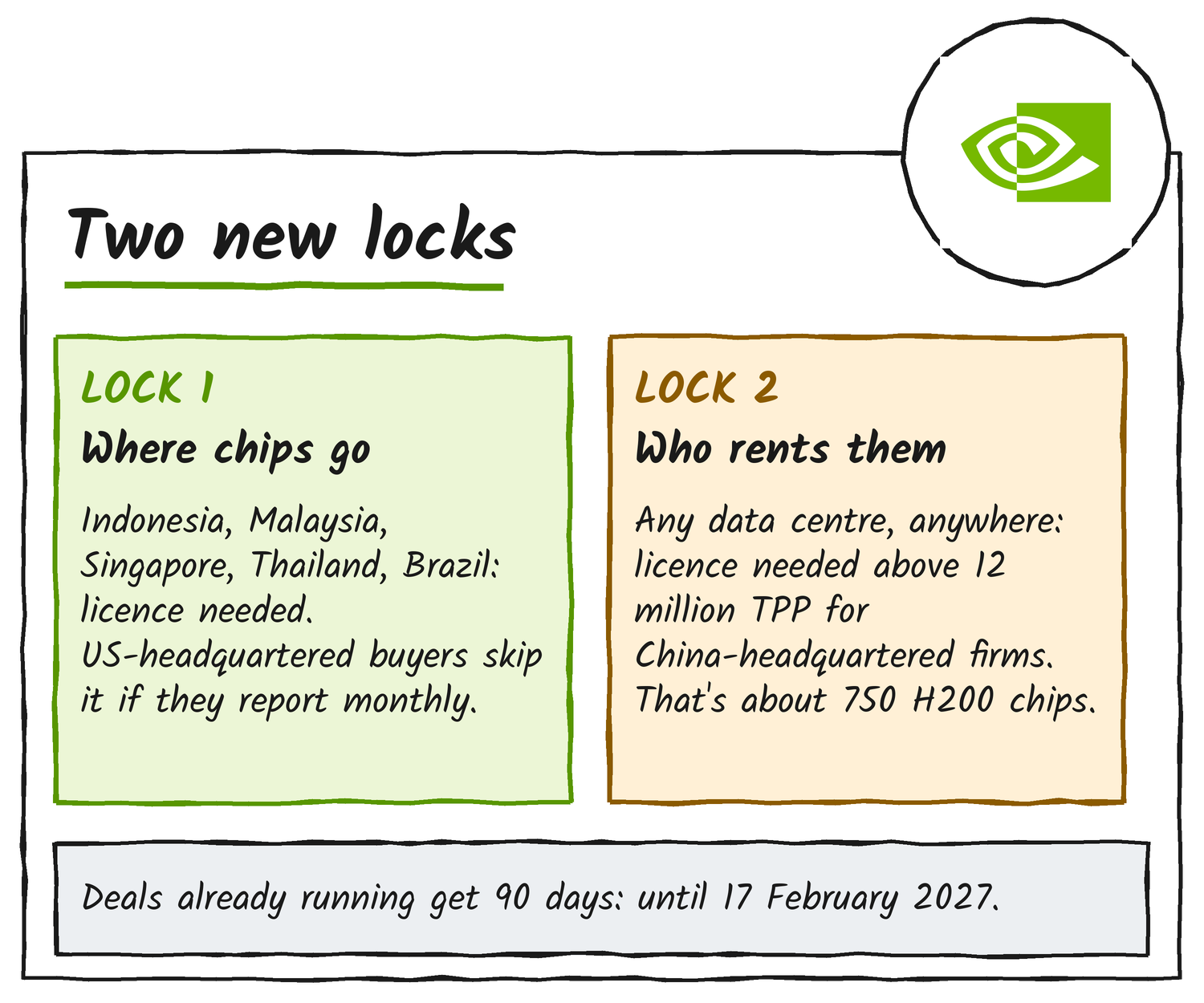
The rule makes two changes that matter for the region. The first is a destination control. Advanced AI chips, servers and related items now need a licence to go to or within Indonesia, Malaysia, Singapore, Thailand and Brazil, which Commerce says carry a higher-than-normal risk of diversion. Buyers whose ultimate parent is headquartered in the US are exempt as long as the exporter files monthly reports, with the first due on 1 December, according to law firm Akin. Applications for everyone else are reviewed case by case, and Commerce says it will weigh how well each country’s export controls work and how closely it coordinates with the department on enforcement.
The second is an end-use control. A data centre anywhere in the world that supplies more than 12 million aggregate total processing performance (TPP) to companies headquartered in China, Macau or another arms-embargoed country now needs its chip suppliers to hold a licence. The Center for Strategic and International Studies (CSIS) puts that threshold at around 750 H200 GPUs. Data centres already serving such customers have until 17 February 2027 to get one. CSIS says the control reaches hardware that was exported earlier, which closes a gap: Commerce advisory opinions had held that selling cloud access isn’t an export.
What’s a TPP?
Total processing performance is the export-control measure of a chip’s speed. A cap of 12 million is low by data centre standards. The rule exempts compute used only for commercial recommender systems, the kind retailers and social media companies run, if the reporting requirements are met. CSIS says that exemption may emerge as a loophole, because a data centre is unlikely to be able to tell recommender work from other AI development.
The same rule formally rescinds the Biden-era AI Diffusion Rule, which set a worldwide licence requirement with country quotas and controls on model weights. Commerce says that rule was never enforced.
Who is exposed
Malaysia carries the most risk. Capital Economics told CNBC that more than half of Malaysia’s data centre capacity sits in colocation facilities, where Chinese firms take a sizeable share of the workloads. Goldman Sachs analysts wrote that Malaysian sites built for Chinese AI training may struggle to lease space and be left with idle power. DayOne, a Johor operator, said in a securities filing that an unnamed customer running a “leading short-form video” service made up nearly 70% of its revenue in the first half of 2026. The New York Times reported that analysts identify the customer as ByteDance, which didn’t respond to its request for comment. DayOne says it supplies land, buildings and power while customers bring their own chips.
Malaysian officials put the exposure lower. Central bank governor Abdul Rasheed Ghaffour said 17 of the 120 data centre companies operating in Malaysia, about 13%, are Chinese-owned, and that data centre investment should stay strong at least until 2028. Trade minister Johari Abdul Ghani said Malaysia hasn’t received official guidance from Washington beyond what it has read in the media, and that it will brief all 117 approved data centre projects once it does.
If you are not prepared to comply, then you should not operate in Malaysia.
Johari Abdul Ghani, Malaysia’s trade minister, to operators, via Bernama
Singapore’s digital and trade ministries said on 16 November that they’re studying the rule, talking to US officials about “trusted access” for Singapore companies, and don’t condone firms using the country’s name to get around other countries’ export controls. Singapore-listed data centre REITs fell on 17 November. CGS International says the second round of Singapore’s data centre capacity tender and a planned Jurong Island park could be deferred, and the Business Times notes four operators were each provisionally allocated 50 MW in August: Digital Realty, Equinix, STT GDC and Keppel. Keppel says it doesn’t expect a significant impact. Singtel says its GPU business serves Singapore only, and that only an “insignificant amount” of Nxera capacity is contracted to neoclouds.
Indonesia’s Government Communication Agency told Bloomberg that officials are reviewing the rule and working on a strategic trade management framework. That matters because the rule ties licence decisions to a country’s own controls. ISEAS-Yusof Ishak Institute fellow Maria Monica Wihardja says Singapore and Malaysia already have such frameworks, while Indonesia relies on scattered customs and sector laws. Maybank says the hit falls harder on pure-play AI infrastructure operators than on telcos. Thailand’s vice minister for commerce, Kirida Bhaopichitr, told CNBC the country was “prepared” and doesn’t want to be a transshipment hub. The Business Times reports colocation demand in Thailand is expected to slow as operators serving Chinese tech firms apply for licences.
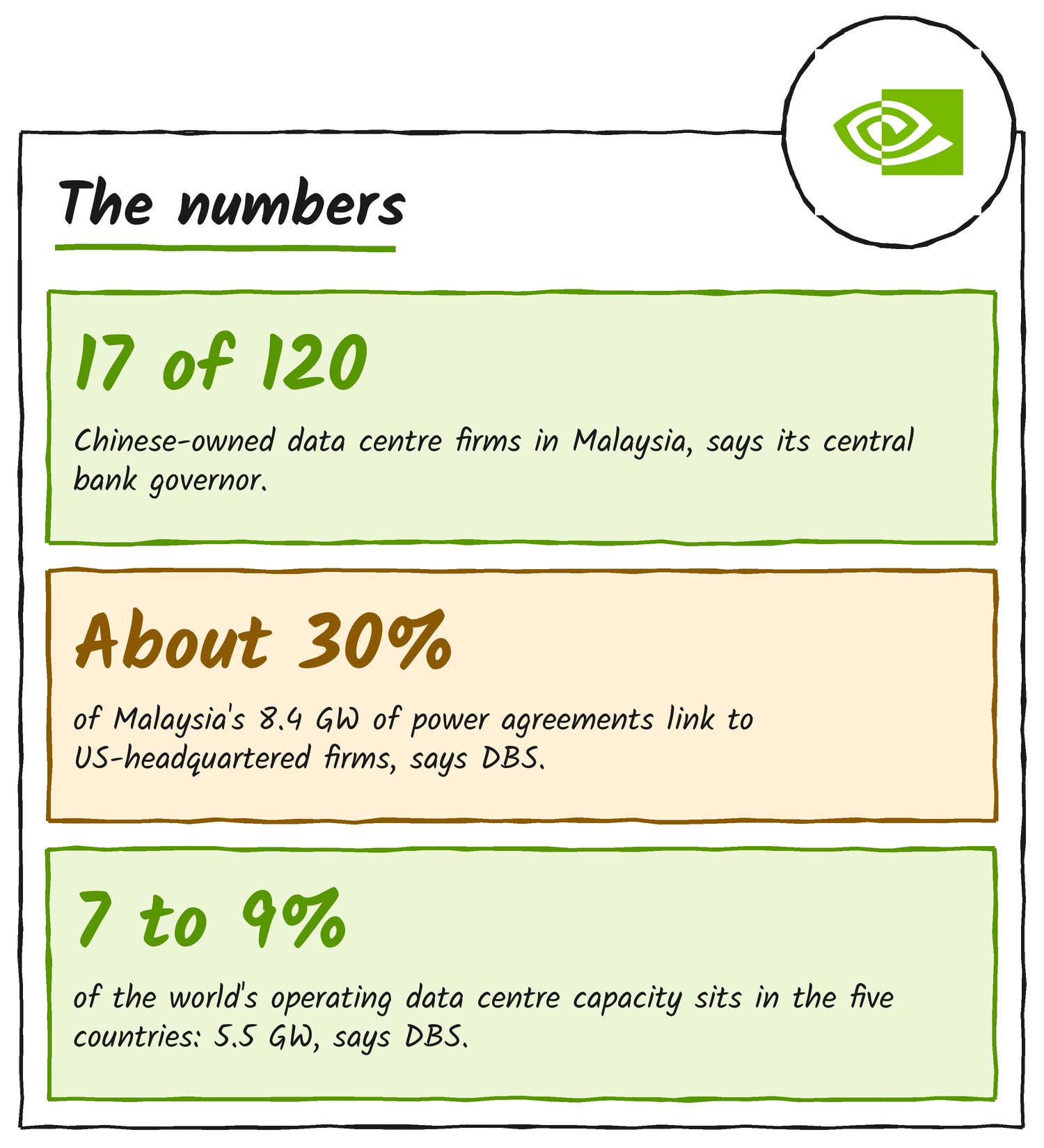
DBS Group Research says the five countries hold 7 to 9% of the world’s operating data centre capacity, about 5.5 GW of IT load, and that about 30% of Malaysia’s 8.4 GW of power agreements signed with the government as at June are linked to US-headquartered companies. Institute for Progress estimates cited by CNBC put 505.8 MW of China’s 794.2 MW of forecast overseas AI capacity in Southeast Asia, about three-quarters of the total.
The pain isn’t spread evenly. DBS says non-US cloud operators will feel it most and that investment could shift to jurisdictions with fewer hurdles, and CGS International expects US hyperscalers to benefit. The Straits Times describes a two-tier market in Singapore, with licensing for local and non-US operators and exemptions for Amazon Web Services, Microsoft and Google. Macquarie’s Foo Zhiwei expects “a slowdown, not a halt”.
How other regions are treated
Before this rule, the licence requirement for advanced chips covered 45 countries in Commerce’s D:1, D:4 and D:5 country groups, including Saudi Arabia, Kazakhstan and Vietnam, but none of the five Southeast Asian countries now added. The Gulf now sits at the other end of the scale. A July 2026 Commerce rule moved the United Arab Emirates into the favourable A:5 group and gave UAE government agencies and approved companies licence-free access to advanced chips. The approved list covers G42 and Core42 for 270 days, to 6 April 2027, plus eight US-headquartered AI companies. Everyone else in the UAE still needs a licence.
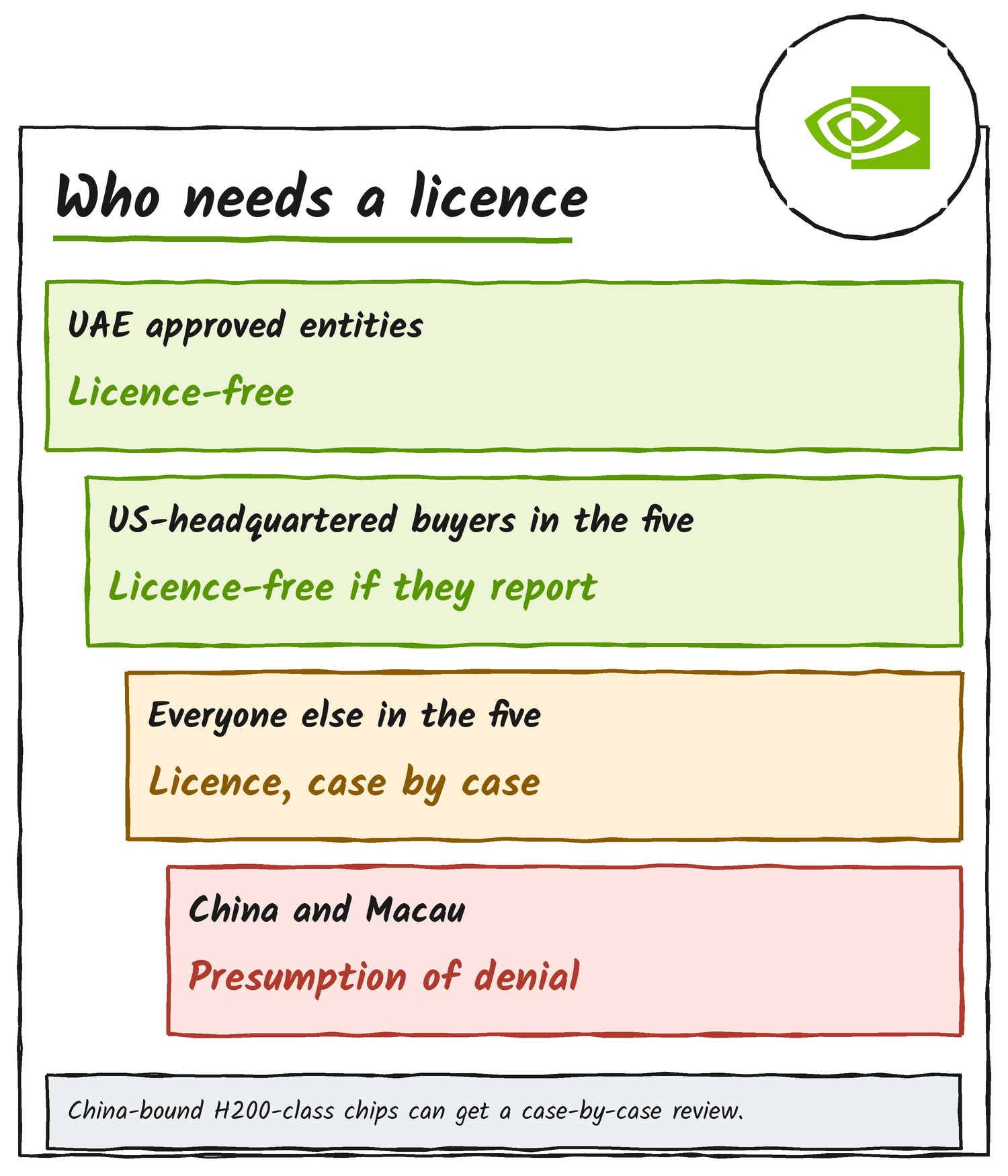
| Destination or buyer | Licence | Review policy |
|---|---|---|
| UAE government and approved entities | None | Not applicable |
| Other UAE buyers; D:1 and D:4 countries such as Saudi Arabia and Vietnam | Required | Presumption of approval |
| US-headquartered buyers in the five Southeast Asian countries | None, with monthly reports | Not applicable |
| Other buyers in Indonesia, Malaysia, Singapore, Thailand and Brazil | Required | Case by case |
| China, Macau and other D:5 countries | Required | Presumption of denial; case by case for H200-class chips under 21,000 TPP with certifications |
Southeast Asia’s governments had already moved on their own. Malaysia has required a strategic trade permit since 14 July 2025 for exports, transshipment and transit of US-origin high-performance AI chips, according to its trade ministry. Reuters reported in September 2025 that Johor’s vetting committee had rejected about 30% of data centre applications as of late 2024 for failing to show sustainable water and energy use.
The Nvidia backdrop and Beijing’s reply
The rule landed days after Jensen Huang stepped down as Nvidia’s chief executive on 12 November. The Straits Times links his exit to the disclosure of his relationship with Alice Huang, a former top executive at Singapore-based Megaspeed whom the US suspects of being a Chinese spy. Singapore’s Ministry of Home Affairs says she wasn’t investigated for espionage, and Commerce and Justice haven’t announced charges against Megaspeed. I’ve covered the rule’s first release, the earlier Wall Street Journal report on Southeast Asian data centres and Nvidia’s new board committee on export controls.
China’s commerce ministry said on 17 November that it firmly opposes the rule and will take countermeasures if the US persists. Foreign ministry spokesperson Guo Jiakun called the rule “a typical example of economic coercion and long-arm jurisdiction”. President Donald Trump and President Xi Jinping met in Shenzhen on 19 November, the day the rule took effect. The Straits Times reports no major breakthrough was announced, and that Beijing’s readout didn’t mention the chip restrictions.
What happens next
Public comments on the rule are due on 19 January 2027, and data centres serving Chinese customers have until 17 February 2027 to hold a licence. Commerce says it will watch for countries that tolerate evasion and lists import restrictions, new licence requirements, a downgrade in export-control status and sanctions among the possible consequences. Singapore is negotiating trusted access for its companies, and Malaysia is still waiting for official guidance. Trump and Xi are due to meet again at the G20 summit in Miami on 14 and 15 December, according to the Council on Foreign Relations.
Discover more from Sulat AI & Tech News
Subscribe to get the latest posts sent to your email.