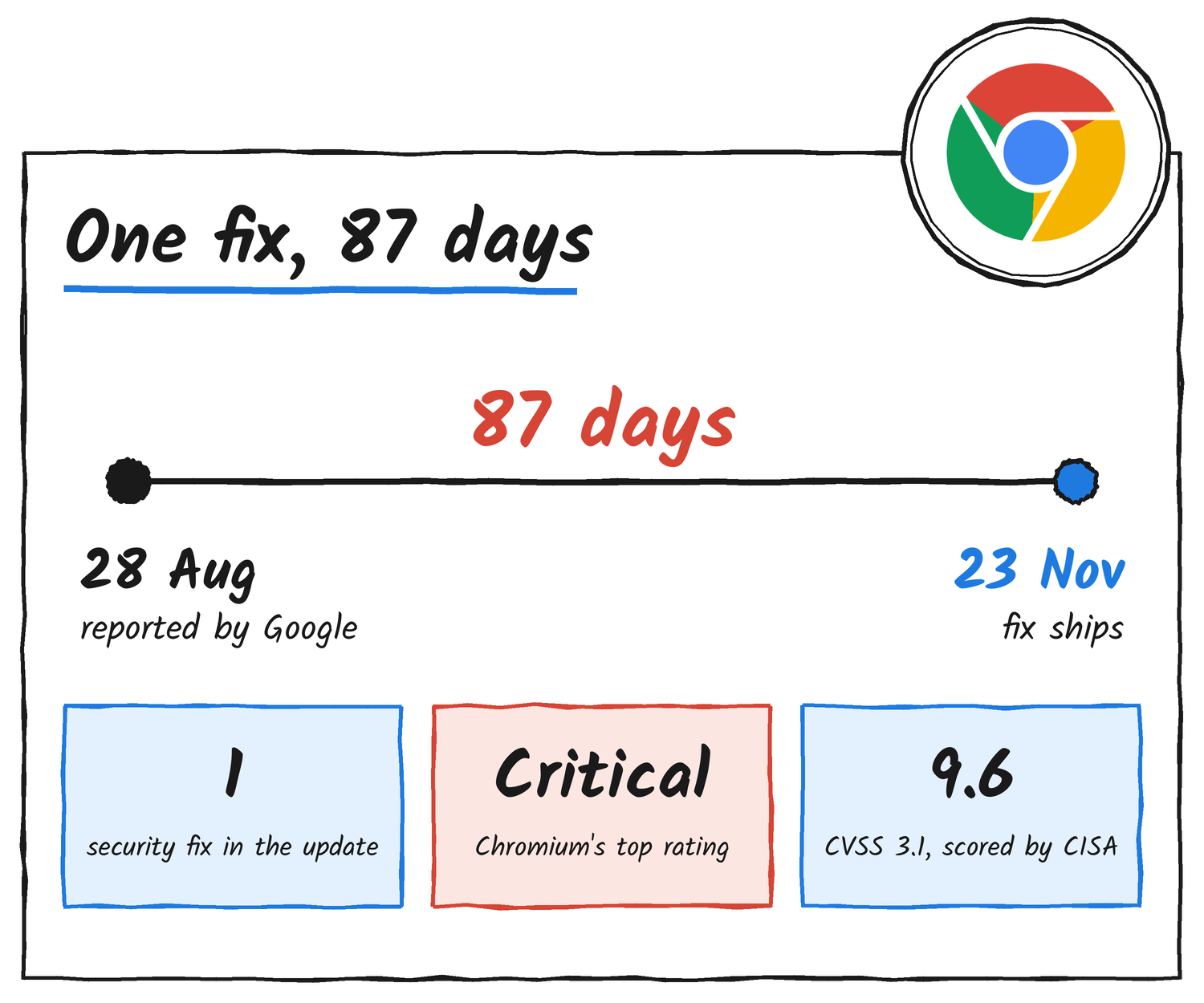
Google’s Chrome update of 23 November carries one security fix: CVE-2026-134401, a Critical bug in Variations. The build is 158.0.8127.88 on Linux and 158.0.8127.88 or .89 on Windows and Mac. The CVE record says a remote attacker could potentially run code outside Chrome’s sandbox through a crafted HTML page. Google lists itself as the reporter, on 28 August, and the update rolls out over the coming days and weeks.
The CVE record went public at 11:29pm UTC on 23 November. CISA then added a 9.6 CVSS score and, on 24 November, recorded no known exploitation. The update lands six days after Chrome 158 shipped with 204 fixes, and 12 days after the 83-fix Chrome 157 update.

What Google and the CVE record say
Google’s Chrome Releases post lists a single entry. The bug is rated Critical, the bounty field reads N/A, and the weakness is improper input validation (CWE-20). The CVE record covers Chrome before 158.0.8127.88. The Extended Stable update for Windows and Mac, 156.0.8078.114, lists the same CVE and carries no description.
Google reported the bug to itself on 28 August and shipped the fix on 23 November, 87 days later. The Chrome Releases post doesn’t say when the fix was written. The bug number is 554051967, and its tracker page returns “Access is denied”. Google’s standard note says it can keep bug details restricted until most users have updated.
Variations, and why “outside the sandbox” matters
Variations is the system Chrome uses to switch features on and off for slices of its users. Chrome’s developer documentation says the browser asks a dedicated server for a configuration file, the variations seed, each time it starts and every 30 minutes, and sends its version and operating system with the request. Chrome then uses that file and a locally stored randomisation seed to place the browser in a variation group. Google hasn’t said which Variations input failed validation, or how a crafted HTML page reaches it.
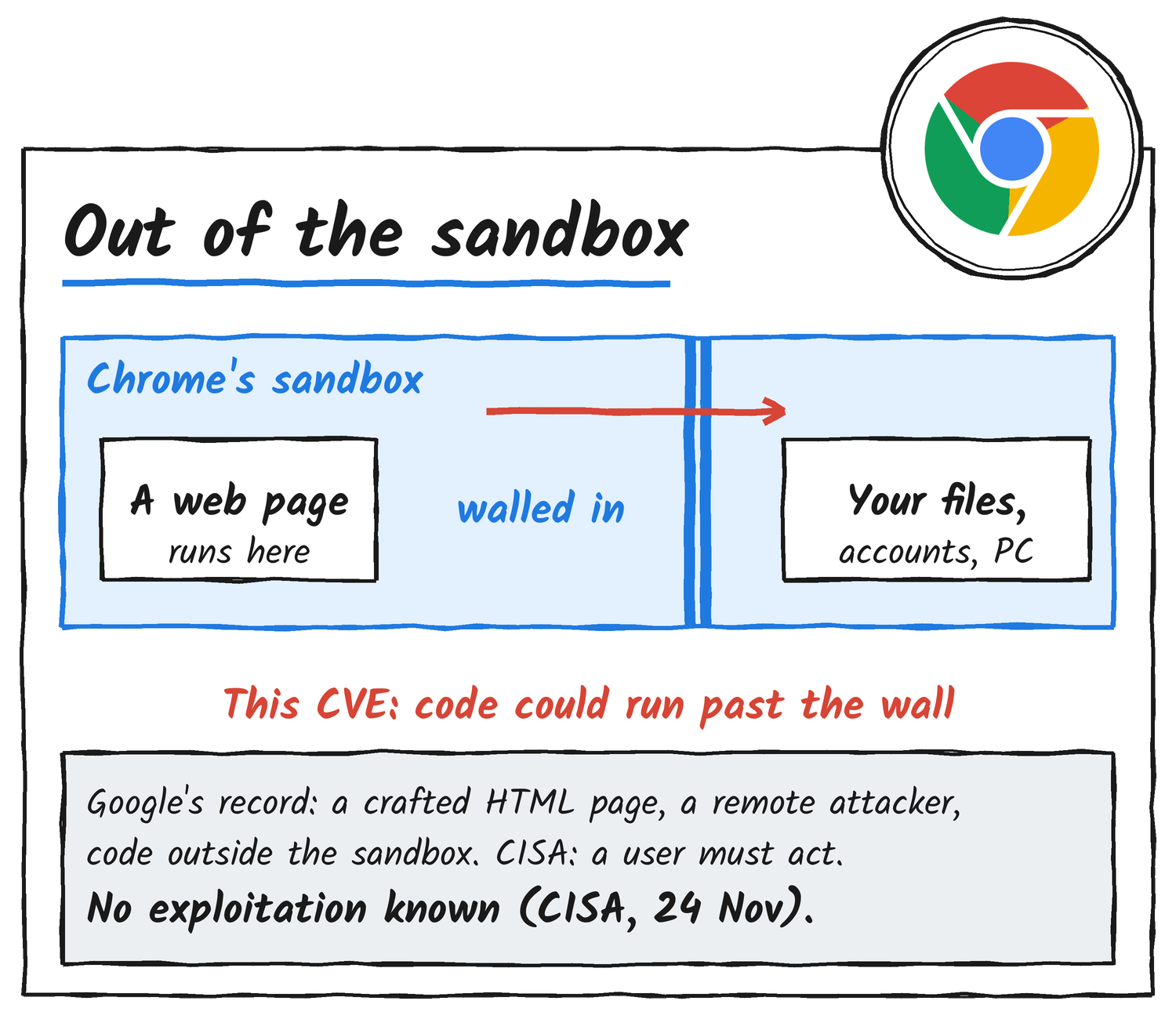
The sandbox is the restriction Chrome puts around the processes that handle web pages. A bug that runs code inside it stays boxed in. The CVE record describes code running outside it, which is the step that reaches files and accounts on the machine.
Three ratings for one bug
Chromium rates the bug Critical, its top severity. CISA scored it 9.6 on CVSS 3.1, with a vector that needs a user to act, such as opening a page. The National Vulnerability Database lists the record as awaiting enrichment and hasn’t scored it.
| Who | What it says |
|---|---|
| Chromium | Critical, the top of its four-step scale |
| CISA, CVSS 3.1 | 9.6 Critical; network attack, low complexity, no privileges, user must act, scope changed, high impact on confidentiality, integrity and availability |
| CISA, exploitation, 24 November | None known; not automatable; total technical impact |
| NVD | Awaiting enrichment; no NVD score yet |
Which build each channel needs
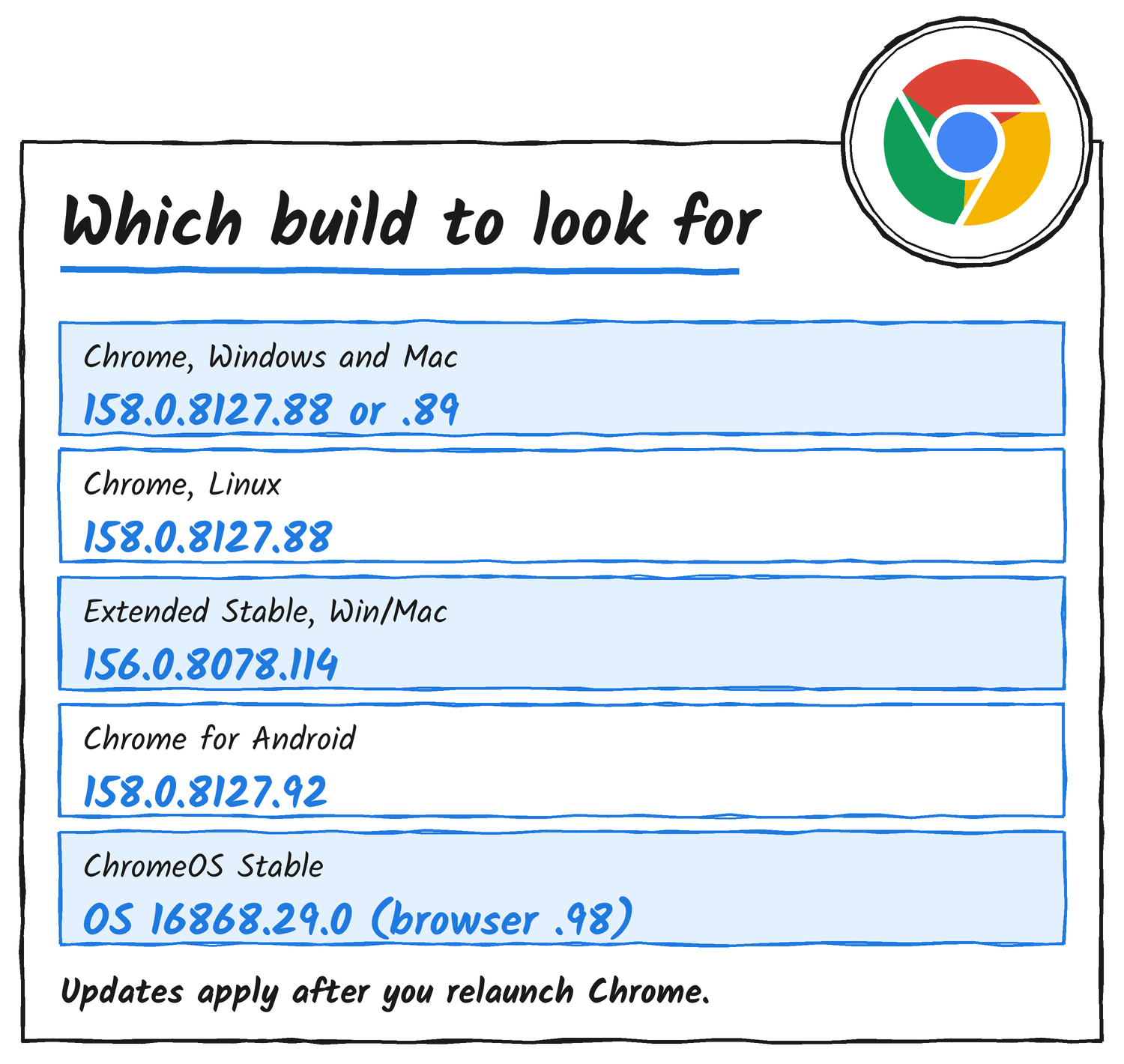
Chrome Releases gives separate builds for each channel. Android’s Chrome 158.0.8127.92 becomes available on Google Play over the next few days, and Google says Android builds carry the same security fixes as the matching desktop release. Google’s ChromeOS post moves Stable to OS 16868.29.0 with browser 158.0.8127.98 and lists no fixes.
Other Chromium browsers
Other Chromium browsers need the same fix from their own makers. PC-WELT’s table from 19 and 20 November put Chrome, Brave and Edge on Chromium 158 builds and Opera on a 157 build, all below 158.0.8127.88. Vivaldi was on the Extended Stable branch at 156.0.8078.110. No note on CVE-2026-134401 from Edge, Brave, Vivaldi or Opera had appeared when I checked late on 24 November, NZ time. Microsoft’s newest Edge security entry I could read, dated 19 November, lists Edge 158.0.4370.33.
| Browser | Version on 19 to 20 November | Chromium base |
|---|---|---|
| Google Chrome | 158.0.8127.37 | 158.0.8127.37 |
| Brave | 1.100.58 | 158.0.8127.42 |
| Microsoft Edge | 158.0.4370.33 | 158.0.8127.37 |
| Opera One | 140.0.6074.36 | 157.0.8103.79 |
| Vivaldi | 8.3.4191.45 | 156.0.8078.110 (Extended Stable) |
Chrome’s month in fixes
Chrome has had a heavy month. Chrome 157 reached Stable on 3 November with 213 fixes, seven of them Critical, according to SOCRadar. A 9 November update fixed CVE-2026-125350, an XML bug Google said had an exploit in the wild, which CISA added to its Known Exploited Vulnerabilities catalogue the next day. The 11 November update fixed 83 bugs, five Critical. Chrome 158 on 17 November fixed 204, six Critical. This update is the smallest of the five by a wide margin: one fix, one Critical, and no exploitation recorded.
| Date (UTC) | Build | Fixes | Critical |
|---|---|---|---|
| 3 November | 157.0.8103.38/.39 | 213 | 7 |
| 9 November | 157.0.8103.50/.51 | 9, one exploited | 0 |
| 11 November | 157.0.8103.78/.79 | 83 | 5 |
| 17 November | 158.0.8127.36/.37 | 204 | 6 |
| 23 November | 158.0.8127.88/.89 | 1 | 1 |
What to do
- Open Chrome, go to Settings, then About Google Chrome, let it download the update and click Relaunch. The new version doesn’t apply until the browser restarts.
- Open
chrome://version. The build should read 158.0.8127.88 or later. - Managed Extended Stable fleets on Windows and Mac need 156.0.8078.114. Android users update through Google Play.
- For Edge, Brave, Vivaldi and Opera, open the About screen and look for a build that includes the 23 November Chromium fix.
Discover more from Sulat AI & Tech News
Subscribe to get the latest posts sent to your email.