
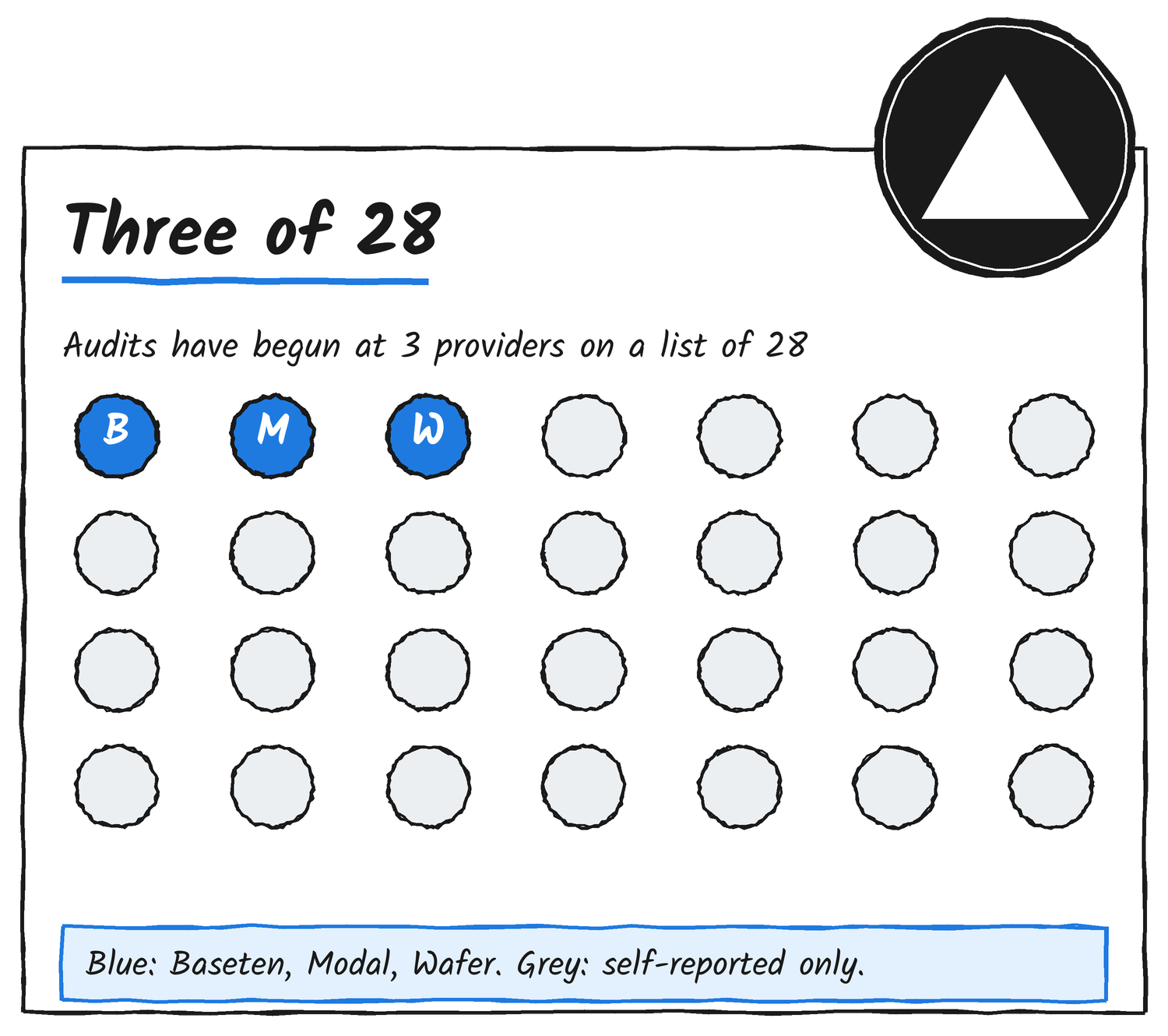
Vercel has started auditing the zero data retention claims on its AI Gateway, and the first three providers in line are Baseten, Modal and Wafer. Nate Berkopec, who co-maintains the Puma web server and runs the Speedshop Rails consultancy, quoted Vercel’s announcement and wrote that the initial list “definitely should tell you something” about who’s on it and who isn’t. He didn’t say what. The record is public, so I went through it, and some of it is below.
What Vercel announced
Vercel’s post, dated 23 November (US) and written by Harpreet Arora and Talha Tariq, adds a provider tier to AI Gateway and a team-wide toggle in its policy settings. With the toggle on, the gateway routes and fails over a team’s requests only across providers whose audit reports are published. Each provider joins the tier when its report goes live, and Vercel expects the three launch reports by 8 December (US). Until then no provider is in the tier.
We are now asking inference providers for the same thing we asked of ourselves: independent verification.
Vercel, “Introducing Audited ZDR on AI Gateway”, 23 November
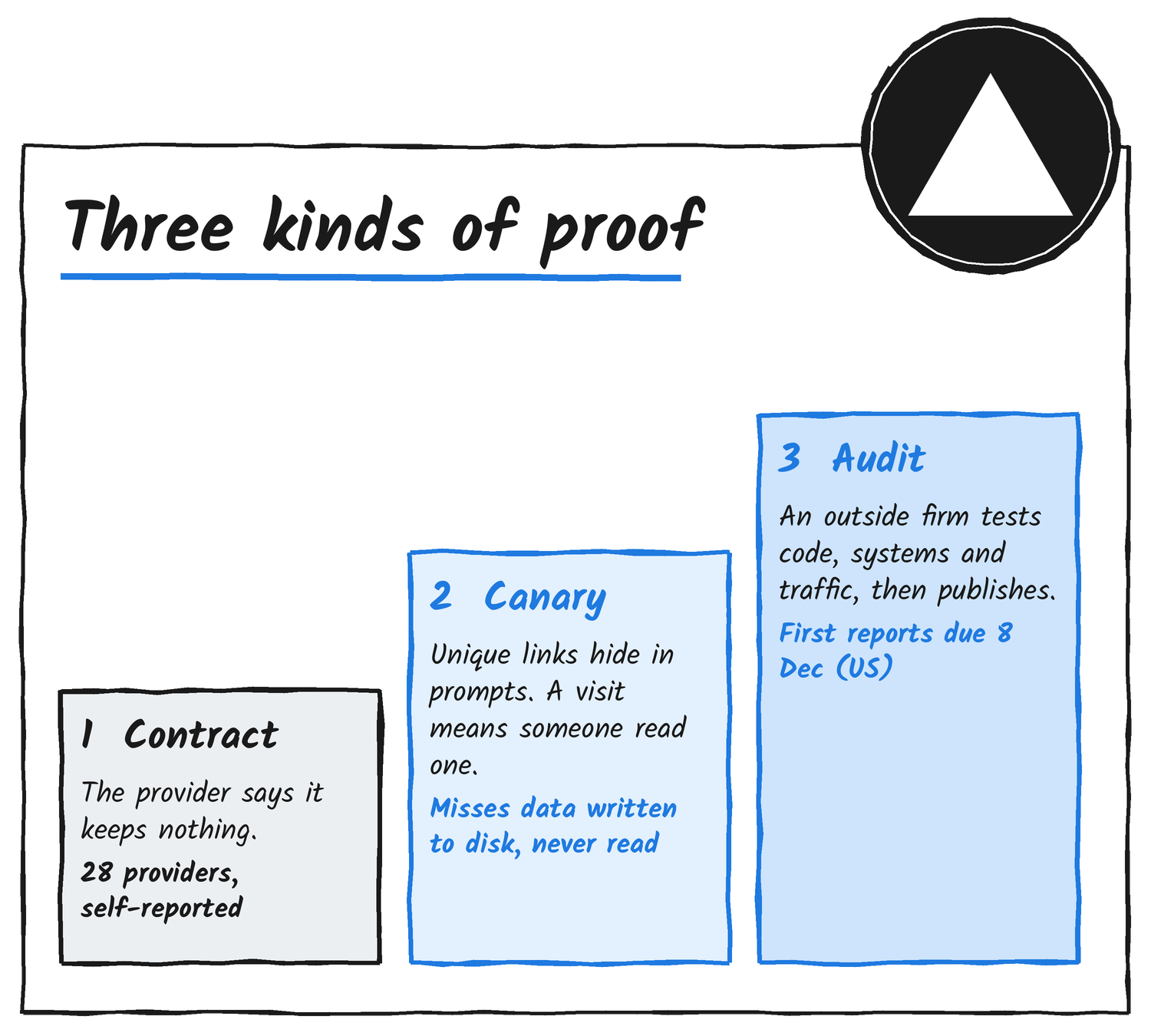
The reason Vercel gives is that ZDR has rested on contracts and self-attestation. Vercel’s own docs say the same about the status quo: “Provider ZDR on AI Gateway is self-reported.” Vercel’s April 2026 team-wide ZDR launch, for Pro and Enterprise teams, routed traffic only to providers it had agreements with. The audited tier is the next step up.
3
launch partners with audits under way
28
providers on Vercel’s self-reported ZDR list
8 Dec
when the launch reports are due (US)
What the audit tests
The provider hires an independent security firm, which Vercel says is chosen “from among respected third-party auditors”. The firm tests the provider’s ZDR policy across the serving path for every model, endpoint, feature and tool that handles AI Gateway traffic. Auditors read the serving-path source code and infrastructure configuration, then send marked prompts through the gateway and search the provider’s logging, caching and storage systems for any trace of them.
- Customer data, meaning prompts, completions, system prompts, embeddings, files, tool payloads and anything derived from them, is never written to durable storage in any system.
- Once a response goes back to the gateway, the content is deleted. A KV cache may exist only in volatile storage for the length of the request, and the provider has to disclose it.
- A request marked ZDR never fails over to a non-ZDR endpoint, tool or feature.
- No person or automated process touches customer data except to handle the request, sub-processors follow the same rules, and nothing is used for training.
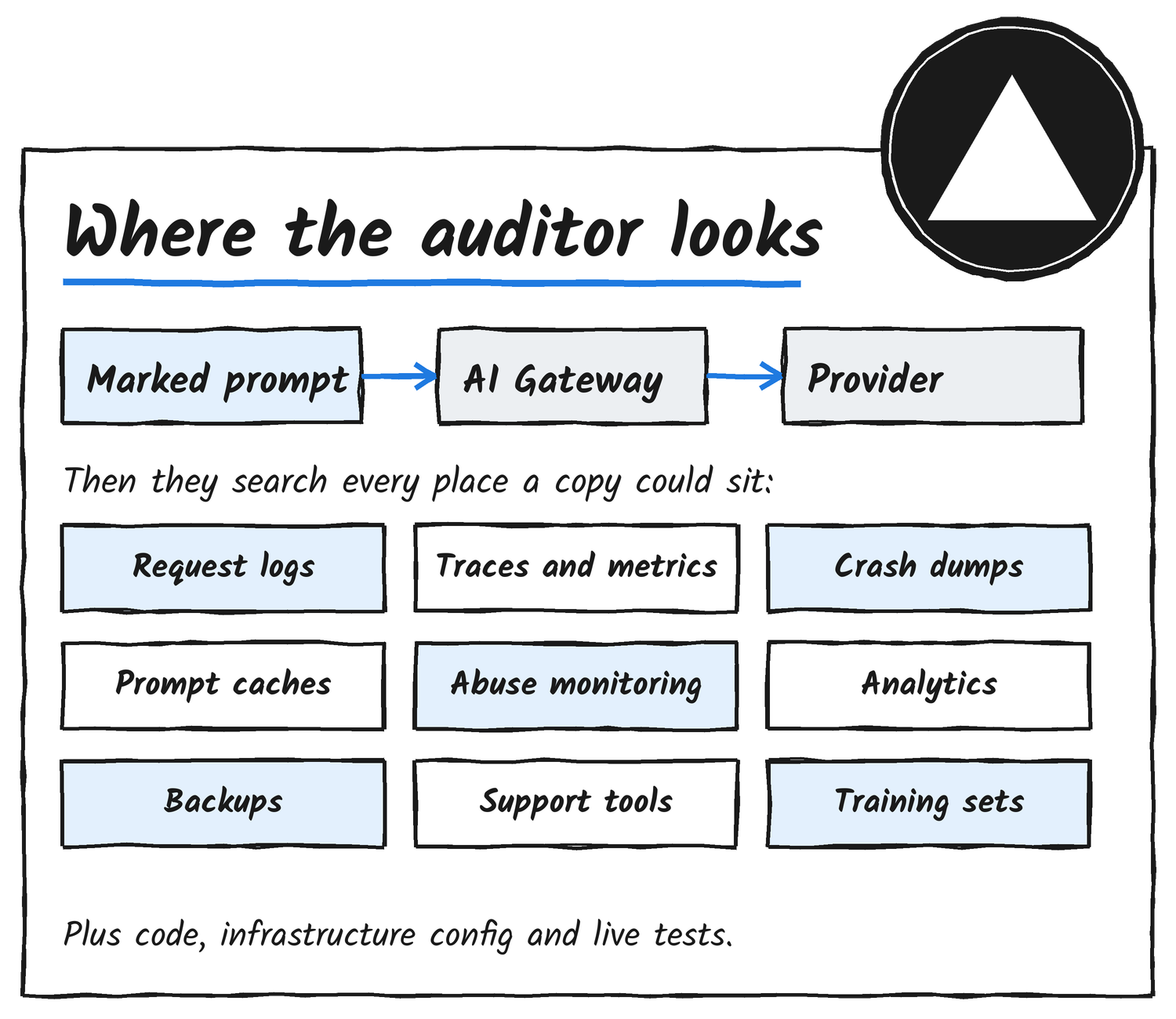
Every passing provider publishes the report under the auditor’s name, covering scope, method, dates, findings and fix status. Exceptions are disclosed, and redactions are limited to exploit detail. That is a different arrangement from the SOC 2 reports many providers hold, which are usually shared under a non-disclosure agreement. Baseten’s own security page says its SOC 2 Type II report is available to customers under NDA.
The three launch partners
I read each company’s own pages on 24 November. They aren’t the same kind of company, and they start from different places.
| Provider | Outside assurance it lists | ZDR terms it publishes |
|---|---|---|
| Baseten | SOC 2 Type II, ISO 27001:2022, HIPAA and PCI DSS (SAQ D) on its trust centre | Zero data retention for Model APIs and Dedicated Inference inputs and outputs |
| Modal | SOC 2 Type II, and HIPAA on its Enterprise plan | Servers, Dedicated Endpoints and Shared Endpoints payloads are never written to disk. Function inputs and outputs are kept up to 7 days |
| Wafer | Its data processing addendum says it “may engage third-party assessments over time” | ZDR on Privacy and Enterprise keys, or on requests that require it, for models marked ZDR-supported. Wafer Pass Starter logs can keep prompts and completions for up to 30 days |
Wafer is the youngest. Its own page says it was founded in 2025, came through Y Combinator’s Summer 2025 batch, raised a US$4 million seed in April and a US$40 million Series A on 1 September at a US$220 million post-money valuation. It runs dedicated and serverless inference for open models. Vercel’s audit scope is the traffic that reaches a provider through AI Gateway, and Wafer’s ZDR terms apply only where ZDR is enabled or required.
Who’s on the list, and who isn’t
Vercel’s ZDR docs table lists 28 providers with a checkmark for self-reported ZDR. It runs from the big clouds (Azure, Amazon Bedrock, Google Vertex AI) and model labs (Anthropic, Meta, Mistral, xAI, Moonshot AI, Alibaba Cloud) to inference hosts (Baseten, Fireworks, Groq, Modal, Nebius, Parasail, Together AI, Wafer) and search tools such as Exa and Parallel. Three of the 28 are launch partners. All three are open-model inference hosts, and none is a hyperscaler or a model lab. Vercel’s post doesn’t say how it picked them.
Berkopec didn’t spell out his reading. These are the checkable facts around the list.
- The incident names aren’t all on it. Together AI said on 21 November that an unauthorised party downloaded stored prompt samples, and BleepingComputer reported two Fireworks AI incidents in October. Both are among the 28 and neither is a launch partner. Novita, AtlasCloud, StreamLake, Phala and NEAR AI, named in this month’s OpenRouter and Dragos coverage, aren’t among the 28 at all. Vercel’s docs say a provider whose ZDR stance it doesn’t know is treated as not ZDR, and a ZDR request won’t route to it.
- Exclusions sit inside the list. The docs table carries per-model carve-outs. Claude Fable models aren’t ZDR on any provider, including Anthropic, Google Vertex and Amazon Bedrock, because Anthropic retains prompts and outputs for 30 days. I covered Anthropic’s safeguards beta earlier today. An audit covers what a provider enters, so it can’t cover a model the provider excludes.
- Wafer has two other ties to Vercel. They’re in the next section.
Wafer’s other ties to Vercel
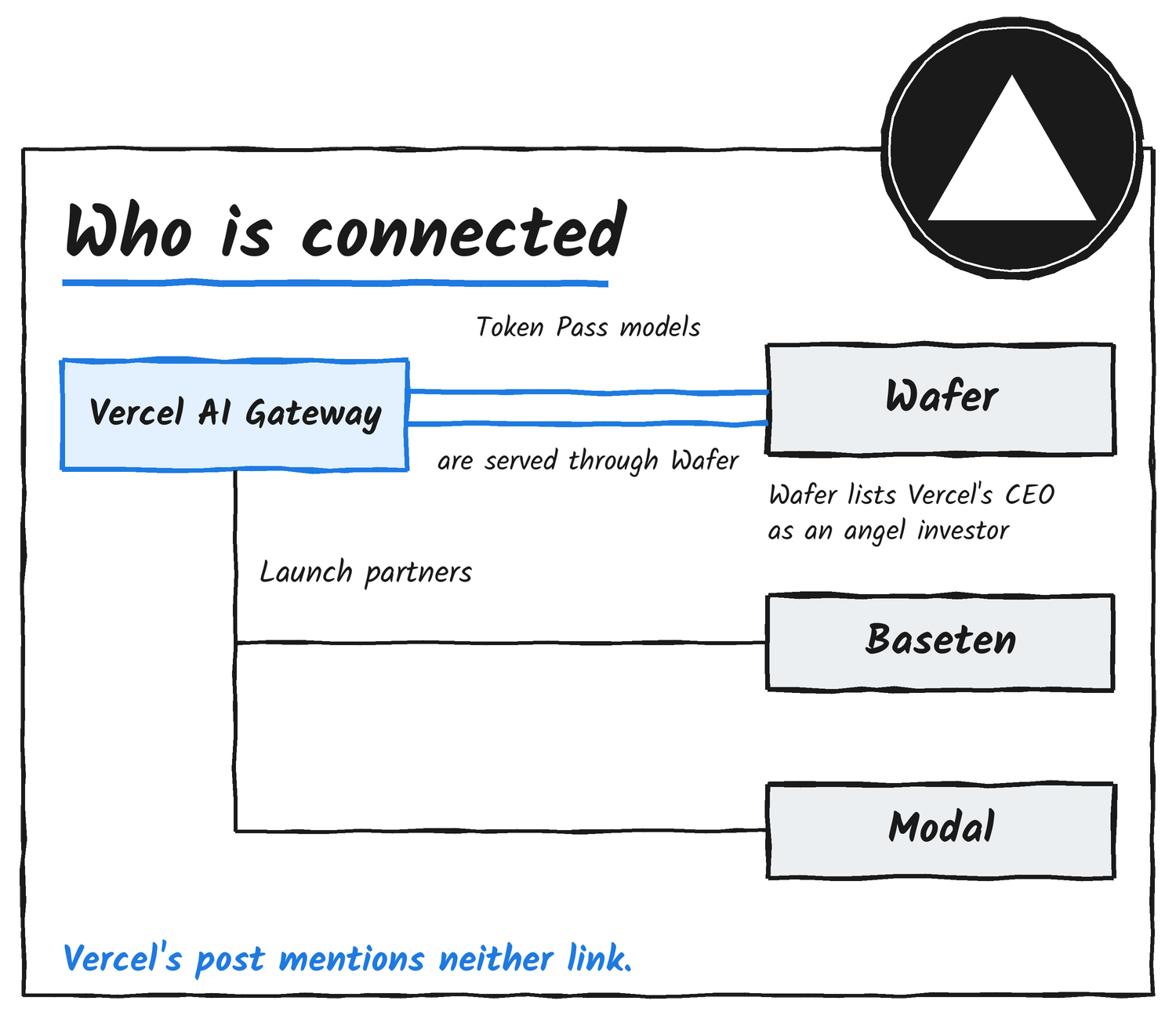
Vercel’s docs say its Token Pass models are served through the token-pass provider, which “currently serves its models through Wafer and follows Wafer’s zero data retention policy and terms”. And Wafer’s own information page lists Guillermo Rauch among its angel investors. Rauch is Vercel’s chief executive, and Vercel competes with OpenRouter, whose ZDR claims I covered over the weekend.
None of that says the audit is anything other than what Vercel describes. Vercel’s post mentions neither tie, and a reader weighing “independent” should have both.
Between audits, canaries
An audit is a snapshot. Vercel’s changelog, also dated 23 November, says AI Gateway now runs canary audits on providers. Each run mints unique URLs that exist nowhere else, each mapped privately to a provider, model and run, and puts them in prompts sent through the normal path with ZDR requested. A ZDR provider shouldn’t retain, inspect or crawl a prompt, so any request to a canary URL triggers an investigation. Vercel includes non-ZDR provider and model pairs as positive controls, so it can see the canary working.
It’s the technique Dragos used at scale. Dragos said about two million canary-seeded prompts exposed three breached providers and one Chinese lab whose systems fetched secret URLs from roughly two-thirds of the requests marked ZDR. Vercel states the limit of its version plainly: canary checks can’t detect prompts written to disk and never read, so they sit beside the independent audits and don’t replace them.
How the other gateways handle it
| Gateway | How ZDR status is set | What checks it |
|---|---|---|
| Vercel AI Gateway | Providers report it, per Vercel’s docs | Canary audits since 23 November. The audited tier opens as reports publish |
| OpenRouter | Endpoint policies it tracks with providers. Its CEO told me they “relied mostly on self-attestation” | Three providers off-boarded and 125 endpoints removed. It says it will require stronger verification before restoring any of them |
| Cloudflare AI Gateway | ZDR routes Unified Billing traffic through provider endpoints that don’t retain prompts. It doesn’t apply to bring-your-own-key requests | Its ZDR docs describe no audit. They say ZDR doesn’t control the gateway’s own logging |
I covered Cloudflare’s gateway on Saturday, and the Baseten security checklist the same day. Of these three gateways, Vercel is the only one that has announced a published outside report as a condition of its ZDR label.
What Vercel hasn’t said
- It hasn’t named the auditing firm or firms, or said who pays for the audits.
- It hasn’t said which plans get the audited-tier toggle, or what it costs. Team-wide ZDR itself is for Pro and Enterprise teams.
- It hasn’t said how it chose Baseten, Modal and Wafer, or whether any other provider has started an audit.
- It hasn’t said what happens to a provider’s place in the tier after a later incident, or how often an audit is repeated.
What to do now
- Turn on ZDR. Use the team-wide setting in the AI Gateway dashboard, or set it per request, so sensitive prompts only reach providers with a ZDR agreement.
- Check where requests went. Each response carries metadata showing which providers were considered and which were filtered out.
- Wait for the reports before relying on the audited toggle. It has nothing to route to until a provider’s report is out.
- Read each report for scope. Check that your model and endpoint are covered, the audit dates, the findings, the fix status and any disclosed exceptions.
- Keep your own canary. Put a fake credential in the context your agents already send and treat any use of it as an incident.
import type { GatewayProviderOptions } from '@ai-sdk/gateway';
import { streamText } from 'ai';

const result = streamText({
  model: 'anthropic/claude-sonnet-4.6',
  prompt: 'Analyze this sensitive business data and provide insights.',
  providerOptions: {
    gateway: {
      zeroDataRetention: true,
    } satisfies GatewayProviderOptions,
  },
});
The snippet is from Vercel’s April 2026 post on team-wide ZDR.
Discover more from Sulat AI & Tech News
Subscribe to get the latest posts sent to your email.