Anthropic opened Enterprise Frontier Safeguards (EFS) in public beta on 23 November (US), a system that lets business customers use its most capable models with zero data retention while Anthropic still monitors for misuse. The copy of each prompt and response that safety monitoring needs sits in a bucket the customer owns, not on Anthropic’s servers.
It replaces a policy that Anthropic introduced in June, under which it kept prompts and responses for 30 days on its newest models. That rule drew pushback from regulated customers, and Anthropic says it built EFS with more than 100 of them. Bloomberg, which reported the launch, describes the 30-day requirement as continuing; Anthropic’s own pages call the new setup zero data retention. Both are describing the same 30 days, and the difference matters, so it’s laid out below.
100+
customers Anthropic says helped develop EFS
7 days
to answer a Safety Case before access can be suspended
30 days
before each record’s decryption key expires
US$0
charged by Anthropic; storage is billed by the cloud provider
- What opened on 23 November
- How the system works
- What the June policy required, and why
- Who pushed back
- Which customers and models it covers
- Cost, and who does the work
- How other providers handle retention
- What comes next
What opened on 23 November
The beta is available on Claude Platform, Claude Platform on AWS, Amazon Bedrock and Claude on Google Cloud. Microsoft Foundry is listed as coming soon. Anthropic’s documentation carries a beta warning, saying settings and behaviour can change while it runs. Customers ask their account team for access, and Anthropic hasn’t said what makes an organisation eligible.
Bridgewater, Salesforce and Stripe used the system in private beta, which opened on 9 November alongside Claude Fable 5.2 and Claude Mythos 5.2. Anthropic says the 100-plus customers that shaped it span financial services, healthcare, manufacturing, telecom, law, retail and the public sector, and include a quarter of the Fortune 100. Wells Fargo’s chief information security officer, Munish Kumar Sharma, is quoted by Unite.AI describing the split of duties.
We keep custody of our data while Anthropic operates the detection.
Munish Kumar Sharma, chief information security officer, Wells Fargo, as quoted by Unite.AI, 23 November 2026
How the system works
EFS has two required parts and one optional one. The customer supplies a storage bucket, either Amazon S3 or Google Cloud Storage. Anthropic encrypts each record kept for monitoring before it’s written there, and the customer can require its own key to decrypt it. Anthropic calls this Sealed Safety Data. Each record’s key expires within 30 days, after which Anthropic’s systems can’t decrypt it.
Monitoring then runs on isolated compute and returns closed-schema results, such as policy categories, harm scores and record identifiers. The point of keeping records at all is cross-request detection. Anthropic argues the most sophisticated misuse can spread across many tasks, sessions and accounts, so checking each interaction once and discarding it isn’t enough.
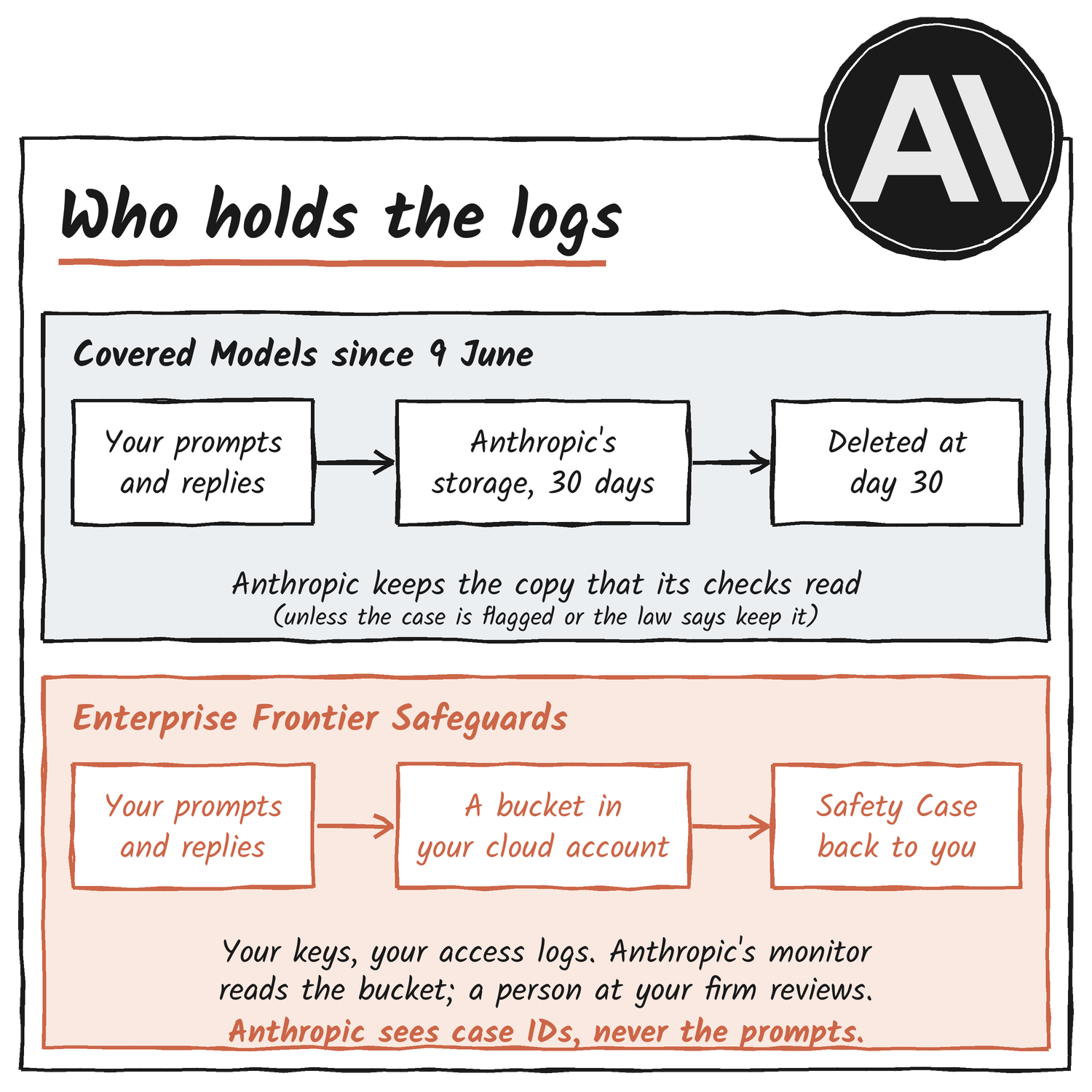
When monitoring finds a possible breach of Anthropic’s Usage Policy, Anthropic may open a Safety Case. It’s a record that names the policy category and lists the related transcripts by identifier, without including inputs or outputs. It’s delivered to the customer’s bucket. Anthropic staff handling it see limited details and can’t read the transcripts. Anthropic says neither its own nor cloud-provider staff can access the prompts and responses, and that it never trains on the data.
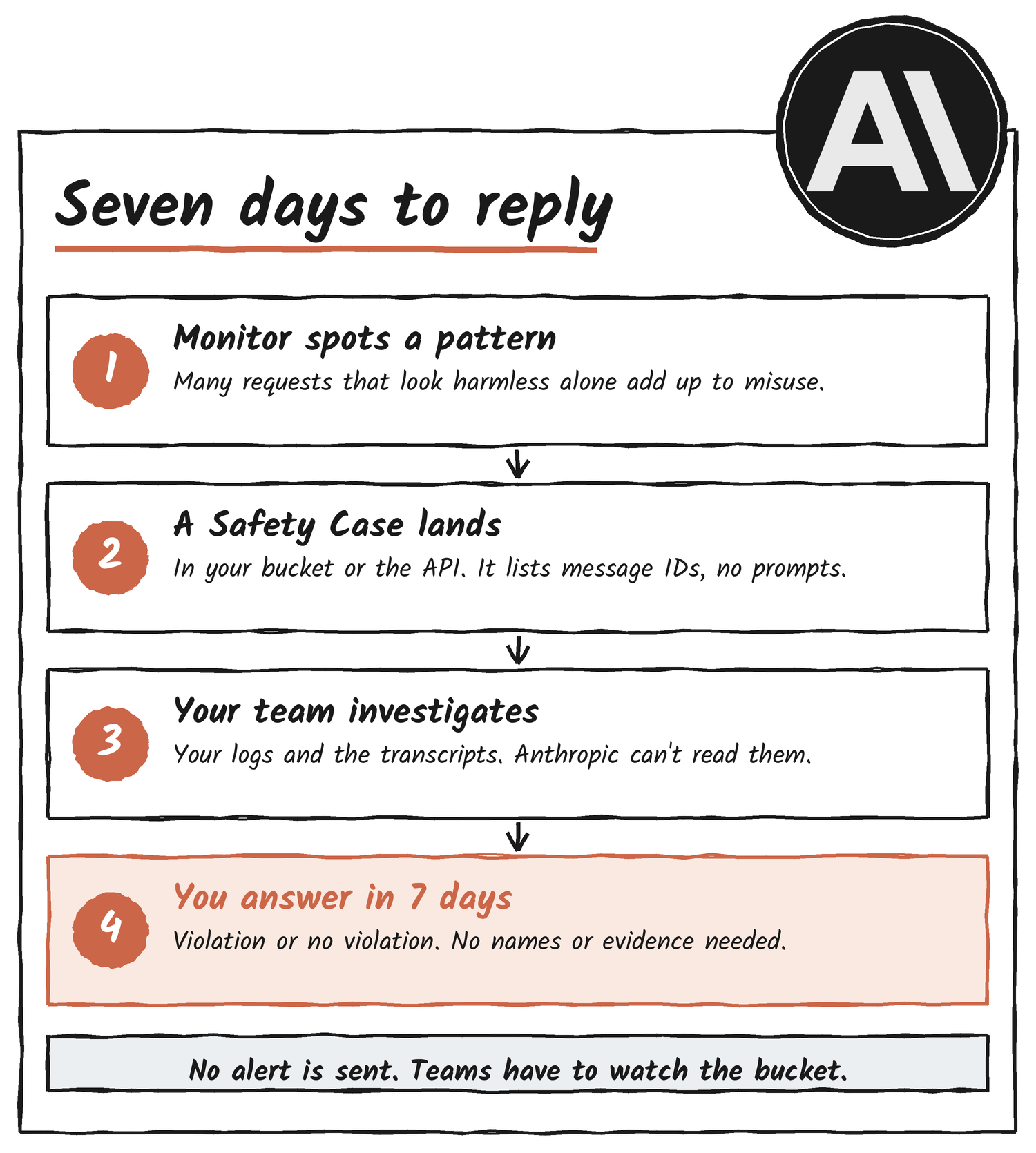
The customer’s security team investigates with its own logs and replies whether it found a violation. It doesn’t have to hand over names, evidence or transcripts, and a valid reply closes the case. The documentation gives seven calendar days. An unanswered case may lead to suspended access, and Anthropic can also suspend access in rare cases of clear, intentional harm while the customer investigates. There are no automatic notifications or webhooks, so teams must watch their storage or, on Claude Platform, poll the beta Safety Cases API.
The two meanings of “30 days”
Bloomberg reports that the 30-day requirement to retain prompts and responses remains for enterprise customers using these models, with the data now housed in cloud environments the customers operate. Anthropic describes EFS as zero data retention: neither it nor the cloud provider keeps the prompts and responses, and the customer stores its own data. Anthropic’s documentation puts the 30 days on the key, which expires within that window. Read together, the data is still kept for monitoring, but by the customer and not by Anthropic.
What the June policy required, and why
Anthropic introduced 30-day retention from 9 June 2026, starting with Claude Fable 5 and Claude Mythos 5. Its reasoning, set out in the September announcement, was that effective detection needs data kept for a meaningful period so it can be correlated across time and accounts. Security is the backdrop: Sulat has covered Anthropic’s 30-day bug disclosure deadline and its photo ID check for individuals who want Claude Mythos 5.2. Anthropic added that the policy wasn’t about training: it says it has never trained on enterprise data without explicit permission and never will.
| Date | What happened |
|---|---|
| 9 Jun 2026 | 30-day retention takes effect, starting with Fable 5 and Mythos 5 |
| 20 Aug | Bloomberg reports Anthropic’s plan to let customers keep the data |
| 1 Sep | Anthropic announces EFS, with temporary ZDR on Fable 5 and 5.1 for eligible customers |
| 9 Nov | Fable 5.2 and Mythos 5.2 arrive; EFS enters private beta with Bridgewater, Salesforce and Stripe |
| 23 Nov (US) | EFS opens in public beta |
Who pushed back
The Verge reported that Microsoft was evaluating whether the new retention rules sat comfortably with its customer data and confidentiality obligations. It also relayed a report from The Information that several AI legal firms had warned the policy could create problems for attorney-client privilege, the rule that shields communications between lawyers and their clients from disclosure.
Anthropic’s own account is blunter. In its September post it said many regulated enterprises found it difficult to use models with data retention, and that adding another trusted data vendor is a lot of work for them: notifying their own customers, updating contracts and meeting internal storage and audit requirements. EFS is designed around that objection, since the sensitive data never leaves the customer’s account.
Which customers and models it covers
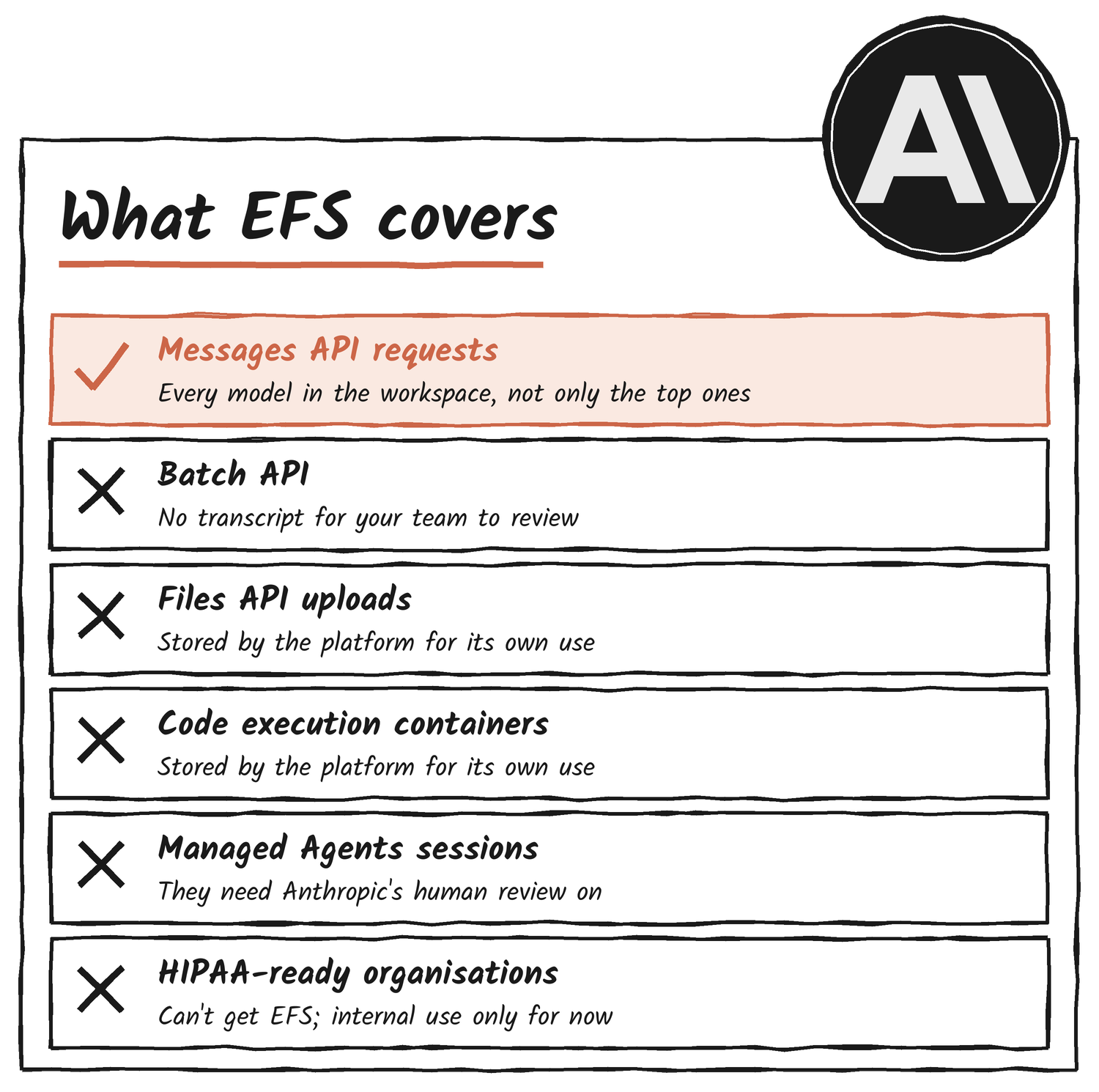
The covered models are Claude Fable 5, 5.1 and 5.2, and Claude Mythos 5, 5.1 and 5.2. The scope is narrow, and the limits are as important as the headline.
| Platform | Status in the beta |
|---|---|
| Claude Platform | Public beta; Safety Cases API available |
| Claude Platform on AWS | Public beta |
| Amazon Bedrock | Public beta; Mythos isn’t covered by EFS on Bedrock, and the ZDR transition runs through at least 30 Jun 2027 |
| Claude on Google Cloud | Public beta |
| Microsoft Foundry | Coming soon |
The documented limits: EFS is for internal use only, it excludes organisations that are HIPAA-ready, and it applies to a whole workspace. Batch, the Files API, code execution containers and Managed Agents aren’t supported. A workspace already on legacy ZDR needs a new workspace to adopt EFS. For the models’ background, Sulat covered the Claude Fable 5.2 launch.
Cost, and who does the work
Anthropic doesn’t charge for EFS. The customer pays its cloud provider for storage, and takes on the work: provisioning the bucket, setting access policies and audit logging, and staffing the review of Safety Cases. Because no alert fires, a team that doesn’t monitor its bucket can miss the seven-day window.
| Safety Case outcome | What it means |
|---|---|
| Valid reply within seven days | Case closes; no names, evidence or transcripts required |
| No reply within seven days | Access may be suspended |
| Clear, intentional harm | Anthropic can suspend access in rare cases while the customer investigates |
How other providers handle retention
Retention for abuse monitoring is standard across the industry, and the windows are similar. What EFS changes is where the monitored copy lives. The figures below are from each provider’s published policy as of October 2026 and may have moved since.
| Provider | Abuse-monitoring retention | Zero-retention route |
|---|---|---|
| Anthropic (EFS) | Customer’s own bucket; key expires within 30 days | ZDR with Sealed Safety Data |
| Anthropic (June policy) | 30 days on Anthropic’s side | Eligible customers only, transitional |
| Mistral | Input and output for 30 rolling days, unless ZDR is on | ZDR agreement |
| Gemini Developer API | 55 days on the paid tier | Separate ZDR page for eligible workloads |
| Vertex AI (Gemini Enterprise Agent Platform) | Up to 90 days from flagged prompts only, to up to 30 days for all prompts, by model class and agreement | By agreement |
Training is a separate question. Anthropic and Google (on its paid API and Vertex) say they don’t train on API data by default. At Mistral, zero data retention and the training opt-out are separate controls.
What comes next
Three things are open. Microsoft Foundry support is promised without a date. Bedrock’s ZDR transition for these models runs through at least 30 June 2027, and Mythos isn’t covered by EFS there. And the system’s own terms can change during the beta.
Anthropic hasn’t published eligibility criteria for EFS or a general availability date.
Sources: Anthropic, Enterprise Frontier Safeguards announcement and technical overview (23 November 2026); Anthropic platform documentation; Anthropic’s September 2026 announcement; Bloomberg (23 November 2026); Unite.AI (23 November 2026); The Verge and The Information via The Verge; vendor retention policies for Mistral, Google Gemini API and Vertex AI (checked October 2026).
Discover more from Sulat AI & Tech News
Subscribe to get the latest posts sent to your email.