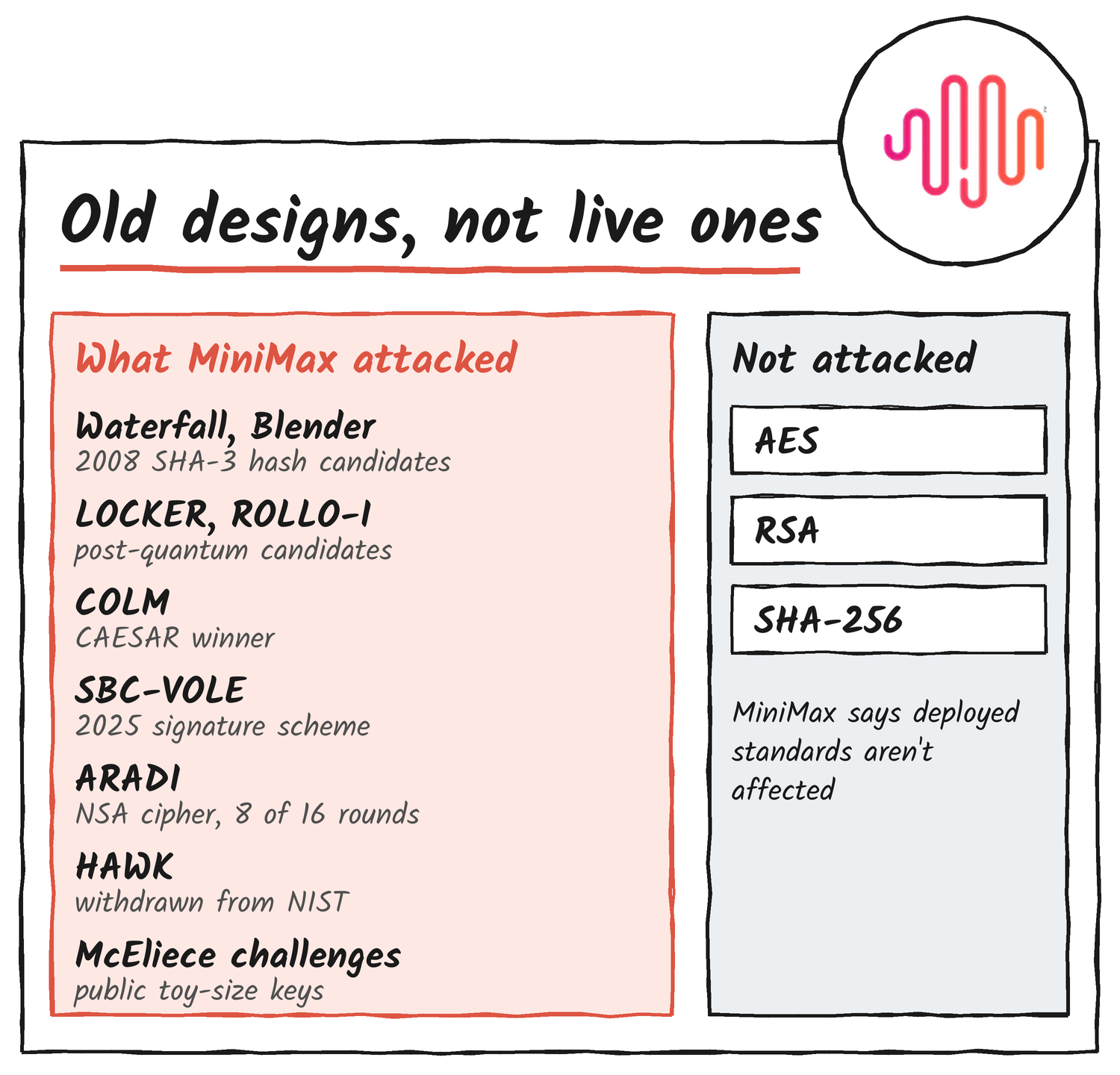
MiniMax says an internal AI model it hasn’t released found practical attacks on older and experimental cryptographic designs, and recovered 55 public McEliece challenge keys that nobody had published a solution for. The company posted its results, plus eight papers with proof-of-concept code, on 20 November. Its own conclusion is blunt about scope: the work “does not affect deployed cryptographic standards.”
The model is called MiniMax’s Internal Model, or MIM. The company’s research post says it ran automated cryptanalysis across three kinds of target: candidates from past NIST competitions, peer-reviewed schemes and competition winners, and public challenge problems. The repository credits a MiniMax Cyber Team of five: Lili Tang, Hao Jiang and Yansong Feng as core contributors, with Tianyi Li and Guancheng Li as project leads.
94
McEliece challenge keys recovered
55
of them first solves
43,400×
best speedup on one instance
8
papers with code on GitHub
What MiniMax released
Each paper in the MiniMax-AI/Research repository covers one target. The repository also lists an earlier result from 23 October, in which MiniMax says it disproved two conjectures about Boolean bent functions and checked the proofs in Lean 4.
| Target | What it is | MiniMax’s result |
|---|---|---|
| TII McEliece | Public key-recovery challenges on McEliece codes | 94 private keys, 55 first solves, up to 43,400× faster than earlier records |
| HAWK | Lattice signature scheme, withdrawn from NIST’s signature process in July | HAWK-256 key recovered in 30.9 minutes on one core; security estimates cut by 9.3 to 23.7 bits |
| COLM | Authenticated cipher in the CAESAR final portfolio | Forged ciphertext from 2 encryption queries, no decryption queries |
| SBC-VOLE | Post-quantum signature scheme from ASIACRYPT 2025 | Secret key from one signature in 0.06 seconds, across every parameter set |
| ARADI | NSA’s low-latency block cipher, published in 2024 | Key recovery up to 8 of 16 rounds in 16 seconds or less; a new 9-round attack |
| LOCKER and ROLLO | Post-quantum key-exchange candidates; ROLLO reached Round 2 | All 9 LOCKER parameter sets broken; ROLLO-I-128 private key in 5.97 seconds |
| Blender | SHA-3 competition hash function, 2008 | Full-round collisions on Blender-256 and a 2^35.9 preimage attack |
| Waterfall | SHA-3 competition hash function, 2008 | Collisions on all four output sizes within a second |
The McEliece keys
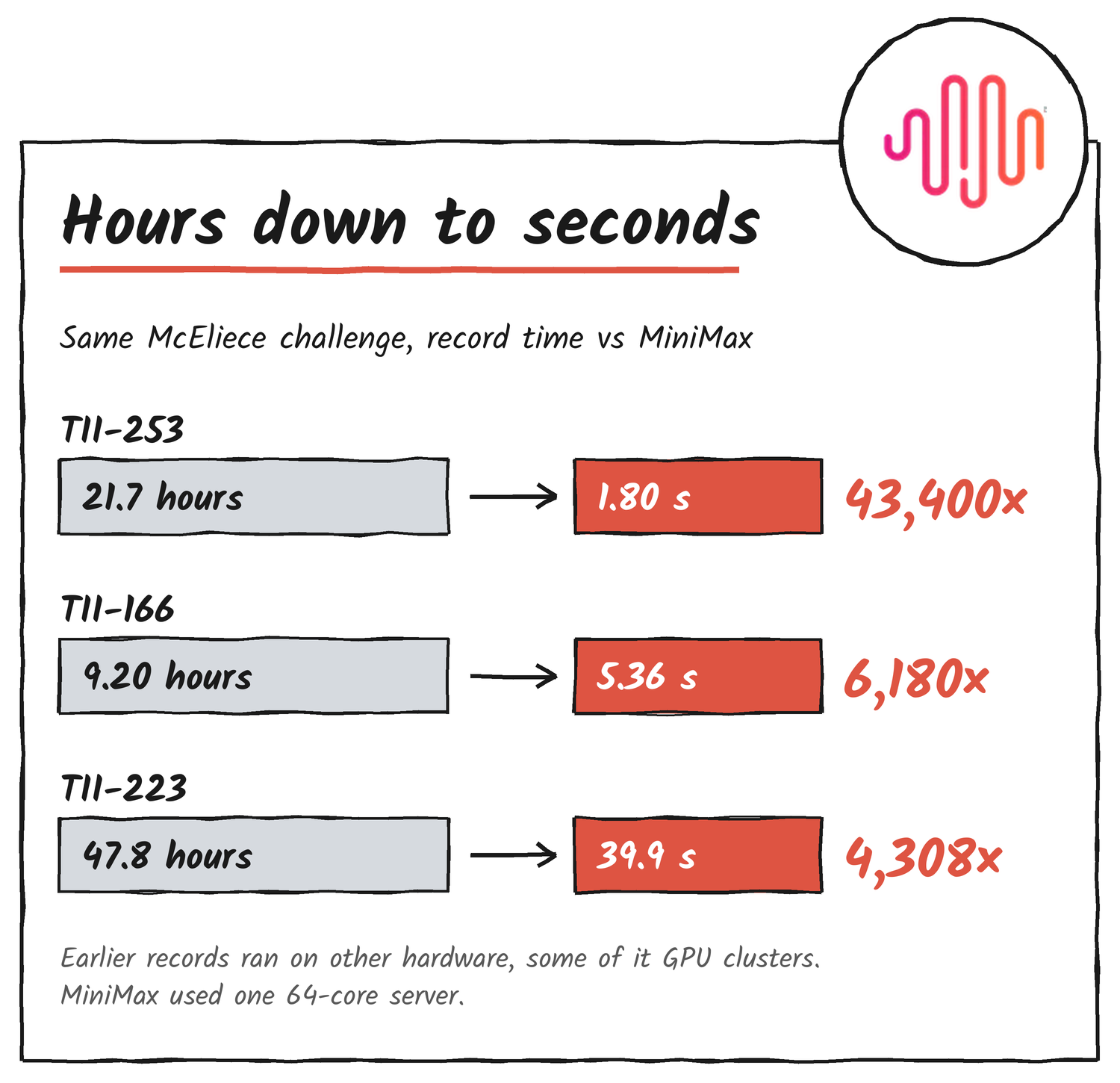
The headline number comes from the TII McEliece Challenges, run by the Technology Innovation Institute’s Cryptography Research Center in Abu Dhabi. McEliece is a public-key scheme from 1978 built on error-correcting codes, and its modern form, Classic McEliece, was a fourth-round NIST candidate that ISO/IEC standardised in June 2026. TII’s key-recovery track gives solvers a public key and asks for the matching private key. There are 206 instances, and the 170 with 83 or more bits of claimed security are the hard ones.
MiniMax’s paper says 41 of those 170 had been solved across eight public papers and repositories before 20 November. MiniMax recovered 94 keys, all of which passed TII’s official SageMath checker. Of those, 55 were first solves and 39 were faster re-solves. The 92 single-node recoveries took 177.82 core-hours between them. The two heavy ones, TII-228 and TII-250, ran on clusters of 2,048 to 10,240 cores and took 2,463 and 66,722 core-hours.
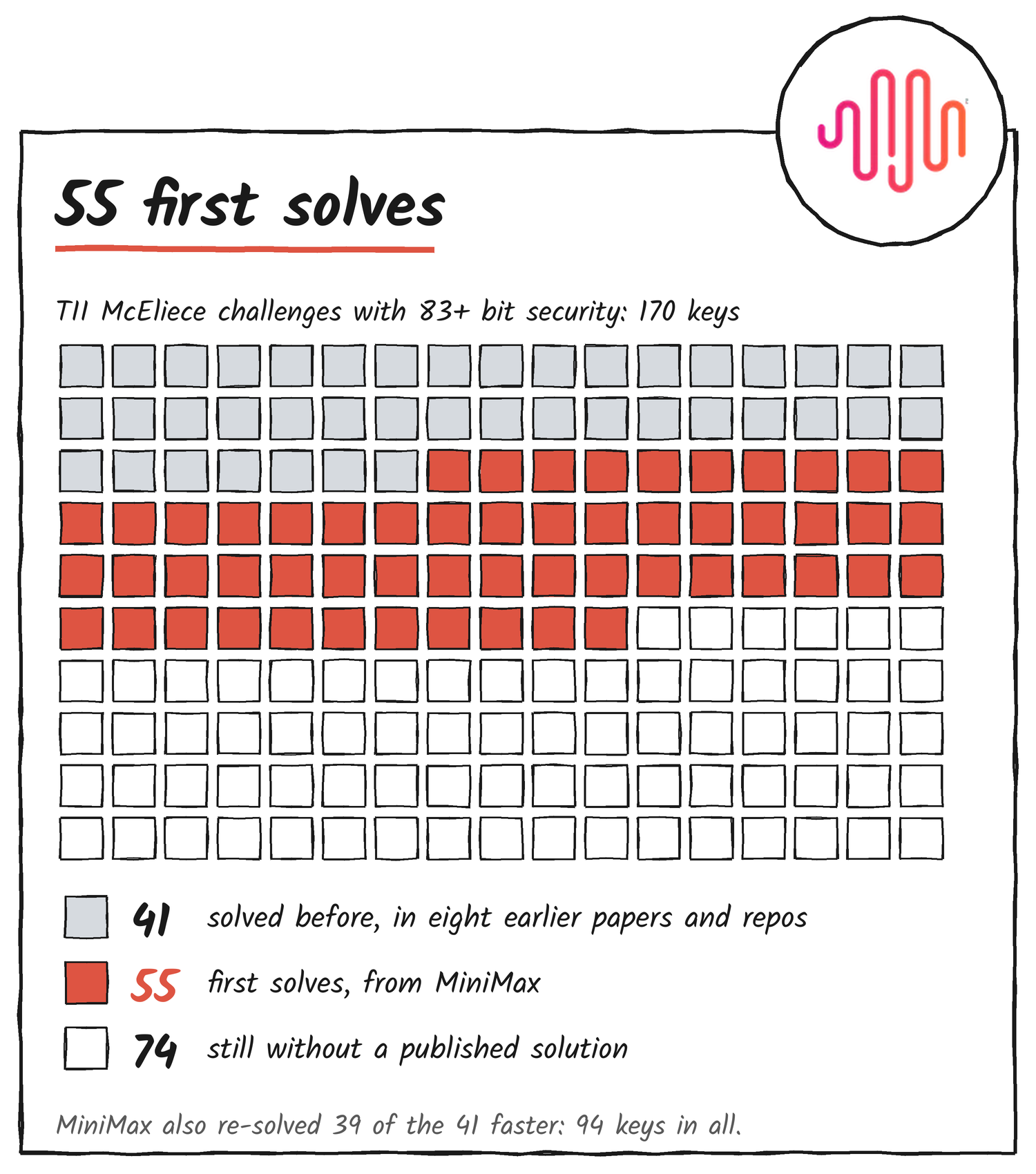
The speedups are large but uneven. On TII-253, MiniMax’s 1.80 seconds compares with 21.7 hours for Anthropic’s earlier hold-out solver, a 43,400× gain in wall time. On TII-166 its 5.36 seconds compares with the CRYPTO 2026 record of 9.20 hours on 72 cores. The repository’s table of earlier records also shows gains as small as 4.17× on TII-252, and the earlier times came from different hardware, some of it GPU clusters. MiniMax used a single 64-core server for the fast cases.
The method is a primal-shortened version of information-set decoding for binary Goppa codes. MiniMax says it shrinks the equation systems by up to 6.59×. The paper also marks where the attack stops. Of the 76 instances the method didn’t solve, 60 don’t contain enough minimum-weight codewords for it to work at all, and 16 need an estimated 10,000 to 100 million core-hours. For Classic McEliece’s standard parameters, the paper says the attack is “far outside the feasible regime.”
How the TII challenge started
TII launched the challenges in May 2023 as a year-long crowdsourced contest. Its 2024 results named Lorenz Panny of the Technical University of Munich as the Track 1B winner, with US$10,000 for recovering the key of an instance rated at 83 bits.
Bugs as well as maths
Not every result is a break of a design. MiniMax says the model found more than a dozen unreported bugs in the reference code that candidates submitted to NIST. In DRS, a first-round lattice signature scheme, a logical AND (&&) was typed as a bitwise AND (&) in the verification code. MiniMax used that to forge signatures from the public key alone, with no signing queries, in 0.1 to 0.8 seconds. In LAC-128, the decryption-failure branch left out a ciphertext copy and hashed uninitialised memory into the derived key. In KCL it found a truncated seed, and in LEDAkem some macro parameter errors that weakened security.
The hash functions and key-exchange candidates are a mix. For Blender, earlier models had only exploited a 64-bit word-size bug in the C code. MiniMax says its attack works on the construction itself, and the repository lists full-round collisions in 0.045 to 0.73 seconds on eight threads, where the blog quotes 0.36 to 2.3 seconds on one core. On LOCKER, MiniMax first patched buffer bugs in the reference code, then solved the underlying rank-metric problem directly, shrinking the solver matrix from 42 petabytes to 58 megabytes and recovering the shared secret across all parameter sets in about two seconds.
Designs that had survived review
The more unusual results are against schemes that had passed human review. COLM was selected for the CAESAR final portfolio after five years of public review and appeared in the Journal of Cryptology in 2024. It claims 64-bit integrity. MiniMax’s paper splices ciphertexts across two initialisation vectors and gets a valid forgery from two encryption queries, where the best earlier route needed 2^64 queries or a weaker security model.
SBC-VOLE, a post-quantum signature scheme with a security proof, has a flaw in its signature-compression step. A verifier can reconstruct values that cancel the secret’s quadratic terms, which leaves 257 linear equations in a 256-bit key. One passive signature is enough to recover it. ARADI is different again. The NSA published it with no formal security bounds and no criteria for its linear-layer constants, and earlier practical attacks reached 5 rounds. MiniMax used algebraic patterns in those constants to reach 8 of 16 rounds on a single core.
What it doesn’t touch
Every target is a retired candidate, an academic design or a challenge key. TechNode, which reported the story on 23 November, says the published work doesn’t establish attacks on mainstream standards such as AES, RSA or SHA-256. The McEliece challenge instances use small codes with extension degrees of 5 to 10, while Classic McEliece’s standard parameters use 12 and 13, with code lengths from 3,488 to 8,192.
Classic McEliece does have a separate problem, and it isn’t MiniMax’s. Germany’s BSI said on 29 September that the scheme “should currently no longer be used in new developments,” citing a run of recent papers that cut the estimated cost of structural key recovery. The BSI limits its current recommendation to hybrid use, will revise it in early 2027, and says the results don’t yet give a practical attack on the recommended parameter sets. FrodoKEM and ML-KEM, which rest on different mathematics, aren’t affected. The note was written seven weeks before MiniMax published.
HAWK, and who got there first
MiniMax isn’t the first lab to publish AI-found cryptanalysis. Anthropic’s Frontier Red Team posted its own results on 28 July, using Claude Mythos Preview. One was a key-recovery attack on HAWK that effectively halved the key size. The other sped up the best attacks on a round-reduced version of AES by 200 to 800 times. Anthropic put each result at roughly US$100,000 in API cost. HAWK’s team withdrew the scheme from NIST’s additional-signatures process the next day, and NIST’s page for the third-round candidates now carries that note.
MiniMax builds directly on that HAWK attack. Anthropic recovered a HAWK-256 key in 3 hours and 42 minutes on a 96-core server. MiniMax reports 30.9 minutes on one core, about 690 times fewer core-hours, and lowers its estimated cost for HAWK-256, HAWK-512 and HAWK-1024 by 9.28, 11.15 and 23.74 bits. The blog rounds the largest of those to 23.8.
| Date | Who | What was published |
|---|---|---|
| 28 July 2026 | Anthropic | HAWK key-size attack and a faster round-reduced AES attack, found with Claude Mythos Preview |
| 29 July 2026 | HAWK team | Withdraws HAWK from NIST’s additional-signatures process |
| September 2026 | Anthropic’s Stephen Weis | Cheaper key recovery for Classic McEliece, plus the key for TII-253, on ePrint |
| 20 November 2026 | MiniMax | Eight papers: 94 McEliece keys, HAWK, COLM, SBC-VOLE, ARADI, LOCKER, ROLLO, Blender, Waterfall |
MiniMax also used the yardstick Anthropic helped build. CryptanalysisBench, from researchers at ETH Zurich, Tel Aviv University, TU Berlin and Anthropic, packs 191 tasks drawn mostly from four NIST competitions. MiniMax ran MIM on Tier 2, which holds 135 schemes with no known practical attack.
How much can be checked
More than most AI announcements, this one can be tested. A recovered key or a colliding pair of messages either works or it doesn’t, and MiniMax’s code is public. The McEliece keys were checked against TII’s own script. The repository does carry a caveat: the manuscripts “may still contain minor bugs or typos and are not yet intended as polished academic papers.” MiniMax says it told the schemes’ authors before publishing. I haven’t found an independent rerun of the attacks as of 23 November.
The model itself isn’t available. MiniMax hasn’t published its size or architecture, and says qualified researchers and developers can apply for testing access at [email protected]. The McEliece paper says its results “were initially developed through an autonomous agent system powered by a MiniMax internal model,” and that the team then validated the main technical claims. The post’s own conclusion says the bottleneck is moving from finding attacks to verifying them, because judging a design’s security margin still falls to human cryptographers.
What to do with it
- Don’t change anything for AES, RSA or SHA-256. None of the papers attack them.
- Read the BSI note if you use Classic McEliece. Its advice to stop new deployments and use it only in hybrid mode comes from other research, and a revised recommendation is due in early 2027.
- Review reference code if you ship a niche or custom scheme. The DRS and LAC flaws were typos and uninitialised memory that two rounds of public review missed.
- Build in crypto-agility. The BSI says cryptanalytic advances can never be ruled out, and keeps its 2031 deadline for finishing the move to post-quantum key agreement.
Discover more from Sulat AI & Tech News
Subscribe to get the latest posts sent to your email.