
Rocco Saviano, who runs digital transformation at the Istituto Nazionale Tumori in Naples, told Help Net Security that banning shadow IT in research “often doesn’t work”. The institute, formally the IRCCS Fondazione G. Pascale and known as the Pascale, tries to see what researchers run first and govern it second. It also uses microsegmentation, so a new or vulnerable system can’t talk to the clinical ones.
The Pascale is a public cancer hospital and research institute in Naples, founded in 1933. It isn’t Milan’s Istituto Nazionale dei Tumori, which is a separate institute with a near-identical name.
What Saviano told Help Net Security
Saviano says shadow IT is everywhere in research and mostly innocent. In the interview he puts it down to “a perceived need to move quickly”, such as trying new software, working with a university, analysing a dataset or spinning up computing capacity fast.
We see more of it than we’d like, but it’s almost normal for the research world.
Rocco Saviano, Help Net Security
His objection to a ban is practical. Prohibiting the behaviour, he says, “only risks moving those devices into areas where IT and cybersecurity no longer have visibility”. So the institute offers researchers secure environments that are simple and quick enough that looking for shortcuts “seems pointless”, and assumes some unplanned systems will still appear.
That second assumption is where segmentation comes in. “If an organization’s security depends solely on perfect, prior knowledge of everything on the network,” he says, “sooner or later something will slip through the cracks.”
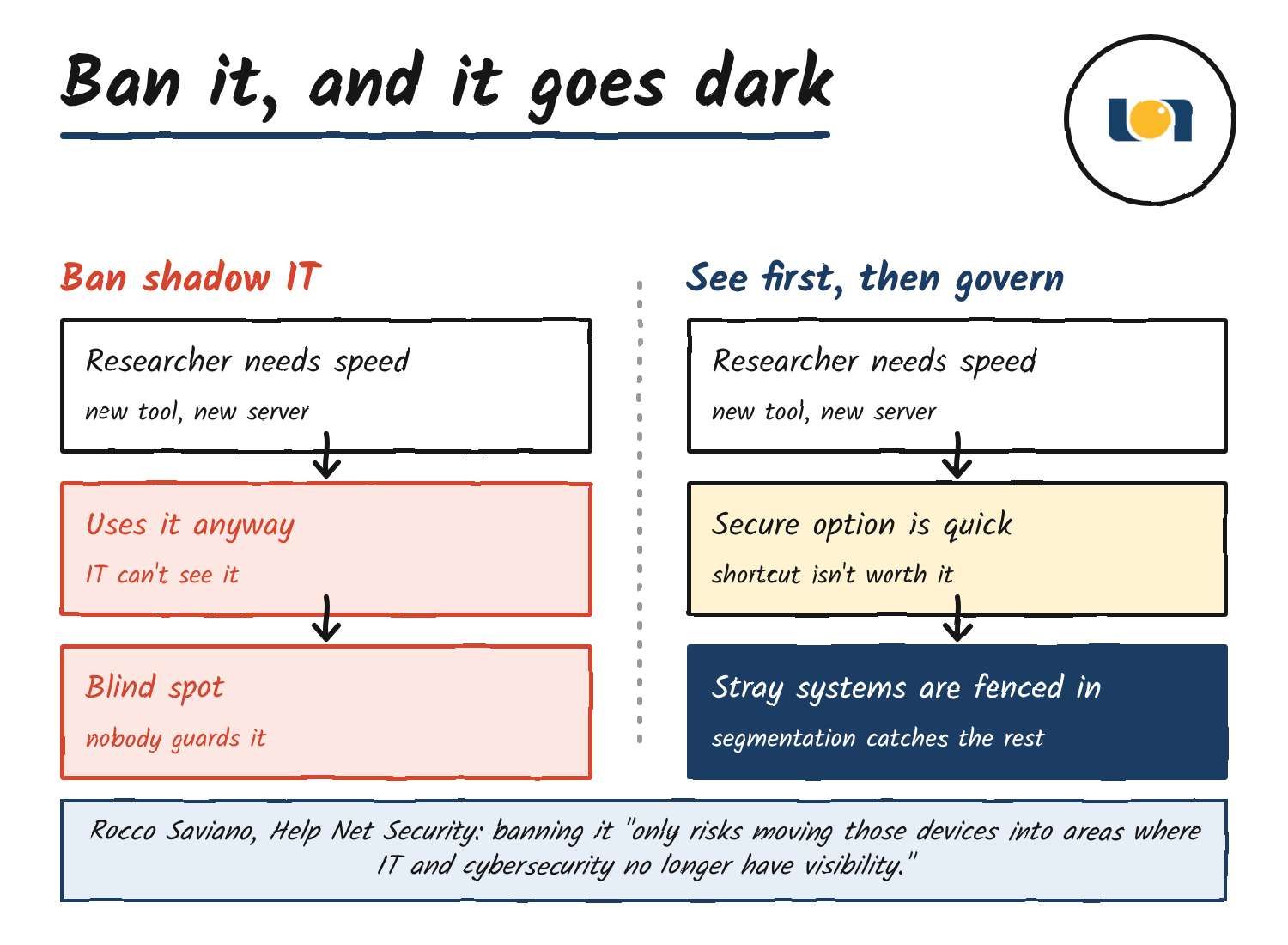
Cybersecurity shouldn’t be the department that constantly says “No.” We must be able to say “Yes, but securely.”
Rocco Saviano, Help Net Security
Isolate the problem, not the hospital
The Pascale runs on a zero trust rule: each system may talk only to the resources it needs. A compromised workstation then can’t reach clinical systems, laboratories or critical devices. Saviano says research and clinical environments are kept separate, with pseudonymised data, controlled access and resource-level segmentation.
He is blunt about what happens when a nurse can’t open a chemotherapy plan: “nothing is administered based on memory or unverified information.” Continuity procedures start, authorised alternative sources are used, and clinical checks run before treatment resumes. Events during the downtime are logged and reconciled afterwards.
For a cyber incident, as opposed to a plain failure, he rules out shutting down the wider network. “The principle is: isolate the problem, not the hospital.”
The same logic covers outside partners. The interview describes sharing cases with smaller hospitals in what it calls the Rare Cancer Network. Saviano says the Pascale’s responsibility ends where its control ends, “but our duty of care does not”. Partners get segregated platforms, strong authentication, time-limited access, pseudonymised data where possible and least privilege. If a partner’s security is weaker, the Pascale shrinks that partner’s reach instead of ending the collaboration.
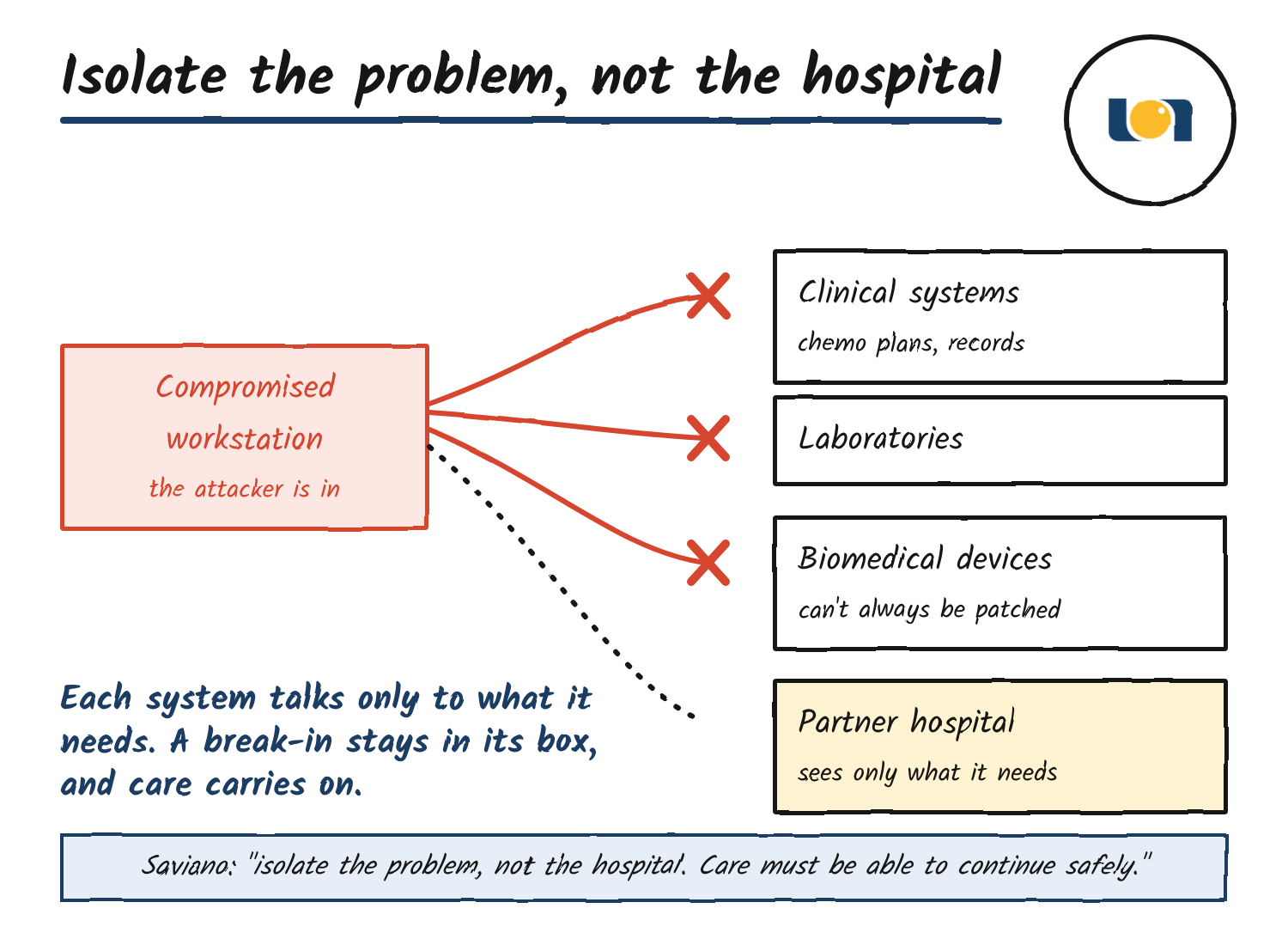
Medical devices are the hard case. Saviano says the EU Medical Device Regulation is “probably” the rule with the greatest procedural burden compared with its immediately perceptible cyber benefit, because certified devices can’t always be patched as freely as a server. Segmentation fills the gap: “Segmentation thus becomes a form of compensatory control.” He credits NIS2, the EU’s network security directive, as the rule that changed the institute’s thinking most, from asking “How do we prevent an attacker from getting in?” to also asking “If he gets in, how far can he reach?”
The vendor, and what its case study claims
Saviano names Zero Networks as the institute’s microsegmentation platform, including its secure remote access for third parties. Zero Networks published a case study on the Pascale in April 2026, with Saviano quoted. The figures below come from that vendor document:
- A 5 out of 5 in a cybersecurity maturity assessment tied to NIS2 enforcement, against a regional healthcare average of 3.
- Lower cyber insurance premiums, after the insurer compared several healthcare institutions in the region.
- About one full-time equivalent of staff time regained through automated policy creation.
- Unsanctioned devices and previously hidden traffic patterns surfaced once the platform watched internal traffic.
The case study says the institute’s VLANs, access control lists and firewall policies gave baseline protection but not certainty about internal traffic. “Traditional segmentation gave us structure, but it didn’t give us confidence,” Saviano is quoted as saying. The institute had already picked Fortinet for its network and perimeter, as Sanità Digitale reported in 2021. The audit behind the 5 out of 5 score hasn’t been published, and the Pascale hasn’t said how many unsanctioned systems it found.
Why availability is the constraint
The Pascale has little paper to fall back on. Il Mattino reported on 18 September 2026 that bedside tablets now track therapy and drug administration across about 90 per cent of its wards. In the pathways covered, paper records are gone and the time to retrieve patient information has halved.
It also sits at the centre of a regional network. Campania gave the Pascale the job of building the hardware and software behind the Campania Oncology Network, and a 2023 project sheet put that network at about 50,000 cancer patients across all 17 health and hospital bodies in the region. An agreement in Abruzzo’s official bulletin of 1 September 2026 lets that region reuse the network’s ROC/Sinfonia 2.0 platform, with Saviano’s IT team helping adapt it.
What an outage costs elsewhere
The clearest recent case is Synnovis, the pathology provider hit by Qilin ransomware on 3 June 2024. NHS England’s tally for the two most affected London trusts:
10,152
outpatient appointments postponed
1,710
elective procedures postponed
97
cancer treatments postponed in the first week
The 97 figure comes from NHS London’s first weekly update, covering 3 to 9 June 2024. NHS data obtained by Bloomberg showed two cases of severe harm, 11 of moderate harm and more than 120 of low harm in four London boroughs. A King’s College London report says the attack possibly contributed to the death of at least one patient. Computer Weekly reported in June 2026 that the forensic investigation took nearly 18 months and that Qilin published over 400GB of data.
An EU Joint Research Centre study from 2024 found 21 European healthcare cyber incidents that could have affected patients and said none appeared to have caused direct health consequences. The effects it did find were postponed therapies, delayed surgeries, diverted ambulances and limited emergency room access.
Italy’s National Cybersecurity Agency (ACN) counts significant healthcare ransomware events: 10 in 2024, 5 in 2025 and 8 in the first half of 2026.
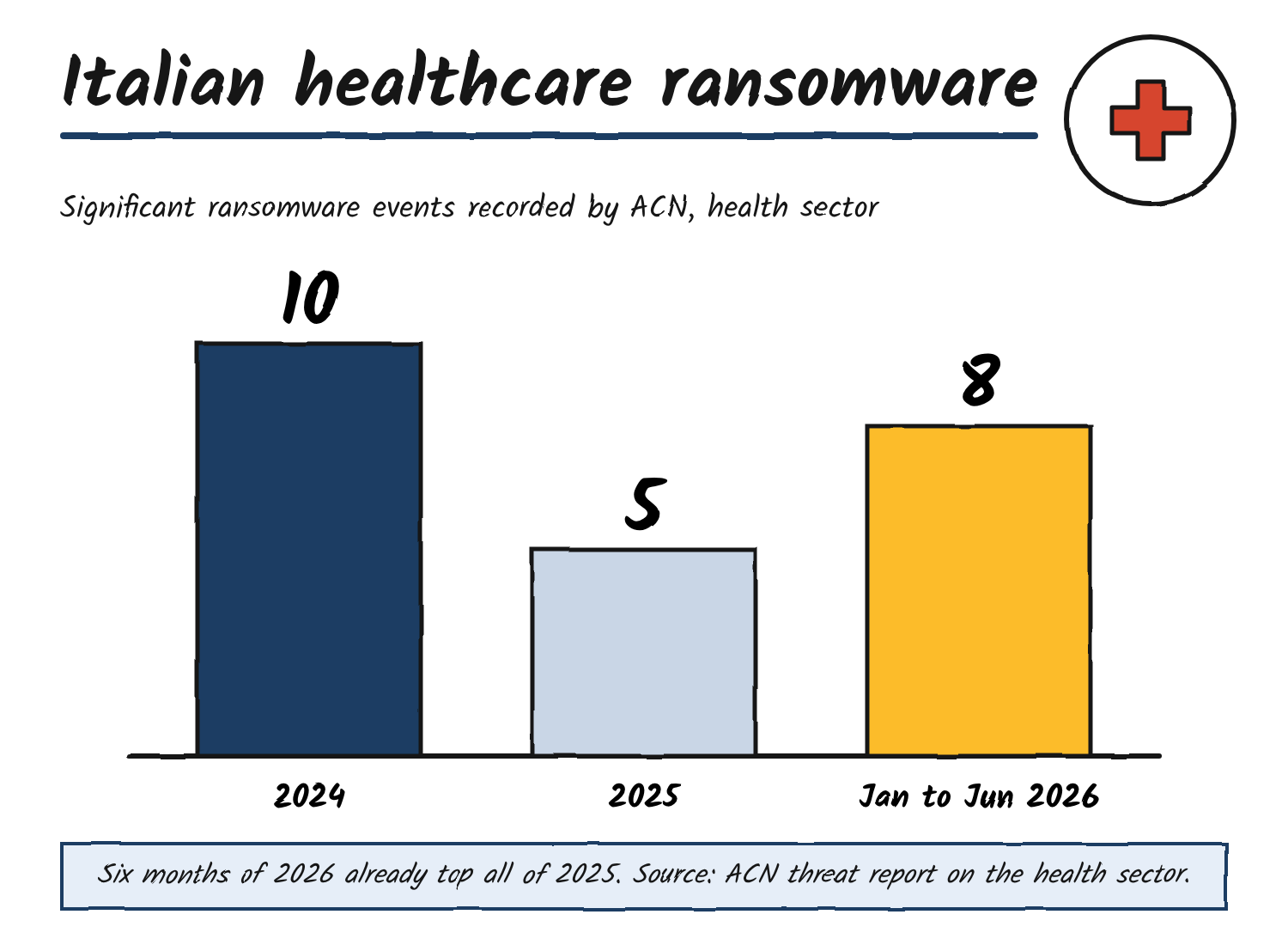
ACN’s health sector report records 151 cyber events and 102 incidents in January to June 2026, up from 45 and 13 a year earlier. ACN says part of that rise comes from NIS2 incident notification becoming mandatory in January 2026. The report lists decentralised IT buying, too few dedicated security staff and obsolete devices as causes of bad practice.
ACN’s September 2026 operational summary describes a ransomware attack on a hospital complex spread over two sites. The compromise of its virtualised infrastructure and storage closed one facility temporarily and limited patient management at the other, and ACN says a flaw in a perimeter device was the possible way in. Among the countermeasures it lists are network segmentation, multi-factor authentication, least-privilege accounts and tested, unalterable backups.
The rules behind it
Italy brought NIS2 into law through decree 138 of 2024, and healthcare is one of its high-criticality sectors. An Italian compliance guide says large providers, with 250 or more staff or €50 million in turnover, are normally “essential” entities. It puts the maximum fine at €10 million or 2 per cent of worldwide turnover for essential entities, and €7 million or 1.4 per cent for important ones. Boards must approve the security measures and answer for them.
The Pascale’s own region has just added a layer. On 12 November 2026 Campania’s government set up a permanent NIS2 board with rules for information flows, monitoring and a link to the regional incident response team.
How other health systems treat unsanctioned tools
| Who | Stance on unsanctioned tools | What it leans on |
|---|---|---|
| Pascale, Naples | See first, then govern. A ban hides the problem. | Microsegmentation, separate research and clinical environments, pseudonymised data |
| US health systems (CMIO panel) | Blocking is “impractical and counterproductive”. Unsanctioned use signals an unmet need. | Broader governance, plus approved tools rolled out widely |
| ACN, Italy | Names decentralised buying and obsolete devices as causes of bad practice. | Segmentation, EDR/XDR, multi-factor authentication, tested backups |
| NHS, after Synnovis | A supplier’s outage reached hospitals’ patients. | King’s College London calls for central oversight and shared capability |
The numbers on unsanctioned AI tools back the point that people reach for them to save time. A December 2025 Wolters Kluwer Health survey of 518 healthcare workers found 17 per cent had used unapproved AI tools and 40 per cent had come across them. Of those who had used them, 45 per cent said their main reason was a faster workflow. Wolters Kluwer Health commissioned the survey and sells clinical AI tools.
At a May 2026 Becker’s session, four health system chief medical informatics officers, in a session hosted by Wolters Kluwer Health, said blocking was both impractical and counterproductive. SSM Health’s Ann Cappellari said only about 2 per cent of its physicians had access to an approved ambient documentation tool while hundreds waited for one. In Sweden, a study of 357 physicians in the Journal of Medical Internet Research found they used unauthorised AI for clinical decision support, paperwork and research, and noted that general-purpose chatbots haven’t passed the conformity assessment the Medical Device Regulation requires for clinical use.
Discover more from Sulat AI & Tech News
Subscribe to get the latest posts sent to your email.