AMD says it has completed its purchase of Taalas, the Toronto startup that builds AI chips with one model hardwired into the silicon. AMD’s completion release, dated 17 November, gives no price. Its quarterly filing does: about US$2.9 billion in cash and stock, of which up to about US$1.4 billion is contingent.
AMD plans to fold Taalas’s technology into its accelerator roadmap and build systems around it alongside Instinct GPUs. DigiTimes Asia, which dates the announcement 18 November, frames the deal as AMD’s GPU-plus-ASIC answer to Nvidia’s CUDA. AMD’s releases don’t mention CUDA. They name AMD’s own software, ROCm.
- What AMD announced
- What AMD paid
- What Taalas builds
- The company and its backers
- AMD’s run of AI deals
- How the peers compare
- The CUDA question
- What isn’t known
- Sources
What AMD announced
AMD announced a definitive agreement to buy Taalas on 6 August 2026. The completion release came 103 days later. Vamsi Boppana, senior vice president of AMD’s Artificial Intelligence Group, said in it:
With Taalas now part of AMD, we’re expanding our ability to deliver differentiated inference performance and efficiency, while strengthening our full-stack AI platform.
Vamsi Boppana, AMD, 17 November 2026
AMD says it will integrate Taalas’s technology into its accelerator roadmap and develop system-level solutions alongside Instinct GPUs. It lists EPYC CPUs, ROCm software and the Helios rack-scale system as the rest of that platform. The release also says the deal expands AMD’s engineering presence in Canada.
The August release carried a line from Ljubisa Bajic, Taalas’s co-founder and CEO: “We founded Taalas to rethink AI inference from the ground up by building the hardware around the model.” SiliconANGLE reported that his Toronto team joins Boppana’s group.
US$2.9 billion
Price in AMD’s 10-Q, cash and stock
103 days
From agreement to the completion release
~US$219 million
Taalas’s total funding before the deal
17,000
Tokens a second per user on HC1, Taalas’s own figure
What AMD paid
Neither press release states a price. AMD’s 10-Q for the quarter ended 26 September, filed on 3 November US time, does. Note 5 says AMD agreed in August “to acquire Taalas Inc., a developer of specialized inference silicon, in a cash and stock transaction valued at approximately $2.9 billion, including contingent consideration of up to approximately $1.4 billion.”
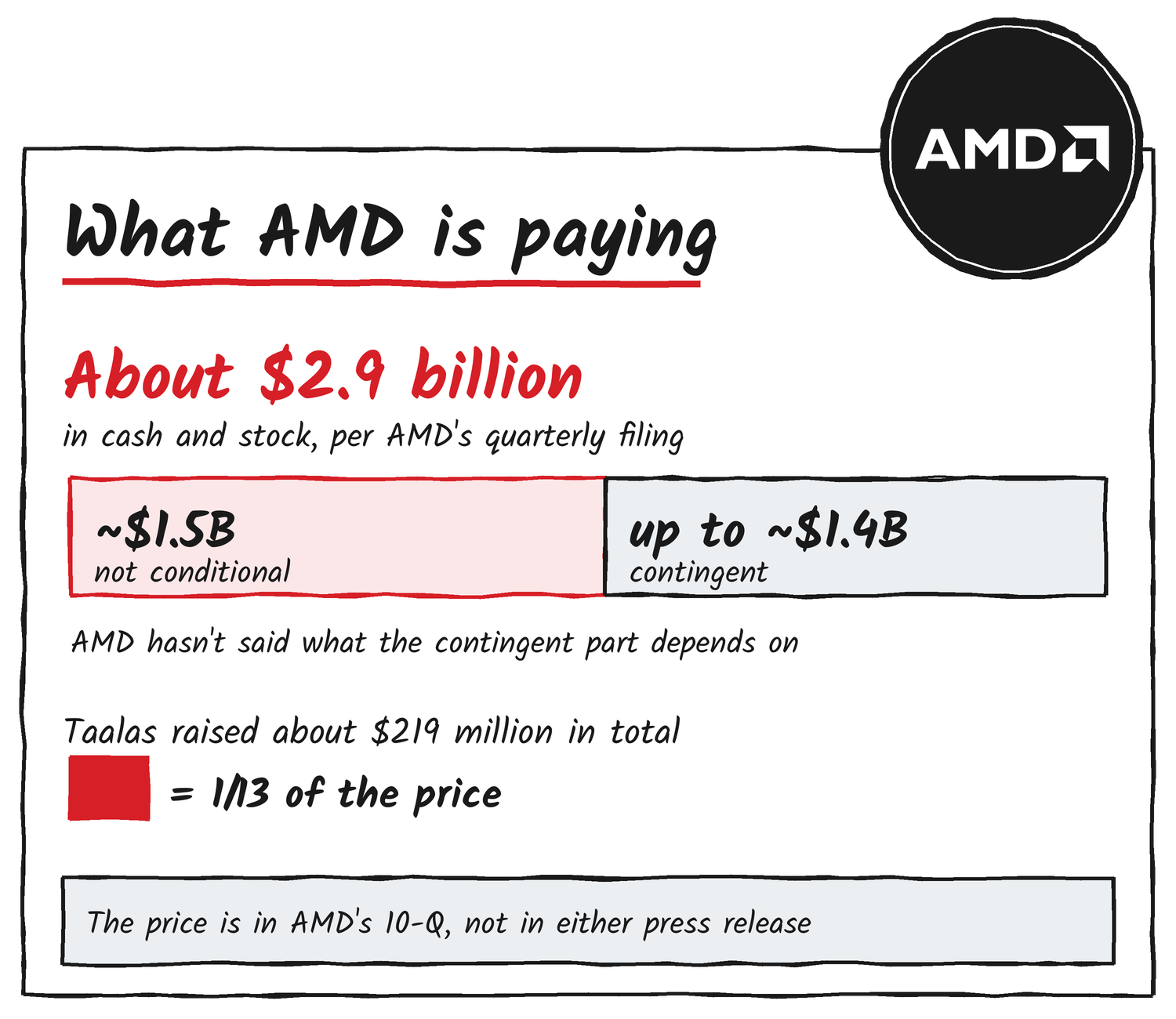
That leaves about US$1.5 billion not labelled contingent, by our arithmetic from the two rounded figures. The filing doesn’t say how the fixed part splits between cash and shares, and it doesn’t say what the contingent part depends on. AMD’s completion release adds neither.
AMD’s 2025 purchase of ZT Systems is the nearest comparison. Its total consideration was US$4.4 billion: US$3.2 billion in cash, US$860 million in shares and US$361 million contingent, about 8% of the total. AMD says that contingent part was settled in October 2025. Up to about 48% of the Taalas price is contingent.
Against what Taalas raised, the price is about 13 times its roughly US$219 million in funding, or about 7 times on the fixed part alone. The agreement came less than six months after its US$169 million round in February.
What Taalas builds
Taalas makes chips that cast one model’s weights and dataflow into the silicon, instead of loading them from memory each time. Its first product, HC1, is a hardwired Meta Llama 3.1 8B. Taalas’s product page lists the specs.
| Spec | HC1 | Source |
|---|---|---|
| Model | Meta Llama 3.1 8B, hardwired | Taalas |
| Process | TSMC 6nm | Taalas |
| Die size | 815 mm² | Taalas |
| Transistors | 53 billion | Taalas |
| Server power | 2.5 kW | Taalas |
| Speed | 17,000 tokens a second per user, 1,000-token input and output | Taalas’s own lab |
| Claimed edge | Nearly 10x faster than the current state of the art, 20x cheaper to build, 10x less power | Taalas |
Taalas says the design needs no high-bandwidth memory, advanced packaging, 3D stacking, liquid cooling or high-speed I/O. It says a previously unseen model can become silicon in two months. SiliconANGLE reports that only two of the chip’s more than 100 layers change between designs.
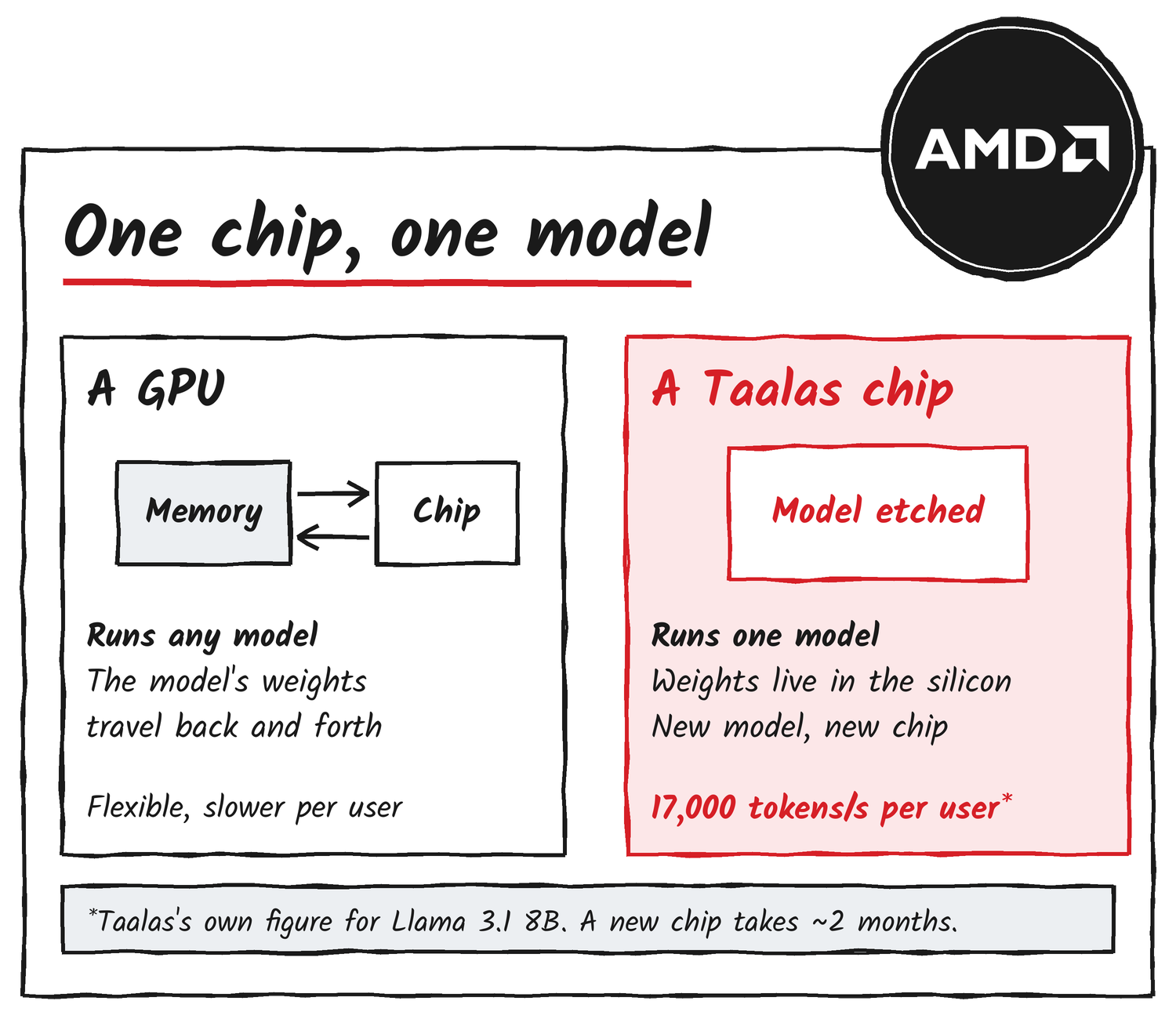
The trade-off is flexibility. A finished chip runs the model it was built for and nothing else, so a new model means new silicon. HC1 keeps a configurable context window and supports fine-tuning through low-rank adapters. Llama 3.1 8B came out in July 2024.
Taalas says its first-generation chips store weights in a mix of 3-bit and 6-bit parameters, which costs some quality against GPU results, and that its second generation moves to standard 4-bit floating-point formats. Unite.AI relays both points. SiliconANGLE reports a second chip, HC2, aimed at models of about 20 billion parameters.
What “tokens a second per user” counts
It measures how fast one person’s answer streams out. It isn’t the total a chip serves to everyone at once, so it favours chips built for speed on a single request.
The company and its backers
Taalas was founded in August 2023 in Toronto by Ljubisa Bajic, Lejla Bajic and Drago Ignjatovic. DatacenterDynamics describes Ljubisa Bajic as a former architect at both AMD and Nvidia and a co-founder of Tenstorrent. Tech.eu puts Tenstorrent’s valuation at US$6.2 billion.
Taalas raised US$169 million in February, which Reuters reported on 19 February. SiliconANGLE names Quiet Capital, Fidelity and semiconductor investor Pierre Lamond, and puts the total raised at about US$219 million. Tech.eu adds Belgrade’s Fifth Quarter Ventures to the investors, and quotes its general partner, Tihomir Bajic:
When we started Fund I, betting on AI compute from Belgrade sounded esoteric. Today, it proves to be the right call.
Tihomir Bajic, Fifth Quarter Ventures, to Tech.eu
AMD’s run of AI deals
Taalas is one of several purchases AMD has made to build out its AI stack. SiliconANGLE counted it as AMD’s third AI acquisition in nine months at the time of the August announcement, after MK1 in November 2025 and the memory-optimisation startup Mext in June, with the FastFlowLM team joining in July. The two largest are in the table.
| Deal | Value | Status | Source |
|---|---|---|---|
| ZT Systems | US$4.4 billion total, including US$361 million contingent | Completed March 2025; manufacturing arm sold to Sanmina in October 2025 | AMD 10-Q |
| Taalas | About US$2.9 billion, up to about US$1.4 billion contingent | Completion announced 17 November 2026 | AMD 10-Q |
| World Labs | About US$8.2 billion, all stock | Completion announced 16 November 2026; Fei-Fei Li is AMD’s chief scientist | AMD |
Taalas and World Labs together come to about US$11.1 billion on AMD’s rounded figures. In its 10-Q, AMD says it agreed to buy both “to strengthen our model research and inference capabilities and development of future super intelligence (SI) hardware, software and systems.”
How the peers compare
Nvidia took a different route into the same market. It signed a non-exclusive licence for Groq’s chip technology on 24 December 2025, hired Groq’s founder, Jonathan Ross, and president, Sunny Madra, and says its Groq 3 LPX rack has been in full production since 24 August. CNBC reported the price at about US$20 billion. Groq’s announcement didn’t disclose one.
| Company | Approach | Latest money | Source |
|---|---|---|---|
| Nvidia | Licensed Groq’s chip technology; Groq 3 LPX racks alongside Vera Rubin GPUs | About US$20 billion licence, as CNBC reported | Groq |
| Cerebras | Wafer-scale chips; split inference with AMD GPUs and AWS Trainium | US$5.55 billion IPO in May; US$210.8 million third-quarter revenue | Cerebras |
| Etched | Its own inference chips | US$700 million at a US$21 billion valuation, 18 August | Etched |
| SambaNova | SN50 chips paired with Intel GPUs | Valued at US$11 billion in July | Sulat analysis |
| Positron | Atlas racks | US$875 million at a US$5 billion valuation, 10 September | Positron |
| d-Matrix | Corsair accelerator | In full production since 9 June | d-Matrix |
| AMD | Taalas hardwired chips plus Instinct GPUs; a Cerebras pairing announced 23 July | About US$2.9 billion for Taalas | AMD 10-Q |
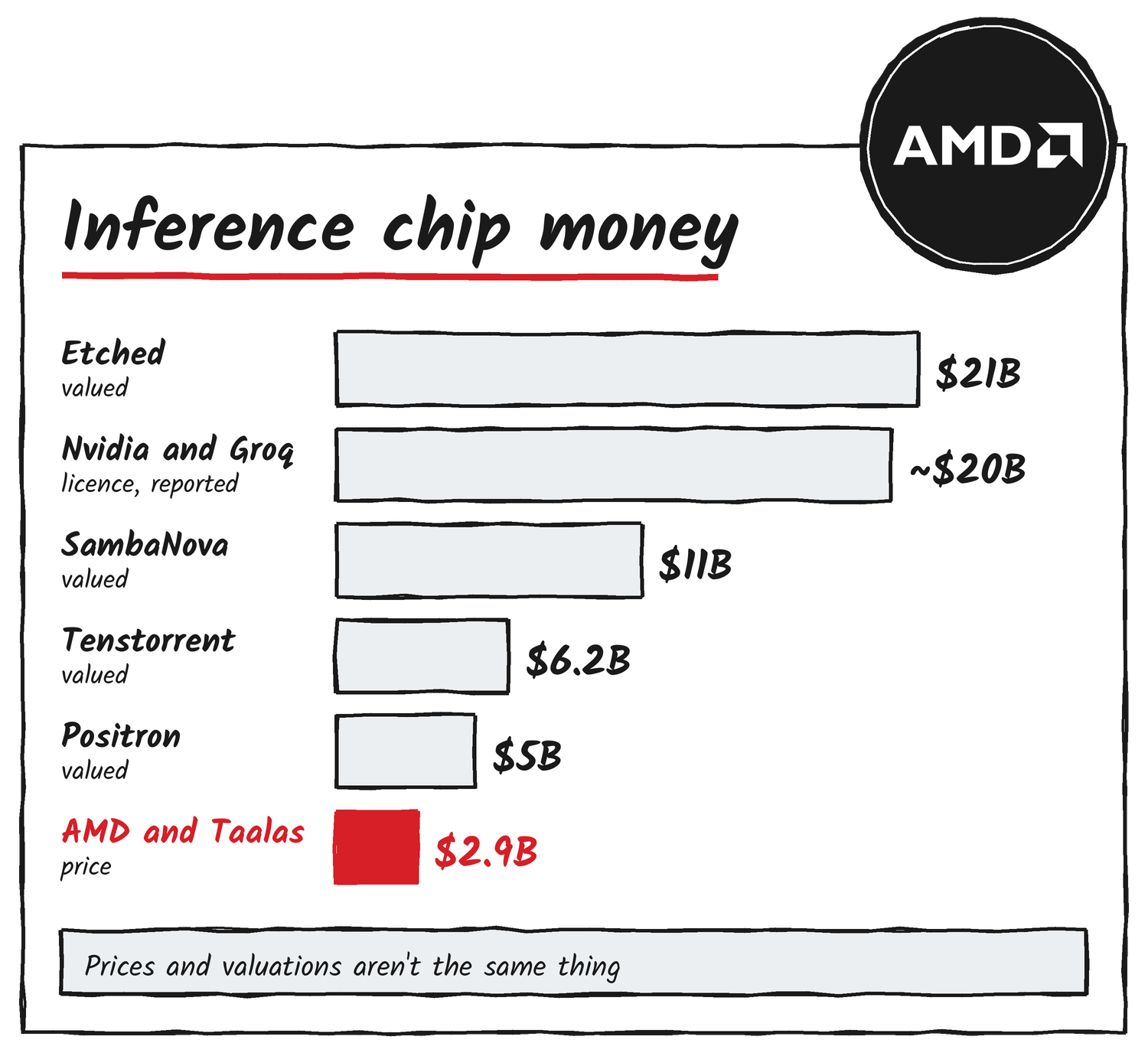
Taalas builds one chip per model. AMD says it will pair that with Instinct GPUs, which run any model, so it now sells both ends of the range.
The CUDA question
DigiTimes’s headline says AMD is targeting CUDA with a GPU-plus-ASIC approach to inference. AMD’s own releases describe a different aim: more choice, with “the right compute solutions for every AI workload,” in Boppana’s August words. They name ROCm, Instinct, EPYC and Helios, and not CUDA.
SiliconANGLE describes the plan as Taalas chips working next to Instinct GPUs, wired into Helios racks and EPYC processors and programmed through ROCm. A Taalas chip runs the one model it was built for, so there’s no model code to port to it. The software work sits in routing requests between GPUs and fixed chips, and AMD hasn’t described that.
The deal also lands in a week of other AMD and Nvidia news:
- AMD’s shares fell up to 11% on 20 November after Hunterbrook published a short report, which AMD says misrepresents its business.
- Taiwan’s server makers say Nvidia rack demand is unchanged since Jensen Huang resigned.
- Anthropic told investors that Claude Mythos Preview got Claude running on AMD GPUs in about three days.
What isn’t known
- AMD hasn’t said when a Taalas-based product will ship or how it will be packaged.
- AMD hasn’t said what the up to US$1.4 billion of contingent payments depends on, or how the fixed part splits between cash and shares.
- AMD’s release gives no closing date, only the date of the announcement. It doesn’t say how many Taalas staff joined.
- Taalas’s speed, cost and power figures are its own, measured on one 8-billion-parameter model.
- AMD hasn’t said whether the second-generation chips or HC2 will reach customers under the AMD name.
Sources
- AMD completes acquisition of Taalas, AMD, 17 November 2026
- AMD acquires Taalas, AMD, 6 August 2026
- AMD Form 10-Q, quarter ended 26 September 2026, Note 5
- AMD completes acquisition of World Labs, 16 November 2026
- The path to ubiquitous AI, Taalas, 19 February 2026, and its product page
- AMD acquires Taalas to hardwire AI models into silicon, SiliconANGLE, 6 August 2026
- AMD acquires AI chip startup Taalas for $2.9B, Tech.eu, 23 November 2026
- Analysis: AMD lands Taalas, targets CUDA with GPU-ASIC inference, DigiTimes Asia, 23 November 2026
- AMD closes Taalas deal to add model-specific AI inference chips, Unite.AI, 17 November 2026
- AMD acquires AI chip startup Taalas, DatacenterDynamics
Discover more from Sulat AI & Tech News
Subscribe to get the latest posts sent to your email.