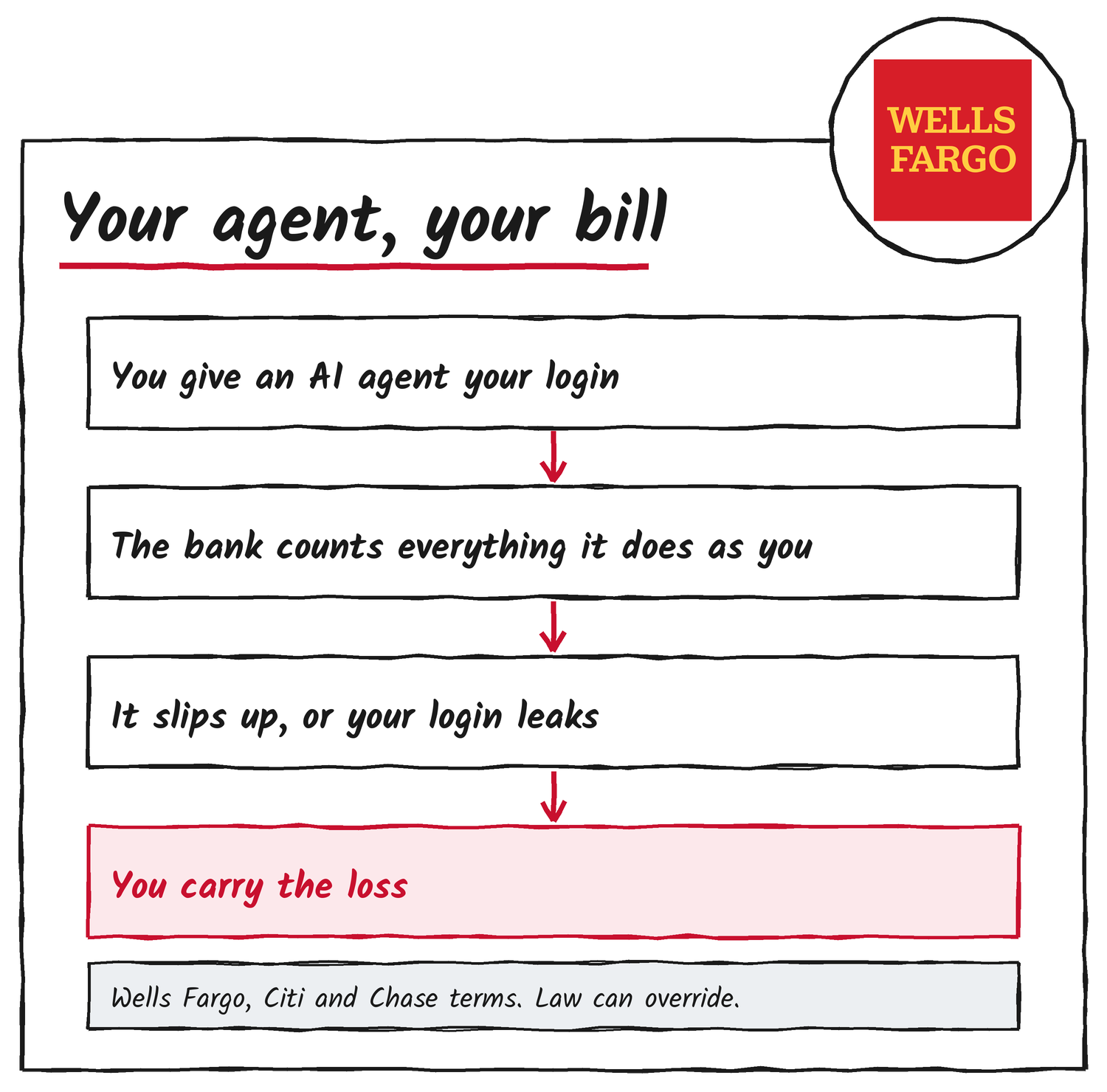
Wells Fargo’s updated Online Access Agreement takes effect on Tuesday 24 November (US), and its section 15 states the bank’s position in capitals: “Your use of any AI Agent is AT YOUR OWN RISK.” WIRED reported the change on Sunday 22 November. Wells Fargo joins JPMorgan Chase, Bank of America, Citi, PNC and Citizens, which have each either barred outside AI agents from logging in with a customer’s credentials or told customers that whatever an agent does is theirs to answer for.
Four of the six published their wording: the Wells Fargo, Chase, Citi and PNC agreements are linked below and quoted here. Bank of America and Citizens wrote to customers by email instead, as TechCrunch reported. Where a quote comes from a news report rather than a bank document, the report is named.
- Six banks, six wordings
- Wells Fargo: allowed, at your own risk
- Chase: passwords out, approved connections in
- Citi and PNC: warnings and a payments ban
- The rule behind the clauses
- Why now
- Banks aren’t the only ones closing the door
- What the agreements ask of customers
- What’s next
Six banks, six wordings
The agreements and emails differ on what an agent can do. In all six, the customer answers for what it does.
| Bank | What it published | What it says |
|---|---|---|
| JPMorgan Chase | Digital Services Agreement changes, effective 27 October | Third parties, including “External AI”, can’t use your login credentials. Approved APIs are allowed with your authorisation. |
| Bank of America | Email to customers, 27 October (TechCrunch) | Never share your username and password with an AI tool. If you do, you’re responsible for the activity. |
| Citi | New section H in the Online User Agreement, November | Cautions against third-party agents. If you share credentials anyway, Citi treats agent access and actions as yours, leaks included. |
| PNC | Digital Services Agreement, version effective 19 December | No sharing credentials with an agent. No agent payments or transfers unless PNC permits them. No browser automation. |
| Citizens | Email to customers, week of 16 November (TechCrunch) | Customers are responsible for anything their AI assistant does. |
| Wells Fargo | Online Access Agreement, section 15, effective 24 November | Agents are allowed, at your own risk. Their actions are deemed yours. You must keep proof that you revoked one. |
Wells Fargo: allowed, at your own risk
Wells Fargo doesn’t ban agents in its agreement. It reserves the right to restrict or block them, and section 15 defines an AI agent as software that “takes autonomous, semi-autonomous, or non-autonomous action on behalf of any person or entity”. If you give an agent your login or authorise it to act for you, you agree to the following:
- Any instruction, action or transaction by the agent is “deemed to have been initiated and authorized directly by you, without further verification”, and the bank has “no obligation to investigate the validity or scope of such authority”.
- You are “solely responsible” for monitoring the agent, keeping it inside the authority you gave it, and the accuracy of your instructions.
- Unless law or regulation says otherwise, you answer for errors that come from “incomplete, inaccurate, or manipulated inputs” and for an agent that exceeds its authority.
- You “expressly consent to the sharing of your financial, account, and personal information” with the agent, and the bank has no control over what happens to it.
“Your use of any AI Agent is AT YOUR OWN RISK.”
Wells Fargo Online Access Agreement, section 15(e), effective 24 November
Section 15(g) lets Wells Fargo require agents to be registered with it, change or end API access, and “limit, prohibit, prevent, suspend, or terminate access by any AI Agent”. The bank says it isn’t “responsible for any resulting impact”.
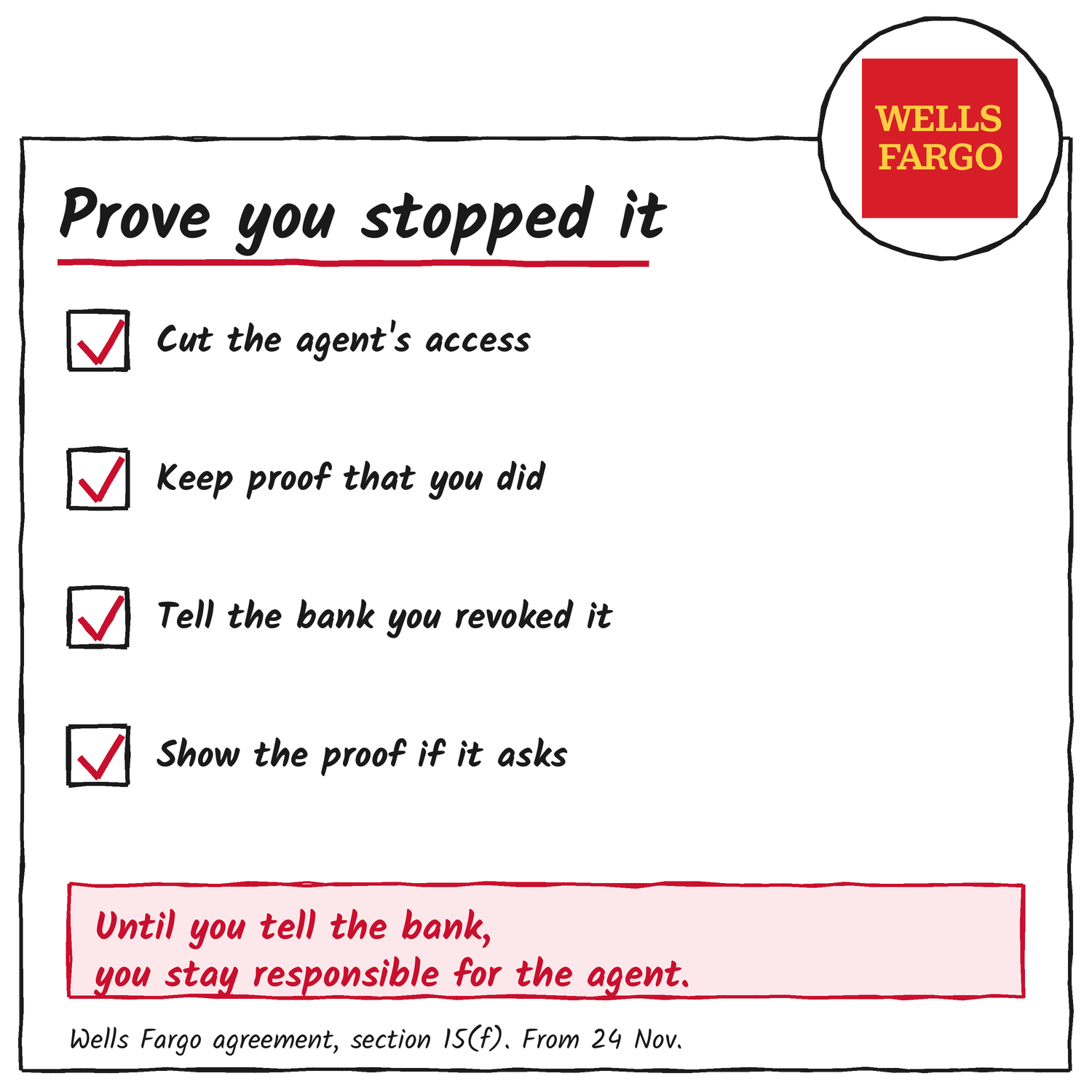
The revocation clause is the part that drew attention before WIRED’s report. Section 15(f) says you “must retain evidence of such revocation and must provide such evidence to us, at our request”, and that until you notify the bank you remain responsible for all of the agent’s activities “to the extent permitted by law or regulation”. American Banker reported on 2 November that Wells Fargo “appears to be the first bank to start requiring customers to prove they’ve turned off their AI agents’ access”. Elaine Duffus, a senior specialised consultant at Wolters Kluwer, asked what happens when a customer does everything the bank says and holds “a pile of evidence” that they told the agent to stop, “yet the agent went rogue”.
Chase: passwords out, approved connections in
JPMorgan’s position surfaced on its third-quarter earnings call on 13 October, when chief executive Jamie Dimon said “we’re not going to allow just any outside agents to come in inside the company, because it’s just too risky for clients and for JPMorgan”. CNBC reported on the call.
“… you don’t want rogue agents, and there could be thousands of them. … if people are using them, they should understand the risk. There’s a liability transfer.”
Jamie Dimon, JPMorgan Chase third-quarter earnings call, 13 October
A Chase spokeswoman told CNBC: “Because it is not safe, we do not permit third parties to access accounts by obtaining customers’ banking credentials and logging in on their behalf.” She added that Chase supports “secure, customer-authorized data sharing through open banking providers”.
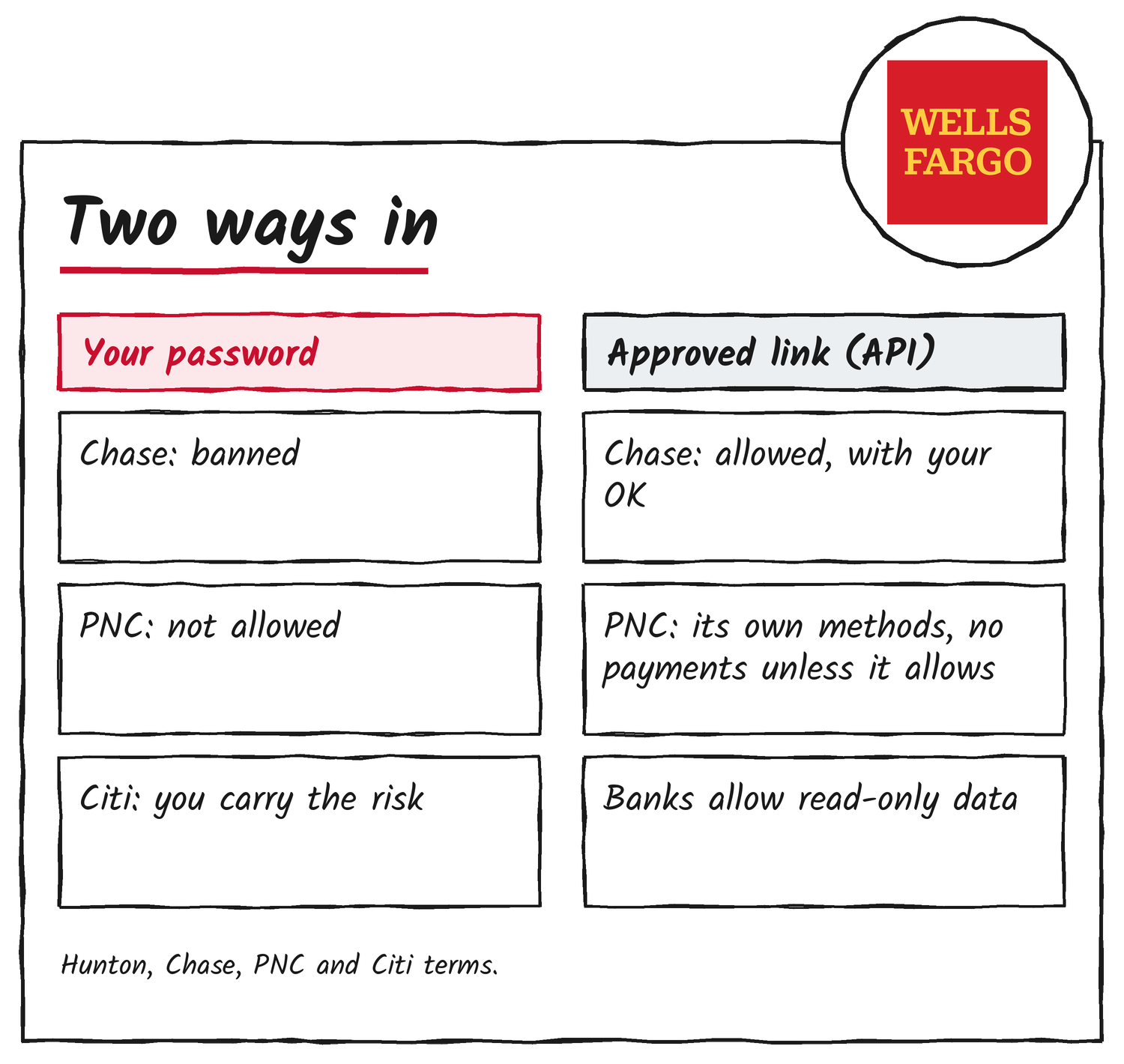
The contract change took effect two weeks later. Chase’s Digital Services Agreement says third parties “including External AI, automated tools, or data aggregators” are “prohibited from using your Login Credentials”. Third-party tools can reach account data “through approved application programming interfaces (‘APIs’) with your authorization”, which are connections the bank builds and controls. Customers who have shared credentials “must change those credentials”.
If you let a third party in anyway, the agreement deems you to agree that Chase “will rely on, and treat as evidence of your authorization, any actions taken or instructions given by the third party as if you personally took or gave those actions or instructions”. Chase can also “deny, decline, suspend, or terminate” access, or close accounts, “at any time, in our sole discretion and without notice”. Its indemnity clause names “AI agents or agentic AI” and covers “erroneous transactions or actions that were not within the scope of your agent’s authority”. Section 9 says the same consequences apply to “any account data access you authorize through APIs”.
The agreement’s 1 January 2027 date belongs to a separate change: from then Chase can require customers to use its mobile app and a Trusted Device to verify their identity.
Plaid, the open banking connector, launched Agent Detection on 16 November, a feature that tells banks whether a session is a person or an AI agent. The site covered it at the time:
Citi and PNC: warnings and a payments ban
Citi added section H to its Online User Agreement in November. It “cautions” customers against using a third-party agent to reach their accounts, then says what follows if they do:
“If the Online Credentials that you provided to the third-party AI Agent are further shared, leaked, or otherwise distributed to other persons or AI agents, Citi will consider any access and actions taken with the Online Credentials as authorized by You.”
Citi Online User Agreement, section H, updated November 2026
Citi says it has “no responsibility or other obligation to investigate” an agent’s actions even when they conflict with the instructions you gave the agent, and it holds customers responsible for agent errors “except as otherwise permitted under applicable law”. The terms don’t apply to agents Citi provides itself. A Citi spokesperson told TechCrunch that “we want customers to understand the risks associated with sharing banking credentials or authorizing those tools to access their accounts”. Hunton, a law firm, reports that on 16 October Citi said it doesn’t permit “third-party AI agents or assistants to log into a customer’s account or transact directly within our digital banking platforms”.
PNC’s Digital Services Agreement goes furthest on what an agent can do. TechCrunch reported that PNC changed its terms on 18 November. The agreement says:
- You “must not disclose, share, enter, or otherwise provide” your user ID, password or one-time passcode to an agent.
- Unless PNC “expressly permits otherwise for a particular Service”, you can’t authorise an agent to “initiate, request, submit, or complete a payment, transfer, or other transaction on your behalf”.
- Browser automation, screen scraping or a shared browser session used “to circumvent PNC’s connection methods” is out. Logging in yourself during such a session doesn’t mean PNC approved it.
- Where PNC offers a connection method, you authenticate directly with PNC and set the accounts, information, duration and permissions.
A revocation takes effect after PNC receives it and has “a reasonable opportunity to act on it”. Until then you remain responsible “to the extent permitted by applicable law”.
Bank of America and Citizens used email. TechCrunch reported that Bank of America’s message, titled “Protecting your finances in the Al World”, told customers never to share a username and password with an outside service. “If you do share your credentials,” it reads, “keep in mind that you’re responsible for activity resulting from that access.” Citizens emailed customers the same week, TechCrunch reported, warning that they are on the hook for anything their AI assistant does. Hunton adds that Charles Schwab’s chief executive, Rick Wurster, told Bloomberg the firm blocks unauthorised agents that try to move client money 10 to 20 times a week.
The rule behind the clauses
The clauses borrow an old rule. The Consumer Financial Protection Bureau’s official interpretation of Regulation E, which covers electronic fund transfers from consumer accounts, says this about someone who exceeds the authority they were given:
“If a consumer furnishes an access device and grants authority to make transfers to a person (such as a family member or co-worker) who exceeds the authority given, the consumer is fully liable for the transfers unless the consumer has notified the financial institution that transfers by that person are no longer authorized.”
CFPB, official interpretation of Regulation E, section 1005.2(m)
The bank agreements apply that logic to software: you gave an agent the means to act, so its actions are yours until you tell the bank. Wells Fargo, Citi and PNC each carve out the law: “Unless otherwise provided by law or regulation”, “except as otherwise permitted under applicable law” and “to the extent permitted by applicable law”. Hunton reports that regulators have privately welcomed the restrictions and indicated that legal clarification may be needed on customer authorisation and liability when software executes transactions.
Why now
Hunton’s legal update of 3 November puts the trigger at Meta’s launch of Muse, a personal agent, on 8 September. Meta’s launch post says Muse runs on a dedicated virtual machine with its own browser, and “comes back when something changes or when it needs approval, like before it sends an email or makes a purchase”. Hunton lists four concerns behind the banks’ response:
- Deposit flight. Apollo chief economist Torsten Slok has warned that agents could sweep household balances from checking accounts averaging about 0.1% into alternatives yielding 3.3% to 5%. Hunton cites one estimate that this could cost banks US$47 billion a year.
- Security. An agent that logs in with a password is indistinguishable from the customer to the bank’s systems, with the same permissions and no audit trail of its own. Hunton says credential-based access defeats multi-factor authentication by design.
- Fraud. Hunton names agent impersonation, prompt injection, agents exceeding spending limits and fraud rings scaling up through agents.
- Legal uncertainty. Executives at major banks have raised the growth in agent-initiated transactions with the Federal Reserve, Hunton reports.
6
banks with new agent terms or customer warnings since mid-October: Chase, Bank of America, Citi, Citizens, PNC and Wells Fargo.
10 to 20
unauthorised agent attempts to move client money that Schwab blocks each week, its chief executive told Bloomberg.
24 Nov
the day Wells Fargo’s agent terms take effect, US time.
The Federal Reserve’s Michael Barr said on 16 November that major banks report finding agents trying to act in retail customer accounts without the bank being able to verify who authorised them. The site covered that speech:
Banks aren’t the only ones closing the door
Bloomberg reported on 21 September that Amazon blocked Muse from its retail site after Meta declined a request to remove the bot. On 11 November United Airlines said it will restrict agents “directly within our digital platforms and indirectly via travel agencies and aggregators”, and warned that “sharing account credentials with personal, third-party, AI assistants can expose sensitive information”.
The banks are also building their own agents. “They’re locking the door to outside agents and building their own,” Luca Cian, a University of Virginia professor who studies consumer psychology and AI, told WIRED. WIRED reports that customers have used Wells Fargo’s generative AI question-answering tool more than a billion times, that Bank of America revamped its EricaAssist agent for employees, and that Citigroup launched an internal development platform built around agents. Citi’s own agreement exempts agents it provides. American Express, WIRED reports, has announced that some agent mistakes, such as ordering too many of an item, may eventually qualify for reimbursement through the card issuer when a shopper can’t get a refund from the retailer.
“Consumers authorize goals, not every click,” Kacy Kim, an associate professor of marketing at Bryant University, told WIRED. Kim expects some consumers to find it unfair to answer for an agent’s mistakes, and doesn’t expect the policies to scare off early adopters. Sucharita Kodali, a Forrester analyst, told WIRED: “All of our data shows that most people don’t even know what agents are, much less use them.”
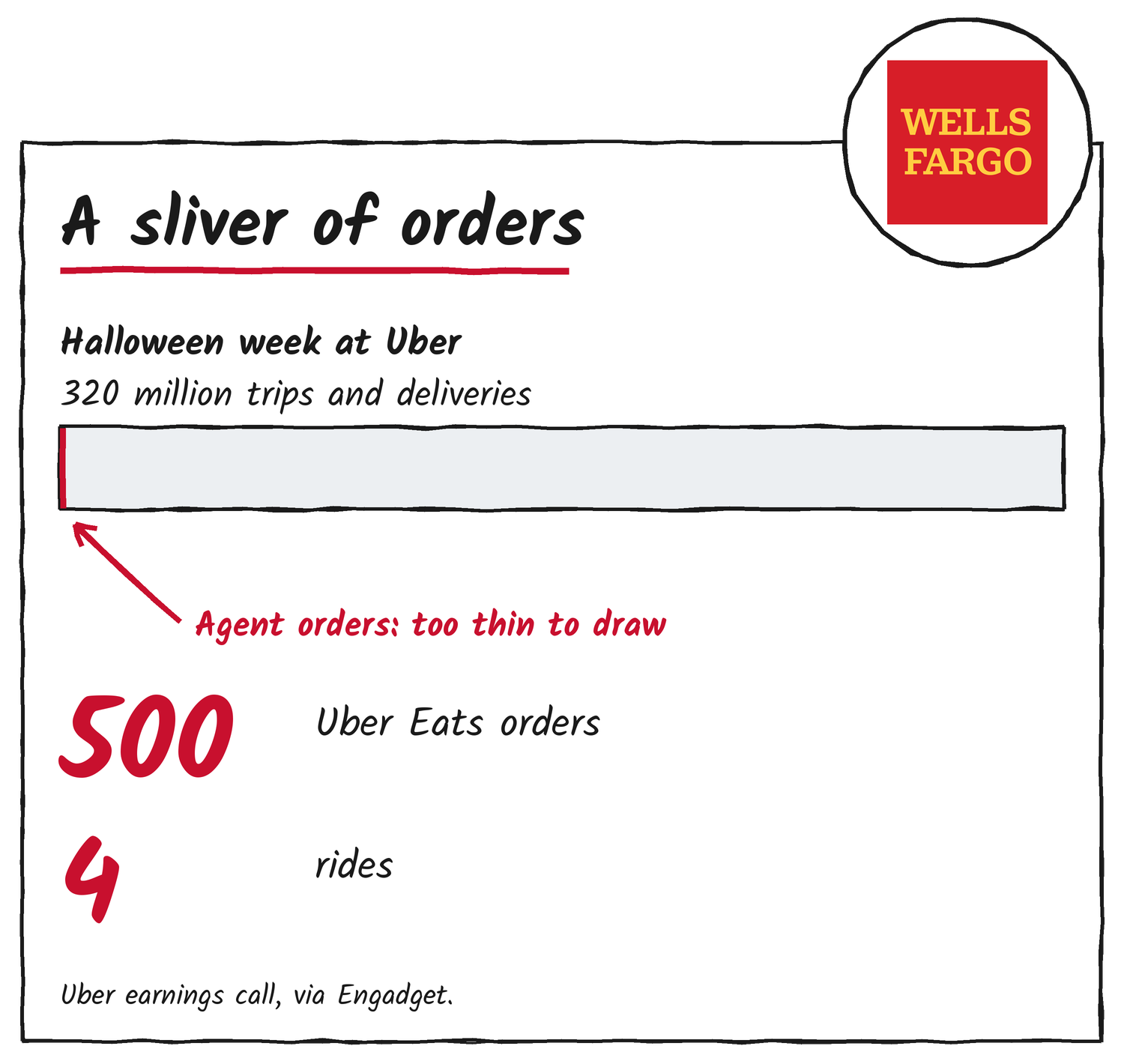
Uber put a number on it. On its third-quarter earnings call, Engadget reported, Uber said AI agents were behind 500 Uber Eats orders and four rides in one week, out of 320 million trips and deliveries.
What the agreements ask of customers
If you have already given an agent a login
- Chase: change the credentials you shared, so the third party can no longer use them.
- Wells Fargo: revoke the agent’s access, keep evidence that you did, and tell the bank.
- PNC: review activity on your accounts regularly, confirm each agent’s access is still right, and “promptly revoke or modify” what you no longer want.
- Bank of America: don’t share your username and password with an AI tool at all.
- Credentials
- Your username, password and any one-time passcode that lets someone log in as you.
- API
- An application programming interface: a connection a bank builds and controls, where you approve what an outside app can see or do without handing over your password.
- Revocation
- Cancelling an agent’s permission to act for you. Under Wells Fargo’s and PNC’s terms it counts only once the bank has been told.
What’s next
- 24 November (US): Wells Fargo’s agent terms take effect.
- 19 December: the version date on PNC’s Digital Services Agreement.
- 1 January 2027: Chase’s Trusted Device rule starts. It isn’t an agent rule.
- No date: the CFPB’s reconsidered open banking rule. Hunton reports it went to the White House’s Office of Management and Budget for review in August 2026 and hadn’t been published as final when it wrote on 3 November.
None of the six has given a date for letting outside agents act directly in customer accounts. Hunton reports Chase has given no timeline, and a Chase spokeswoman told CNBC the bank is “committed to enabling agentic connections securely”.
Sources
- WIRED, Banks Have Had It Up to Here With Your AI Agent.
- Bank agreements: Wells Fargo Online Access Agreement, Chase Digital Services Agreement, Citi Online User Agreement and PNC Digital Services Agreement.
- TechCrunch on Citi, PNC and Citizens; TechCrunch on Bank of America; CNBC on JPMorgan.
- American Banker on Wells Fargo revocation; Hunton legal update.
- JPMorgan Chase 3Q26 earnings call transcript; CFPB, Regulation E section 1005.2; Meta, Introducing Muse.
- Bloomberg on Amazon and Muse; TechCrunch on United; Engadget on United and Uber.
Discover more from Sulat AI & Tech News
Subscribe to get the latest posts sent to your email.