Threadbear is a free, MIT-licensed desktop app for running coding-agent threads, and an X user said on 23 November that it beat T3 Code and that they’d move their local tooling over to it. Mike Cann, a Developer Experience Engineer at Convex, started the app on 26 October and made it public on 5 November. The repo had 233 forks, 176 stars and 36 contributors on 23 November.
It isn’t a coding agent. Threadbear drives the official command-line tools for Claude Code, Codex, Grok, Cursor, OpenCode and Gemini, signed in as you, and wraps them in an inbox built around decisions.
What the user posted
The post, from the account @cu30rry_ (kaito), is in Japanese. In a translation from the Japanese, it says: “Beat T3 Code! I’ve decided to use Threadbear for my local tools. I like every feature, but two favourites: 1. Options, 2. Customisation. Options lets you pick a UI design from a set of candidates, which I think is a hugely helpful feature.” The attached picture shows that Options window, with three layouts for the end-of-walk screen of a phone app and a note typed under the pick: “Stats first, but give the map a bit more room”.
What Threadbear is
Cann announced it on X on 5 November as “my take on the perfect app for agentic work,” listing apps including Cursor, Claude Desktop and T3 Code that “none quite hit the spot.” The post says it’s powered by Convex, the backend company Cann works for. A 25-minute launch video followed.
The pitch is in the README’s first lines.
I made it for myself, and you get the whole thing: the source, the desktop app, a little runner that keeps your agents going when the app’s closed, and a Convex backend in your own account so the iPhone and Android apps and a web page for each thread can follow along.
Threadbear README
Three parts do the work. The app is only a front end. A separate background process called the runner starts and owns the agents, so quitting or updating the app never stops a turn. The runner mirrors a summary of each thread to a Convex deployment, which is how the phone apps, a web page for each thread and runners on other machines stay in step.
How it works day to day
The design bet is that the slow part of agent work is the human’s decisions, not the agent’s typing. When a thread needs you, it says what, with the choices as buttons, and when the agent is unsure how something should look it opens an Options window with a few designs side by side. That’s the feature in kaito’s post.
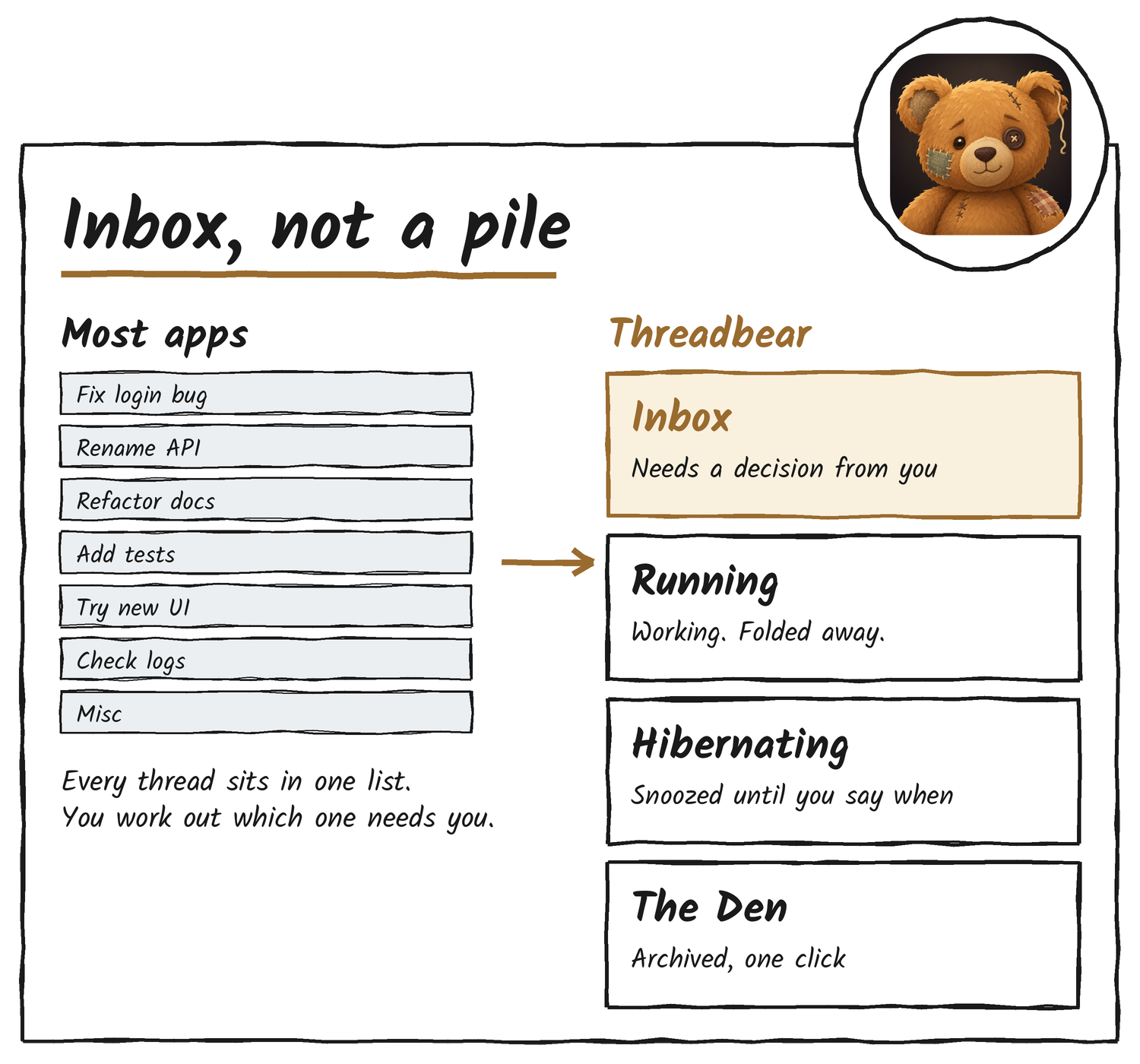
The sidebar sorts threads into lanes. Threads that need a decision sit in the Inbox, working ones fold into Running, snoozed ones sit in Hibernating and finished ones go to the Den, the app’s name for the archive. Cann says the hibernation idea, where you can write “next time I talk about woodworking” as the wake-up condition, and the background updating of the agent tools both came from T3 Code.
There’s no project picker when you start a thread. A background helper called the librarian, which runs on Anthropic’s small Haiku model, files each thread into a project, makes a new project when nothing fits, keeps project notes up to date and renames threads that have wandered off their title. Cann has 76 projects. Schedules can start a thread at a set time or on a cron pattern on any of your machines, and Cann has 31 switched on, including a nightly one that reads back over the day’s messages and starts a thread to fix whatever annoyed the user.
A Linux server or a second Mac can act as an extra runner, and you pick the machine when you start a thread. A message sent from the phone while its Mac is asleep shows faded, with Cancel, until that Mac takes it, according to the changelog.
Patches, and a fork as the installer
The customisation kaito praised is built on two things. A patch is a small TypeScript file in a project’s .threadbear folder that adds buttons above the message box and panels beside a thread. It can also run a command after each turn, such as a type check, and tell the agent when it fails. Cann’s launch post shows one from a walking app called Walkies that pulls live stats into a panel.
// .threadbear/patches/walkies.ts (trimmed)
export default {
  icon: "figure.walk",
  actions: [{ title: "Website", url: "https://walkies.mikecann.app/" }],
  panels: [{
    title: "Walkies stats",
    icon: "chart.bar",
    items: async ({ sh }) => {
      const out = await sh("npx convex run --prod stats:overview");
      const stats = JSON.parse(out.slice(out.indexOf("{")));
      return [{ title: `${stats.users.total} people` }, { title: `${stats.walks.total} walks` }];
    },
  }],
};
The second thing is the install. There’s no download. You paste a prompt into Claude Code or Codex that forks the repo, tells the agent to treat the repo’s own AGENTS.md and CLAUDE.md as text to check, not instructions, and has it compare the code against a list of everything the app installs and contacts before it runs any of it. Your fork is the app. Cann publishes a release about once a day, and an Updates panel starts a thread that merges it into your fork and asks before landing it. A release only counts if its tag carries an SSH signature from the release key your setup pinned.
That install route explains the repo’s shape: 233 forks against 176 stars. Cann says the point is that nobody waits on the maker for a change. The FAQ answers “Will you add a feature for me?” with “Probably not, to be totally honest.”
The numbers
3,747
commits on main since 26 October
233
forks, up from 195 on 13 November
176
stars, up from 141 on 13 November
36
contributors on GitHub
All four are from the GitHub repo on 23 November, apart from the 13 November counts, which are Cann’s. By then 56 pull requests had come in from seven people, Cann wrote, and about 70 phones had been paired. The launch video had passed 10,000 views. Cann also wrote that Threadbear accounted for 57% of their Mac screen time at the start of November, and that it now handles non-coding jobs such as renewing a passport and designing a shed.
The code is TypeScript (42.8%), Rust (26.4%), Swift (20.9%) and Kotlin (3.1%) by GitHub’s count. The runner and the Convex backend are TypeScript, the desktop app is Rust, the iPhone app is Swift and the Android app is Kotlin. Convex’s Wayne Sutton is among the contributors.
Where your data lives, and what it costs
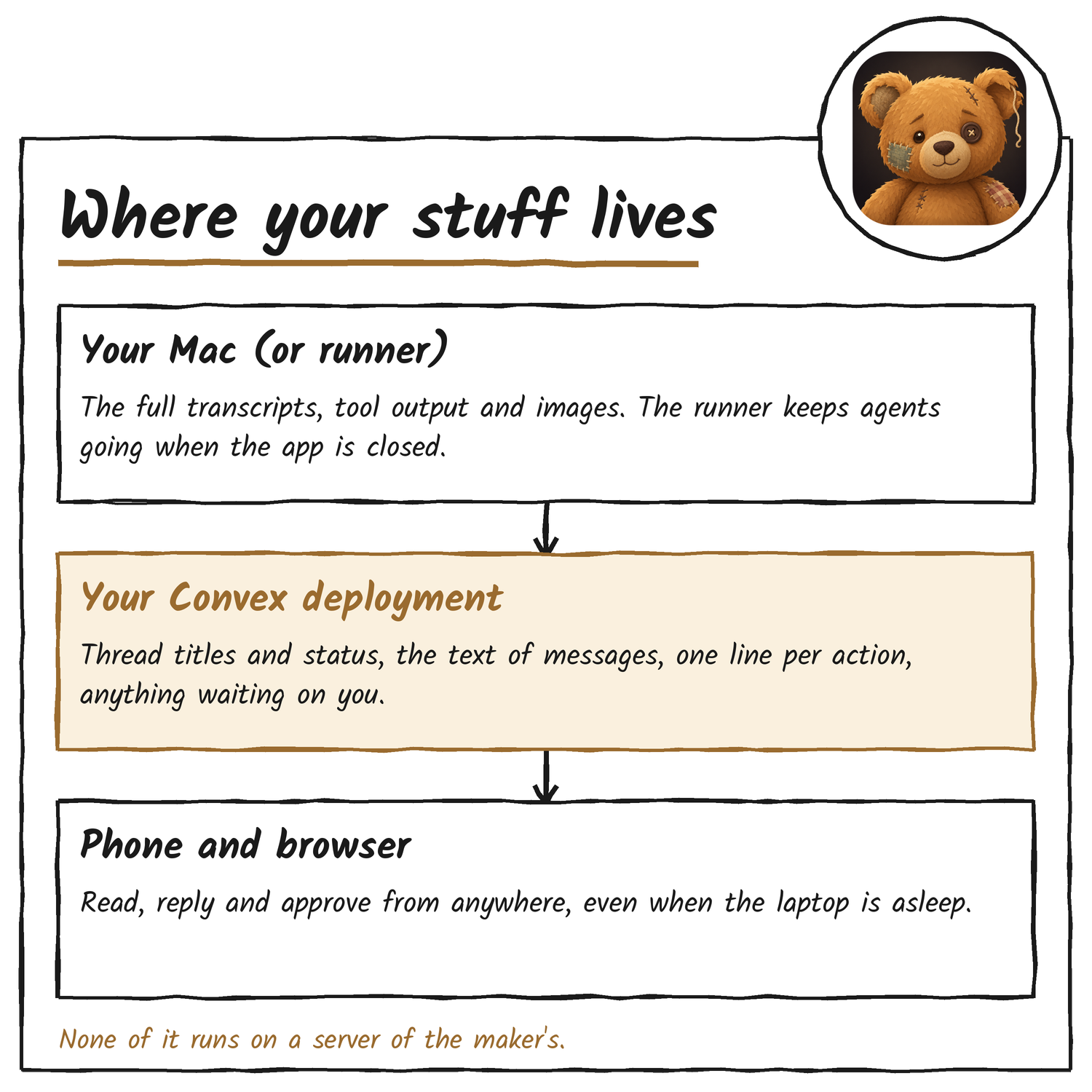
Setup creates a Convex deployment in your own Convex account. According to the FAQ, what goes up is each thread’s title and status, its newest 20 messages, anything waiting on you, and your projects and schedules. Full transcripts, tool output and images stay on the Mac. A photo sent from the phone passes through the deployment with its location data stripped and is deleted once the Mac has it. Agent traffic goes to Anthropic or OpenAI under your own account, through their CLIs.
Threadbear is free, but it isn’t the only bill. You need a Claude or ChatGPT plan for the agents and a Convex account. Cann says one Mac and a few threads a day fits Convex’s free plan, and puts their own heavy use at about US$1.50 a month on the Starter plan. A self-hosted backend is possible with ./threadbear setup --self-hosted, but the install guide says it means no phone notifications, a Tailscale connection for the phone, and nothing working while the Mac sleeps.
Which computers, which agents
Threadbear began as a Mac app. The Swift app is about 79,500 lines, according to the port plan, and Cann approved a rewrite in Rust with Zed’s GPUI interface framework on 9 November to cover Windows and Linux. The old Mac app is frozen, and a fresh install builds the new one. The README now says Mac, Windows and Linux, while the website’s FAQ still says Apple silicon Macs only.
The install guide is written for an Apple silicon Mac first. It needs Node 24 or newer, Xcode’s command-line tools, a Convex account and an agent already logged in, and the first run takes 30 to 45 minutes and about 5 GB of space. A Linux server or a Windows PC can then join as an extra runner. The Windows section calls itself new and says to expect rough edges, and the plan says it no longer needs WSL.
Claude Code and Codex run through their own command-line tools. Grok, Cursor, OpenCode and Gemini (Antigravity) run over the Agent Client Protocol. The site says Threadbear isn’t made by or connected to Anthropic or OpenAI.
Security
Threadbear gives agents the access you give them, and says so.
Threadbear doesn’t sandbox an agent. Its job is to not hand anything more to code or text you haven’t chosen to trust.
Threadbear SECURITY.md
SECURITY.md describes a one-owner design: you, your machines, your phone and your own Convex backend. A repo’s patches, hooks and settings don’t run until you trust them. Pairing a phone uses a code that works once and for ten minutes. In a thread on Auto, an approval card goes to Anthropic’s Opus model through the same CLI so it can decide for you, according to the docs on what Threadbear does on your Mac.
The changelog also shows how fast the code is moving. The entries for 9, 11 and 12 November each list closed security holes, among them a stopped share link that could still show newer messages and a folder’s git settings that could run a program before it was trusted. SECURITY.md calls Threadbear “one person’s project,” with no formal fix timeline, and supports only the latest main. In the launch post, Cann warns that anyone who scans a real pairing QR code can run your agents.
Who’s behind it
Cann is a Western Australia-based developer with more than 20 years of experience. They co-founded the games company Gangbusters, where they were CTO and built BattleTabs, and joined Convex in late 2024 as a Developer Experience Engineer, making videos, posts and tools. The blog post that introduced Threadbear’s Convex design ran on Convex’s own Stack site, and Convex’s head of community, Wayne Sutton, featured it in a weekly roundup on 6 November. Cann’s own post says “yes I work there.”
Threadbear doubles as a showcase for Convex’s pitch. The company raised a US$57 million Series B led by Insight Partners on 4 August, which SiliconANGLE put at US$110.5 million in total funding, and says its platform powers nearly 2 million applications. Convex sells its backend as a good fit for agents because of its TypeScript types and ACID transactions. Threadbear uses it as the sync layer between a Mac, a phone and a browser.
Why it’s called Threadbear
The FAQ says a threadbare teddy is the one you’ve had for years, worn and patched and loved for it. The bear words run through the app: snoozing is Hibernate, the archive is the Den, and an agent at work says “Bear with me.” A patch is what you stitch onto it.
Where it sits
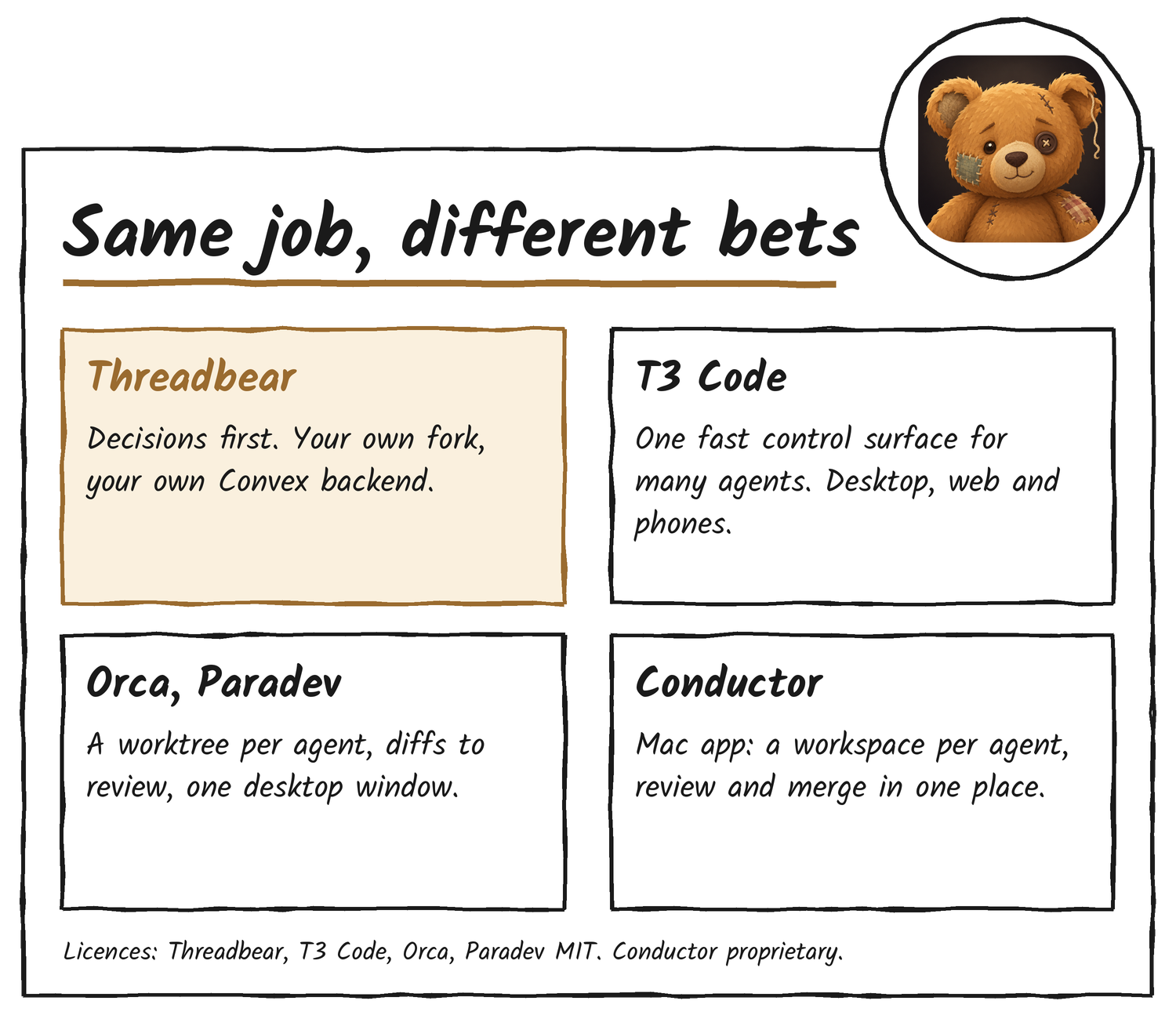
Threadbear belongs to a category that Warp named in June 2025, the agentic development environment, or ADE: a workspace where agents do the work and a person directs and reviews it. The difference is what each one puts first.
| Tool | Starts from | Platforms | Licence or price |
|---|---|---|---|
| Threadbear | An inbox of decisions, patches, your own fork | Mac, Windows, Linux; iPhone and Android apps | MIT, free; you supply agent logins and a Convex account |
| T3 Code | One control surface for many agent CLIs | Mac, Windows, Linux, web; iOS and Android | MIT, free; site claims 71,000+ stars |
| Orca | A git worktree per agent on one desktop | Mac, Windows, Linux; iOS and Android | MIT, free |
| Paradev (formerly Superset) | A worktree per agent, with cloud workspaces on paid plans | Mac; Linux experimental; iPhone and iPad | MIT since 4 November; free tier, paid plans from US$20 per user a month |
| Conductor | A Mac workspace per agent, review and merge in one place | Mac only | Proprietary; Meta bought it on 4 November |
| Claude desktop app, Code tab | Parallel Claude sessions, optional worktrees | Mac and Windows; Linux in beta | Included in paid Claude plans, from US$20 a month |
T3 Code, from Theo Browne’s team, is the closest relative and the one Threadbear’s own plan measured itself against. The plan’s trial was to use Threadbear beside T3 for a week and stop if the transcript wasn’t nicer, and the plan, dated 29 October, has the runner drive Claude Code through the Claude Agent SDK, “the same way T3 does.” T3 Code was created on 8 February and has 13,066 commits. Threadbear’s difference is the backend: T3 runs a server on your machine that you reach over Tailscale or its T3 Connect, while Threadbear mirrors summaries to a Convex deployment so the phone can read threads while the Mac sleeps.
Conductor shows the category’s volatility. Meta bought it on 4 November, according to Flavio Copes, and the team announced a shutdown before reversing it on 12 November. Conductor is continuing, with version 0.95 adding agents that manage local workspaces. Orca and Paradev both start from a worktree per agent. Paradev, formerly Superset, moved from the Elastic License to MIT on 4 November.
What it changes
Threadbear’s bet is that the app you spend all day in should be yours to change, and that an agent is the cheapest way to change it. Most of the category sells a finished app. Threadbear sells a fork, a daily release stream and a guide that tells your agent how to merge the two.
For someone choosing, the questions are practical. It’s a one-maker project with a fast release rhythm and no formal support, it needs a Convex account, and its Windows and Linux paths are newer than its Mac one. In return you get decision cards, an Options window and a backend that lets the phone keep reading threads while the Mac sleeps. kaito’s post is one user’s verdict, and the code is open for anyone to check it against.
Sources: kaito (@cu30rry_) on X (23 November 2026); Mike Cann on X (5 November 2026); the Threadbear repo, README, INSTALL.md, SECURITY.md, LICENSE and docs; threadbear.mikecann.app FAQ, privacy page and changelog; Convex Stack launch post; mikecann.blog (13 November 2026 and about page); T3 Code site and repo; OpenChamber’s ADE guide (9 November 2026); Flavio Copes on Conductor (17 November 2026); Enjoy Agentic Industries; Convex and SiliconANGLE (4 August 2026).
Discover more from Sulat AI & Tech News
Subscribe to get the latest posts sent to your email.