Jiayuan Zhang posted on 22 November that Multica is the “agent platform of 2027, free and open-source.” Multica isn’t new. Zhang’s team has shipped it since January, its GitHub repo sits at about 56,800 stars, and that repo now calls it source-available under a licence that blocks hosted use without a commercial deal.
Multica is a project board where coding agents are assignees alongside people. You file an issue, pick Claude Code, Codex, Cursor or another agent CLI from the assignee list, and a daemon on your own machine runs it. The agent comments as it works and moves the issue to review when it’s done. Multica doesn’t ship a model of its own.
What Zhang posted
The post is a headline, a line and a link to the repo. It quotes an earlier post from John Suh, who wrote “Agent platform of 2027. This is the end game.”
It’s a re-introduction, not a launch. Silicon Star reported in May that Zhang first posted “We created the open source version of Claude Managed Agents. Introducing Multica” in April, as Anthropic opened that service in public beta. Anthropic’s version lets a company describe an agent in natural language or YAML and run it on Anthropic’s infrastructure, billed at standard token rates plus US$0.08 per session hour of active runtime. Multica takes the opposite route. It drives agent CLIs already installed and signed in on machines you control.
How Multica works
Four ideas carry the product. A runtime is any machine running Multica’s daemon, which detects the agent CLIs installed there. An agent is a profile on top of a runtime, with a name, instructions and attached skills. An issue is the unit of work. The inbox collects whatever needs a person.
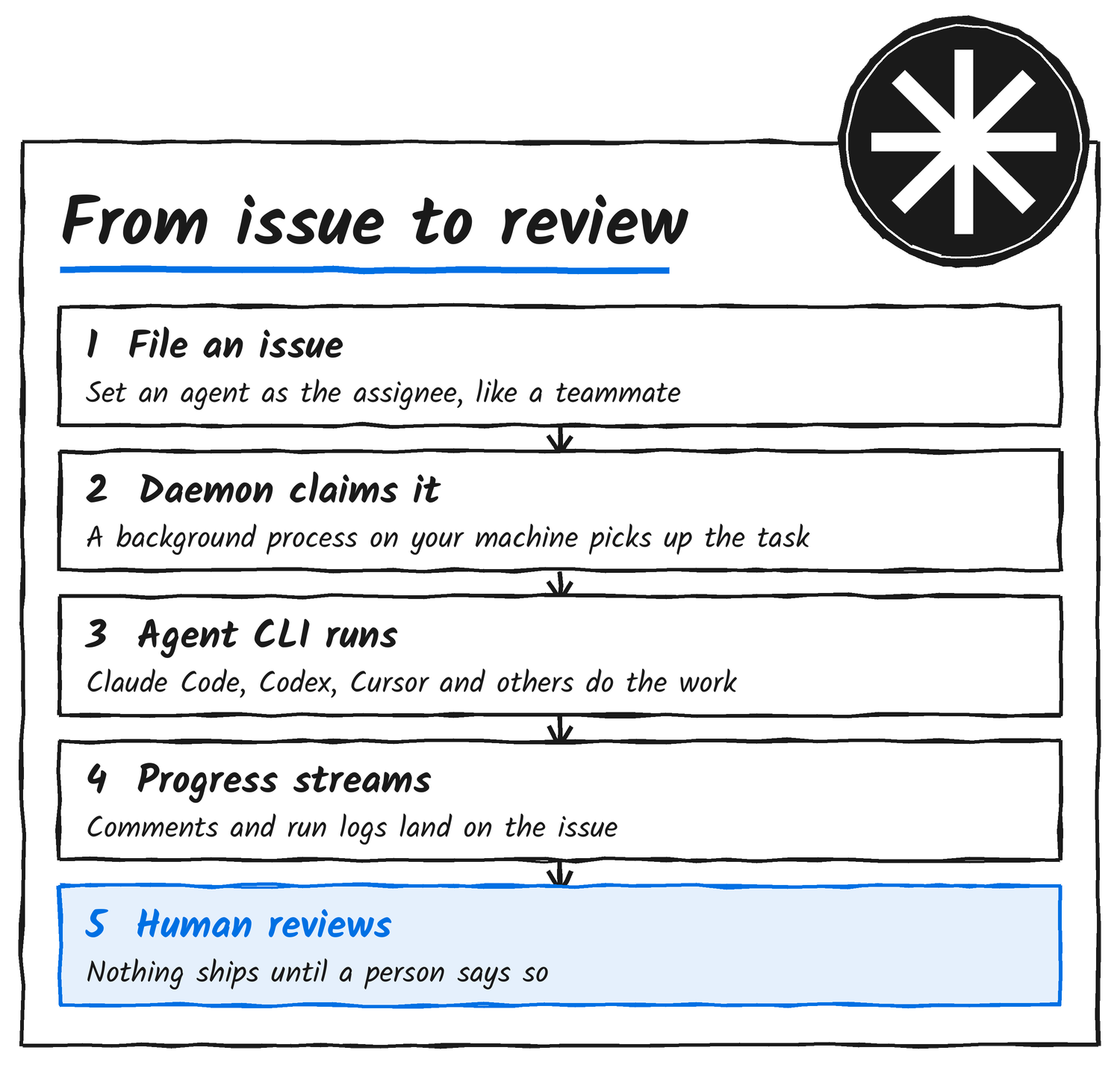
Around that core the changelog lists squads of agents, skills that agents reuse, autopilots that run on a cron schedule, chat, projects, run steering, per-run cost curves and review gates. Recent releases added agents that guide each other mid-run and WeChat chat with an agent. Issues can also run on Qoder Cloud Agents, a hosted service.
Developer Tom Rochette’s notes on the repo list a Go backend, a Next.js front end and PostgreSQL with pgvector. You can self-host with Docker Compose, a single binary or Kubernetes, or use the hosted cloud. Desktop apps cover macOS, Windows and Linux. The iOS app builds from source and isn’t on the App Store yet, the README says. A self-hosted server sends one anonymous snapshot a day, with the release version and bucketed counts, until you set DO_NOT_TRACK=1.
The site names 26 supported agent CLIs, including Claude Code, Codex, Cursor, GitHub Copilot, Kimi CLI, OpenCode and Hermes. The README says the current source supports 31. GitHub, GitLab, Gitea and Forgejo connect for code, and Slack, Lark, DingTalk, WeCom and Telegram for chat.
The numbers
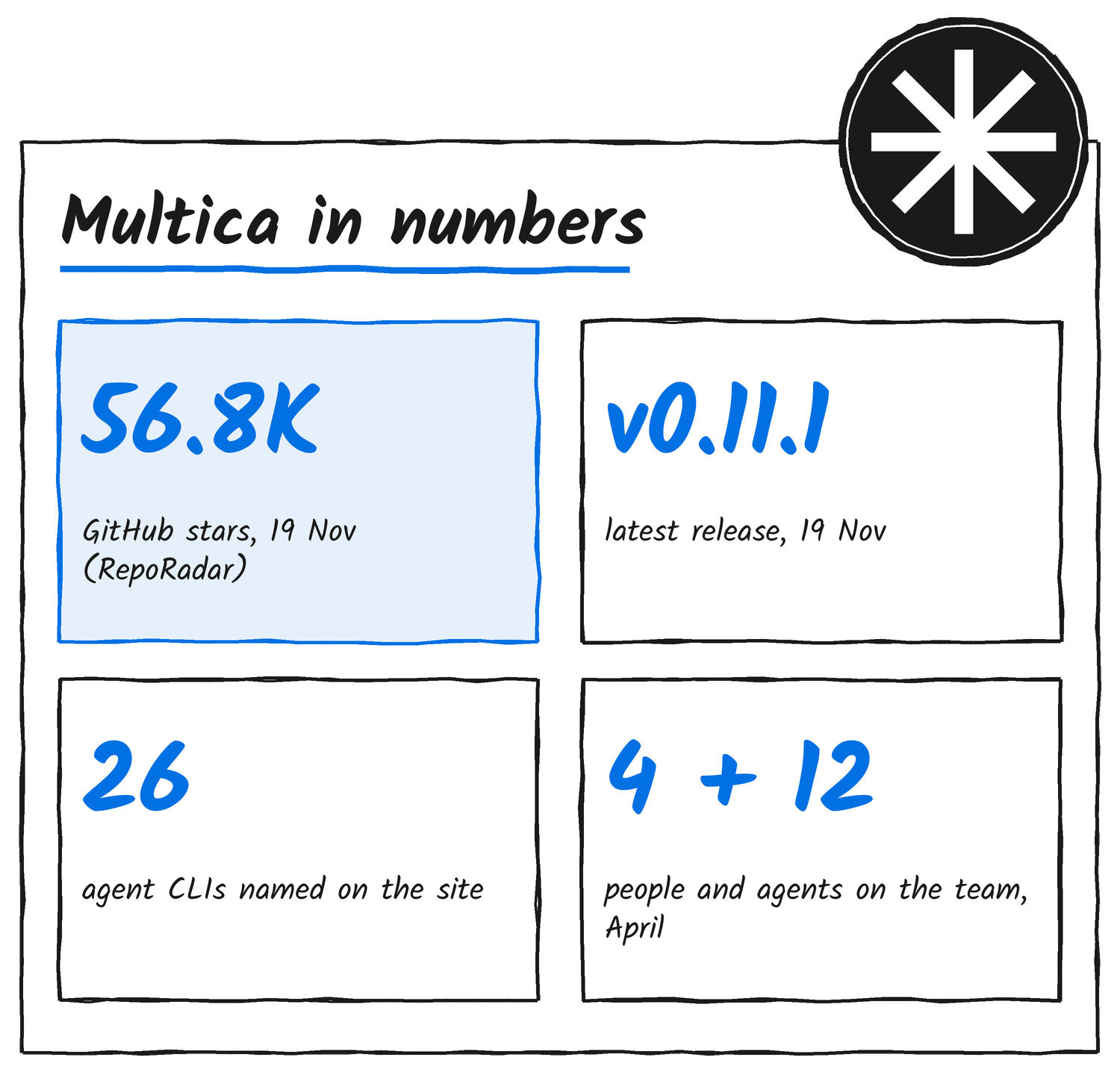
The repo was created on 13 January. By the time QbitAI wrote it up on 9 April it had about 2,600 stars, and Silicon Star put it at 22,700 by the end of that month. RepoRadar measured 56,800 stars and 7,471 forks on 19 November, with 902 gained in the previous seven days. Releases land every one to three days, and v0.11.1 shipped on 19 November.
Zhang’s own April numbers came from an interview with Crossing. New users were up 37% week on week, new issues 574% and new agent tasks 387%, and an agent task started about every ten seconds. Zhang’s reading was that users leaned on agents more each week, not just that more of them signed up.
Who’s behind it
Zhang used to work at TikTok US, and the X bio also lists Devv. Devv, an AI search engine for developers, launched in October 2023, and Zhang has said it reached 500,000 users in 2024. Zhang told Silicon Star in May that demand for developer search had drained into the model makers and that Devv would be shut down. A coding product, DevCode, followed and didn’t last either. Multica is the third.
Multica started in January as the team’s own tool. Zhang told Silicon Star the problem was context stuck in each person’s agent sessions, which Zhang summed up as people and their AIs being unable to work together. The team is four people and a dozen-plus agents, Zhang told Crossing in April, and Zhang said it had closed two funding rounds, with leading US-dollar funds among the existing investors. The LICENSE names Index Labs (Hong Kong) Limited as the producer.
Zhang’s distribution playbook is public. A CLAUDE.md file that Zhang wrote in January from Andrej Karpathy’s comments on AI coding assistants, published as andrej-karpathy-skills, reached about 99,000 stars by the end of April, Silicon Star reported, and its README points readers to Multica. Zhang described the two projects as unrelated.
Why it’s called Multica
The site’s about page says the name stands for Multiplexed Information and Computing Agent. It’s a nod to Multics, the 1960s operating system that introduced time-sharing, letting several users share one machine. The team’s pitch is the same idea with agents: a small team of two engineers and a fleet of agents should move like twenty.
Open source, or source-available?
Zhang’s post says open-source. The repo’s README calls Multica a source-available workspace, and the site’s licensing page says the same. The LICENSE is the Multica License: the full Apache 2.0 text plus a Part I of extra conditions that win if the two conflict. In May Zhang told Silicon Star that the open-source version would stay Apache 2.0.
The conditions that matter:
- Hosted or embedded use. You can’t use the source to offer a hosted service to third parties, or embed Multica in a product sold or distributed to them, without a commercial licence from Index Labs.
- Branding. You can’t remove or change the logo, the product name or the copyright information in a Multica interface without a written branding waiver, which is a separate grant from a commercial licence.
- Backend-only use. If you build on the backend, daemon or CLI without the Multica interface, you keep the notices and say in your user-facing documentation that the product is built on Multica, with a link to the repo.
- Contributions. Contributors agree that the producer can adjust the licence to be stricter or more relaxed, and that their code can be used commercially, including in Multica’s cloud business.
- Two directories. The files in
server/ee/andpackages/ee/sit outside the Multica License, under their own commercial licence.
A publicly accessible instance operated for users outside your own organization requires a commercial license even when it is offered free of charge, carries no advertising, and sells no paid tier.
Multica License, Part I, condition 1(a)
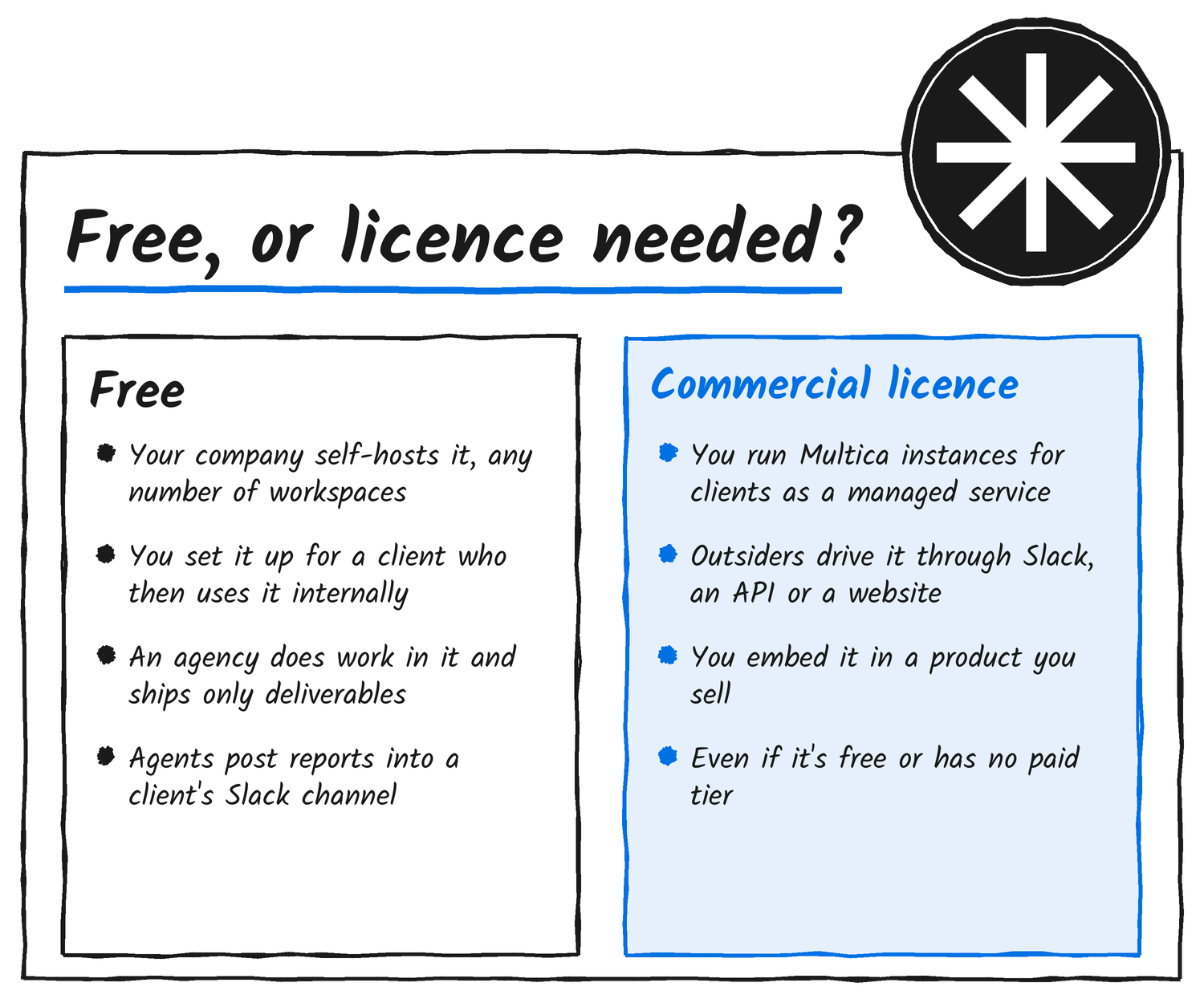
Using Multica inside your own organisation is free, across any number of workspaces. An agency that runs its own work in Multica and sends clients the results doesn’t need a licence, and neither does a consultant who sets it up for a client who then runs it. Running instances for clients as a managed service does, and so does letting people outside your organisation drive an instance through Slack, an API or a public site. Multica says it answers commercial-licence requests within three business days.
Multica Cloud, the hosted version, starts with a free trial. In early November its price wasn’t published, according to Stork.AI and Paradev’s comparison page.
Where it sits
| Tool | Starts from | Licence (or price) | Scale marker |
|---|---|---|---|
| Multica | Shared issue board | Multica License (Apache 2.0 plus conditions) | About 56,800 stars, 19 Nov |
| Paperclip | Org chart, goals and budgets | MIT | Created 2 March; cloud is waitlist-only |
| Orca (Stably AI) | Desktop, a worktree per agent | MIT | 43,000+ stars by August, per Paralect |
| Paradev (formerly Superset) | Desktop, a worktree per agent | Free tier; paid plans from US$20 per user a month | US$11.5 million seed, October |
| Herdr | Terminal panes | Open source | 40,000+ stars, per Paralect |
| T3 Code | Desktop and web app | MIT | About 33,800 stars, 31 Oct |
| Vibe Kanban | Kanban board | Apache-2.0 | Sunsetting since 10 April |
Vibe Kanban is the nearest ancestor of the board idea. Its maker, bloop, shut down in April, and the Apache-licensed project has been sunsetting since 10 April under community maintenance. Paradev, formerly Superset, renamed itself in October alongside a US$11.5 million seed round led by Union Square Ventures, according to Paralect.
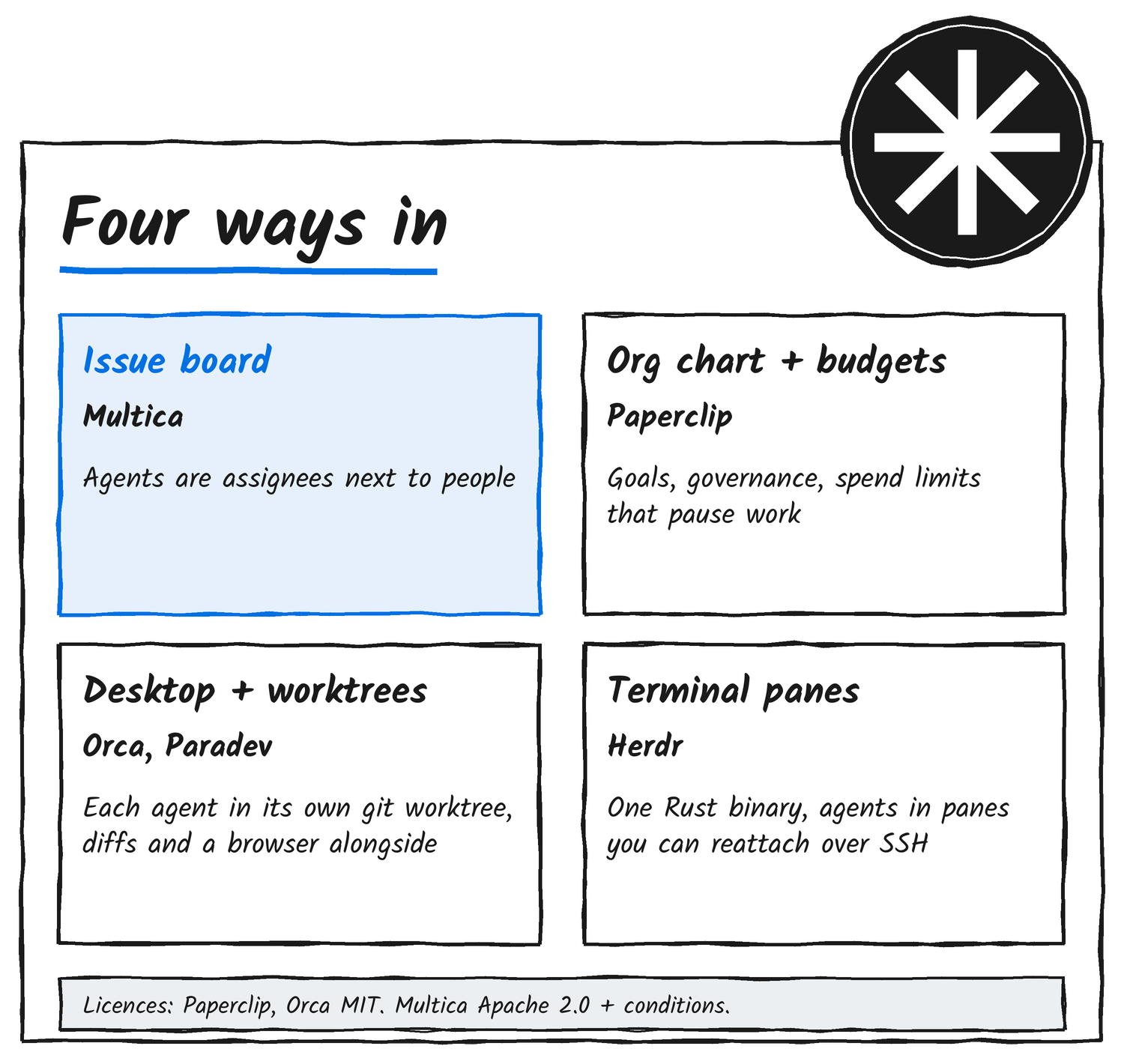
Paperclip’s README puts it as “If OpenClaw is an employee, Paperclip is the company,” and adds org charts and budgets that pause work at a limit. Its cloud is waitlist-only. Orca, made by Stably AI, and Paradev put one developer’s desktop first, with each agent in its own git worktree. Herdr is a single Rust binary that gives each agent a terminal pane. Multica is the one built around a shared board, and it carries the extra licence conditions that bar hosted use, while Paperclip, Orca and T3 Code are MIT.
What users made of it
Silicon Star’s reporter, a non-developer, found the sign-in easy and the setup hard, because installing a client and configuring a local runtime comes before anything works. An AI engineer told the outlet it resembles Vibe Kanban with team features added. A programmer said it was built for the team’s own use and uninstalled it after about ten minutes. Zhang agreed in the interview that issues, projects and boards carry a learning curve and that early users are power users.
What it changes
The bet in Multica is that the unit of agent work should be the issue, not the prompt. A ticket outlives the terminal session. The intent, the run, the comments and the diff stay on one page, so a teammate can pick the work up without asking what the agent was told. Rochette frames it the same way.
make agents first-class assignees with profiles and runtimes, and the durable artifact becomes the ticket that connects intent, execution, decisions, and the diff.
Tom Rochette, notes on Multica
For a team the practical questions are the licence and the setup. Internal self-hosting is free. A company that wants to resell or embed it needs a deal with Index Labs. Everyone running agents on a shared board still needs the agent CLIs and their model subscriptions, which Multica doesn’t supply.
Sources: Jiayuan Zhang on X (22 November 2026); the Multica repo, LICENSE, README and changelog; multica.ai licensing and about pages; Silicon Star via PingWest (6 May 2026); Crossing interview (26 April 2026); QbitAI (9 April 2026); RepoRadar; Tom Rochette; Paralect; Paperclip, Orca and Paradev pages; The New Stack (8 April 2026).
Discover more from Sulat AI & Tech News
Subscribe to get the latest posts sent to your email.