
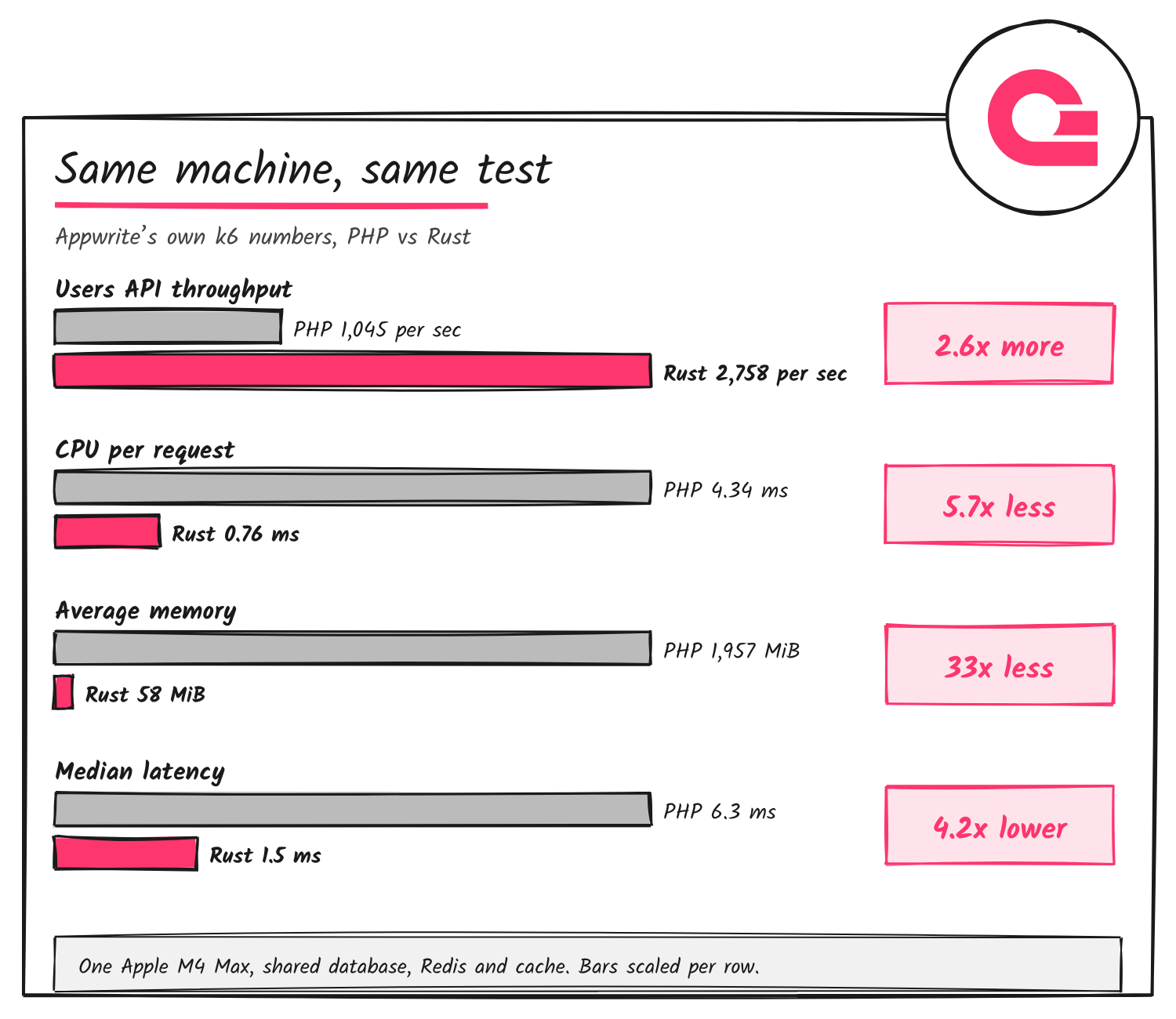
Appwrite is moving its server from PHP to Rust. Founder and CEO Eldad Fux announced it on X on 23 November, New Zealand time, with a blog post dated 22 November. Appwrite’s first numbers, from the same machine and the same workload, put the Rust Users API at 2.6 times the requests per second of the PHP one, with 5.7 times less CPU per request and 33 times less memory.
The API, the SDKs and the data stay the same. Most of Appwrite still runs on PHP today. What runs on Rust so far is a set of core libraries inside the PHP services, plus the first few services starting to move across.
What Appwrite announced
Fux’s case is about cost and speed, not a fault in PHP. The post says PHP and Swoole carried Appwrite from a side project to a platform that serves hundreds of thousands of developers, and that the move isn’t because PHP let the team down. It names two goals: make Appwrite much faster for everyone, and much cheaper to run, for self-hosters on their own hardware and for Appwrite Cloud.
The reason for doing it now is the size of the job. A rewrite of Appwrite means hundreds of thousands of lines, 29 API services, more than 700 endpoints and dozens of libraries, with the product still shipping. A community member asked for a Rust rewrite in a GitHub issue in October 2022. Fux’s thread says the team closed it because, for a team that size, it looked impossible.
With coding agents working alongside our engineers, a migration that would once have taken years is now measured in weeks.
Eldad Fux, Appwrite blog
The numbers
2.6x
more Users API requests per second
5.7x
less CPU per request
33x
less average memory
Appwrite ran the same k6 load test against both runtimes on one Apple M4 Max, with PHP and Rust sharing one database, one Redis and one cache. On the Users API at 200 requests per second, PHP used 4.34 ms of CPU per request and an average 1,957 MiB of memory. Rust used 0.76 ms and 58 MiB. Median latency fell from 6.3 ms to 1.5 ms.
The Storage API, which handles files, gains less but still clearly. Asked for 500 requests per second, the Rust Storage API delivered 506 with no server errors and a 5.8 ms median. PHP delivered 318.
| Storage API measure | PHP | Rust | Difference |
|---|---|---|---|
| Throughput, 200 virtual users | 298 req/s | 624 req/s | 2.1x more |
| CPU per request, 200 req/s | 53.2 ms | 6.7 ms | 8.0x less |
| Peak memory, 200 req/s | 4,132 MiB | 1,403 MiB | 2.9x less |
| Source: Appwrite’s published k6 results, one Apple M4 Max. | |||
Below the services sit Appwrite’s Utopia libraries. Across 230 benchmarks of 49 of them, each run beside its PHP original, Rust is 3.5 times faster, with 3.5 times less CPU per call and 3.8 times less memory (geometric means). The post benchmarks two of Appwrite’s 29 API services, Users and Storage. It publishes no figures for the other 27.
Fux frames PHP as a high starting point. Independent benchmarks over the years compared Appwrite with other backend platforms, he writes, and Appwrite was fast enough in all of them and usually came out on top. Rust, in his words, is raising a bar that was already high.
How the migration works
Appwrite isn’t doing a big-bang rewrite. It’s running two strategies at once.
- Rust inside PHP. The PHP server moves onto swoole-rs, a Rust foundation under the same Swoole programming model the code already uses. New Rust libraries load into PHP as extensions, and the PHP code calls them as it called the PHP libraries before. Each one proves itself in unit tests, end-to-end tests and production before a whole service moves.
- Rust beside PHP. Whole services move to a Rust server one at a time. Appwrite’s proxy routes a migrated service’s paths to Rust, and both runtimes share the same databases (MongoDB, PostgreSQL or MySQL), Redis, queues and caches. Users, Teams and Storage go first. A service can move back and forth between runtimes because there’s no data to migrate.
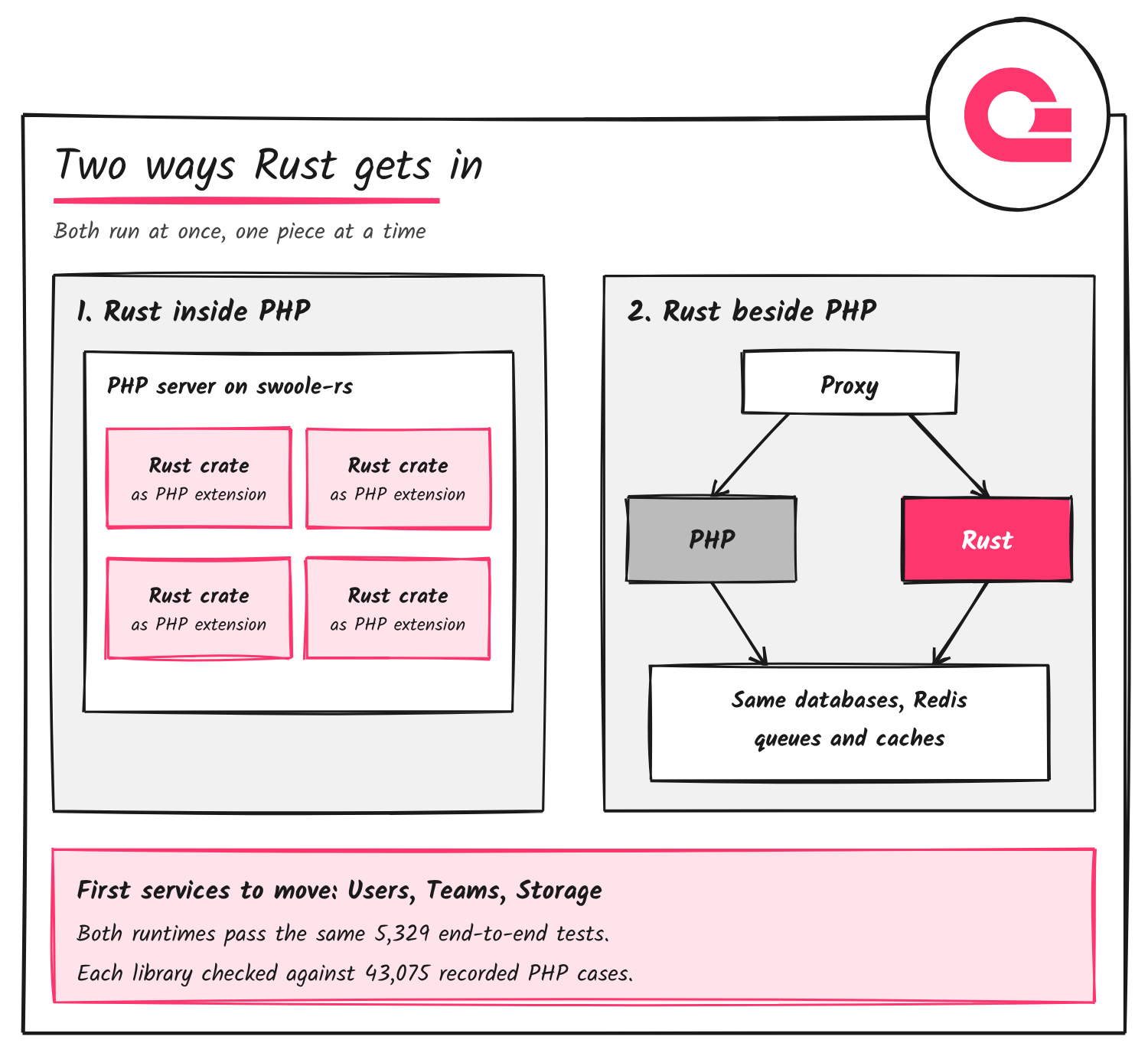
The safety net is the test suite Appwrite already had. Its end-to-end suite of 5,329 tests across 31 suites defines what the API does, and more than 1,400 unit tests cover the libraries. A Rust service counts as ready when it passes that PHP-written suite, through the same proxy, against the same database. Appwrite also built a compatibility tester that records 43,075 cases from PHP across 50 libraries and replays them against Rust, fuzzed inputs included, until nothing differs. A parity tool runs each API scenario on both runtimes and compares responses, database changes and cache effects.
Appwrite moved 48 Utopia PHP libraries into its main repository, beside their 50 Rust counterparts, so one change can update a library, the services that use it and both runtimes together. Fux says the team’s output has risen by more than 400% over the last six months. The company is small. PitchBook lists 48 employees.
Rust already reaches every customer. Over the last few weeks, Appwrite says, every customer has been served by some Rust code inside its services. The next milestone is the services that carry most of the load, which Appwrite hopes to move in the coming weeks. A long tail of lighter services follows in later phases. The stated goal is to replace every line of code, however long that takes.
A year of speed work, and a Go detour
| When | Change | Appwrite’s figure |
|---|---|---|
| May 2026 | Rust runtime for Appwrite Functions | Rust becomes a first-class runtime |
| 11 August | CLI rewritten from TypeScript to Go | Start time 207.6 ms to 11.1 ms |
| 31 August | Appwrite 2.0, with the Hyperloop B engine | 7x throughput at 6x less memory on an I/O-bound workload |
| 22 November | Server moves from PHP to Rust | 2.6x requests, 5.7x less CPU, 33x less memory on Users |
Hyperloop B moved Appwrite from Swoole’s worker model onto its coroutine scheduler, so one process serves many concurrent requests by yielding while it waits on I/O. It was the previous big step for the PHP server. Rust is the next.
The August CLI post chose Go over Rust and gave reasons that read differently now. Appwrite’s engineers wrote that a contributor can learn Go in a week, while the async model and lifetimes of Rust are “a permanent cost for each person who changes the code.” The server announcement says the opposite about maintainers: in an agentic world, where agents write and maintain much of the code, the comfort and experience of the people maintaining it matter less than they used to.
Who Appwrite is
Fux launched Appwrite as an open-source project in September 2019 and left a full-time job to maintain it. Before that he co-founded Careerpage and spent more than a decade at the Israeli portal Walla!, where he rose from junior developer to CTO. Appwrite raised a US$10 million seed round led by Bessemer Venture Partners and Flybridge in 2021, then a US$27 million Series A led by Tiger Global. That’s US$37 million in total, and the Series A was its last announced round. The company is based in Tel Aviv.
The code is BSD-3-Clause licensed. The main repository has about 58,600 stars and more than 62,000 commits. Appwrite covers authentication, databases, storage, Functions, messaging, realtime and hosting, and it runs as Appwrite Cloud or as a self-hosted Docker install. Functions supports Node.js, Python, Go, Rust, PHP, Ruby, Dart, Java, Kotlin, Swift, .NET, C++, Bun and Deno.
Where it sits among open backends
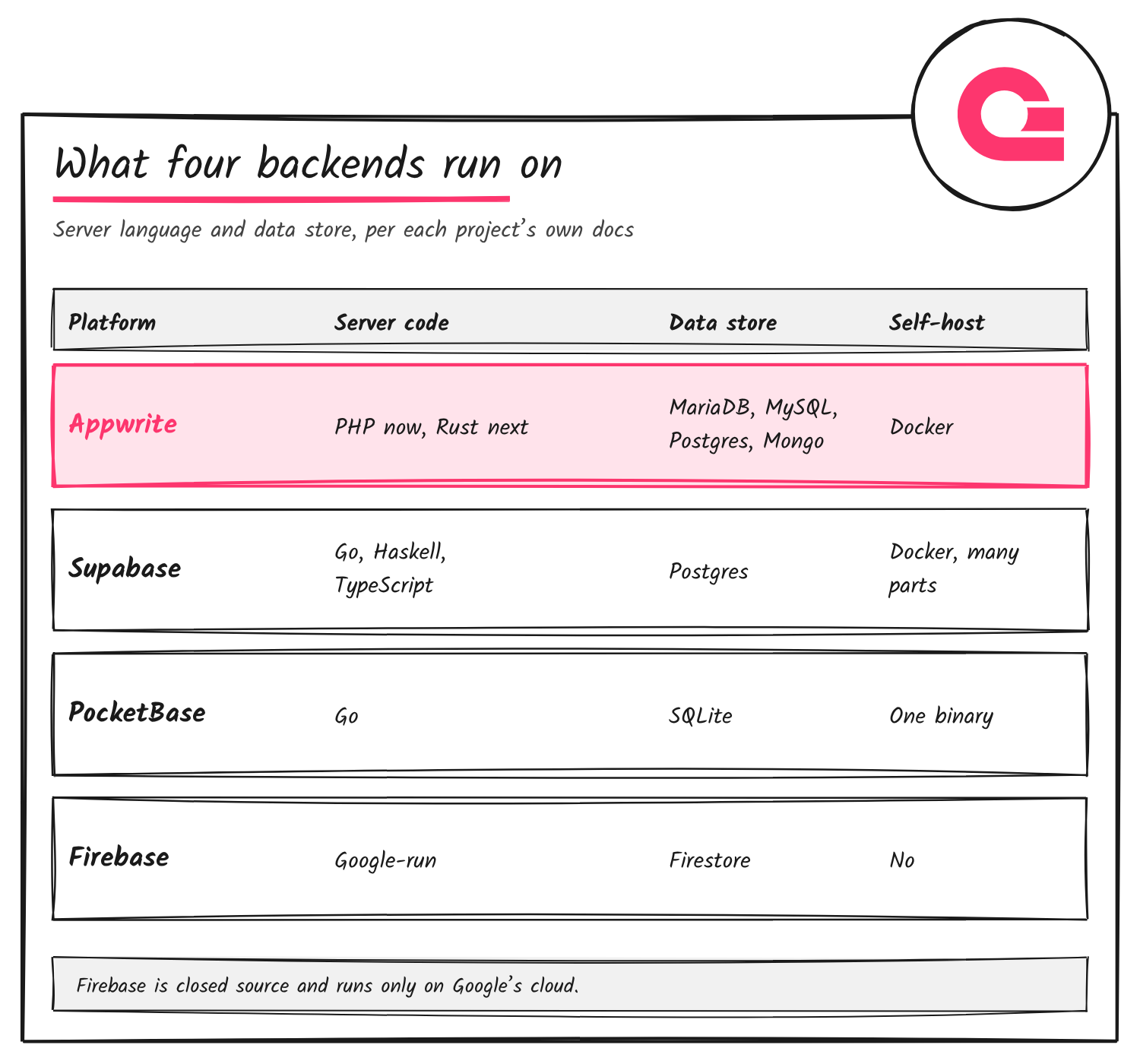
Appwrite’s main rivals are built differently. Supabase is a stack of services around one Postgres database, and its architecture page lists Auth in Go, the PostgREST API layer in Haskell and the Studio dashboard in TypeScript. PocketBase is a single Go binary with an embedded SQLite database, at version 0.41.1 and still pre-1.0. Firebase is Google’s closed product and runs only on Google’s cloud.
Appwrite’s pitch against them is breadth and a self-host path: authentication, databases, storage, Functions, messaging, realtime and hosting in one platform. The Rust move targets the cost side of that pitch. Self-hosters pay for their own CPU and memory, so a server that needs a fraction of both costs less to run.
The wider Rust rewrite wave
Appwrite joins a list of projects that have moved to Rust this year. Bun, GitHub and Ubuntu finished large Rust moves, and Cloudflare is porting the TypeScript compiler. Their reasons were memory bugs, embedding and speed, and a rewrite bill that AI has cut. Appwrite’s method matches a tool covered earlier, rust-anything, which records what an app does today and checks each piece of the Rust version against that recording before the next piece moves.
The sceptic’s case is about people, not speed. In PHP’s own backyard, four Rust rewrites of Composer exist, and Bergmann asks who will maintain them in fifteen years. Appwrite’s answer is that agents will carry much of that work.
What it changes
- Developers building on Appwrite. Nothing. Requests and responses stay exactly the same. The PHP SDK and the PHP Functions runtime stay fully supported, because the move changes the language of Appwrite’s own server, not the languages people build with.
- Self-hosters. They feel it first, on their own hardware, as lower CPU and memory use once the busy services move.
- Appwrite Cloud customers. The post says lower infrastructure cost “opens the door” to bringing prices down. It announces no price change.
- The PHP community. The Utopia libraries started as PHP libraries, and Fux credits the PHP community with contributors, feedback and friends. He ends the post with thanks to PHP and an invitation to teams weighing a similar move to talk to Appwrite on Discord or GitHub.
What’s open is timing. Appwrite gives no date for finishing the move, only “the coming weeks” for the heavy services, and it has published no figures for the services it hasn’t ported.
Sources: Appwrite blog, “Appwrite is moving from PHP to Rust” (22 November 2026) and Eldad Fux’s X thread (23 November NZ time); Appwrite’s CLI post (11 August), Appwrite 2.0 post (31 August) and May product update; Appwrite company page; GitHub repository and issue 4423; Supabase architecture docs; PocketBase site; PitchBook; CB Insights.
Discover more from Sulat AI & Tech News
Subscribe to get the latest posts sent to your email.