
Anthropic launched Claude Ship in beta on 23 November (US), a set of three agents that review GitHub pull requests, push fixes to them and, where a team’s policy allows, approve them. Two of the three are new: PR Steward, which fixes failing checks, merge conflicts and review comments, and Claude Approvals, which decides how many people a change needs and when Claude may be one of the approvers. Code Review, the third, has been generally available since 15 October.
Addy Osmani, a Google engineering leader, flagged the launch on X. The product is only for Claude Team and Enterprise organisations with repositories on GitHub, it bills by tokens, and it isn’t available to organisations with zero data retention, the HIPAA configuration or customer-managed encryption keys.
30,000+
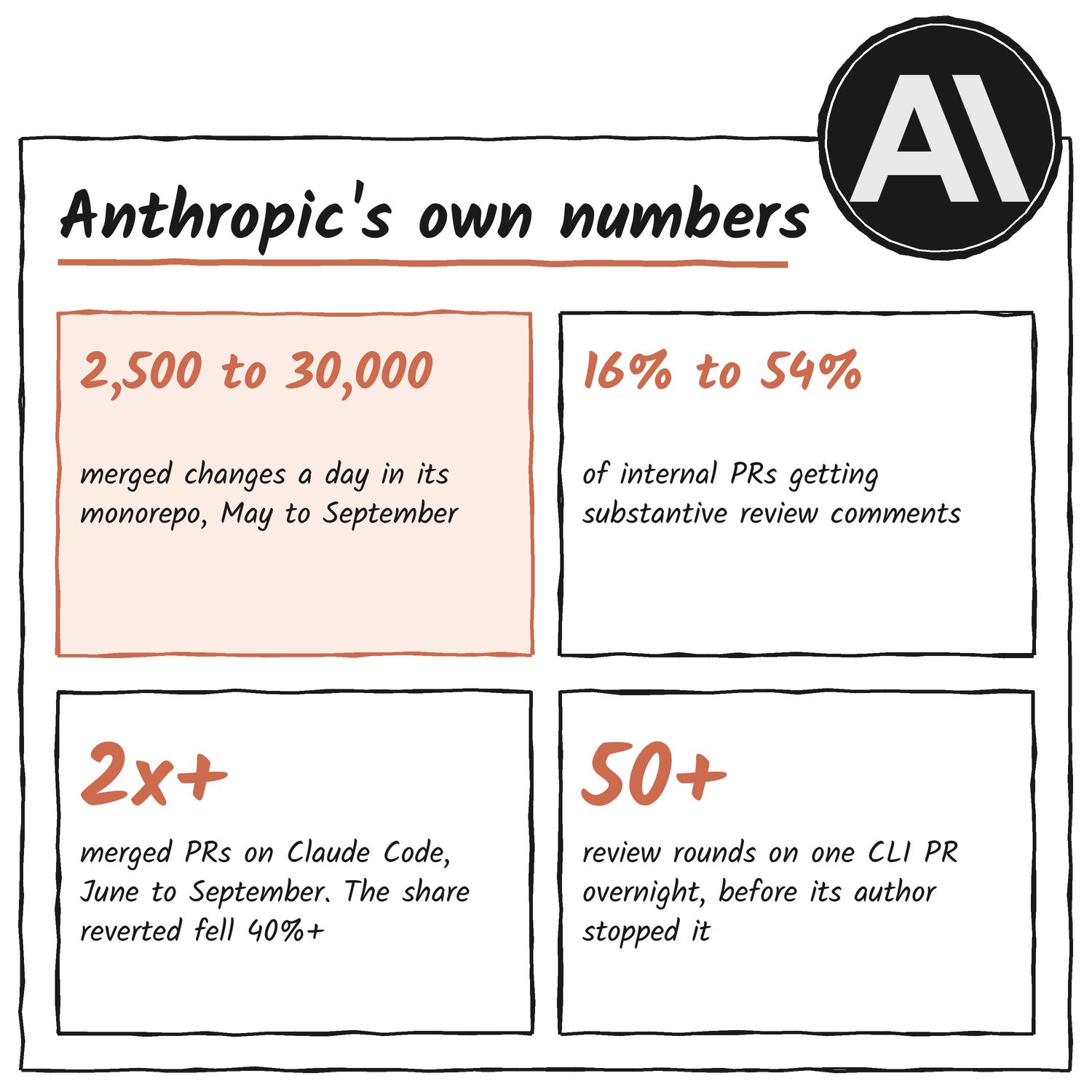
changes a day in Anthropic’s monorepo by September, up from about 2,500 in May
3
review levels per repository: Quick, Standard (the default) and Deep
US$10,000
minimum in credits for eligible Enterprise customers, claimable until 15 January 2027
0
base charge for Claude Approvals; Code Review runs and classifiers are billed by tokens
- What Claude Ship is
- Code Review: the part that already shipped
- PR Steward and what it can’t do
- Claude Approvals and the policy file
- Where the guardrails have gaps
- Cost and who can’t use it
- Anthropic’s own numbers
- How peers handle approval
- A safer rollout order
- What isn’t known yet
What Claude Ship is
Anthropic describes the problem as volume. In its monorepo, changes landing per day rose from about 2,500 in May to more than 30,000 in September, it says, and line-by-line human review can’t keep up with that. Its answer is to let agents do the reading and the routine fixing, and to keep people for the changes that need them.
The goal: ship code as fast as teams write it.
Anthropic, Introducing Claude Ship, 23 November 2026
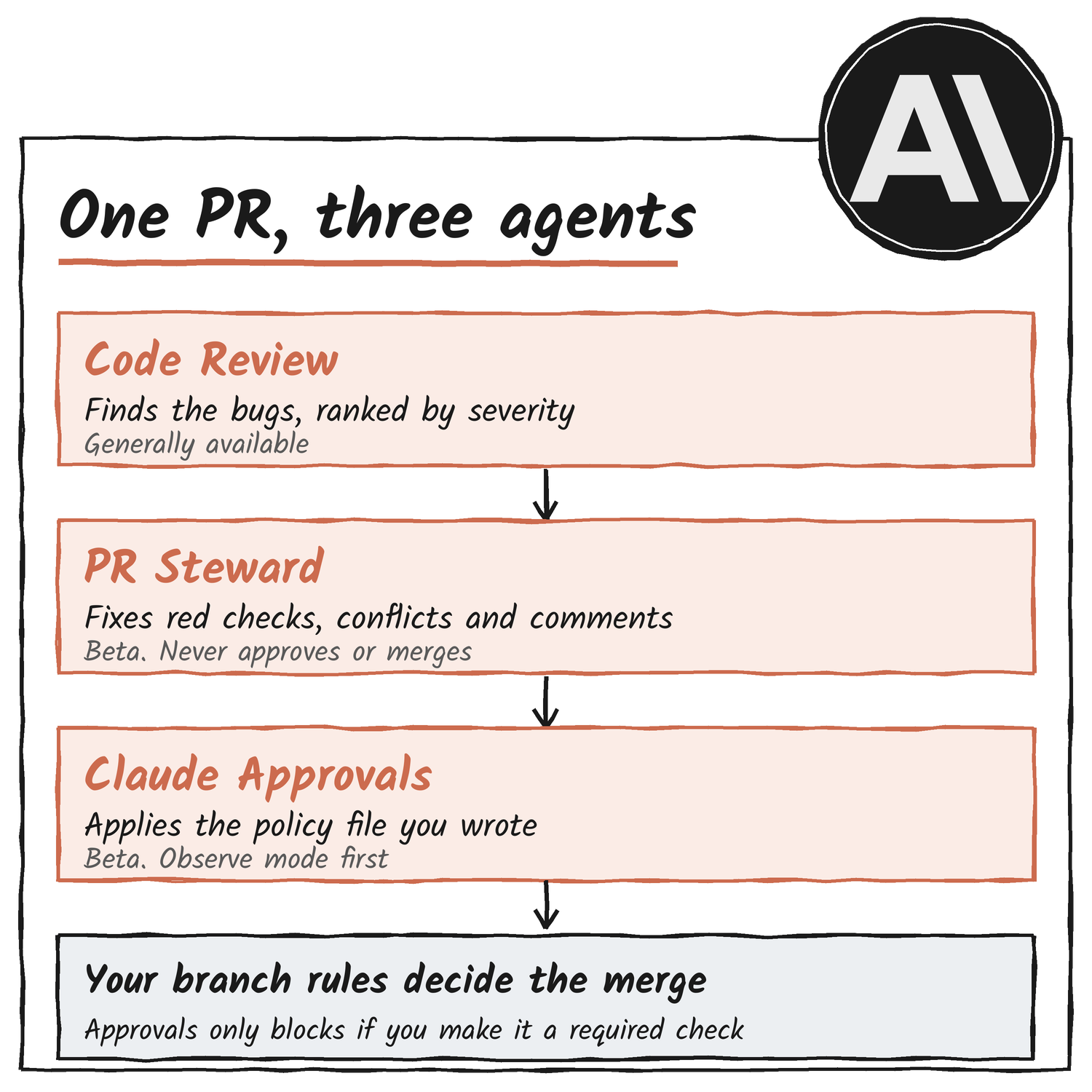
| Agent | Job | Status | Who turns it on |
|---|---|---|---|
| Code Review | Reviews each pull request through several lenses, verifies its own findings, then posts them | Generally available since 15 Oct | An admin, per repository |
| PR Steward | Pushes fixes for failing checks, merge conflicts and review feedback; designed not to approve or merge | Beta | An Owner of the Claude organisation, per repository |
| Claude Approvals | Counts approvals against a policy file and can post an approving review where the policy allows | Beta | Starts when a policy file reaches the default branch; an Owner can switch it off |
Developers can also run the new /ship command from the Claude Code terminal. It commits the work, pushes a branch, opens the pull request as you, runs a review and then watches the pull request, pushing fixes. /steward does the same watch on a pull request that’s already open, without the review. Both need Claude Code 2.1.330 or later, the GitHub CLI 2.63 or later and git 2.38 or later, run in your own session and count against your own usage. On native Windows, no watch starts.
Code Review: the part that already shipped
Code Review left research preview on 15 October. Anthropic says most reviews now finish in six to 10 minutes, down from about 20 during the preview, and that admins pick Quick, Standard or Deep for each repository, so a routine codebase gets a light pass and a critical one gets the full treatment. Reviews post findings to the pull request, graded by severity. A third-party roundup of review tools puts Claude’s Code Review at an average of US$15 to US$25 a review on usage billing; Anthropic hasn’t published a per-review price.
Teams can also run a lighter version locally with /code-review. Anthropic says the share of its own pull requests that got substantive review comments went from 16% to 54% after the research preview launched.
PR Steward and what it can’t do
PR Steward starts when someone opens or reopens a pull request or marks a draft ready, and on the next push to one it hasn’t touched. It skips drafts, forks, pull requests opened by bots and authors without write access, unless an Owner changes the repository’s setting. While it’s watching, the pull request carries a claude-pr-steward-watching label, and commenting @claude stop or removing the label ends it. After each push it comments with what it changed and how to undo it.
It runs as the Claude GitHub App in a cloud session, in auto mode, where any request for permission is denied. Anthropic’s service refuses four things outright from that session: approving a pull request, changing branch protection or rulesets, deleting a branch and pushing tags. Merging, turning on auto-merge and force-pushing are left to GitHub’s branch rules, with two checks on the command first: permission rules that match the command’s text, and a model’s judgment in auto mode. Anthropic’s own documentation says a command written another way can pass both.
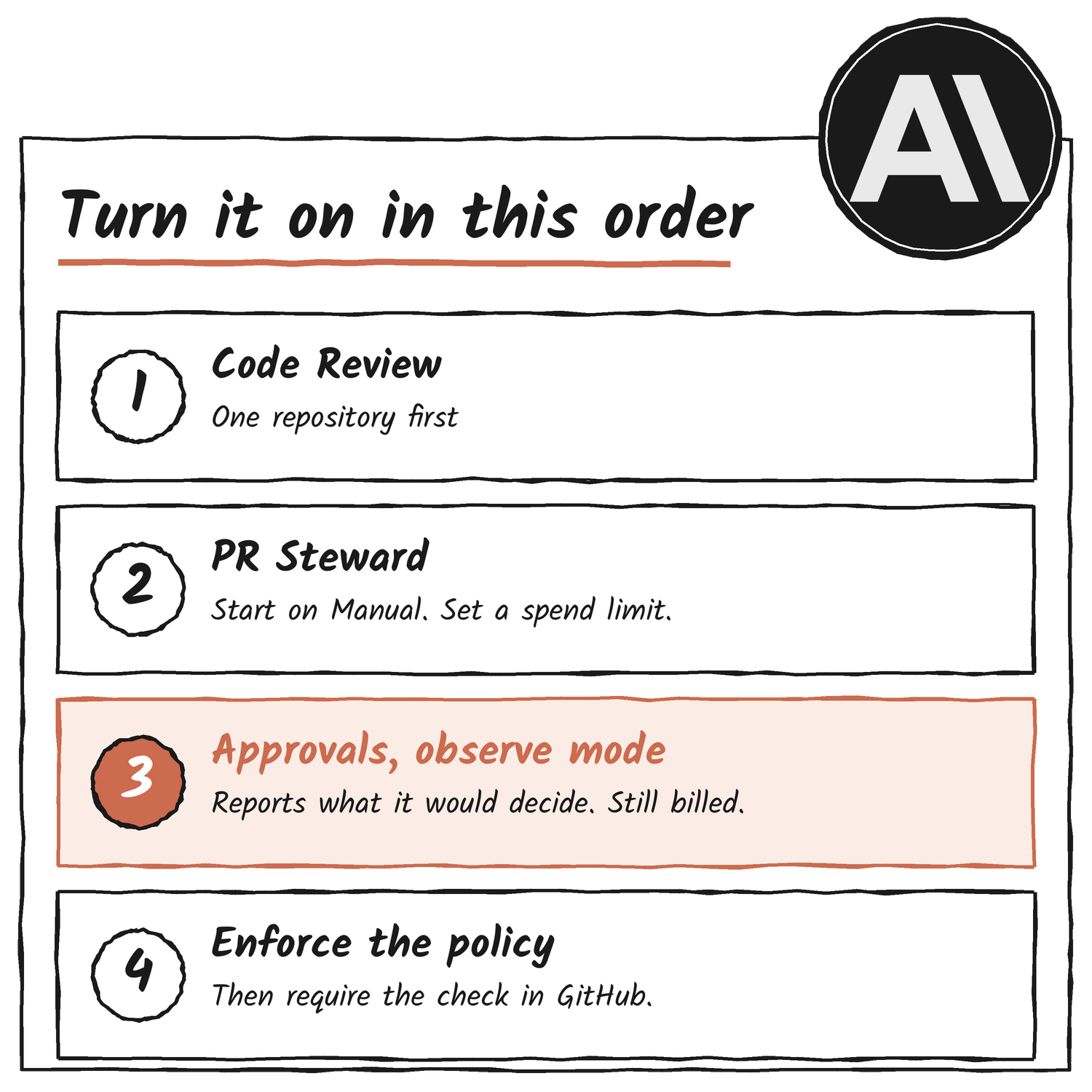
The practical consequence is on the GitHub side. Anthropic tells teams to require reviews through branch rules and keep the Claude GitHub App off every ruleset’s bypass list. PR Steward bills the organisation by tokens and has no spend limit of its own until an Owner sets one. Auto-fix and /steward do similar work but act as you and count against your usage; asking for auto-fix on a pull request PR Steward is watching fails.
Claude Approvals and the policy file
Approvals decides who has to look. A file in the repository, .claude/approvals.yml, sets how many people a path needs and where Claude may approve. Anthropic describes it as a smarter CODEOWNERS file. Approvals reads the policy from the default branch, takes the strictest verdict among the rules that match a pull request’s files, and reports it as a check named Claude Approvals, with a comment giving the reasons.
# .claude/approvals.yml
version: 1
mode: observe
rules:
  - purpose: "A change takes two people, and Claude doesn't approve."
    paths: ["**"]
    verdict: { claude: comments, seats: 2 }
    advisory: [claude/code_review]
That is Anthropic’s own starter example: every change needs two people, one of whom can be the author, and Claude only comments. A rule can instead let Claude approve once Code Review passes, and name the files that always need two people. A condition can read facts about the pull request and a classifier’s answer, but not CI results, so CI stays its own required check in GitHub.
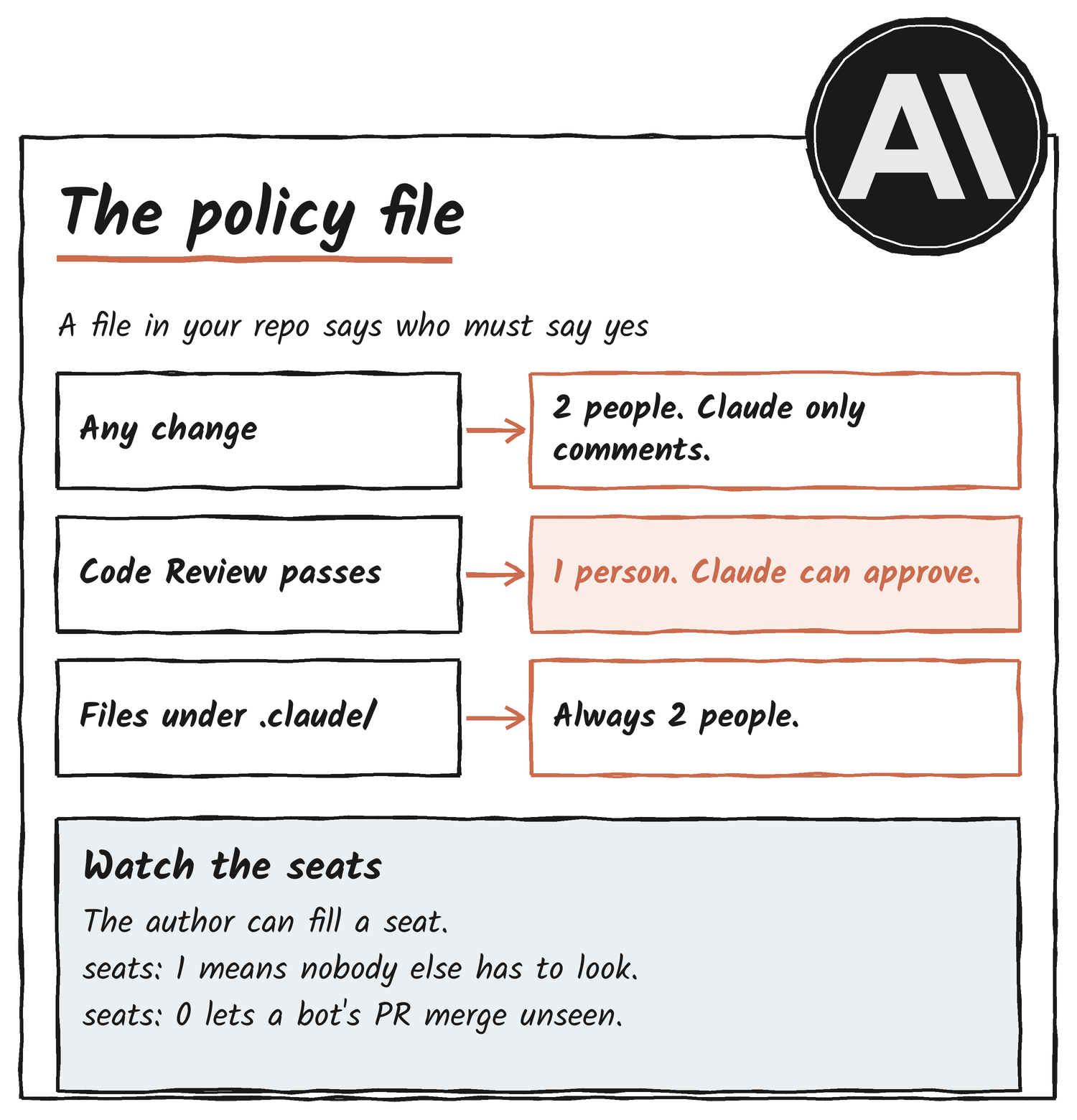
Files that control review itself count as protected. An edit to the policy file, for example, would otherwise let an author lower the bar for later pull requests, so Approvals normally asks for a person on those. The built-in list isn’t complete: Anthropic tells teams to write rules for .github/, CLAUDE.md, AGENTS.md, .mcp.json and the rest of .claude/ themselves.
Where the guardrails have gaps
Anthropic’s documentation lists several ways a pull request can merge with less review than a team expects.
- The author can fill a seat. With
seats: 1, nobody else has to look. Withseats: 0, a pull request a bot wrote can merge with no person having looked at it. - The check blocks nothing by default. Claude Approvals stops a merge only where the team makes it a required check in GitHub, and normally not in observe mode.
- Claude’s approval can satisfy GitHub. Where a branch rule requires one approval, Claude’s approving review can be that approval.
- A classifier reads text the author wrote. Anthropic says that text can try to steer the classifier’s answer, and advises asking for a person, in a rule that reads no classifier, on paths that matter.
- A policy file can switch off automatic reviews. Where every changed file sits under a policy file, automatic Code Reviews normally stop unless a rule names
claude/code_review.
What happens in a merge queue
Approvals doesn’t evaluate the commits a merge queue builds. It normally marks them as passed with the title Stamped for merge queue, except for a pull request evaluated only in observe mode. Whether a pull request enters the queue is decided by GitHub’s own rules, normally after the required checks pass, and it can enter while the Approvals check is still running. A team that wants a person on every path needs a rule that asks for someone who isn’t the author, and needs to make the Claude Approvals check required.
Cost and who can’t use it
Everything bills by tokens against the organisation’s usage credits. Claude Approvals has no base charge, but a policy that uses Code Review starts a billed review, and classifiers bill on the tokens they use, in observe mode too. Admins can set spend limits for Code Review and PR Steward. Anthropic says eligible Claude Enterprise organisations can claim at least US$10,000 in Claude Ship credits, to use within 30 days of claiming, until 15 January 2027. /ship counts as ordinary Claude Code usage.
The exclusions are firm. Organisations with zero data retention, the HIPAA configuration or customer-managed encryption keys can’t use any of it, and those with FERPA or Access Transparency settings can’t start Approvals. Repositories on GitHub only: github.com, including GitHub Enterprise Cloud, for Approvals, and a connected GitHub Enterprise Server instance for PR Steward.
Anthropic’s own numbers
The evidence Anthropic offers comes from its own repositories. On the Claude Code team, where Claude’s review is one layer of a broader process, merged pull requests more than doubled from June to September while the share reverted fell by more than 40%. It also describes a documentation fix that Claude Tag opened, Code Review passed, a docs reviewer signed off and Claude Approvals cleared, merging the same evening. Those figures are Anthropic’s own, and none has been independently checked.
How peers handle approval
Letting a model approve code is no longer unusual. What differs is how much control the team gets and how it’s switched on.
| Tool | Can it approve? | Controls | Also fixes code? |
|---|---|---|---|
| Claude Ship | Yes, where a policy allows (beta) | Policy file with seats, overrides and classifiers; observe mode | Yes, PR Steward |
| GitHub Copilot code review | Yes, announced 1 Sep 2026 as a public preview | Off by default; up to 15 file globs, and every changed file must match for the approval to count; a new commit dismisses it | Not part of this feature |
| Greptile | Yes, auto-approve in beta | Only a clean 5/5 review; a cap on the risk level it will approve | Sends findings to another agent to fix |
| CodeRabbit | Yes, with Automatic Approvals on; not on the Free plan | Approval risk limits that commands can’t bypass | Yes, Autofix |
| Cursor Bugbot | No; its check stays neutral unless findings are set to fail it | Rules in .cursor/BUGBOT.md | Yes, Autofix, up to three attempts per pull request |
The shape of Anthropic’s pitch is the policy file: one place in the repository that says who must approve what. The others offer narrower switches, such as Copilot’s file globs or Greptile’s risk cap. Cursor says Bugbot averages US$1.00 to US$1.50 a run on usage billing, according to a third-party roundup of its figures.
A safer rollout order
Anthropic’s own advice is to start small: one repository, a review level, a monthly spend limit, and the approval policy in observe mode until the team trusts it. The sequence below follows that advice and the gaps above.
What isn’t known yet
Anthropic hasn’t said when PR Steward and Claude Approvals leave beta, hasn’t published a per-review price, and hasn’t published measurements of how often the agents miss bugs. Its own notice says Claude Ship uses AI and may miss bugs, security vulnerabilities or other issues. Claude Ship covers GitHub repositories only, and /ship opens no pull request on a repository hosted elsewhere.
The zero-data-retention safeguards that sit on the other side of the same compliance line are covered in a separate report.
Sources: Anthropic, Introducing Claude Ship (23 November 2026) and Code Review is now generally available (15 October 2026); Claude Code documentation for Claude Approvals, PR Steward, /ship and Code Review; GitHub, Greptile, CodeRabbit and Cursor documentation; a third-party review-tool roundup for per-review prices; Addy Osmani on X.
Discover more from Sulat AI & Tech News
Subscribe to get the latest posts sent to your email.