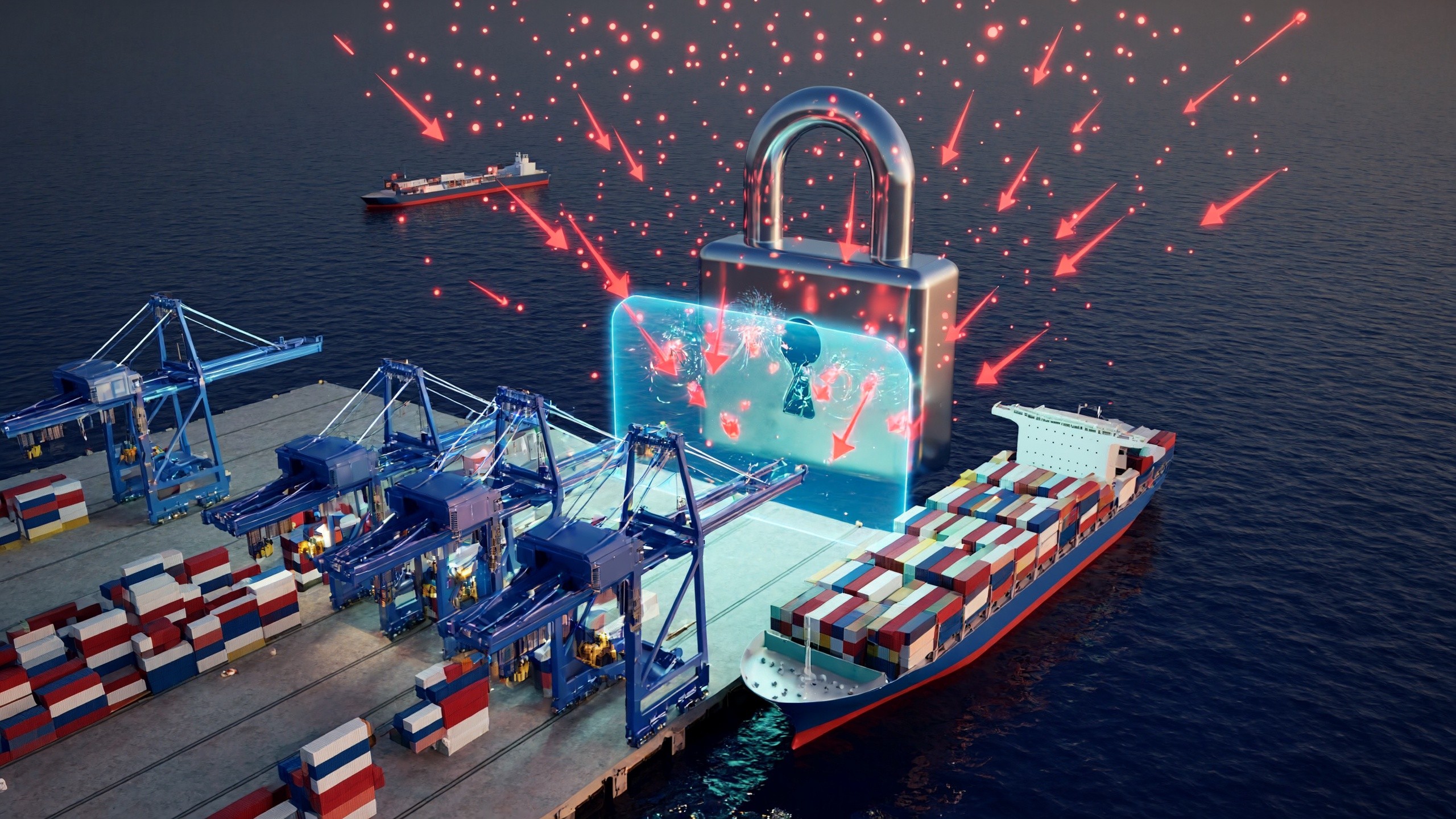
Hackers are mounting an escalating assault on US ports and cargo ships, with thousands of attempted attacks a day, the Financial Times reported on 22 November. That figure counts attempts. The cases on the record are fewer and more specific: a gate-system hack at North Carolina’s ports, two tankers whose networks the FBI and Coast Guard say were compromised, and a data breach at Maersk. Nobody has been publicly named for the first two.
The FT’s article is behind a paywall. Its headline and standfirst are public, and the detail below comes from the agencies, companies and researchers behind the numbers.
- What the FT reported
- Attempts are not incidents
- The cases, and what’s confirmed
- Who’s behind it
- How attackers get in
- The Coast Guard rule and its clock
What the FT reported
- Corpus Christi. The Texas port, a major US crude export gateway at about 2.3 million barrels a day, sees hundreds or even thousands of attempted attacks daily, chief executive Kent Britton told the FT. Attackers probe networks for weak spots and impersonate senior executives in fraudulent messages (Anadolu’s summary of the FT report).
- Los Angeles. The port blocked 120 million attempted attacks in August, the FT reports, nearly twice its monthly average in 2023.
- Coast Guard. Reported maritime cyber incidents rose 17% last year, and the Coast Guard and FBI investigated attacks on two US-bound oil tankers in August.
- Maersk. The shipping giant reported an intrusion this month in which hackers stole data. Maersk said operations weren’t affected and that it wasn’t a ransomware attack.
Attempts are not incidents
The big numbers in the headline are attempts. Port of Los Angeles executive director Gene Seroka told Bloomberg Television the port foiled more than 120 million attempts in August: intrusion, network exploitation, credential harvesting and malware, stopped by a seven-layer defence. That counts blocked traffic, not breaches.
The Coast Guard counts something different. Across the whole US marine transportation system, it and its local units responded to 42 reported cyber incidents in 2025, up from 36 in 2024. Its own review says operational impacts were limited.
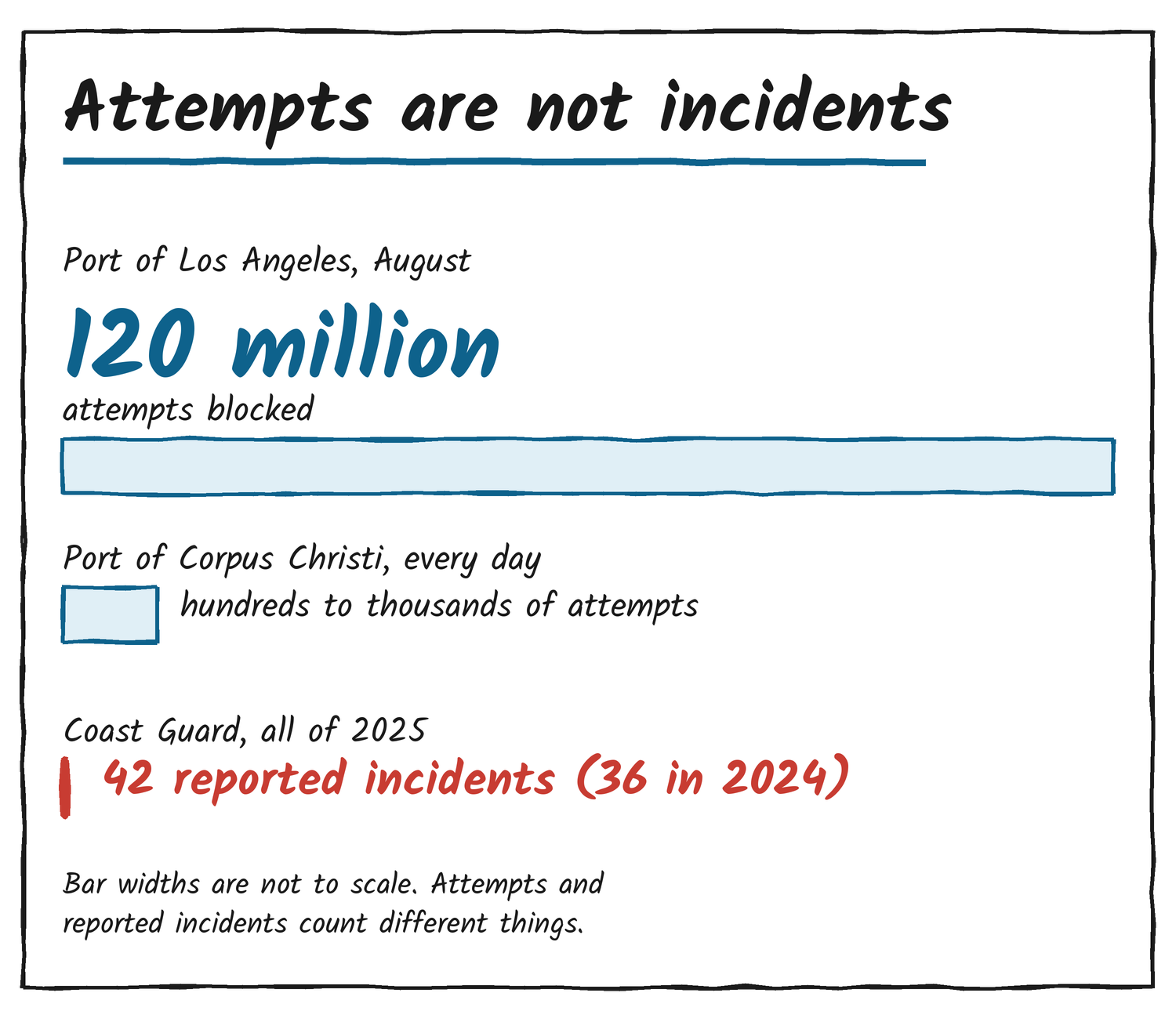
120 million
attempts blocked at the Port of Los Angeles in August 2026
42
cyber incidents reported to the Coast Guard in 2025, up from 36
17%
rise in reported incidents from 2024 to 2025
Despite the rise in reported incidents, operational impacts were thankfully limited.
Rear Admiral Jason Tama, Commander, Coast Guard Cyber Command, 2025 Cyber Trends and Insights in the Marine Environment
The cases, and what’s confirmed
Four 2026 cases carry most of the weight. Three are confirmed by the victim or by US agencies. One is a criminal gang’s claim.
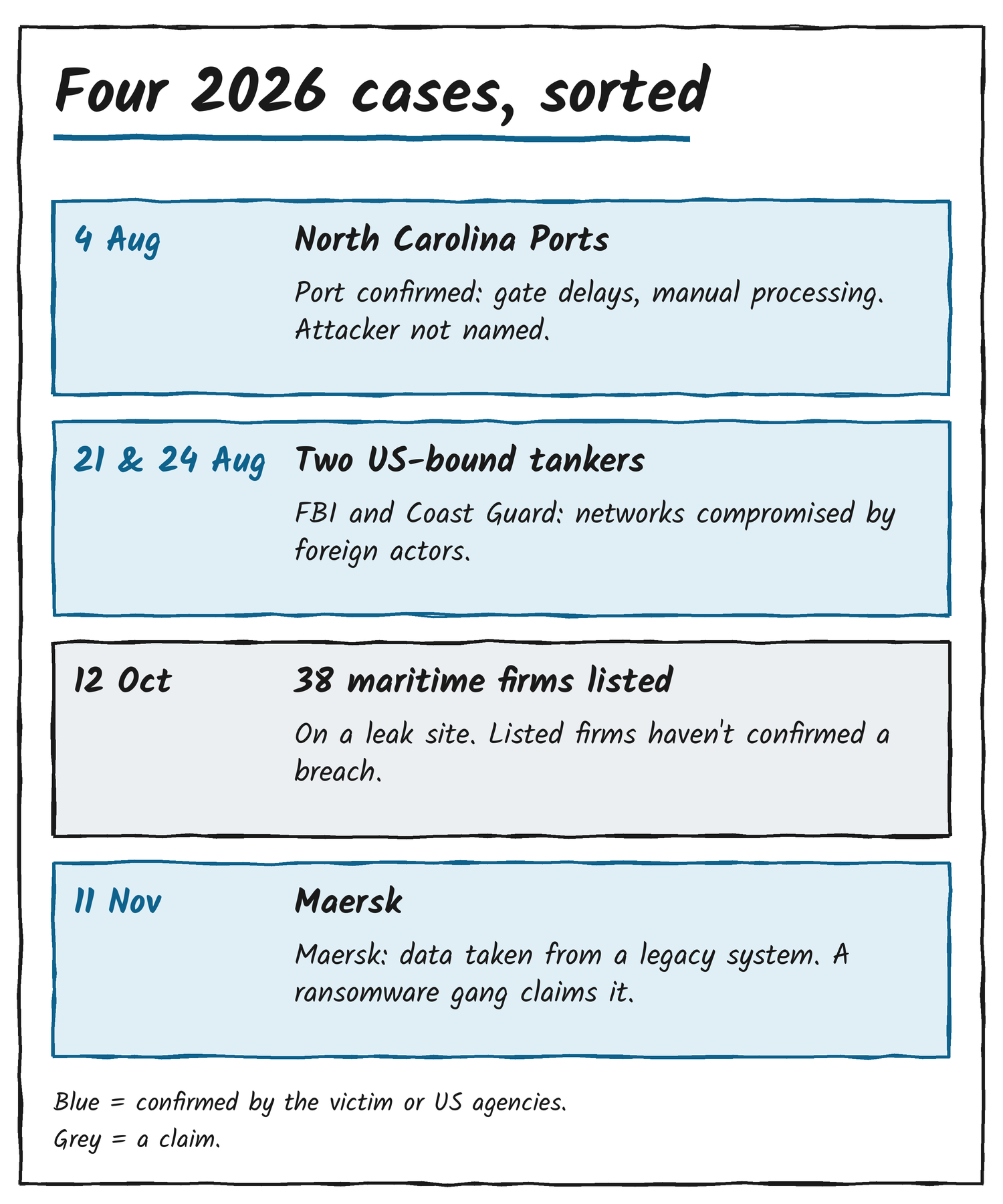
| Case | When | What’s on the record | Source |
|---|---|---|---|
| North Carolina Ports | 4 August | An outside actor hacked the ports’ IT system, hitting Wilmington, Morehead City and the Charlotte inland port. Gate openings were delayed and staff moved to manual processing. The breach was contained. The authority hasn’t said who did it or which systems were hit. | WCNC, CyberScoop |
| Two US-bound tankers | 21 and 24 August | The FBI and Coast Guard boarded two foreign-flagged oil tankers in the Gulf of Mexico after indications their networks were compromised by foreign actors. They report no operational disruption, vessel instability, physical danger to crews or environmental impact. | Maritime Executive, Reuters |
| 38 maritime firms | 12 October | The n0n extortion gang listed 38 port, terminal and shipping organisations in 18 countries on its leak site, with a 19 October deadline. The listed organisations hadn’t confirmed a breach as of 14 October. | Cydome, CyPro |
| Maersk | 11 November | Maersk reported unauthorised access and data extraction from a local legacy system from a previous acquisition, with no disruption to customers expected. The WhiteArmor ransomware gang claims about 100 GB and demands US$5 million. | Maersk, BleepingComputer |
On the tankers, Iranian outlets Tasnim and Mehr reported that the VL Prosperity lost all communications for 30 hours and that attackers reached its engine-room systems. The agencies haven’t confirmed either claim. Maritime InfoSec reports that Bloomberg later wrote that investigators found evidence of access to a digital system linked to the ship’s propulsion.
What a leak-site listing proves
On its own, nothing. A gang can list a company whose data came from a supplier. Cydome says the 38 listings likely trace to one support and project archive linked to CyberLogitec, a Korean software provider, and that being named doesn’t mean an organisation’s own network was breached.
Who’s behind it
The agencies haven’t named anyone for the tankers. Reuters notes that media reports have linked a series of US incidents to Iran since the conflict between Washington and Tehran began, and the Coast Guard has said only that “foreign cyber actors” were involved. North Carolina Ports has named no attacker either.
The criminal cases look different. SOCRadar describes n0n as financially motivated, and Cydome says it doesn’t attribute the group to any country. Separately, a Coast Guard and FBI alert says nation-state actors have exploited Fortinet FortiGate firewalls and VPN gateways used by marine transportation facilities and vessels, and cites CISA’s estimate that credentials for 74,000 Fortinet devices were compromised and leaked.
How attackers get in
The Coast Guard’s 2025 report gives the plainest answer. Phishing was used for reconnaissance or initial access in 43% of reported incidents, up from 25% a year earlier. Account compromise featured in 29%, and ransomware in 19%.
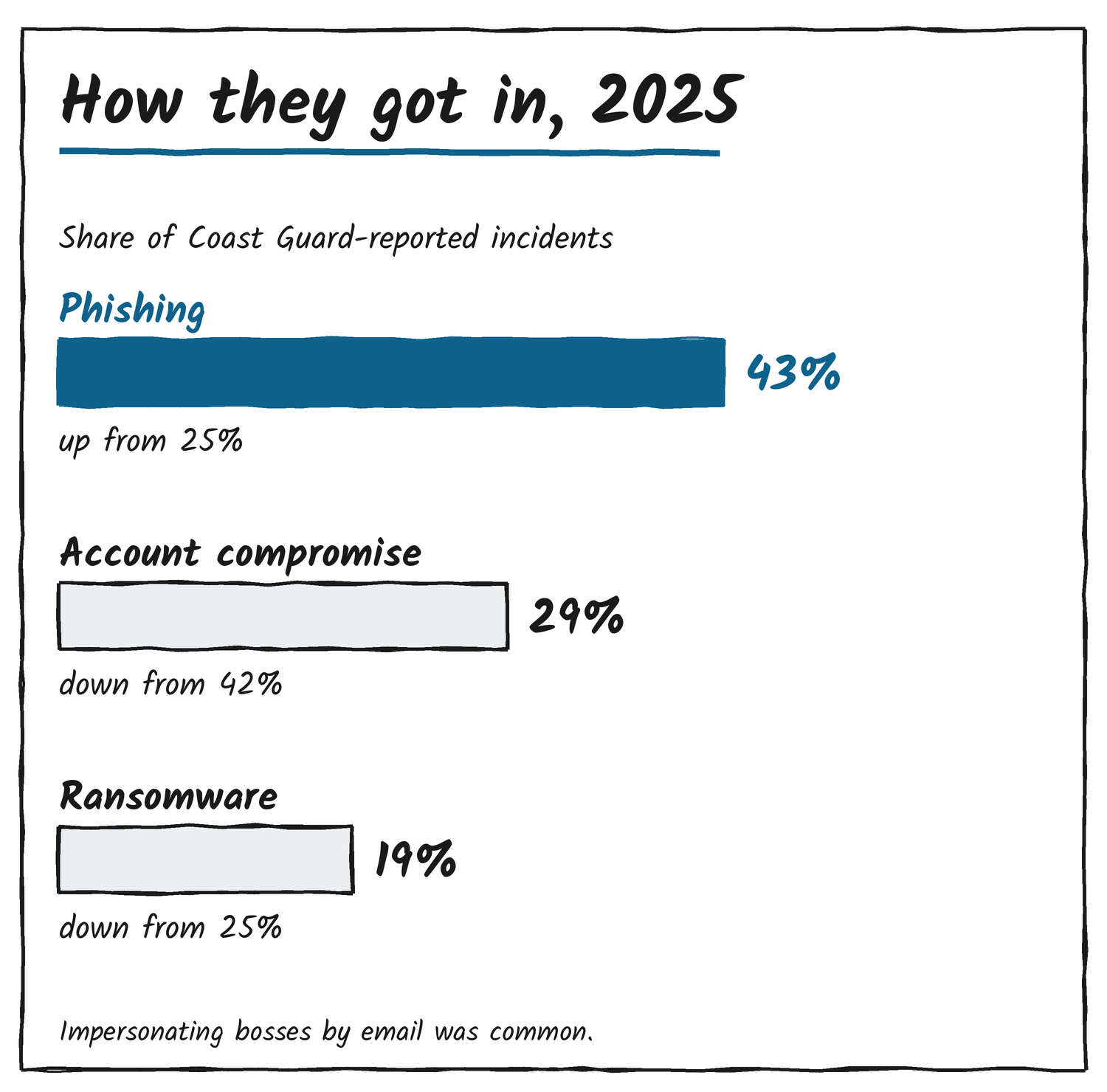
The report’s examples are ordinary. One attacker posed as a company director and asked staff to buy gift cards. Another emailed accounting as the CEO and asked for payment of a nearly US$50,000 invoice. In one incident an employee’s credentials were harvested and multi-factor authentication was switched off, so the attacker walked in. That matches Britton’s description of attackers impersonating executives.
The Coast Guard rule and its clock
Washington’s main answer is the Coast Guard’s Cybersecurity in the Marine Transportation System rule, published in January 2025 and in effect since 16 July 2025. It covers US-flagged vessels, offshore facilities and facilities regulated under the Maritime Transportation Security Act. Its phased schedule runs on three dates:
- 16 July 2025: every reportable cyber incident goes to the National Response Center.
- 12 January 2026: personnel complete the required cybersecurity training, then repeat it every year.
- 16 July 2027: owners and operators designate a Cybersecurity Officer, complete a Cybersecurity Assessment and submit a Cybersecurity Plan to the Coast Guard for approval.
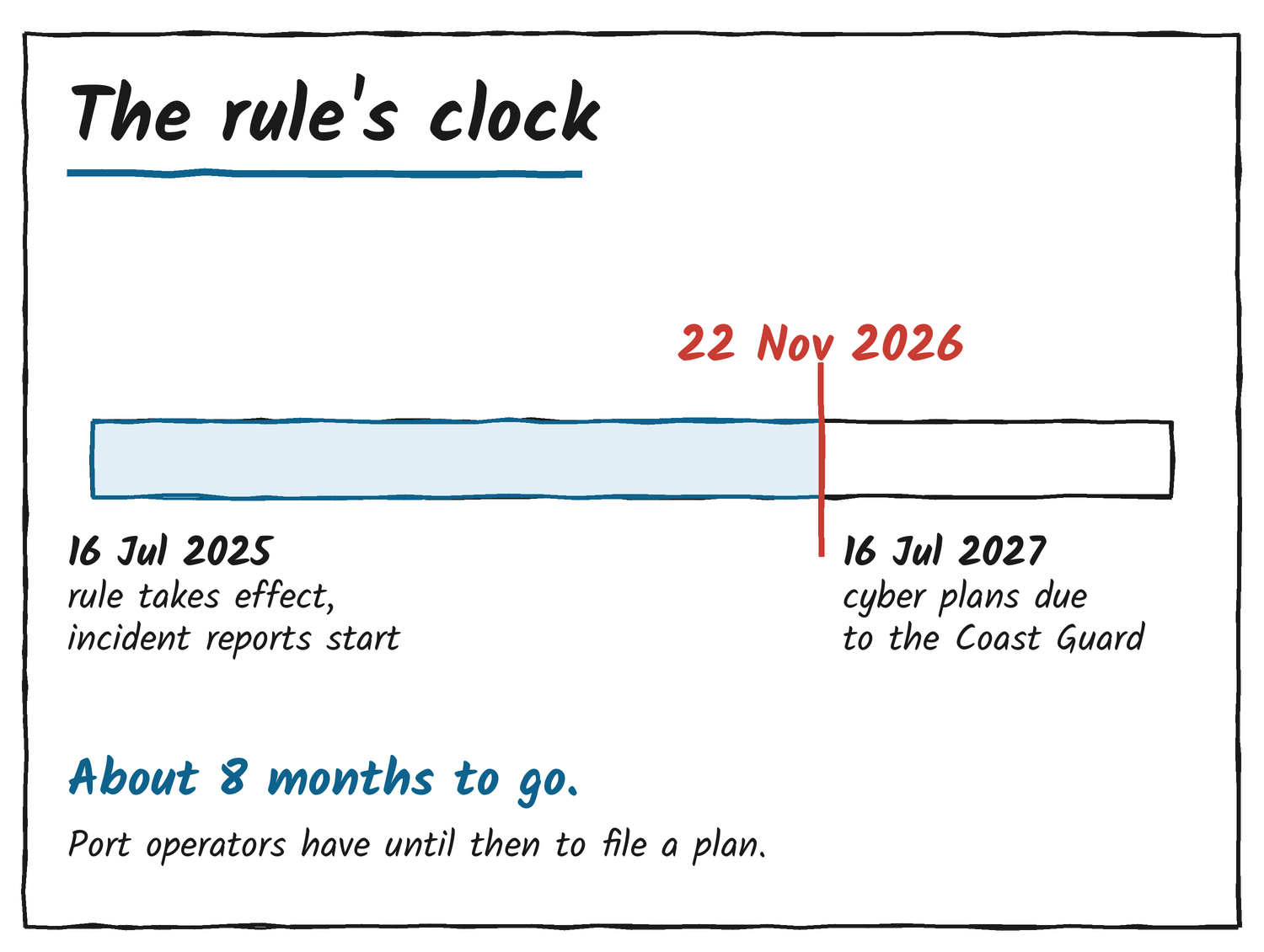
That puts the plan deadline about eight months away. The rule doesn’t apply directly to foreign-flagged ships like the two tankers. For those, the Coast Guard says it will use port state control and its Captain of the Port authority to scrutinise poor cybersecurity practice, which can mean deficiencies, detention or denial of entry. The Coast Guard also announced a new Office of Maritime Cybersecurity Policy on 31 August, according to the Foundation for Defense of Democracies.
In October the US Maritime Administration issued advisory 2026-014, which warns port operators about vulnerabilities in foreign-made port equipment, including ZPMC ship-to-shore cranes, Nuctech scanners and China’s LOGINK logistics platform.
What the Coast Guard tells operators to do
The Coast Guard’s September alert on Fortinet devices lists the fixes it wants from marine transportation partners:
- Patch the most targeted FortiGate flaws, such as CVE-2026-24858 and CVE-2025-25252.
- Require multi-factor authentication on every VPN profile and admin portal.
- Reset credentials that may be exposed, starting with administrator accounts.
- Keep IT and operational technology segmented, and review firewall rules and logs.
- Replace end-of-life devices the manufacturer no longer supports.
The Coast Guard’s 2025 review adds that a terminal operating system is only as secure as its configuration, because it connects customer-facing applications to the systems that run the terminal.
Related coverage of the week’s US incidents:
Sources
- Financial Times: US ports face cyber attack onslaught as hackers target vital trade routes, 22 November 2026
- US Coast Guard Cyber Command, Cyber Trends and Insights in the Marine Environment 2025
- US Coast Guard: Cybersecurity in the Marine Transportation System, implementation timeline, and the Federal Register final rule
- Coast Guard and FBI Maritime Cyber Alert 02-26, Fortinet FortiGate vulnerabilities
- US Maritime Administration advisory 2026-014, 21 October 2026
- Bloomberg: Port of Los Angeles blocks 120 million cyberattacks in August, 17 September 2026
- Reuters: Two US-bound vessels apparently compromised by hackers, 17 September 2026, and The Maritime Executive, 16 September 2026
- CyberScoop: Coast Guard says it is monitoring cyberattack that disrupted North Carolina’s ports, 7 August 2026
- Maersk: IT security incident, 11 November 2026, and BleepingComputer
- Cydome on n0n, SOCRadar and CyPro, October 2026
- Foundation for Defense of Democracies: Maritime Cyber Incidents Test Coast Guard Cyber Preparedness, 23 September 2026
Discover more from Sulat AI & Tech News
Subscribe to get the latest posts sent to your email.