The FBI is investigating an apparent breach of the National Crime Information Center, the nationwide database police use to share warrants and run background checks, CNN’s Evan Perez reported on Friday 20 November (US time). CNN cites two people briefed on the investigation. The FBI hadn’t responded to CNN’s request for comment when the story ran, and it hasn’t published a statement on the report since.
CNN says the intrusion was discovered in recent days and calls it the second breach of an FBI system in recent months, after a September attack on the bureau’s jobs website. Below: what CNN reported, what the FBI says NCIC holds, and how earlier incidents on FBI systems played out.
- What CNN reported
- What NCIC is and what it holds
- Who can query it, and how it’s secured
- Earlier incidents at the FBI
- What isn’t known
- Sources
What CNN reported
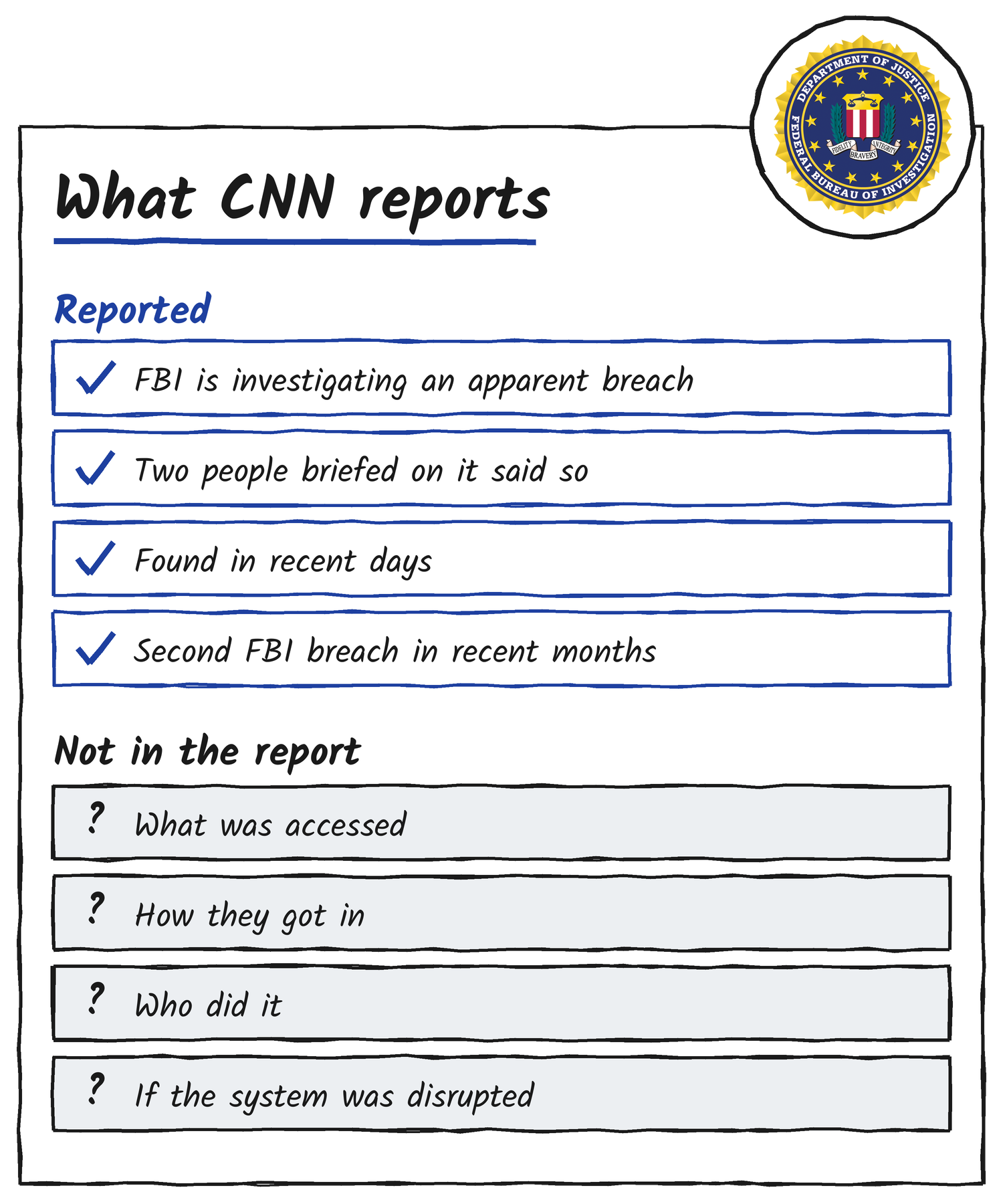
Perez’s report rests on two unnamed people. CNN describes NCIC as a nationwide criminal information database that serves as a lifeline between federal, state and local law enforcement, and says police nationwide use it to share information on warrants and background checks. It calls the intrusion the work of “apparent hackers”.
CNN says the discovery came while the Trump administration was trying to calm public concern about cybersecurity after a run of high-profile outages hit banks, the National Security Agency and the FAA’s air traffic control system. CNN doesn’t say any of those outages is connected to the NCIC intrusion.
On Thursday 19 November (US time), after bureau officials learned of the incident, FBI Director Kash Patel went on Fox News to talk up the FBI’s cyber work, CNN says. CNN reports that Patel referred to Operation Winter Shield, an operation it says was completed months ago to urge companies to update their systems and keep hackers from their sensitive data, as if it was still in the works.
Other administrations could have made these updates, but they didn’t. We are staying ahead of the curve and making up for lost time.
FBI Director Kash Patel on Fox News, 19 November 2026 (US), as quoted by CNN
What NCIC is and what it holds
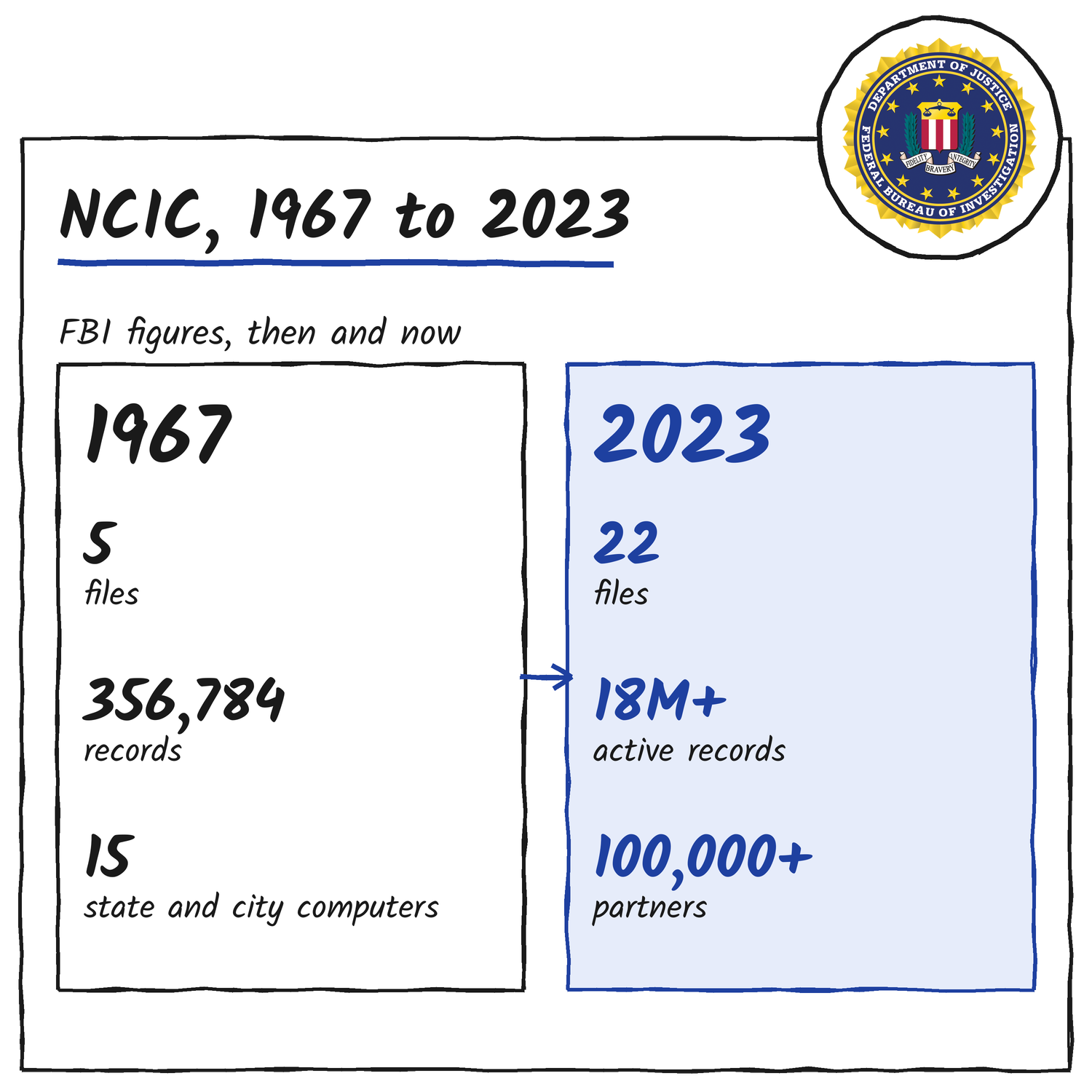
The FBI launched NCIC on 27 January 1967 and describes it as an information system of records contributed by, and accessible to, criminal justice agencies nationwide. Agencies enter the records. The FBI’s Criminal Justice Information Services (CJIS) Division is the custodian, and the records are available to authorised agencies around the clock, every day of the year.
22
files, per the FBI (2023)
18M+
active records, per the FBI (2023)
100,000+
criminal justice and law enforcement partners
The FBI says the system “averages millions of transactions each day with a millisecond response time”. In 2017 it put the daily figure at 14 million, across 21 files and 12 million active records.1 The best-known use is the traffic stop: an officer runs a plate or a licence and the system says whether the driver is wanted or the vehicle is stolen.
What’s a “hit”?
A positive response from NCIC is called a hit. The FBI says a hit doesn’t establish probable cause for an arrest, and agencies must confirm that the record is accurate and current before they act on it.
The FBI lists seven property files and 15 persons files. The persons files cover wanted people, missing and unidentified people, protection orders, the National Sex Offender Registry, gang members, immigration violators, people on supervised release, identity theft victims and the Threat Screening Center.
| Group | Files the FBI lists |
|---|---|
| Property (7) | Article, Boat, Gun, License Plate, Securities, Vehicle, Vehicle/Boat Part |
| Persons (15) | Extreme Risk Protection Order, Foreign Fugitive, Gang, Identity Theft, Immigration Violator, Threat Screening Center, Missing Person, NICS Denied Transaction, National Sex Offender Registry, Protection Order, Protective Interest, Supervised Release, Unidentified Person, Violent Person, Wanted Person |
Some of these files carry stricter rules. The FBI’s CJIS Security Policy names ten restricted files, among them the Gang, Threat Screening Center, Supervised Release, National Sex Offender Registry, Identity Theft, Protective Interest, Violent Person and NICS Denied Transactions files, and says they must be protected as criminal history record information.
Who can query it, and how it’s secured
Taking part is voluntary, the FBI says, but an agency that joins enters, changes and removes its own records. The NCIC operating manual says most records go in through a control terminal tied into the network by the agency that holds the warrant, missing-person report or theft report. Each state’s CJIS Systems Agency is responsible for enforcing security on the agencies it serves. The Colorado Bureau of Investigation, which fills that role in Colorado, says it also audits those agencies.
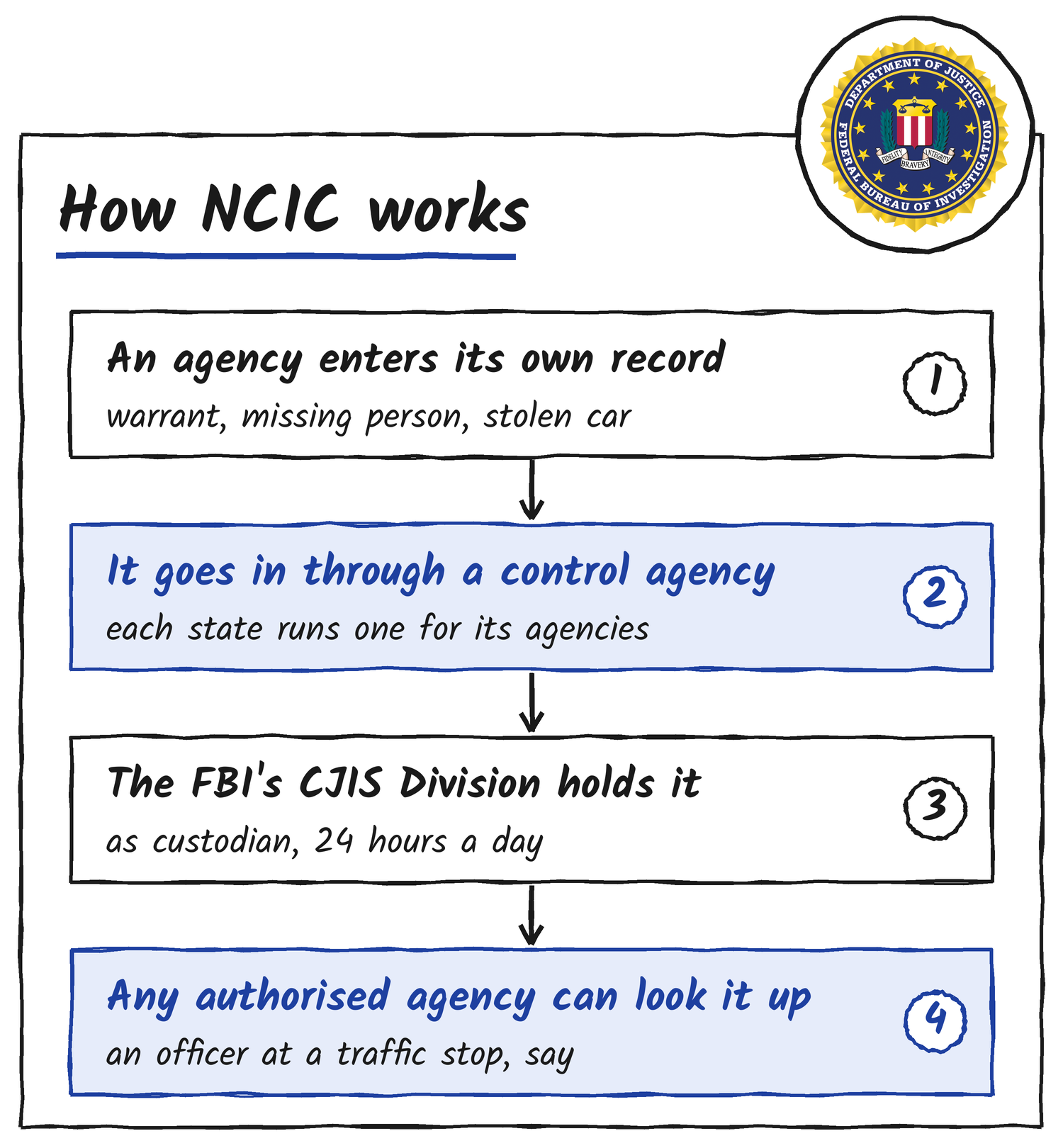
The FBI says its NCIC policy encrypts information, authenticates each agency, requires agencies to validate their records regularly and requires periodic audits. The current CJIS Security Policy, version 6.1 dated 25 June 2026, lists multi-factor authentication for both privileged and non-privileged accounts as a top-priority control. The same operating manual sets out where responsibility sits.
The FBI uses hardware and software controls to help ensure System security. However, final responsibility for the maintenance of the security and confidentiality of criminal justice information rests with the individual agencies participating in the NCIC System.
NCIC Operating Manual, introduction
CNN hasn’t said which part of that chain, if any, was involved in the intrusion.
PDFle.fbi.gov
- NCIC
- The National Crime Information Center, the FBI’s index of criminal justice records that agencies enter and query.
- CJIS Division
- The FBI’s Criminal Justice Information Services Division, custodian of NCIC records.
- CJIS Systems Agency
- The state-level agency that connects local agencies to FBI CJIS systems and enforces security on the agencies it serves.
- Restricted file
- An NCIC file with stricter access and use rules. The CJIS Security Policy lists ten and says they’re protected as criminal history record information.
- Hit
- A positive NCIC response to a query. It doesn’t, alone, establish probable cause for an arrest.
Earlier incidents at the FBI
The FBI has had other incidents on its own systems. The table lists each one, who reported it and what the bureau said at the time.
| Date | System | What was reported | Source |
|---|---|---|---|
| 13 Nov 2021 | LEEP notification server | The FBI said a software misconfiguration let an actor use the Law Enforcement Enterprise Portal to send fake emails, and that no actor accessed or compromised data or personal information on its network. | FBI statement |
| 10 Dec 2022 | InfraGard portal | A database of contact details for more than 80,000 members went up for sale on a cybercrime forum. The FBI said it was aware of a potential false account on the portal. | KrebsOnSecurity |
| 17 Feb 2023 | New York field office computer system | CNN reported a system used in child sexual exploitation investigations was compromised. The FBI called it “an isolated incident that has been contained”. | TechCrunch, CNN |
| 22 Sep 2026 | FBIjobs.gov | ShinyHunters said it stole data on current and former FBI employees. The FBI said it was aware of claims of unauthorised activity affecting FBIjobs.gov and was investigating. | Reuters |
| 5 to 6 Oct 2026 | FBIjobs.gov | FBI cyber chief Brett Leatherman said a contractor failed to apply a security patch. Reuters reported the FBI removed the contractor; its sources named Oracle’s PeopleSoft platform and Accenture. | Reuters |
| 8 Oct 2026 | FBIjobs.gov | Edward Dubrovsky, a Canadian cybersecurity executive, appeared in federal court in the Philadelphia area on charges related to extortion and making threats, CNN reported. | CNN |
| 20 Nov 2026 | NCIC | CNN reported an apparent breach under investigation. The FBI hadn’t responded to CNN’s request for comment. | CNN |
The September breach is the one the FBI has explained. Leatherman’s statement put the cause on a third party.
the incident occurred as the result of a security failure of a platform managed by a third-party organization
Brett Leatherman, FBI cyber chief, statement of 6 October 2026
He added that this followed a contractor failing “to implement a security patch explicitly issued to secure the platform”. The FBI hasn’t said whether the NCIC incident involves a contractor or a third-party platform, and CNN didn’t report how the intrusion happened. CNN’s report doesn’t say the two incidents are linked.
The FBI also put out a separate flash alert this month about ARTEX, an open-source AI tool it says hackers use to automate intrusions.
What isn’t known
- What was accessed or copied, and which NCIC files, if any, were touched: not in CNN’s report.
- How the intruders got in and who they are: CNN doesn’t say.
- Whether the system was disrupted: CNN doesn’t say.
- Whether the FBI has told the agencies that rely on NCIC: CNN doesn’t say.
- The FBI hasn’t confirmed the breach or commented on the report, and it hasn’t said when it will say more.
This article will be updated in place when the FBI says more or CNN adds to its reporting.
- The FBI’s NCIC page gives the 2023 figures. The 2017 figures are from its story “NCIC Turns 50”, published 27 January 2017. ↩︎
Sources
- FBI, National Crime Information Center (NCIC)
- FBI, “NCIC Turns 50”, 27 January 2017
- FBI CJIS Division, CJIS Security Policy v6.1, 25 June 2026
- NCIC Operating Manual, introduction (copy published by the South Carolina Attorney General’s office)
- Colorado Bureau of Investigation, CJIS security
- FBI, statement on incident involving fake emails, 13 to 14 November 2021
- CNN, Evan Perez, “The FBI was hacked again, this time the breach targeted its crime database”, 20 November 2026
- CNN, “FBI arrests cybersecurity executive in major hack on agents’ data”, 9 October 2026
- Reuters, “ShinyHunters hackers say they breached FBI, stole data on bureau employees”, 22 September 2026
- Reuters, “Accenture contractor removed from FBI following damaging data breach, sources say”, 5 October 2026
- KrebsOnSecurity, “FBI’s Vetted Info Sharing Network ‘InfraGard’ Hacked”, 13 December 2022
- TechCrunch, “FBI confirms it’s investigating a cyber incident on its own network”, 17 February 2023
Discover more from Sulat AI & Tech News
Subscribe to get the latest posts sent to your email.