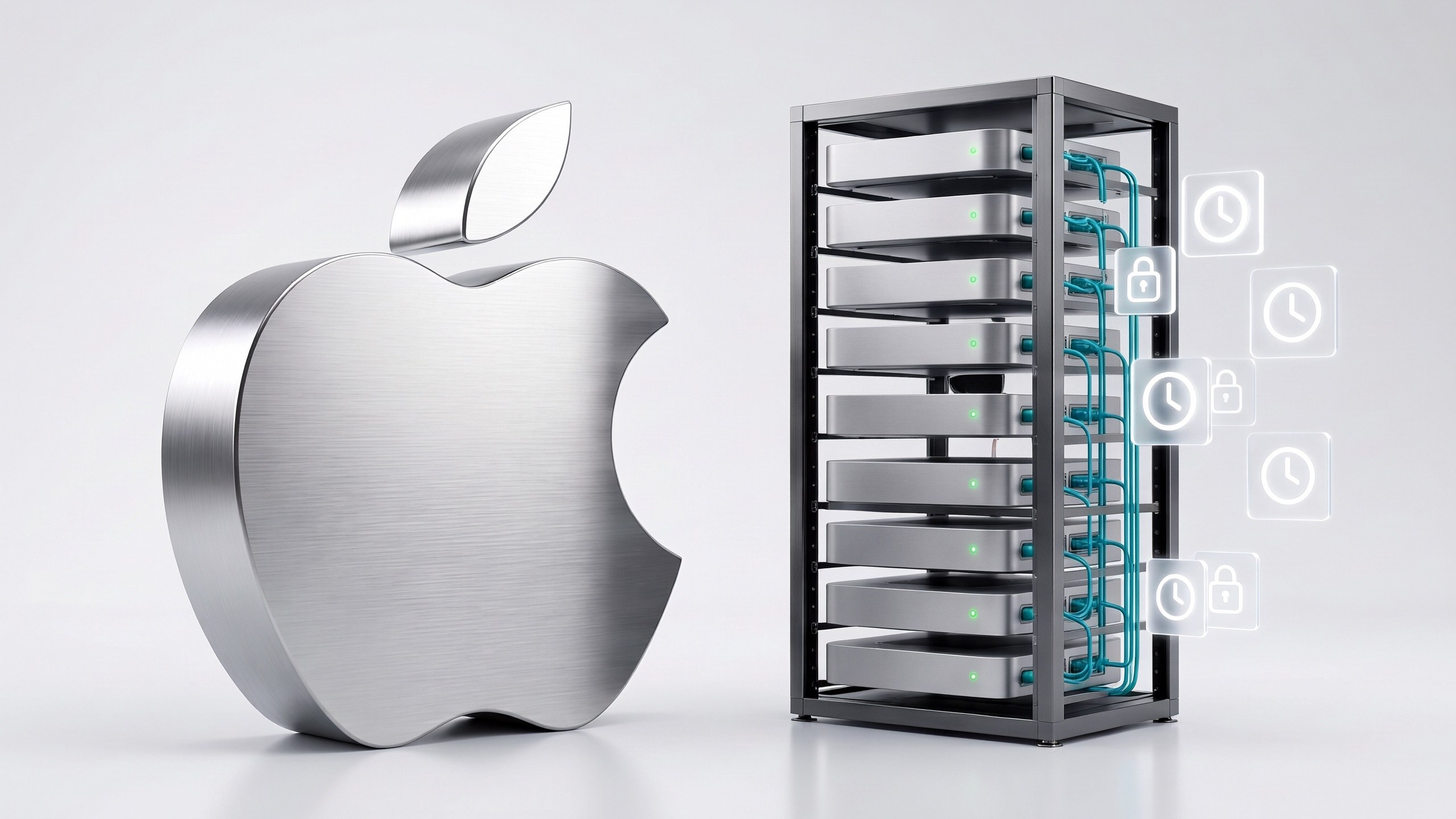
InstaBox, a start-up that gives each AI agent its own machine in the cloud, lists macOS machines from US$0.45 an hour, and co-founder Hang Huang announced them on 21 November. Two other services, Daytona and Amp, now rent Macs to agents as well, and AWS leases them as Dedicated Hosts. Each one runs into the same rule in Apple’s software licence: a Mac is leased for at least 24 hours at a time.
The rental market sits on a hardware squeeze. Tim Cook, then Apple’s chief executive, said on 30 April that the Mac mini and Mac Studio would stay short for several months, and Apple’s August press release called the new Mac mini the leading desktop for always-on agentic computing. This piece covers what the services charge, what Apple’s licence allows, who is buying the machines, and what the prices mean for anyone thinking of buying minis to rent out.
- What the services charge
- The licence behind the 24-hour minimum
- Why Macs became agent hardware
- Most agent work doesn’t need a Mac
- The sums on renting out minis
- What the providers haven’t said
What the services charge
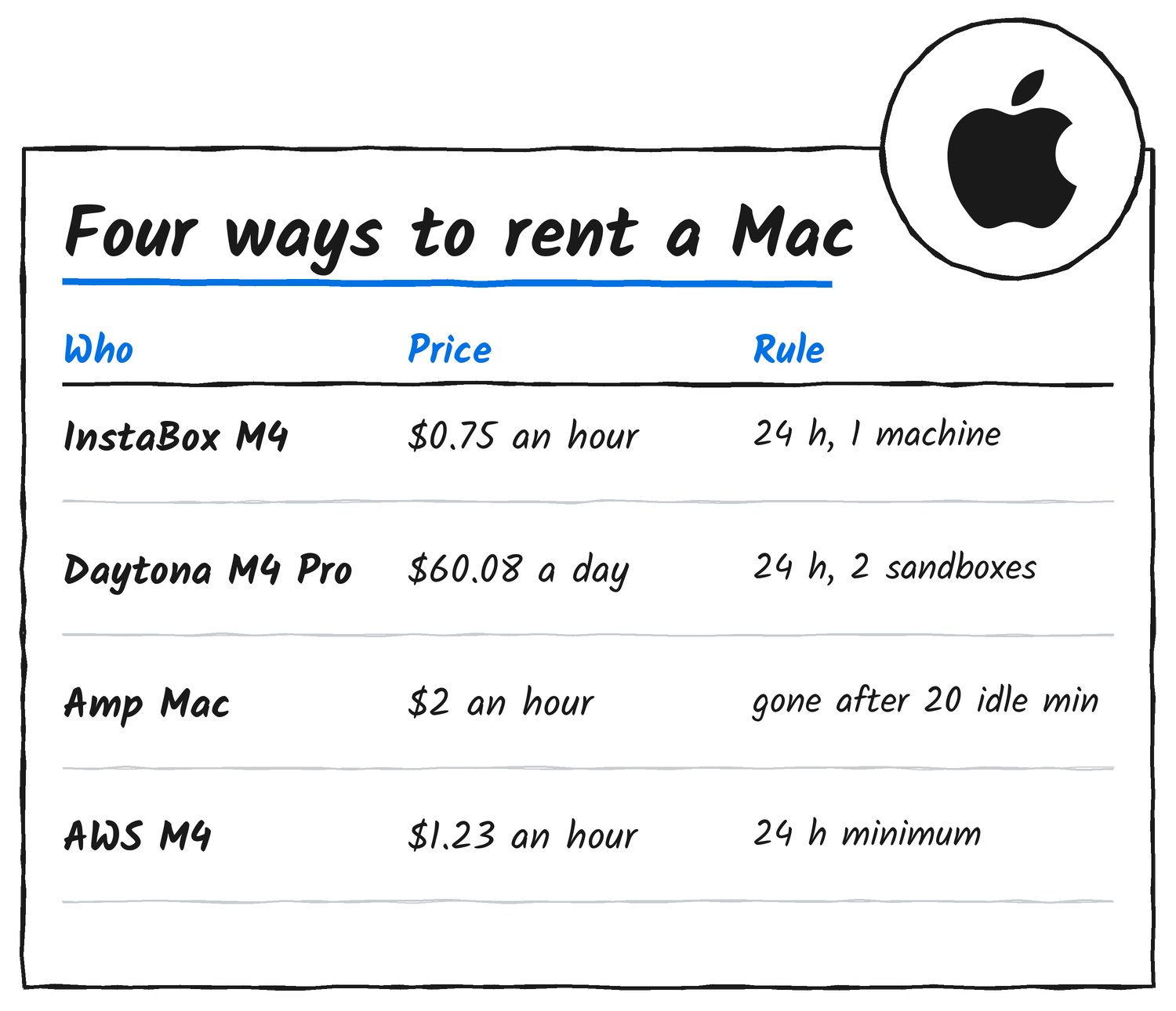
InstaBox’s pricing page lists four Mac models, each leased whole: M2 at US$0.45 an hour, M2 Pro at US$0.85, M4 at US$0.75 and M4 Pro at US$1.25, with the CPUs and memory included. The minimum lease is 24 hours, so the cheapest option costs US$10.80 up front. Its docs say a macOS machine can’t be paused, that macOS machines need the US$20-a-month Pro plan or higher, and that a create request fails at once with a 503 “no_capacity” error when no Mac of that model is free.
Daytona launched macOS sandboxes on 17 November. Each is a virtual machine on a Mac mini reserved for one organisation for 24 hours at a time, and up to two sandboxes share a Mac. Daytona’s docs price an M4 Pro with 24 GB at US$2.5032 an hour, or US$60.08 for each 24-hour period. The use.computer site, which carries a Daytona support address, lists lower rates: M4 at US$0.90 an hour, M4 Pro at US$1.40 and M5 Pro at US$1.75.
Amp takes a different route. Its macOS Satellites, announced on 29 October and still in beta behind a waitlist, boot a fresh Mac with Xcode and the iOS simulators in about 30 seconds while the agent’s thread stays on a Linux machine. A mac.medium with six CPUs and 14 GB costs US$2 an hour, and a mac.large with 12 CPUs and 28 GB costs US$4. Amp deletes the Mac 20 minutes after its last use, and says the waitlist opens up as it adds Macs.
AWS rents EC2 Mac machines only as Dedicated Hosts, billed per second after a 24-hour minimum that it says is there to comply with Apple’s macOS licence. A hosting guide from Everpod, checked on 2 October, listed an M4 with 24 GB at US$1.23 an hour in US East.
| Service | What you rent | Price | Lease rule | Source |
|---|---|---|---|---|
| InstaBox | A whole Mac: M2, M2 Pro, M4 or M4 Pro | US$0.45, US$0.85, US$0.75 and US$1.25 an hour | 24-hour minimum, one machine per Mac, no pausing | InstaBox pricing and macOS docs |
| Daytona | A VM on a reserved Mac mini (M4 Pro, 24 GB) | US$2.5032 an hour, US$60.08 per 24 hours | Reserved 24 hours at a time, up to two sandboxes per Mac | Daytona macOS docs |
| Amp | A fresh Mac started by the agent | US$2 an hour (mac.medium), US$4 (mac.large) | Deleted after 20 idle minutes, beta waitlist | Amp macOS Satellites docs |
| AWS EC2 Mac | A Dedicated Host (M4, 24 GB) | US$1.23 an hour, US East | 24-hour minimum | AWS page; Everpod for the price |
US$0.45
InstaBox’s cheapest Mac-hour, for an M2
US$60.08
Daytona’s price for 24 hours of an M4 Pro
24 hours
The shortest lease Apple’s licence allows
Two
Extra macOS VMs the licence allows on each Mac
The licence behind the 24-hour minimum
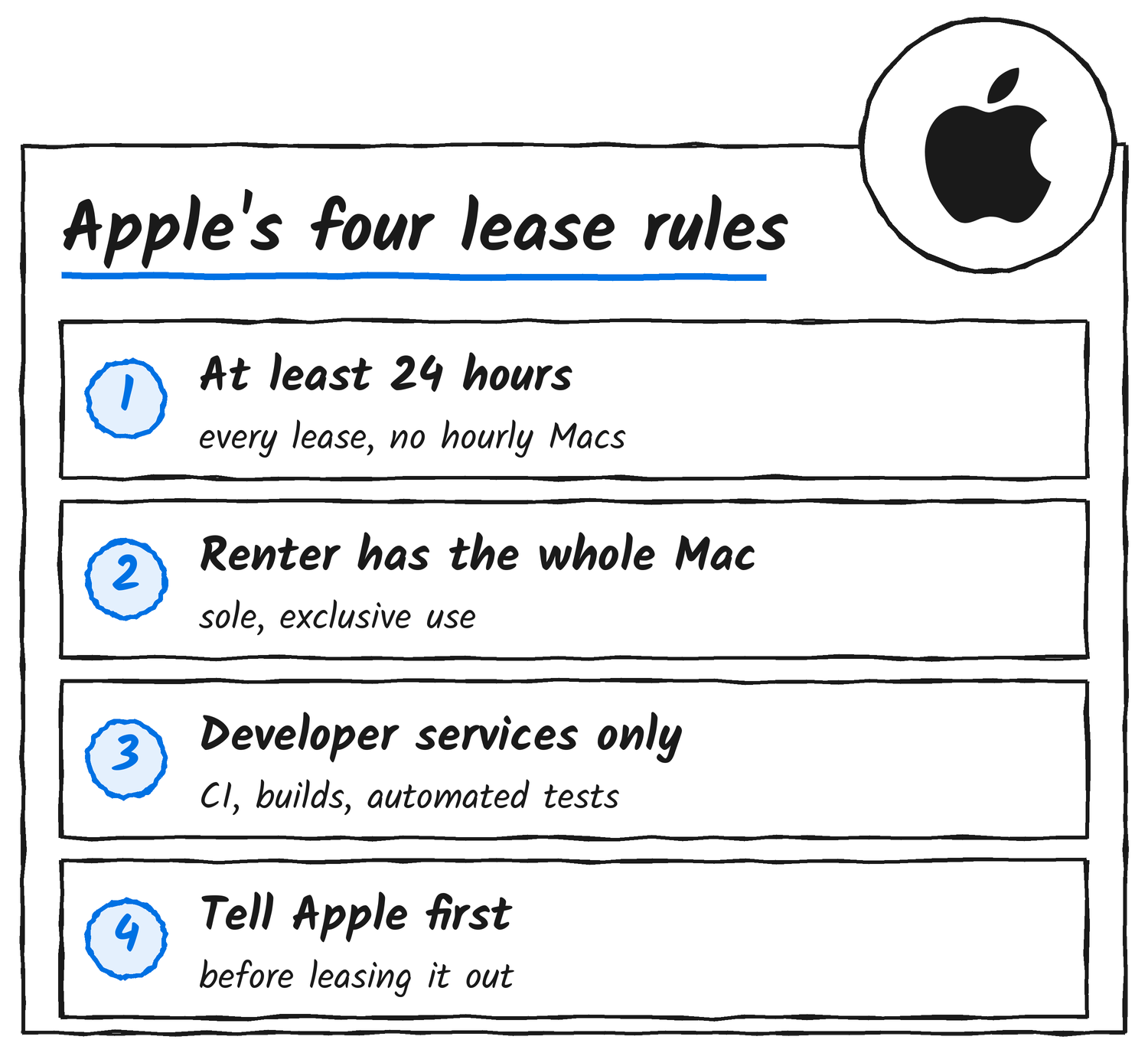
The 24-hour minimum comes from Apple’s licence for macOS, not from the providers. InstaBox’s docs say Apple’s licence lets it lease a Mac to only one customer at a time, for at least 24 hours. Section 3 of the macOS Tahoe agreement, titled “Leasing for Permitted Developer Services”, sets four conditions. Each lease must run at least 24 consecutive hours, the renter must have sole and exclusive use of the Mac, the Mac must be used only for permitted developer services, and the lessor must tell Apple before leasing it out.
each lease period must be for a minimum period of twenty-four (24) consecutive hours
Apple, Software Licence Agreement for macOS Tahoe 26, section 3A(ii)
The same section defines those services:
continuous integration services, including but not limited to software development, building software from source, automated testing during software development, and running necessary developer tools to support such activities
Apple, Software Licence Agreement for macOS Tahoe 26, section 3
Daytona’s launch post lists computer-use agents, which drive macOS apps through screenshots, mouse and keyboard input, among what its sandboxes do, next to Xcode builds and tests. Daytona puts up to two sandboxes on one Mac, and InstaBox puts one.
The InstaBox command that accepts the lease
InstaBox’s docs show the 24-hour minimum as a flag the user has to pass when creating a macOS machine:
instabox create --name mac --template macos --accept-24h-minimumWhy Macs became agent hardware
The Mac mini’s new job started with always-on agents. OpenClaw, an open-source agent released in November 2025 by Peter Steinberger under the name Clawdbot, runs as a persistent process on hardware its user owns and acts on instructions sent through chat apps, TechCentral reports. Decrypt reported on 2 May that the base US$599 Mac mini was sold out in the US with no delivery or pickup, and that 64 GB configurations showed waits of 16 to 18 weeks.
Both of these are amazing platforms for AI and agentic tools, and the customer recognition of that is happening faster than what we had predicted.
Tim Cook, Apple’s Q2 2026 earnings call, 30 April, as quoted by Thurrott
Apple’s 25 August press release headlined the new Mac mini as the leading desktop for always-on agentic computing. The model with the M6 chip starts at US$899 and the M5 Pro version at US$1,699, and both began arriving on 22 September. Reuters quoted Apple’s hardware chief Johny Srouji calling it an always-on agentic device.
Heise reported on 31 August, citing The Information, that AI labs and AI cloud providers bought Mac minis and Mac Studios “in truckloads”, and that some providers buy them in bulk for their own neoclouds, placing them in data centres and renting out the AI applications that run there. Hostzero, a Frankfurt colocation host, sells each Mac mini a shelf, a switched power outlet and an isolated network port for EUR 39 a month on a 12-month term, from 20 units. Its guide says teams “buy 20 or 30 Mac minis, run an agent on each” and then find that an office shelf isn’t a server room.
Capacity is the constraint on the rental side too. Huang’s post says capacity is limited for now and that InstaBox will rack more Macs as it goes. Apple’s own costs are rising: John Ternus, by then chief executive, said on the 2 November earnings call that memory pricing is unprecedented, and Apple raised its manufacturing purchase obligations by US$33 billion from one quarter to the next, Supply Chain Dive reported.
Not everyone reads the squeeze as an agent story. AppleInsider argued on 31 August that AI is increasing demand for Macs rather than driving it. It cited a MacStadium survey of about 300 US developers in which 55% of teams run 26 or more physical Macs for continuous integration and 83% said AI adoption had raised their Mac infrastructure costs. MacStadium sells Mac hosting, and AppleInsider noted selection bias in the sample.
Most agent work doesn’t need a Mac
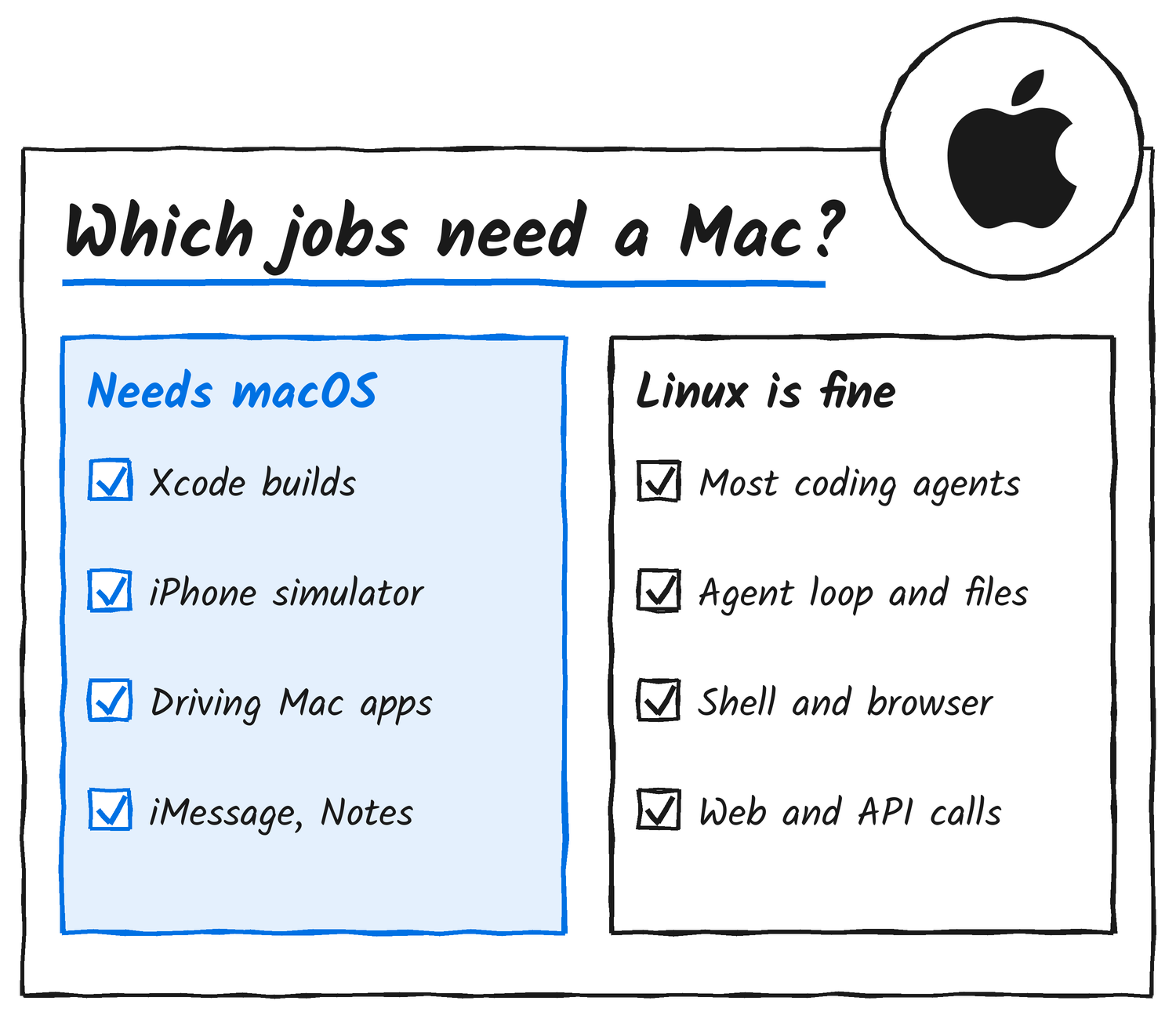
Amp’s account of why it split the work across two machines shows where a Mac pays its way. The company first ran whole agent threads on Macs, then dropped the idea:
Docker and your backend took minutes to start there, and keeping a Mac disk around for every thread got expensive.
Amp, “macOS Satellites”, 29 October
Replicas’s 2 November guide prices cloud Xcode at US$0.10 a build or simulator minute and says to run coding agents in the cloud and buy a Mac mini only for the iOS and macOS work. Everpod’s hosting guide says to rent a Mac only when an agent needs something only macOS has, such as iMessage, Apple Notes or Xcode, and that OpenClaw and nearly everything else an agent does run on an ordinary Linux server for far less. Both companies sell hosting, and both guides are theirs.
The sums on renting out minis
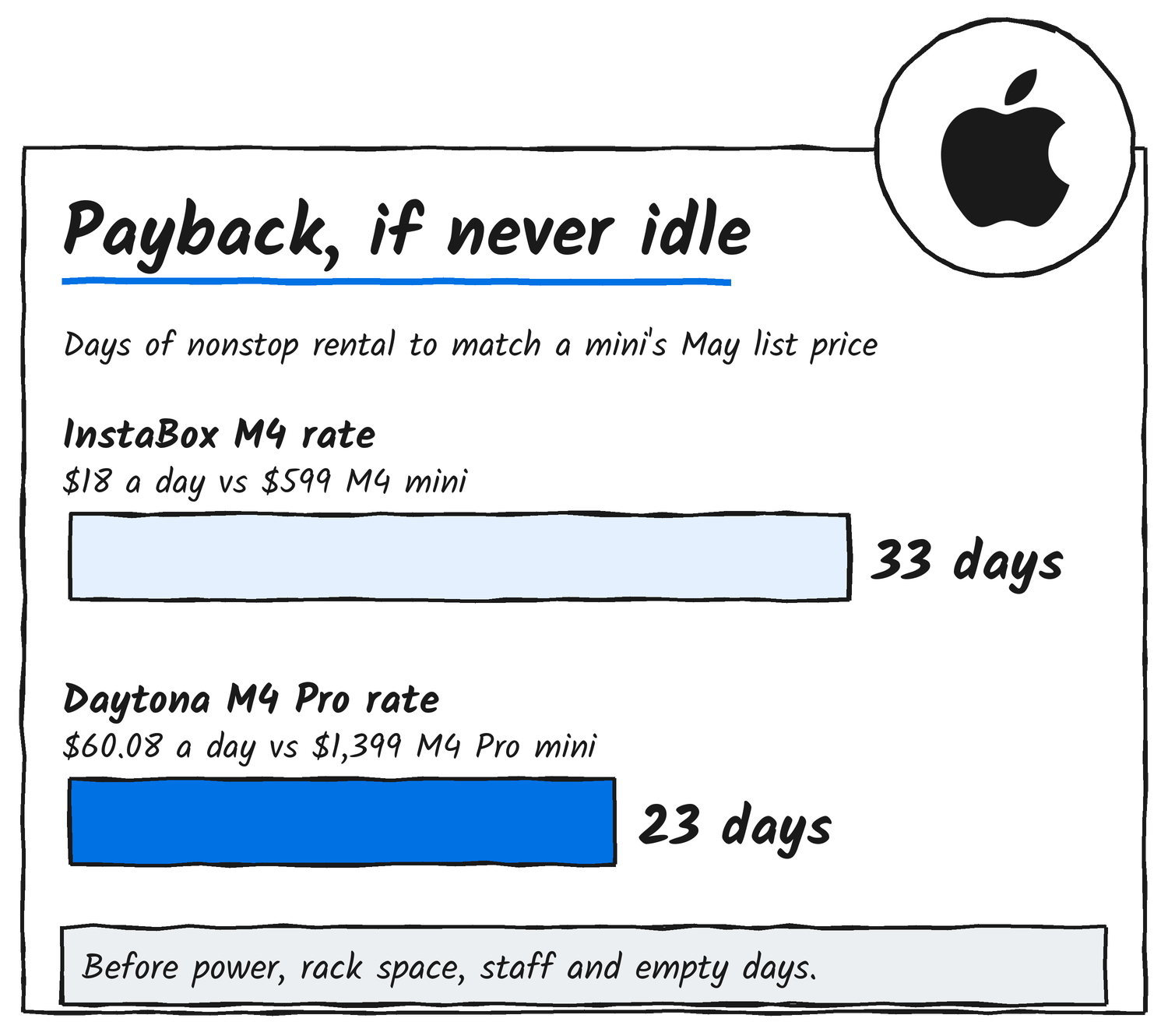
At InstaBox’s M4 rate, a Mac leased every hour of the day earns US$18 a day. Thurrott reported a US$599 list price for the base M4 Mac mini in May, so 33 days of nonstop rental covers it. At Daytona’s US$60.08 per 24 hours for an M4 Pro, 23 days covers the US$1,399 May list price of an M4 Pro mini.
How I worked the numbers
InstaBox M4: US$0.75 × 24 hours = US$18 a day; US$599 ÷ US$18 = 33.3 days. Daytona M4 Pro: US$1,399 ÷ US$60.08 = 23.3 days. The Mac mini prices are Apple’s May list prices as Thurrott reported them, and the rental prices are each provider’s listed rate. Revenue isn’t profit, and the sums assume the Mac is leased every hour.
Three things sit outside that sum. Neither InstaBox nor Daytona publishes how many of its Macs are leased in a given hour. Power and rack costs aren’t in it either, and Hostzero’s price for a shelf is EUR 39 a Mac a month. Apple’s conditions apply on top: anyone leasing out a Mac must tell Apple first, lease it to one customer at a time for at least 24 hours, and limit it to developer services. So buying minis to rent out repays in a month or two only if every Mac is leased every hour, and Apple’s licence rules out leases shorter than 24 hours.
What the providers haven’t said
InstaBox hasn’t given a count of the Macs it runs. Daytona’s two price lists for the same chip disagree. None of the providers publishes utilisation figures. Apple’s licence defines permitted use as developer services, and the providers’ pages list agents driving macOS apps as one of the uses.
Daytona has since answered the questions I sent it. Ivan Burazin, its chief executive and co-founder, said Daytona wants one price list across all its compute, so the per-hour macOS rate on its pricing page sits beside everything else, and that Apple’s licensing means it can only lease Macs in 24-hour periods. He said demand for Macs will be much bigger than Xcode work: QA and Safari testing, and applications such as AutoCAD and SolidWorks that aren’t available on Linux and that an agent may need to drive. On the licence, he said Daytona follows Apple’s terms, that a job-type task can lease a Mac for minutes or seconds, and that anything else must be leased for at least 24 hours. He added that anyone renting Macs for less than 24 hours for a non-job task is breaking Apple’s terms. Burazin also said Daytona will probably offer larger discounts on longer reservations.
That is his reading of the licence. The section of Apple’s agreement it rests on is quoted earlier in this piece, so readers can judge it for themselves.
Sources
- InstaBox pricing and macOS machines docs
- Hang Huang’s announcement on X, 21 November
- Daytona: macOS Sandboxes launch post, 17 November; macOS sandbox docs; use.computer
- Amp: macOS Satellites, 29 October, and docs
- Apple: Software Licence Agreement for macOS Tahoe 26; Mac mini press release, 25 August
- Amazon EC2 Mac instances
- Reporting: Thurrott, Decrypt, Reuters, heise, AppleInsider, Supply Chain Dive, TechCentral
- Provider guides: Hostzero, Everpod, Replicas
Discover more from Sulat AI & Tech News
Subscribe to get the latest posts sent to your email.