
Two a16z partners and a startup that sells agent-readiness services ran 11,307 shopping and software runs across four consumer AI agents, and the results are blunt: the agents pick on price and reviews, cite brand names in under 1% of picks, and every run on a store that demanded a login stopped before the sale. Justine Moore and Olivia Moore published the study on 23 November (US), and Justine shared it on X the next day.
The agents tested were Grok Bot, Muse, Instinct and Dots. The partner was The Prompting Company, which ran the tests between 22 October and 8 November 2026 and published its own report. a16z added a separate YipitData card-panel analysis of where agent-facilitated purchases are already landing, through 11 November.
11,307
completed agent runs
1,270
prompts, shopping and software
2,619
comparison runs on ChatGPT, Gemini and Perplexity
50
top merchants by agent spend, from YipitData
Who is behind the study, and what a16z holds
Justine Moore is a partner at Andreessen Horowitz who focuses on AI, foundation models and applications. Olivia Moore, also a partner, focuses on AI. Their piece is the second in a series that began with Welcome to the B2A Economy on 10 November, which argued that agents will increasingly decide what people buy, subscribe to and spend on.
None of the four agents tested appears to be an a16z investment, and a16z’s public investment list has no entry for The Prompting Company or Instinct. Three links to the firm do sit around the study:
- Exa. a16z led Exa’s Series C in May 2026. The Prompting Company’s activity logs show Grok Bot and Instinct use Exa for web search, and a16z’s post names Exa as a Prompting Company customer.
- Wabi. The first piece names Wabi among the consumer agents. Justine Moore co-wrote a16z’s announcement of its pre-seed round, and a16z took part in Wabi’s US$55 million round led by IVP at a US$1.25 billion valuation on 29 October.
- Ideogram. In one test Dots skipped Midjourney and chose Ideogram for ad images. Ideogram is on a16z’s investment list.
The Prompting Company sells the thing the study says businesses now need. Its site pitches helping companies get “discovered, chosen, and bought by AI agents”, and it has said it raised a US$6.5 million seed round led by Peak XV, with Y Combinator and Base10. a16z closes the piece by saying it sees “a big opportunity for startups helping businesses understand how to market and sell to agents” and asking founders in that space to get in touch. The authors also include the standard line that none of it is investment advice.
Price and reviews decide, and brand names barely register
For broad requests the agents converge. A product picked by one agent had a 73% chance of being picked by at least one other, and in nearly a quarter of cases all four named the same top product. Muse is the only agent whose research logs are fully visible. They show it almost always starts in Meta’s own catalogue, pulls at most 50 options, and when it also browses, opens three product pages on average.
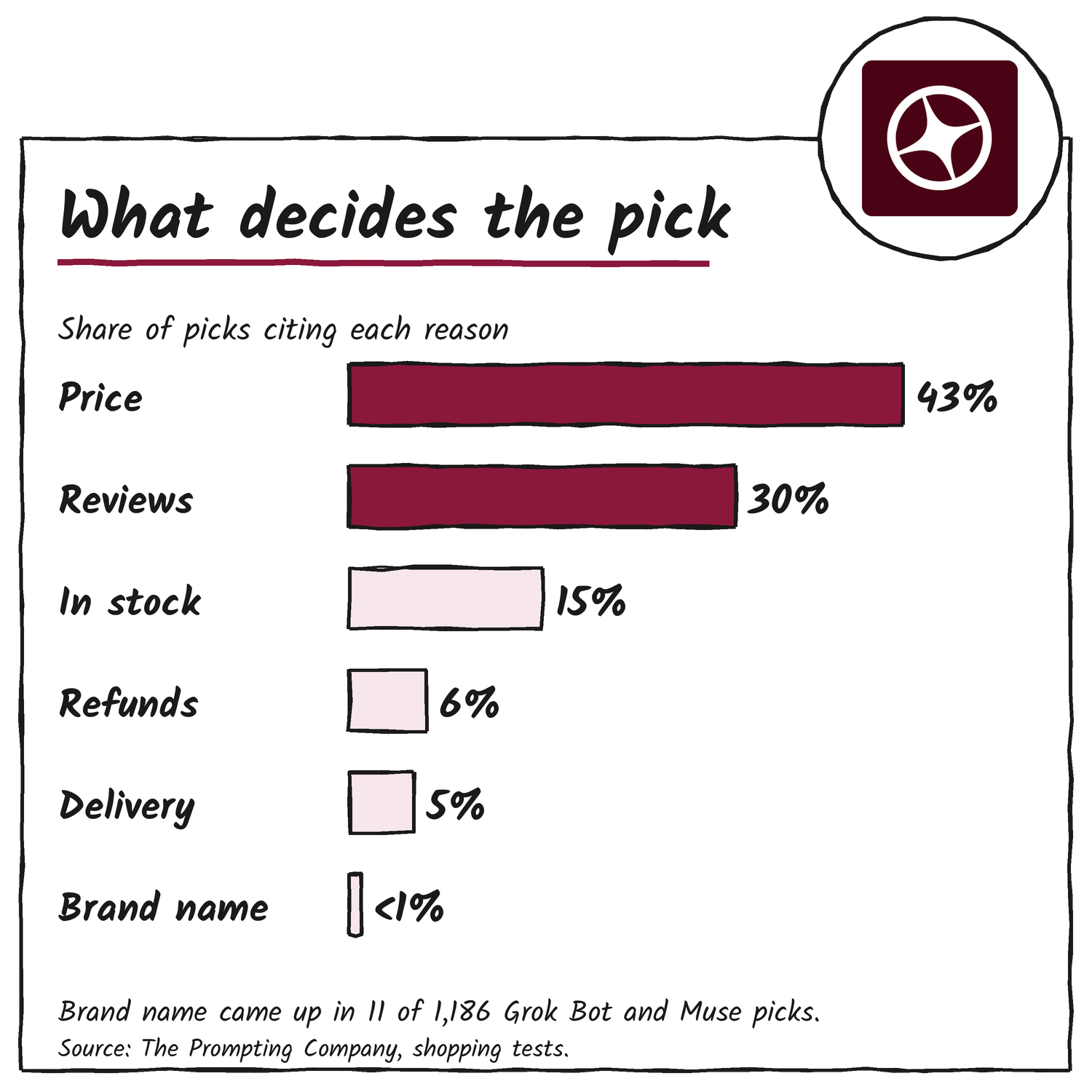
The Prompting Company counted the reasons each agent gave for its pick. Price came up in 43% of picks and reviews in 30%. Brand name came up in 11 of 1,186 Grok Bot and Muse picks. Muse leans hardest on price (57%), while Instinct and Dots mention reviews most (40% and 41%).
The report also compared the agents with regular chatbots. Grok Bot and Muse sent 76.2% of their store and review citations to stores, against 61.6% for ChatGPT and Gemini, so agents behave more like shoppers than like search engines.
One extra detail can flip the default
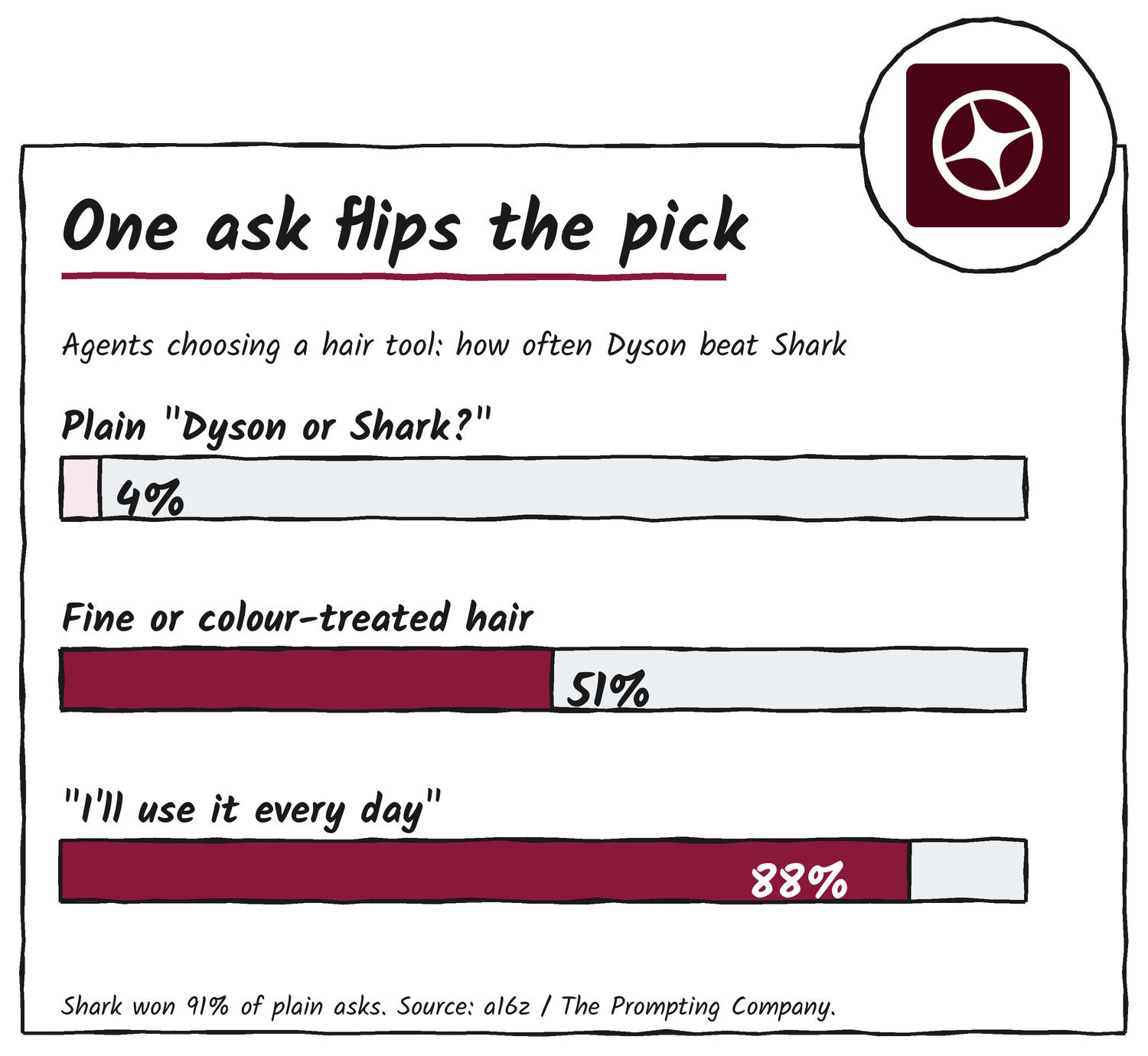
The studies show how sensitive the defaults are. Asked plainly to choose between a Dyson Airwrap and a Shark FlexStyle, the agents picked Dyson in only 4% of runs, usually after reading reviews and concluding performance was similar. Add fine or colour-treated hair and Dyson won 51% of runs. Add daily use and Dyson won 88%, although that last figure rests on eight answers in The Prompting Company’s sample.
Software behaves the same way. With no requirement stated, agents named Canva in 78% of 82 answers and Adobe in none. When the user said they needed professional-level output, they chose Adobe in all 41 answers. Team templates moved Adobe up too: it took 43% of those answers.
Marketing to one agent =/ marketing to them all
Olivia Moore, a16z, on X
Each agent has its own taste
The four agents don’t share a shopping personality, and the differences show up in where they send people and what evidence they trust.
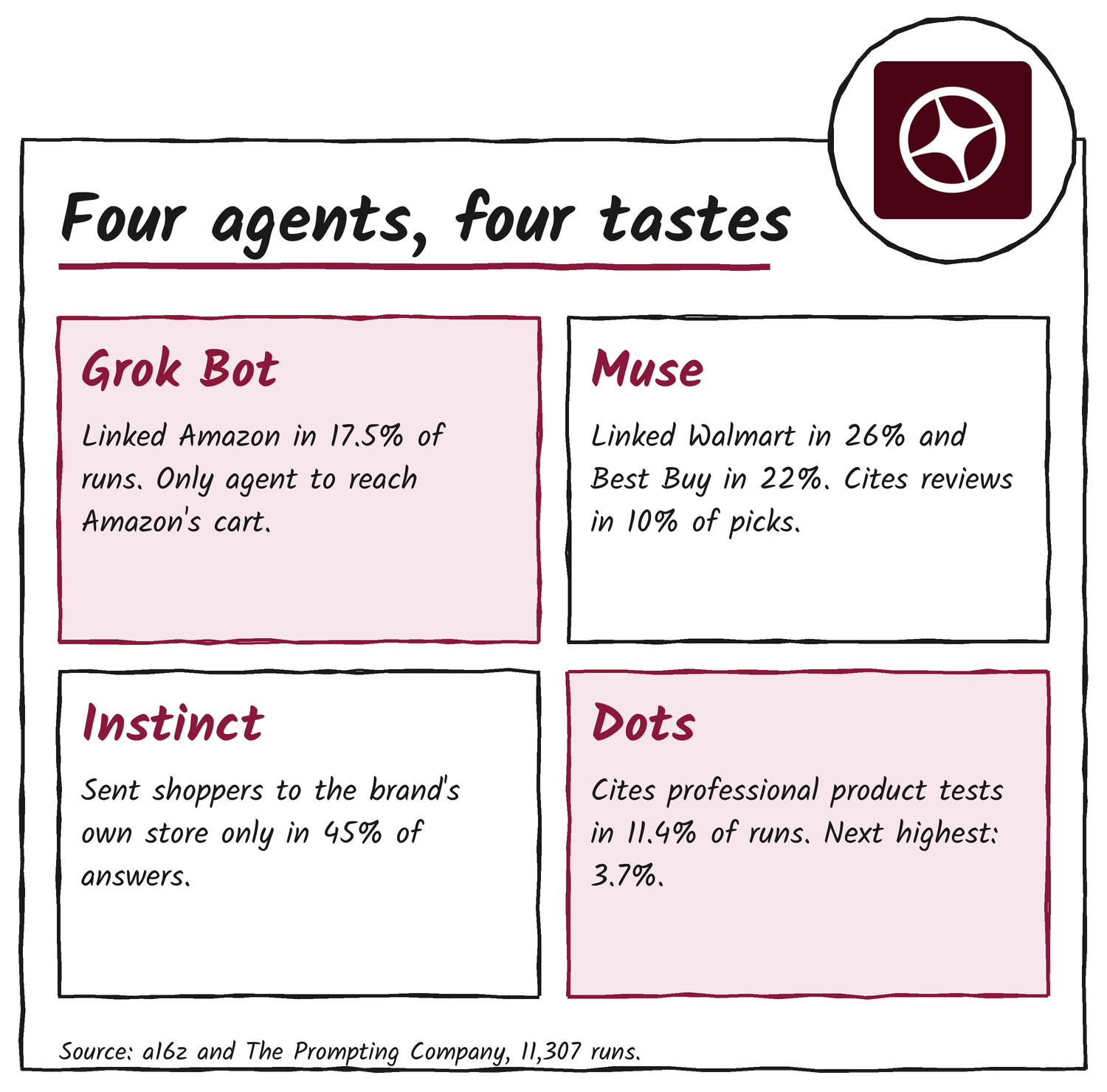
- Grok Bot linked to Amazon in 17.5% of runs. No other agent passed 1.6%. In Amazon checkout tests it reached the cart every time, while Amazon stopped the other three at the cart.
- Muse linked to Walmart in 26% of answers and Best Buy in 22%. It mentions reviews in only 10% of its picks, against 30% to 41% for the other agents.
- Instinct was the most likely to send a user only to a brand’s own store (45% of answers, against 11% for Muse). It checks ratings itself, and “better reviews” won only 4 of its 26 tiebreakers.
- Dots cited professional product tests in 11.4% of runs, while no other agent topped 3.7%. For software, ease of use for the agent is its main decider.
Small tests showed the same split. Given a single tube at US$28 or a two-pack at US$50, Grok Bot, Muse and Instinct all took the two-pack. Given a US$52 item with US$8 shipping on the brand’s site or free shipping at Sephora or Nordstrom, Muse took the retailer 86% of the time and Instinct took the brand site every time. A listing marked “only 3 left” lost to the in-stock one across the agents tested.
Agents do the sums, and they punish tricks
a16z says agents calculate the fully loaded cost: shipping, subscription terms, returns and warranty. With two retailers at the same price, they picked the one with the better return policy in 86% of tests. In 275 real-store comparisons that pitted a cheaper seller against a pricier, more trusted one, they chose the trusted seller 72% of the time. Grok Bot passed over a US$200 Sonos listing for a US$250 one from an authorised dealer, citing warranty cover.
Discounts have a ceiling and a floor. A cut under 10% didn’t move the agents at all. Discounts of 10% to 50% won the cheaper, less trusted option 24% of the time. Beyond 50% the agents steered clear.
Porkbun is the study’s example on the software side. It ranks ninth by agent transactions, ahead of Cloudflare and GoDaddy, although those two register 2.6 times and 4.8 times more domains a month. Muse and Dots both favoured Porkbun’s plain pricing, with no cheap first year that jumps later.
Where agents shop, and what stops the sale
Agents often start and end on aggregators and marketplaces, which put the most options in one place. Nearly a third of observed spend among the top 50 merchants went to marketplaces and aggregators. That rises to 46% with retailers that run third-party marketplaces and 55% with conventional multi-brand retailers.
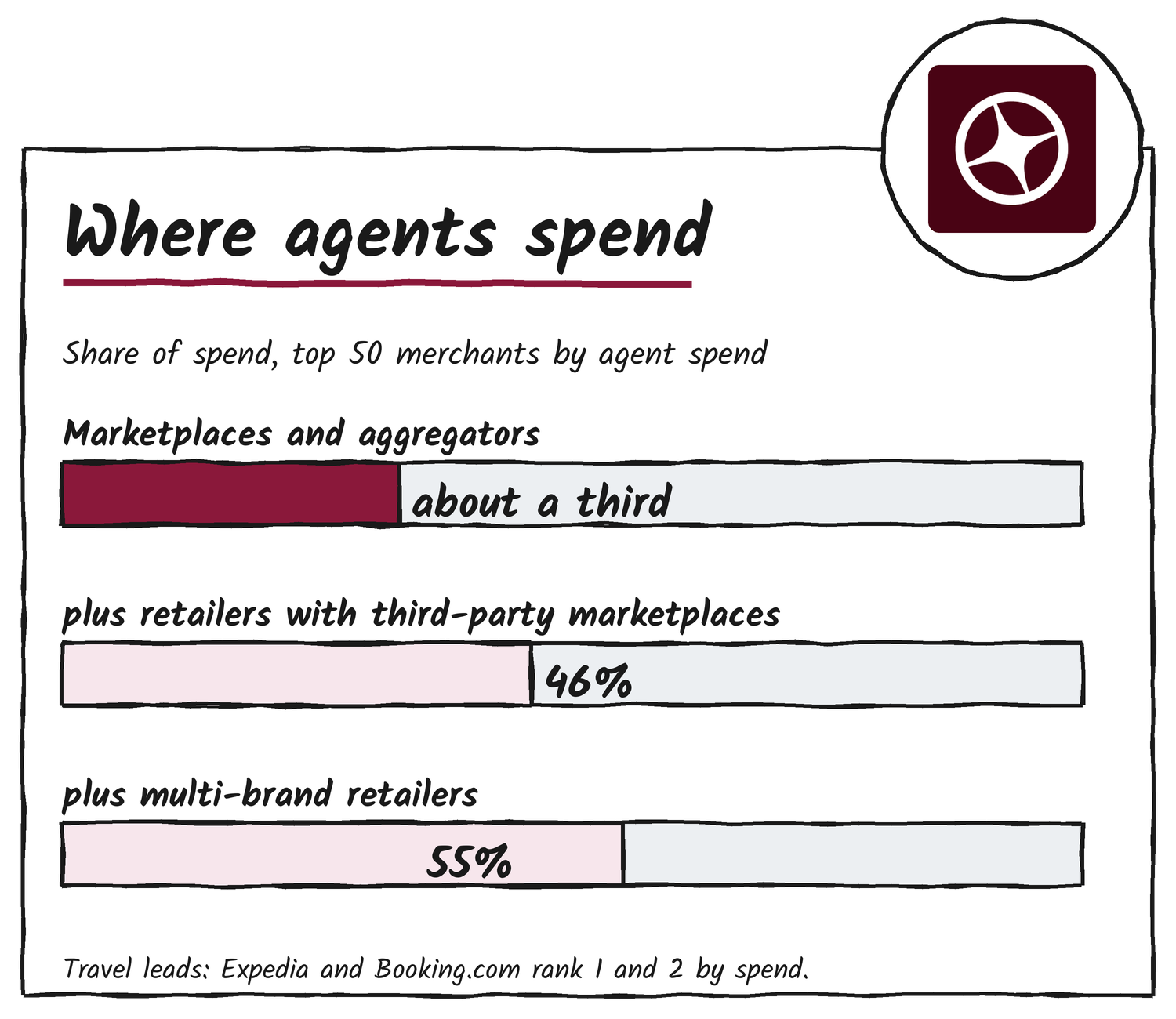
Travel skews that picture. Expedia and Booking.com are first and second by spend in YipitData’s sample, with American Airlines fourth and United sixth. By transaction count Walmart is first and eBay second. In a Hotel Zelos walkthrough for 4 to 6 December, a refundable king room cost US$476.20 booked direct and US$476 on Expedia, which also offered pay-now and pay-at-property options. YipitData’s panel excludes Amazon and can’t tell Muse from Instinct, and its rankings describe the sample, not total merchant revenue.
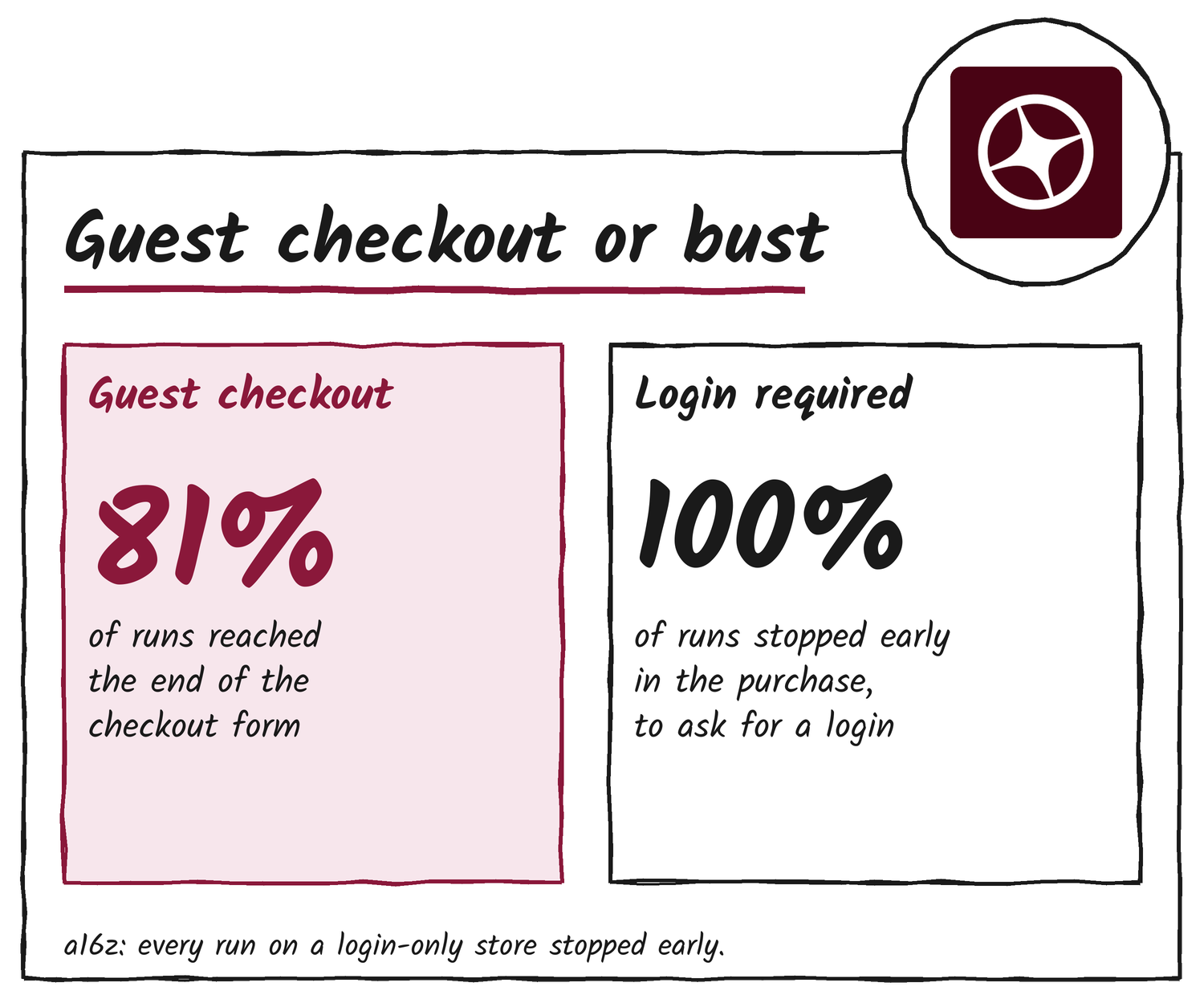
Checkout is the last hurdle. On stores with guest checkout, agents reached the end of the checkout form in 81% of runs. Every run on a store that required a logged-in account stopped early, sometimes to ask the user for credentials and sometimes to try another merchant.
Connectors aren’t the route yet. Grok Bot offered to connect an app in 5% of runs, and Instinct, Muse and Dots each did so in fewer than 1%. The agents mostly lean on their own catalogues and on browser use.
The four agents and their rivals
The study covers four of the consumer agents that have launched since August. They differ in who built them, how they search and how they pay.
| Agent | Maker | Launched | Search | How it pays |
|---|---|---|---|---|
| Grok Bot | SpaceXSI (x.ai) | 11 August 2026 | Exa, per The Prompting Company logs | Stripe Link |
| Muse | Meta | 8 September 2026 | Meta catalogue first, per its research logs | Stripe Link and Shop Pay |
| Instinct | Instinct (start-up) | Raised US$1 billion at US$10 billion, 28 September | Exa, per The Prompting Company logs | Stripe Link and Shop Pay |
| Dots | OpenAI | 29 September 2026 | Not detailed in the study | ChatGPT Wallet, from 13 November |
Order data from fraud-prevention firm Forter shows how fast the category has moved. Forter’s network recorded agentic orders up 67% month on month, with Muse placing 49% of agentic orders in the week of 2 November and about 2.9 times as many orders a day as ChatGPT and Google together. In August, OpenAI placed 80% to 92% of agentic orders each week, before Instinct, Grok Bot and Muse appeared in Forter’s detection. The first a16z piece adds Human Security’s measure: agentic browser traffic grew eightfold between August and October, with Muse at 60% and OpenAI products at 30%. Shopify reported AI-driven traffic to its stores up eightfold year on year in the first quarter, and orders from AI-powered searches up nearly thirteenfold.
The standalone agents aren’t the only route. OpenAI’s Businesses in ChatGPT on 10 November let businesses claim their listing, add product feeds with pricing and availability, and publish a Business Agent, starting with eligible US businesses. Shopify’s Fall ’26 Edition put Shop Pay checkout inside Muse, Claude Duet and Instinct on 28 October, with Shopify Catalog feeding agents including ChatGPT, Copilot and Meta.
Payments, blocking and the courts
Paying is the other contest. Terry Angelos’s “Wallet Wars” essay, published by a16z on 15 October, counts Stripe’s Link at 300 million users, Shopify’s Shop Pay at 250 million and PayPal at more than 400 million, and says the card networks have each answered with agent standards: Visa Intelligent Commerce, Mastercard Agent Pay and Amex ACE. Link’s agent spend rose nearly 80-fold between 1 September and mid-November, as I reported on 22 November.
OpenAI’s ChatGPT Wallet, which began rolling out on 13 November, takes the token route. It was built with American Express, Chase, Mastercard and Visa, gives agents a payment token in place of the card details, and needs a Face ID or fingerprint check for each purchase. It starts with US ChatGPT Pro subscribers using Dots, and OpenAI tells websites to make sure agents aren’t inadvertently blocked. My earlier piece covers the launch.
Blocking is where retailers split. Amazon stopped three of the four agents at checkout in the study. In court, a US appeals court overturned a ruling that had temporarily barred Perplexity’s AI shopping tools from Amazon’s platform, Reuters reported on 4 August. Walmart, meanwhile, is launching an agent-to-agent channel with Muse, according to a16z. US banks are also writing agent losses into customer terms, which I covered in Wells Fargo’s terms that start on 24 November.
The market around the study
The study sits inside a growing business of selling to machines. The Prompting Company’s closest peer by size is Profound, which raised a US$180 million Series D at a US$1.8 billion valuation on 15 September, co-led by Sequoia Capital and Kleiner Perkins, after a US$96 million Series C in February. Profound tracks how answer engines talk about brands for customers including Target, Walmart and US Bank. a16z’s first piece calls generative engine optimisation the basis for this industry and says agents will take it “into evaluation and execution of purchase” choices, which it calls an even larger market.
The agents themselves have raised serious money too. Instinct’s US$1 billion round at a US$10 billion valuation came from Sequoia Capital, Benchmark and Coatue, and Wabi’s US$55 million at US$1.25 billion came from IVP, with a16z, Forerunner and the Amazon Alexa Fund taking part.
What the study says to do
a16z’s five takeaways, in plain steps for anyone selling to agents:
- Win a use case. Defaults are hard to dislodge, but a specific need such as fine hair or professional output can flip them.
- Write pages agents can read fast. Put price, shipping cost, stock and limits near the top. For software, offer an API or MCP and clear docs, as Ideogram did.
- State the whole deal. Return window, refund method, warranty and subscription terms are weighed, and teaser pricing is penalised.
- Test each agent separately. Muse, Instinct, Grok Bot and Dots reward different evidence.
- Be where agents look and keep guest checkout. Show up on aggregators and marketplaces, and don’t put an account wall in front of the buy button.
The Prompting Company also offers a free tool to test how a site performs for agents. It’s a vendor’s tool, so run it knowing who built it.
Sources: a16z, How Agents Buy (23 November 2026), The Prompting Company, How personal agents choose, Justine Moore on X, Olivia Moore on X, a16z, Welcome to the B2A Economy, a16z, Wallet Wars, Forter, AI Agent Order Data, Profound, Shopify, Fall ’26 Edition.
Disclosure: I’m an OpenAI, Firecrawl and Devin ambassador.
Discover more from Sulat AI & Tech News
Subscribe to get the latest posts sent to your email.