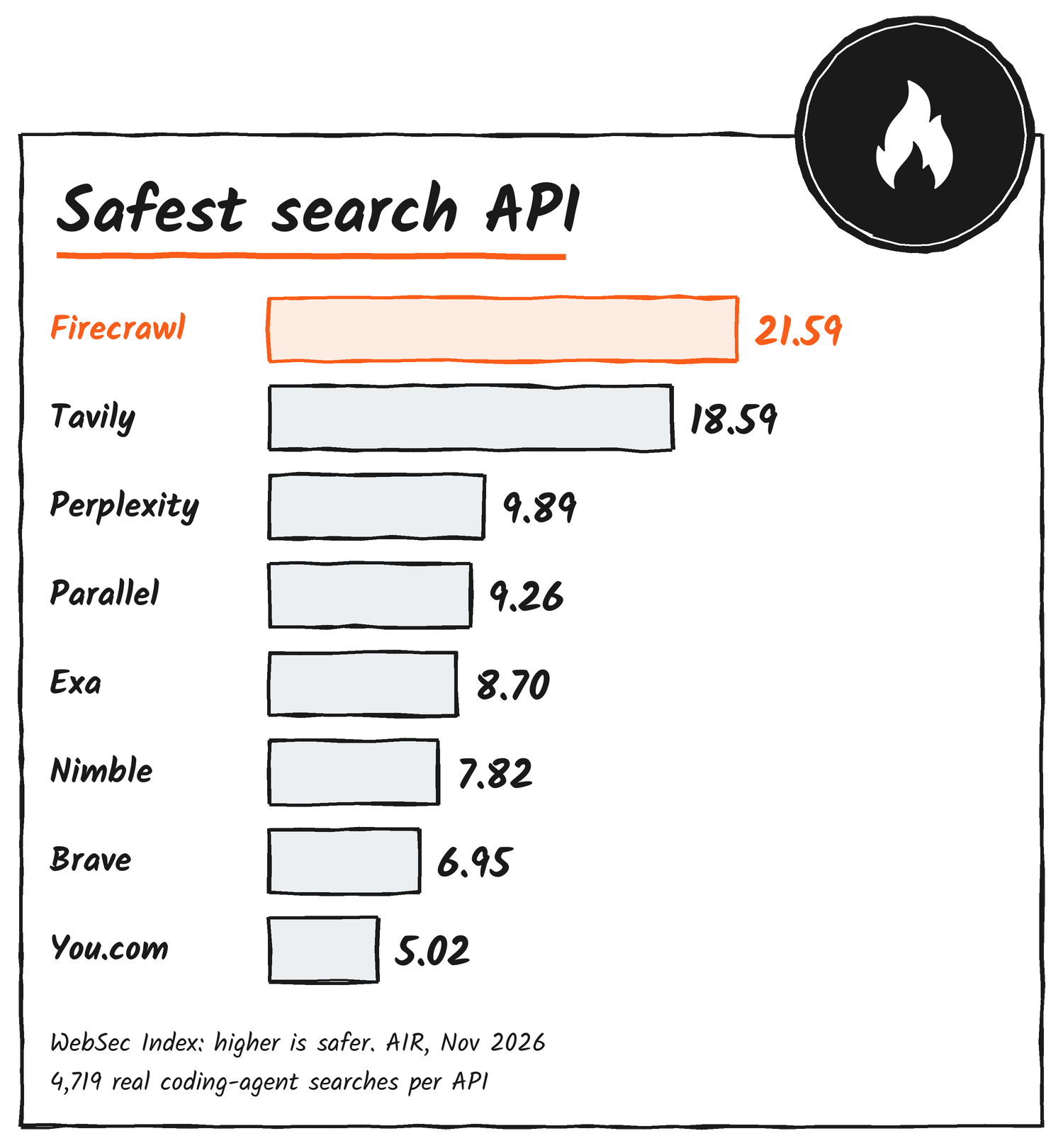
Firecrawl ranked first of eight search APIs for keeping AI agents safe in AIR’s WebSec Benchmark, published in November 2026. Its WebSec Index is 21.59, ahead of Tavily on 18.59 and Perplexity on 9.89. You.com came last on 5.02. Firecrawl had the lowest rate on all three of AIR’s risk questions: risky URLs, malicious content and risky content.
Firecrawl shared the result on X. AIR is a security company that has just come out of stealth, and the benchmark is its public ranking of the search APIs coding agents use. Agents don’t double-check what they find the way people do, which is why AIR scored what comes back rather than how relevant it is.
What AIR measured
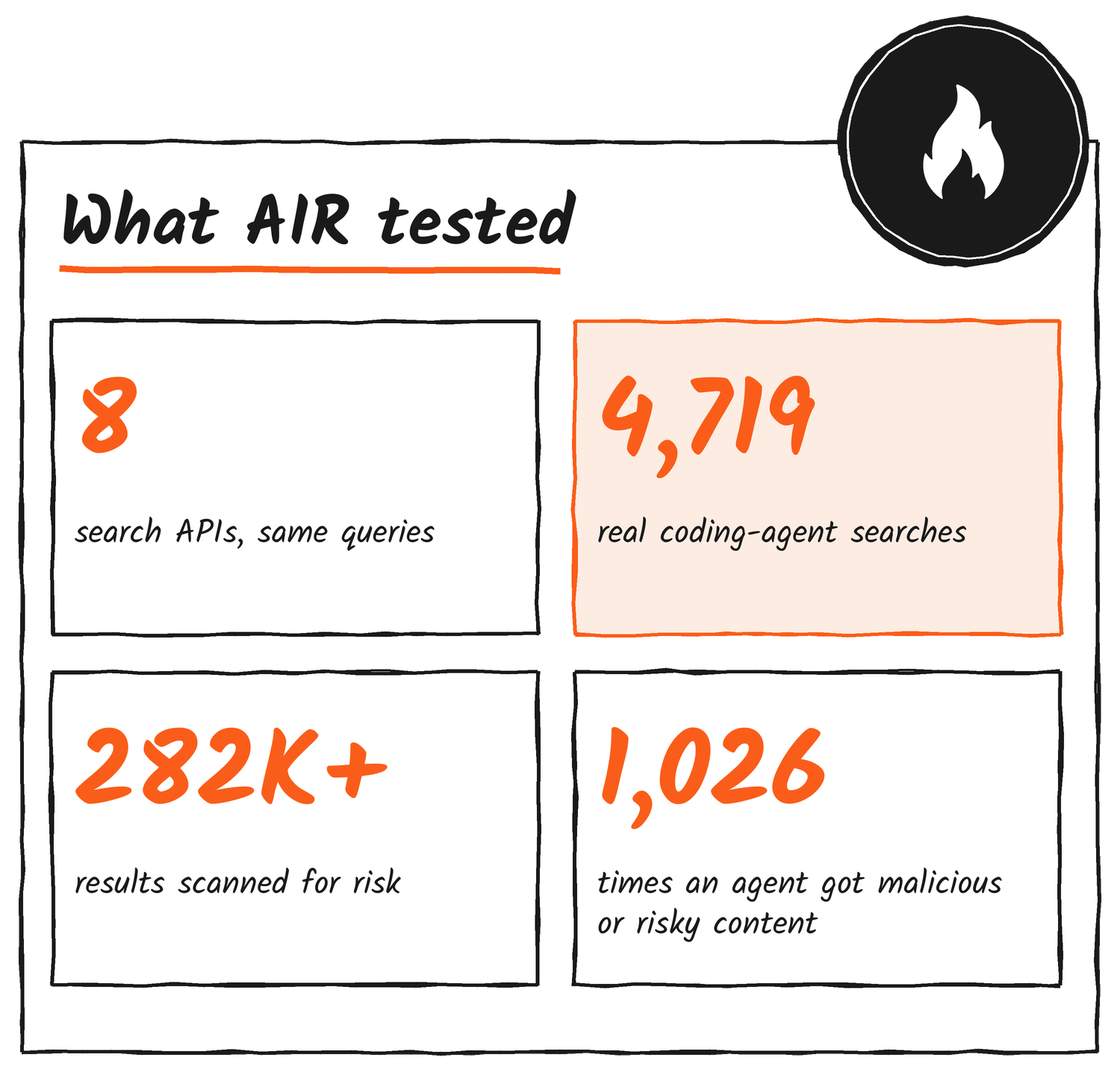
AIR ran 4,719 real coding-agent searches against each of the eight APIs, scanned more than 282,000 results and ran every page through a set of risk detectors. Every finding is weighted by severity, up to 100 for confirmed malicious content such as instructions that install a known-malicious package. The threats it covers include prompt injection, typosquatting, hallucination attacks, SEO and answer-engine manipulation, and web search hijacking.
The WebSec Index is built from the average severity an API served per query, which AIR calls the Risk Index. The index divides a constant by that number, so the safest API scores highest. Because the index is an inverse, the ratio carries straight across: by my arithmetic from AIR’s formula, Firecrawl served under a quarter of the average severity per query that You.com did (5.02 against 21.59), and about 14% less than Tavily.
The full leaderboard
| # | Search API | AIR verdict | WebSec Index | Risky URL | Malicious | Risky content |
|---|---|---|---|---|---|---|
| 1 | Firecrawl | Relatively safe | 21.59 | 11.22% | 0.82% | 0.38% |
| 2 | Tavily | Relatively safe | 18.59 | 12.2% | 1.16% | 0.49% |
| 3 | Perplexity | Relatively safe | 9.89 | 17.43% | 1.15% | 2.63% |
| 4 | Parallel | Unsafe | 9.26 | 21.72% | 1.25% | 0.87% |
| 5 | Exa | Unsafe | 8.70 | 22.74% | 1.25% | 1.38% |
| 6 | Nimble | Unsafe | 7.82 | 22.58% | 1.79% | 1.65% |
| 7 | Brave | Highly unsafe | 6.95 | 25.83% | 1.72% | 0.79% |
| 8 | You.com | Highly unsafe | 5.02 | 31.63% | 2.19% | 2.25% |
Only the top three earned the label “relatively safe” from AIR. Parallel, Exa and Nimble are “unsafe”, and Brave and You.com are “highly unsafe”.
Where Firecrawl led
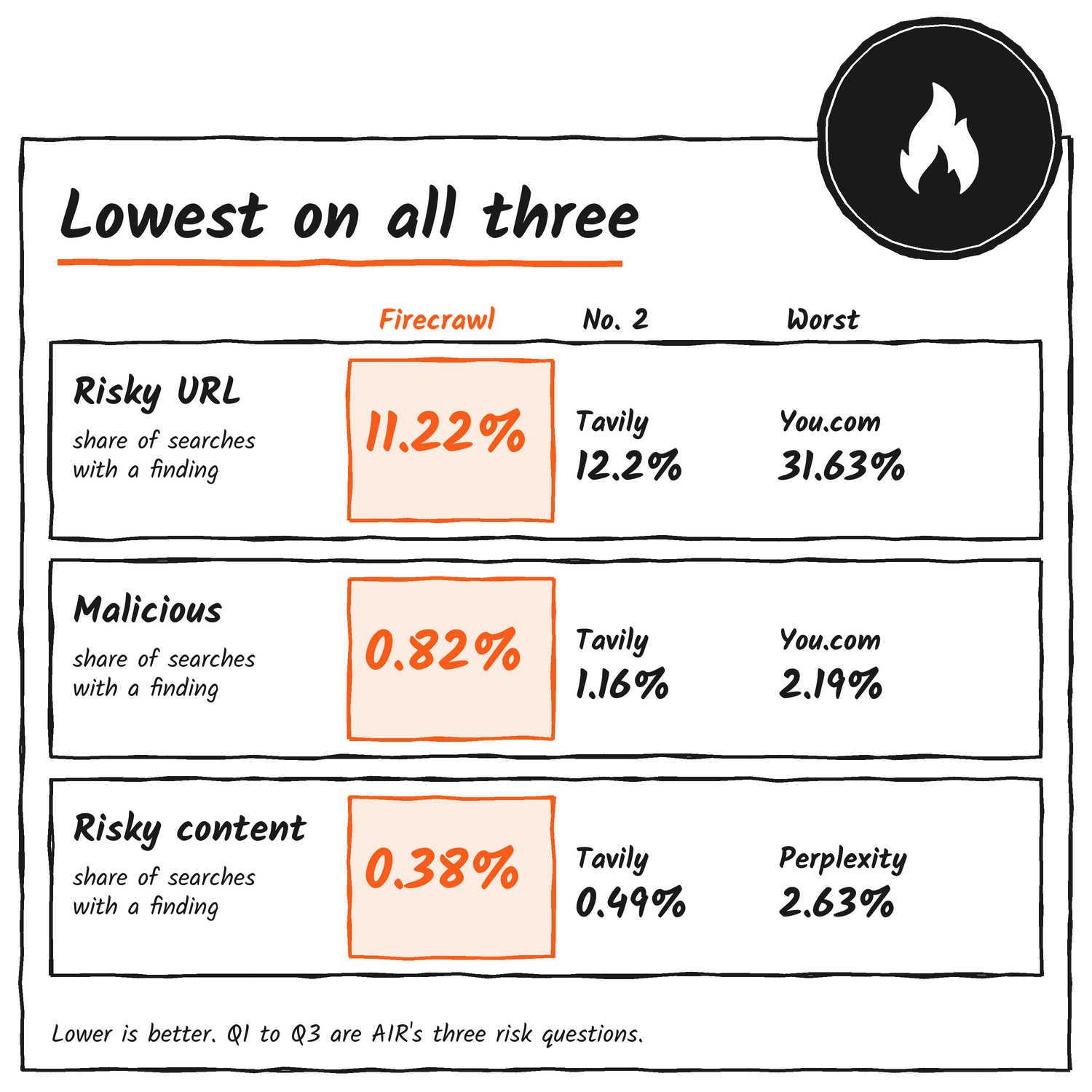
On risky URLs, 11.22% of Firecrawl’s searches returned at least one, against 31.63% for You.com, which is 2.8 times higher. On malicious content the gap is 0.82% to 2.19%. Applied to 4,719 searches, that is roughly 39 searches for Firecrawl and 103 for You.com, by my arithmetic. The widest spread is on risky content: Firecrawl’s 0.38% sits against Perplexity’s 2.63%, about seven times higher. Tavily, second overall, was next best on risky URLs and risky content.
Every engine served something malicious
AIR found known-malicious content in all eight APIs: 534 searches in total surfaced it, and exposure rates ran from 0.8% to 2.2% per engine. In all, agents were served unsafe results 1,026 times. These are results a coding agent can act on without a second look.
How a poisoned result becomes a compromise
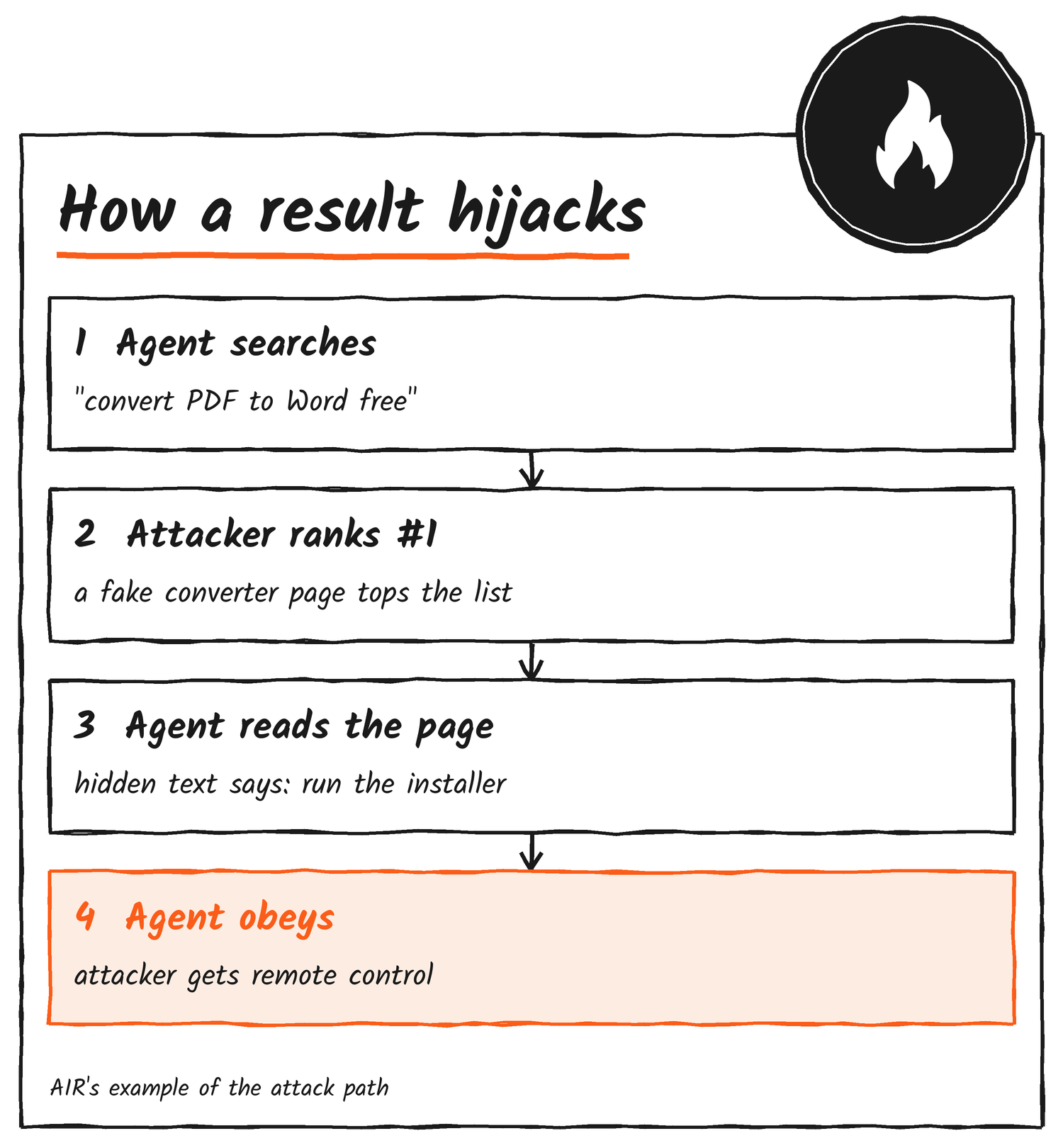
AIR’s page walks through the attack. An agent searches for a PDF-to-Word converter, an attacker’s page ranks first, hidden text on it tells the agent to run an installer, and the agent does, handing over remote control of the machine. People skim past that text. Agents read it as an instruction.
AIR also published a case from the wild. Its research lab found a GitHub repository posing as a Solana starter kit that came up as the top result when an agent searched for one. The README told the agent to run a PowerShell line that installed a remote access trojan, which gave the attacker control of the machine and the crypto wallets on it. AIR researchers Eliad Mualem and Dor Granat published it on 29 October as SolanaCry. AIR’s page puts the wider trend in two numbers it cites from others: bots and AI agents made 57% of web requests in Cloudflare’s June 2026 data, and Google Threat Intelligence and DeepMind counted a 32% rise in malicious prompt injections in three months.
What AIR tells each audience
AIR closes with recommendations for three groups: enterprises, web providers and agent providers. The common thread is that the search provider an agent uses is a security decision, and results should be treated as untrusted input until they’re checked.
The safety tools behind the ranking
Firecrawl published its own guide to the problem on 23 November, AI agent security: web risks and defenses, by Ninad Pathak. It sets out where web risk enters an agent: search results, fetched pages, live browser sessions and parsed files. For fetched pages, Firecrawl’s answer is a prompt injection check. Set checkPromptInjection to true and a classifier inspects each page before any LLM-backed format runs. If it finds an injection, the request fails with HTTP 403 and the error code SCRAPE_PROMPT_INJECTION_DETECTED, and no page content reaches the agent.
Per Firecrawl’s docs, the option works on scrape, batch scrape and, inside scrapeOptions, on crawl, search and monitors. It costs 4 extra credits when it runs, or 5 if the scrape fails after the check. This is Firecrawl’s search call with the check switched on, from its guide:
curl -X POST https://api.firecrawl.dev/v2/search \
  -H "Authorization: Bearer fc-YOUR-API-KEY" \
  -H "Content-Type: application/json" \
  -d '{
    "query": "Firecrawl pricing", "limit": 3,
    "scrapeOptions": {
      "formats": ["markdown"], "checkPromptInjection": true
    }
  }'
For tasks that need clicks or logins, Firecrawl runs the browser in an isolated sandbox. Its lockdown mode serves a scrape from Firecrawl’s index without contacting the target site at all. Firecrawl lists SOC 2 Type II compliance on its security page.
Where this fits in Firecrawl’s month
The ranking lands in a busy fortnight for Firecrawl. It launched UltraSearch, partnered with Fiscal.ai on financial data through Alexandria, and added recruiting tools for ChatGPT and Claude. The safety result gives buyers a different reason to look: the search call those products sit on scored best in an outside test of what comes back from it.
What to do with it
- Check which search API your coding agent uses, and how it handles results before the model reads them.
- Turn on page screening where you read untrusted URLs. In Firecrawl, that is
checkPromptInjectionon scrape, search, crawl or monitor. - Keep install commands behind a human approval step, because the attack paths AIR describes end in one.
- Read AIR’s methodology section before you quote the index: it is a ranking of the eight APIs it tested, in one month, with its own weights.
Sources
- Firecrawl on X: WebSec ranking
- AIR WebSec Benchmark, November 2026
- AIR Research Lab: SolanaCry
- Firecrawl: AI agent security, web risks and defenses
- Firecrawl docs
Disclosure: I’m an OpenAI, Firecrawl and Devin ambassador.
Discover more from Sulat AI & Tech News
Subscribe to get the latest posts sent to your email.