Morph, a company that hosts AI models for coding agents, now sells an abliterated version of Kimi K3.1 Pro. It says the model gets within 5 points of an unnamed rival on frontier cyber benchmarks, with zero refusals. Morph announced the model, called Kimi K3.1 Abliterated, in a post on X stamped 9:46pm on 23 November UTC, which is 10:46am on 24 November in New Zealand.
Access is by approval only. Morph says a person reviews every request, access goes to named individuals, and applicants should use a business email so the company can verify who they work for. Morph lists no price for the model, publishes no benchmark name, score or method behind its claim, and doesn’t say who made the edit.
- What Morph is selling
- How access works
- What it costs
- What Moonshot took out first
- The benchmark claim
- Morph’s argument and the Hugging Face incident
- Who else sells it
- What critics say
- What Morph doesn’t publish
- What security teams can check
- Terms in this article
What Morph is selling
The model id is morph-kimik3-abliterated. Morph’s privileged-access page lists it beside morph-dsv41flash-abliterated, an abliterated DeepSeek V4.1 Flash that Morph has sold on the same terms since October. One application covers both. Morph’s terms of service describe the pair as DeepSeek V4.1 Flash and Kimi K3.1 Pro “with their refusal directions ablated.”
Morph already sold stock Kimi and DeepSeek through its US$200-a-month Ultra plan, which I covered on 10 November. Its docs say Ultra doesn’t cover the abliterated Kimi.
2
abliterated models behind one approval
1M
tokens of context on the Kimi model
5
points from a rival, by Morph’s own say-so
0
prices listed for it
How access works
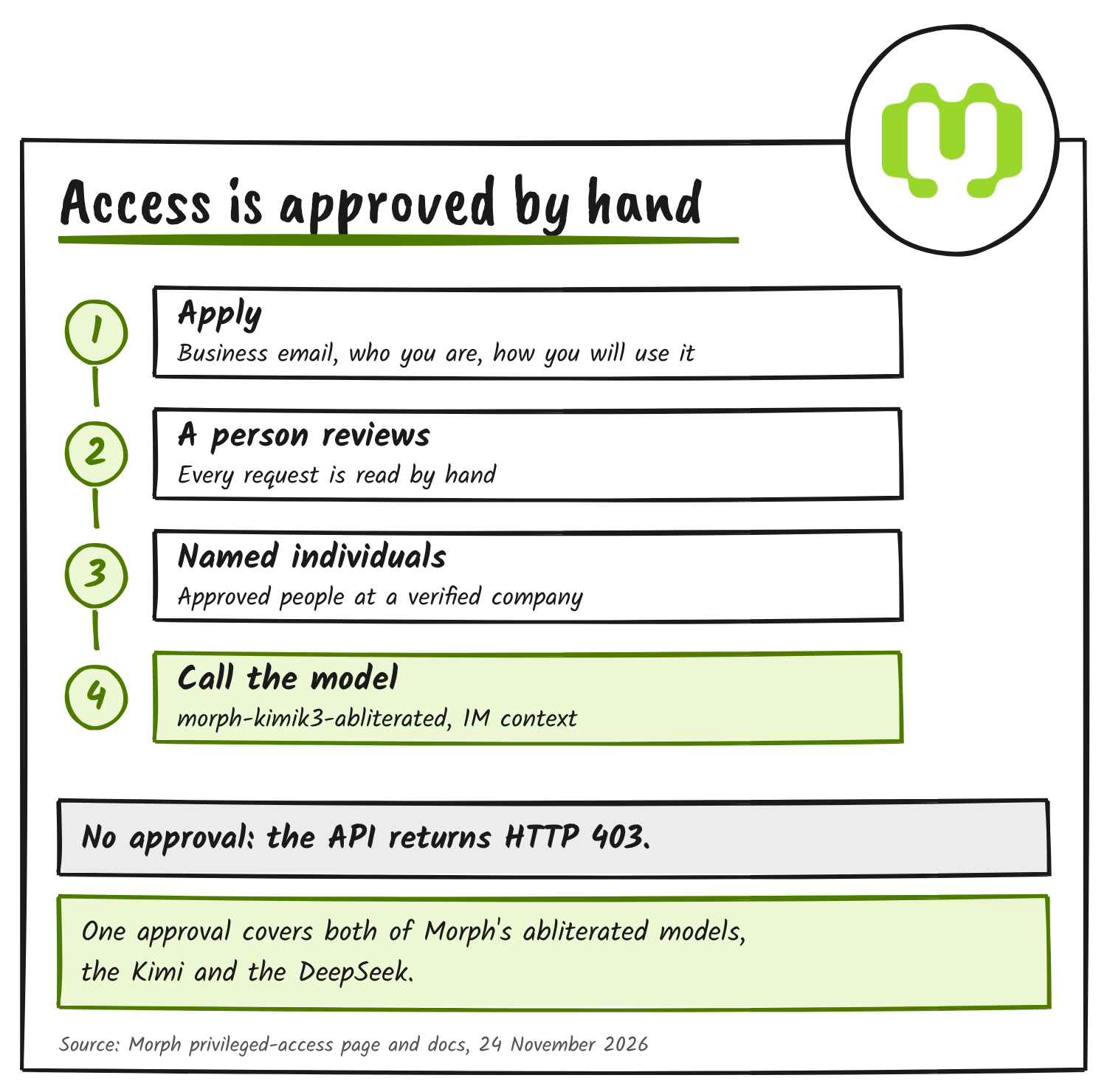
Without approval, the API returns HTTP 403. Morph’s terms open the relevant section with a line about who gets in: “Some models are released only to organizations we have verified.” The same section sets a condition that follows the customer onto every plan. Prompts flagged as an attempt to compromise systems you don’t own are kept for safety review, and that holds on enterprise accounts that otherwise run zero data retention.
What it costs
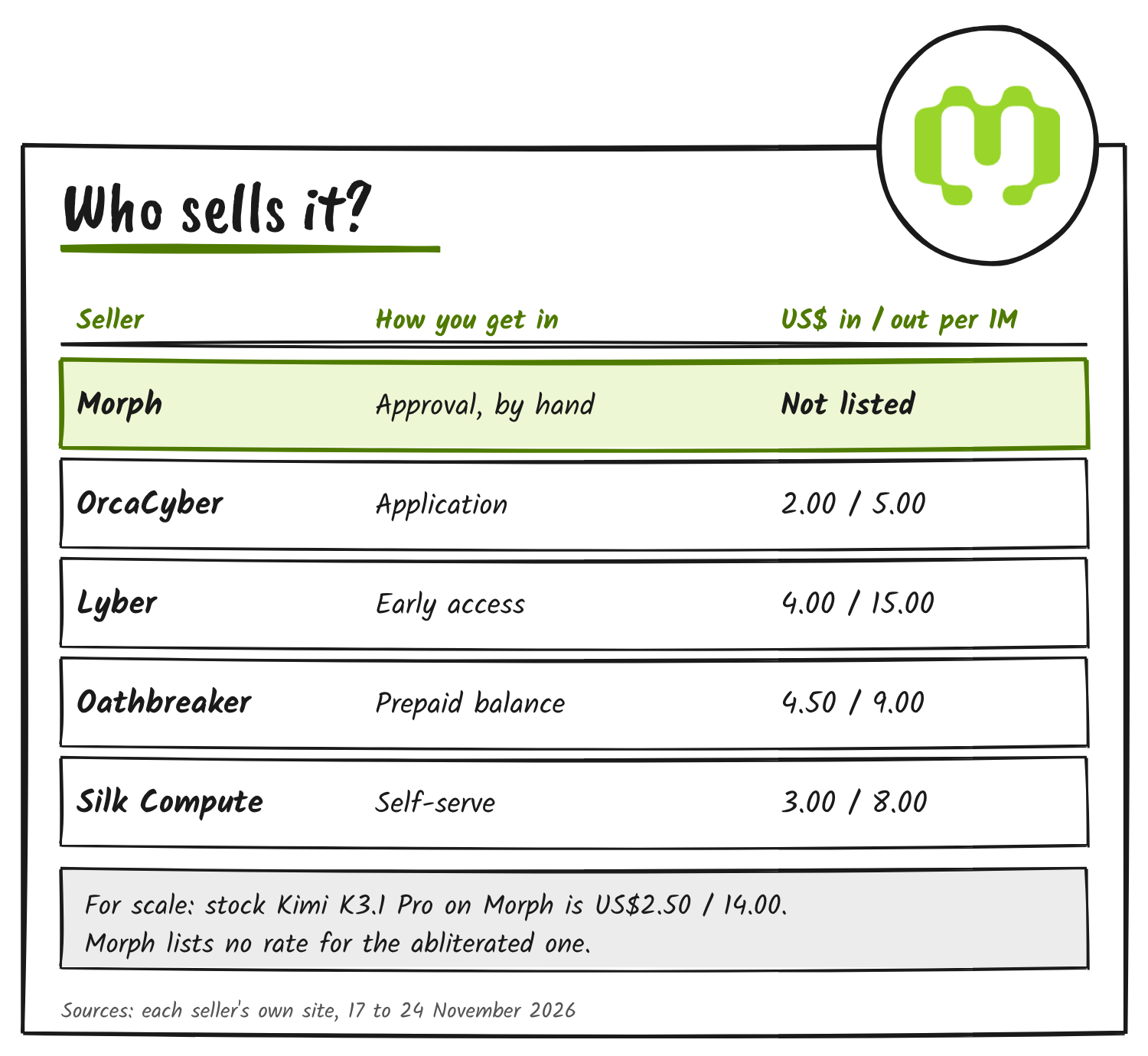
The stock Kimi K3.1 Pro on Morph costs US$2.50 per million input tokens and US$14 per million output tokens. For the abliterated model, Morph’s docs say it bills at its own rates, and no rate is listed. A customer finds out the price after approval.
What Moonshot took out first
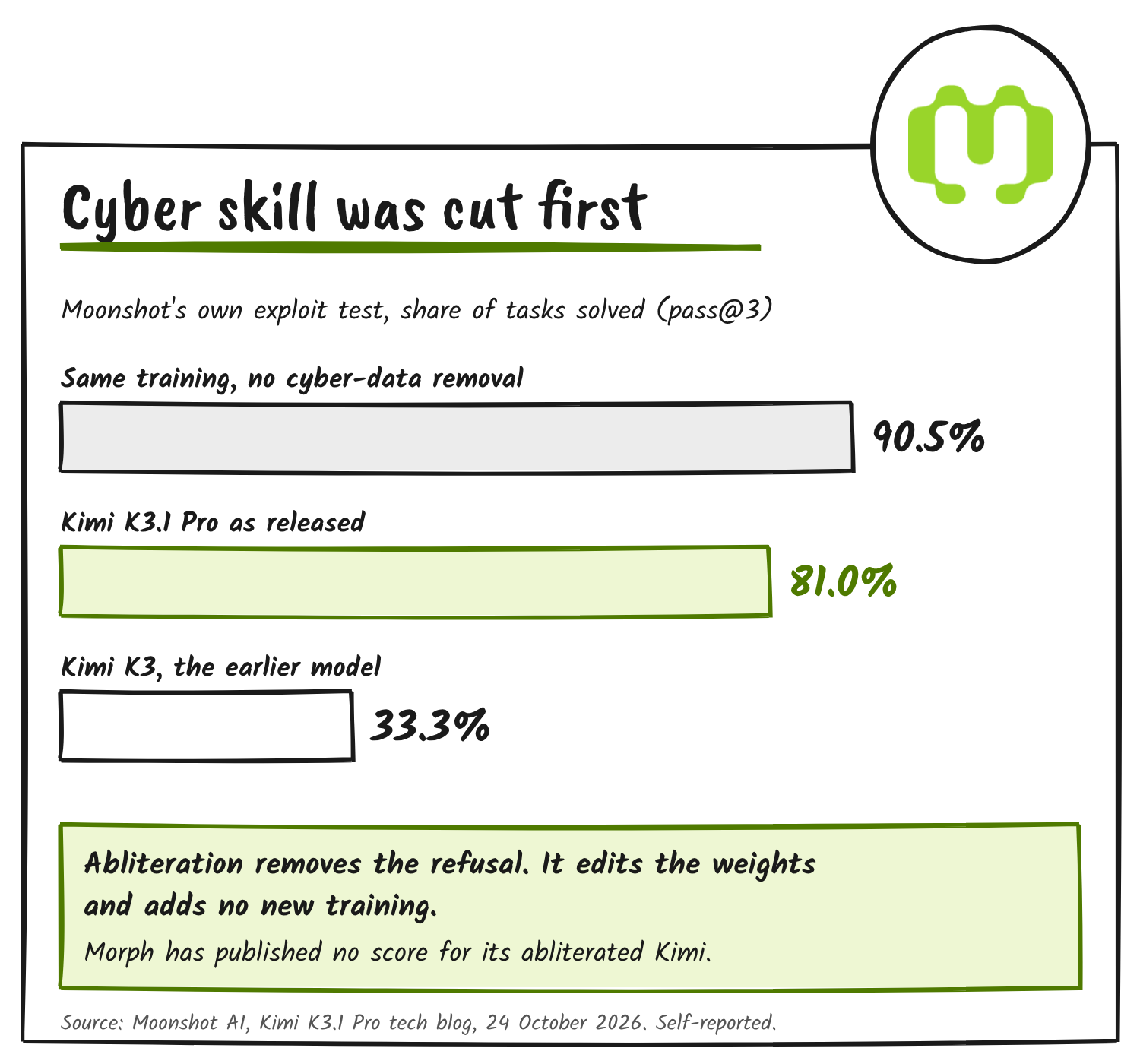
Kimi K3.1 Pro arrived with its cyber skill already trimmed. Moonshot AI’s launch post says it down-weighted cyber data during training. On Moonshot’s own exploit test, a model trained the same way without that removal solved 90.5% of tasks, K3.1 Pro solved 81.0%, and the earlier K3 solved 33.3%. All three figures are self-reported.
K3.1 Pro’s offensive cyber capability is, by design, below what our pipeline can produce, and remains behind that of frontier proprietary models.
Moonshot AI, Kimi K3.1 Pro launch post, as read out on Interconnects
Abliteration edits the weights to remove the direction that drives refusals. It adds no training. Removing a refusal doesn’t put removed data back, so I’d expect an abliterated K3.1 Pro to inherit that gap. That is my inference, not a measurement, and Morph has published no score for its model.
The benchmark claim
Morph’s post says the model performs “within 5 points” of its comparator “on frontier cyber benchmarks with zero refusals.” It names the comparator only by a product label, names no benchmark and gives no scores for either model, so the gap can’t be checked.
The zero-refusals half is weaker than it sounds. Artificial Analysis scored stock K3.1 Pro 64 on its Cyber Index and recorded no refusals for it.
Morph’s argument and the Hugging Face incident
Morph has made its case before. Its 23 October post, “Why We Serve an Abliterated DeepSeek,” by Tejas Bhakta, argues that defenders get refused and attackers don’t. It says the weights are public, the refusal direction is a published paper and 6,644 uncensored checkpoints are “a search away.” Morph also says why it gates access: a swarm of agents is capped by compute, and Morph sells compute, so “some of that responsibility is ours.” It has partnered with MindFort, which runs security agents on the abliterated DeepSeek.
It would be better if nobody had these models. Somebody already does.
Morph, “Why We Serve an Abliterated DeepSeek,” 23 October 2026
The post opens with a July break-in at Hugging Face. Hugging Face’s own technical timeline says an autonomous agent ran roughly 17,600 actions against its systems between 9 and 13 July. The agent was running a lab’s internal cyber evaluation with production safety classifiers off and cyber refusals reduced.
Hugging Face’s disclosure adds the part Morph leans on. Its responders first tried frontier models behind commercial APIs, and the providers’ safety guardrails blocked the work. They did the analysis on an open-weight model, GLM-5.2, running on their own infrastructure. Hugging Face’s stated lesson was to have a vetted model ready to run in-house before an incident, and it wrote that this “is not an argument against safety measures on hosted models.” It did not recommend buying access to an abliterated one.
Who else sells it
Morph isn’t alone. OrcaCyber, Lyber, Oathbreaker and Silk Compute all sell an abliterated Kimi K3.1 Pro, and their gates run from an application to a prepaid balance to a sign-up form. A Lyber-branded abliterated build, lyber-ai/Kimi-K3.1-Pro-ABLITERATED-MXFP4, is also public on Hugging Face. Morph doesn’t say whether its weights are that build or its own.
| Seller | How you get in | Input, per 1M tokens | Output, per 1M tokens |
|---|---|---|---|
| Morph | Approval, by hand | Not listed | Not listed |
| OrcaCyber | Application | US$2.00 | US$5.00 |
| Lyber | Early access | US$4.00 | US$15.00 |
| Oathbreaker | Prepaid balance | US$4.50 | US$9.00 |
| Silk Compute | Self-serve | US$3.00 | US$8.00 |
Venice, OpenUncensored and XField turn up in the same market, but I haven’t confirmed that each sells this model, so they aren’t in the table. Silk is the one I’ve covered in full.
What critics say
Interconnects took up this exact question on its 25 October podcast, which names both Morph and Abliteration.ai. One of the hosts, speaking about hosted abliterated models:
I think it is a bad judgment call for these companies to host these models at this time.
Interconnects podcast, 25 October 2026
The same episode backs Moonshot’s trimming. Florian Brand calls it reasonable to throw offensive-skill data out of training, because defenders don’t need it. The two views meet at the same product: a model whose maker cut the offensive skill, edited by a host so it stops refusing.
What Morph doesn’t publish
- A benchmark name, score or method for “within 5 points,” and the identity of the comparator beyond a product label.
- A price for the abliterated Kimi. The docs say only that it bills at its own rates.
- Who made the edit. The terms say the refusal directions were “ablated,” and don’t say whether Morph or a third party did it.
- How many applicants it has approved or turned away, and what a review checks.
- How its use sits against Kimi K3.1 Pro’s licence, which is MIT-style with a Model-as-a-Service revenue condition above US$20M and an attribution condition.
What security teams can check
- Search code, configs and gateway logs for the model ids
morph-kimik3-abliteratedandmorph-dsv41flash-abliterated. - Check what an approved account can send. Under section 5.7, flagged prompts are kept for safety review even on zero-retention plans, so don’t assume nothing is stored.
- If you want a model without refusals for incident response, weigh Hugging Face’s own lesson: a vetted open-weight model on your own infrastructure keeps attacker data and credentials in-house.
- Don’t rely on refusals as a security control. Enforce security with identity, network policy and sandboxing.
Terms in this article
- Abliteration
- Editing an open-weight model’s weights to remove the internal direction that drives its refusals. It adds no training.
- Open-weight model
- A model whose trained weights are published for download, which is what makes editing it possible.
- Privileged access
- Morph’s name for models released only to approved, verified customers.
- Zero data retention
- Processing prompts and answers in memory only, with nothing written to storage. Morph offers it on enterprise tiers, with the flagged-prompt exception.
- pass@3
- A task counts as solved if any of three attempts succeeds.
- Model-as-a-Service
- Selling remote access to a model, for example through an API. Kimi K3.1 Pro’s licence has a revenue condition for it.
Sources
- Morph: Kimi K3.1 Abliterated access, and Morph on X, 23 November 2026 UTC
- Morph: fast models docs, Ultra plan docs and terms of service, section 5.7
- Morph: Why We Serve an Abliterated DeepSeek, 23 October 2026
- Moonshot AI: Kimi K3.1 Pro, and the model card and licence on Hugging Face
- Artificial Analysis Cyber Index
- Hugging Face: security incident disclosure, 16 July 2026, and technical timeline, 27 July 2026
- Interconnects: Kimi K3.1 Pro, the new cyber reality, 25 October 2026
- Other sellers: OrcaCyber press release, Lyber on Hugging Face, Oathbreaker and Silk Compute
Discover more from Sulat AI & Tech News
Subscribe to get the latest posts sent to your email.