
Ramp posted a 33-second film about Glass on X on 23 November (US), called it a deeper look at what the company has been building, and sent viewers to a waitlist at ramp.com/glass. Glass is Ramp’s shared AI workspace. The company opened it to outside businesses in early access on 13 October. Ramp hasn’t published a price, and you don’t need to be a Ramp customer to join the waitlist.
The post makes one argument. Access to the best models doesn’t turn into better results unless the AI knows your business and works beside your team, without being briefed from scratch every time. The clip shows what that looks like. It opens on the Glass logo and the words “The AI workspace”, then “your entire company”. Teammates join a chat, someone asks for a pricing plan to be updated from a Notion doc, a file called “Proposal Deck 2027” comes back, and an email reply carries an @Glass mention asking it to add something to a calendar. It closes on “Where knowledge compounds”.
The film is the headline, but the detail sits on Ramp’s own pages. The Glass page, a connectors page, a workflows page and a blog post published the same day that compares Glass with Ramp’s coding agent, Inspect, say what the product does, where it runs and how it treats data. This piece goes through all of it, then the money behind it and the rivals around it.
What Glass is
Ramp built Glass for its own staff first. In the launch post, co-founder and co-CEO Eric Glyman says a small team made it after Ramp spent US$1.5 million on AI tokens in a single week in May, and that within weeks it wasn’t a tool the company used but how it worked.
One week in May, we burned $1.5 million in tokens. Our CFO didn’t like telling me that, and he won’t like that I told you.
Eric Glyman, co-founder and co-CEO of Ramp, launch post, 13 October
The problem Glass goes after is a familiar one. Someone works out a good way to prep a renewal call or check a contract, and it lives in their chat history until they close the tab or leave. Glass keeps that work where colleagues can reuse it. Glyman’s shorthand, which he says he sent podcaster David Senra when asked how Ramp moves so fast, was four words: “We learn things once.”
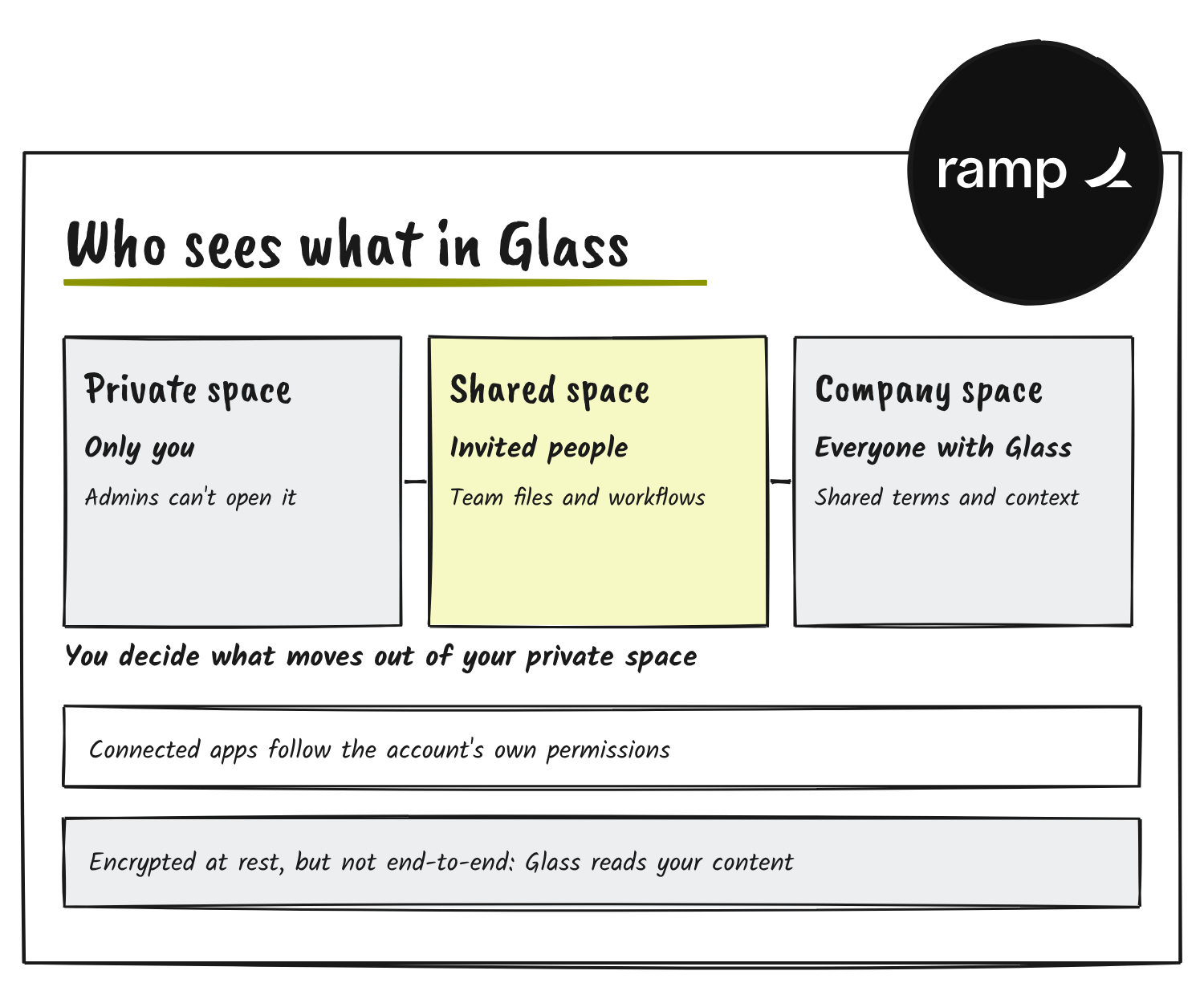
Knowledge is stored in spaces. A private space is yours alone, a shared space holds a team’s files and workflows, and a company space holds what everyone should know, such as internal terminology. Ramp’s help centre says Glass memory is mostly saved files that it reads, not hidden state inside a model. A company can set one context file of up to 8,000 characters to load in every chat, and each shared space can pick a guide that loads in its own chats.
Ramp calls reusable instructions workflows. One person’s best process is saved in a space, and teammates can run it or @mention it by name. Four starters are listed: deal desk quotes, sales enablement answers, campaign drafts built from past experiments, and finance requests triaged in a Slack channel. Sessions are multiplayer, so a teammate can join mid-task, in Glass or in Slack. Every project has a meter showing what the work costs while it runs.
Glass isn’t tied to one model provider. An Auto mode matches each task to a model across providers, and Ramp says every request runs through Ramp Router, its model-routing product. It runs in a browser on Mac, Windows, Linux and ChromeOS, as a desktop app for Macs on macOS 13 or later, and inside Slack, where you can DM it or bring it into channels and threads. A Microsoft Teams version is in the works, and Ramp hasn’t said when it will arrive.
What it connects to
Ramp lists eight named connectors, which it calls plugins, and says more can be added through the Model Context Protocol (MCP). Glass works within each connected account’s permissions, and some tools need an admin to switch them on first.
| Tool | What Ramp says Glass does with it |
|---|---|
| Slack | Answers in a DM or an internal channel |
| Google Drive | Uses one shared company Drive across the team |
| Notion | Connects a shared company Notion account for everyone |
| Salesforce | Uses your own account once an admin installs the Glass package |
| Linear | Gives the team one shared Linear account |
| GitHub | Shares a company account, limited to the repos the Glass app can reach |
| Snowflake | Runs read-only SQL queries on your data |
| Ashby | Uses your own account once an Ashby admin turns on its MCP server |
What Ramp has shown so far
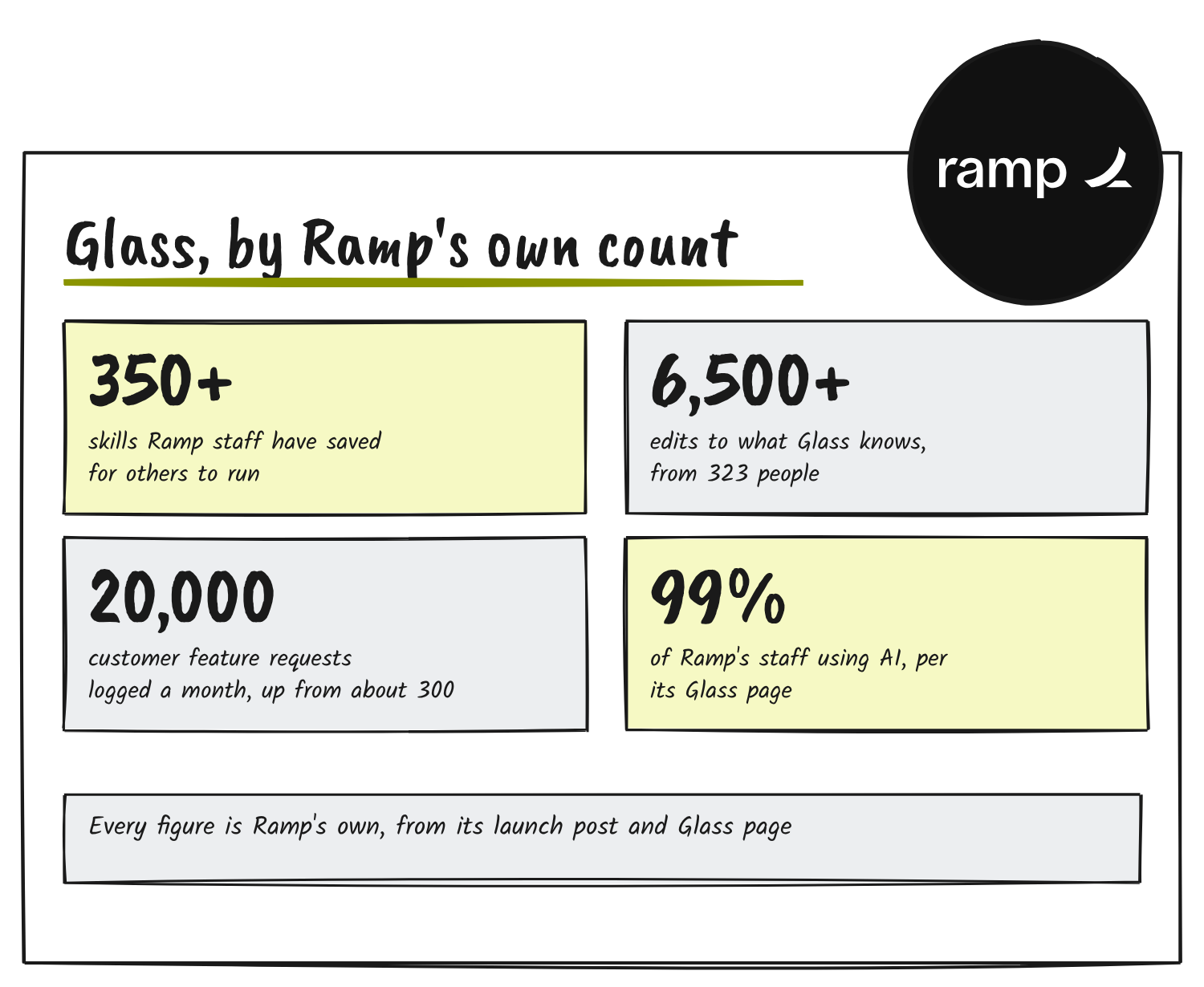
Every number about Glass in use comes from Ramp. In the launch post and the coverage that followed, Ramp says its staff have saved more than 350 skills, that 323 employees have made more than 6,500 edits to what Glass knows, and that a saved prompt now pulls customer feature requests out of call recordings. That one took the count from about 300 a month, copied into Salesforce by hand, to 20,000 a month, and a second prompt has emailed customers more than 5,000 times when something they asked for shipped. The Glass page says Ramp reached 99% AI adoption.
The Glass page backs this with short quotes from Ramp employees in product, finance, marketing, data, sales, customer experience and growth. One support agent says skills she built let her solve three to four times as many tickets an hour. A finance analyst says Glass found a model error that would have cost him 45 minutes to an hour. Those are people describing their own company’s use of its own tool. The page carries no testimonial from a customer outside Ramp, and Ramp hasn’t published a result from one.
Ramp’s engineers have been open about how Glass was built. In an April post on X, Shane Buchan wrote that it was mostly vibe coded by a three-person core team, a product manager, an engineer and an IT engineer, and that it was then used by about 700 people. Ramp’s own accounts since then put adoption across the company near everyone.
How Glass handles your data
Ramp’s help centre is blunt about the limits, which is useful for a buyer. The points that matter:
- Content is encrypted at rest and in transit. It isn’t end-to-end encrypted, because Glass has to read it to do the work and send relevant parts to model providers.
- Ramp won’t train or fine-tune a model on Glass content unless the company agrees in an order form.
- Model providers keep data under their own terms, and those differ by model. Ramp says no training and zero retention are different promises, and that zero retention at a provider doesn’t mean zero storage inside Glass.
- Glass admins see company-level account and activity information. Being an admin doesn’t unlock anyone’s private space.
- Information Glass fetches through your own connected account can show up in answers that others in a shared space can read. A 19 November changelog entry points to account-sharing risks before you allow a plugin in every space.
- Archiving a chat hides it and doesn’t confirm permanent deletion. To delete a company’s Glass data, you email Ramp’s privacy team.
The security page also names prompt injection. Documents, emails and web pages can carry instructions meant to redirect an assistant, and Ramp says access controls and approval prompts don’t guarantee that every harmful instruction gets caught. Approvals pause some actions and not others, and the rules vary by action and integration.
Why a card company is building this
Ramp started in 2019 as a corporate card and spend platform. Its 15 October funding post now lists Stack for faster accounting closes, Accounts Receivable, AI Spend Management, Router and Glass as the year’s builds. Glass is the newest layer in a stack aimed at one budget line: what companies spend on AI.
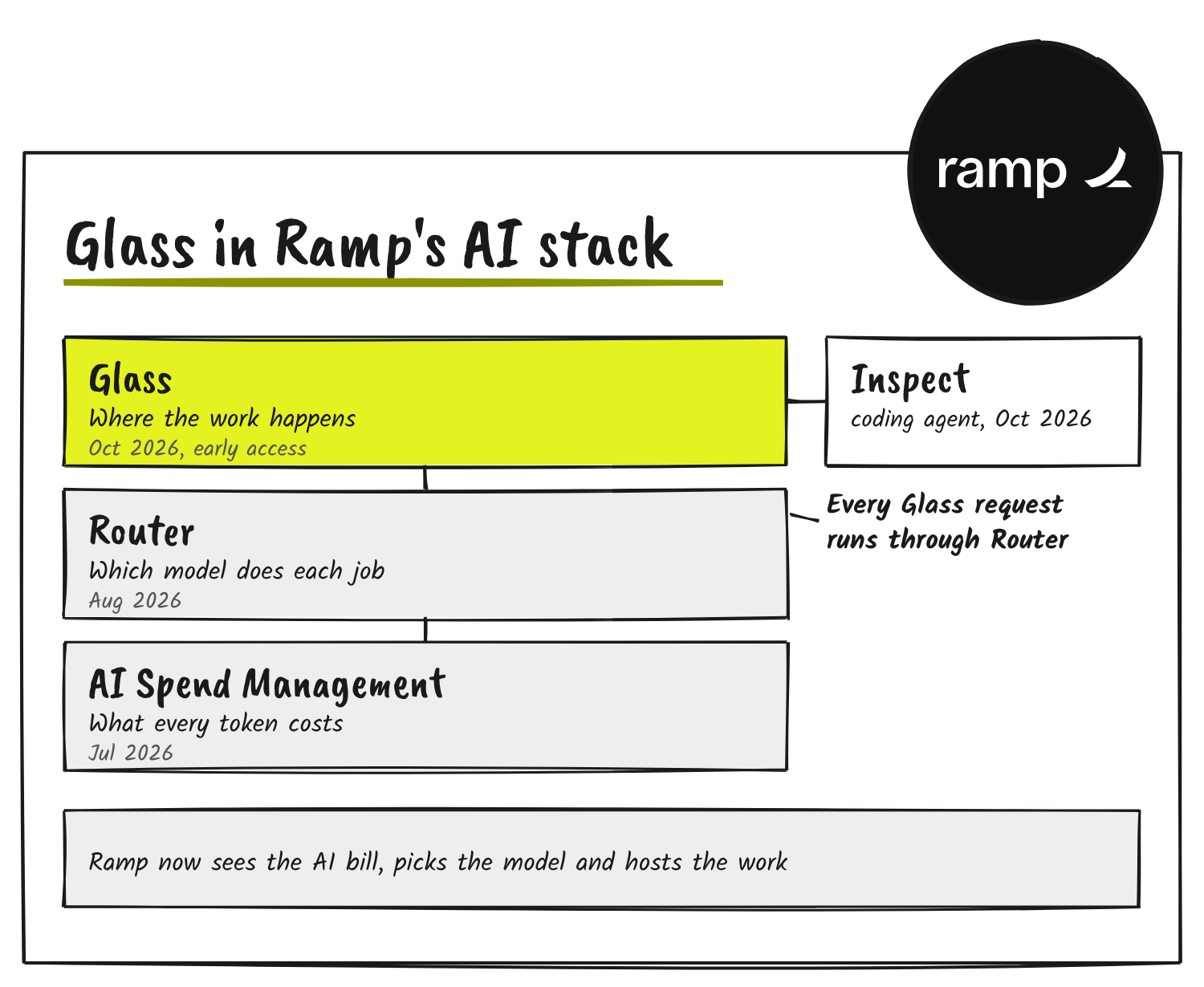
AI Spend Management launched on 16 July and tracks token spend by provider, model, team and user. Router.com followed on 19 August, a single endpoint to models from many labs that sends each request to the cheapest model that meets the required performance. TechCrunch noted it was free through the rest of 2026 and that it records model inputs, outputs and tool calls for a year by default. Payments Dive reported that Stripe had agreed to buy the rival routing service OpenRouter for a reported US$7.5 billion, so Ramp is one of about a dozen players in the field. Inspect, Ramp’s cloud coding agent, followed on 27 October, and Ramp says Glass and Inspect are separate products for now, with integrations planned.
US$60B
valuation after the 15 October round of US$1.85B
US$2B+
annualised revenue, with positive cash flow, per Ramp
85,000
businesses using Ramp, up from 70,000 in June
US$275B
annualised purchase volume, up 175% on a year earlier
Dragoneer led the round with Thrive Capital, Founders Fund, Sands Capital and Avenir co-leading, and Ramp has raised about US$5 billion in all. TechCrunch reported that Ramp has also run into Rippling, which has pushed into cards, expenses and bill payments. In the same report, early investor Keith Rabois said Ramp wasn’t worried about Rippling: “We’re going to compete with Anthropic. That’s the goal.”
Ramp also sees where the money is going. Its AI Index, built from card, invoice and bank-transfer data on more than 85,000 businesses, says 56.8% of US businesses on Ramp paid for AI in October. The median firm paying for it spent US$16.32 per employee a month, and the top 1% spent US$10,199.20. I covered those figures when Aaron Levie cited them.
The rivals Glass will meet
A shared AI workspace tied to company knowledge isn’t a new idea, and Glass walks into a crowded field. The sharpest difference is that the others sell by the seat and Ramp sells the AI bill view alongside the workspace. Ramp hasn’t said how it will charge for Glass, so the comparison on price is open.
| Product | How you get it | Price | Reach |
|---|---|---|---|
| Ramp Glass | Early access waitlist, open to non-customers | Not published | Eight named connectors plus MCP; more in the changelog |
| Glean | Sales demo | Not published; third-party buyer guides put it near US$40 to US$50 a seat with a seat minimum | 275-plus apps and 40-plus models, per Glean |
| Gemini Enterprise | Business edition has a listed price; Standard and Plus go through sales | From US$21 a seat a month for Business, up to 300 seats | 100-plus integrations, per Google |
| Microsoft 365 Copilot | Add-on to a Microsoft 365 licence | US$30 a user a month, paid yearly | Microsoft Graph plus connectors and agents |
| Notion AI | Business plan | Agents and Enterprise Search (beta) come with a monthly credit allowance of 1,500 standard and 500 select credits per member | Search across Slack, Google Drive, GitHub and more |
Notion is a useful case, because it sits on both sides. It’s one of Glass’s connectors, it’s on Ramp’s customer list, and Notion’s AI page carries a quote from Ramp’s head of AI and operations, Ben Levick: “If it’s something that’s repetitive, we have a Notion Agent for it.” Ramp uses a rival’s agents while it sells its own workspace. Glass is where Ramp wants those repeatable workflows to be saved and shared across the whole company.
How it got here
- April 2026: Ramp engineers describe how the internal Glass was built.
- 4 June: Ramp raises US$750 million at a US$44 billion valuation.
- 16 July: AI Token Spend Management launches.
- 19 August: Router.com opens.
- 13 October: Glass opens in early access.
- 15 October: Ramp raises US$1.85 billion at US$60 billion.
- 27 October: Inspect, the cloud coding agent, launches.
- 23 November: Ramp posts the Glass film and publishes the Glass versus Inspect guide.
I’ve followed Ramp’s AI work through the month. Earlier pieces cover its offer to onboard big engineering teams onto Inspect and the AI-only offer test from Ramp’s engineering blog.
What to watch
- Price. Ramp hasn’t published one on its Glass page, its pricing page or its help centre.
- An outside customer. The first company that isn’t Ramp to report a result will test the numbers above.
- Teams. Ramp says it’s working on a Microsoft Teams integration and hasn’t given a date.
- Glass and Inspect. Ramp says it plans integrations that let each pull context from the other and will share details when they’re ready.
Sources
- Ramp on X, 23 November
- Introducing Glass: Learn things once, Eric Glyman, 13 October
- Glass or Inspect? Where to start, 23 November
- Glass security and data handling, Ramp Help Center
- Glass changelog, Ramp Help Center
- Ramp reaches US$60 billion valuation, press release, 15 October
Discover more from Sulat AI & Tech News
Subscribe to get the latest posts sent to your email.