
Google’s Gemini API now lets a tool hand audio, video, Word, Excel and PowerPoint files back to the model as a function result, alongside the text, images and PDFs it already took. A tool can send the bytes inline or return a Files API link, and Gemini reads the file the way it would read one a user uploaded.
Philipp Schmid, whose X bio lists agents and the Gemini API at Google DeepMind, announced it on 23 November as a rollout for Gemini 4 Neon. Google’s release notes list the change under 5 November, 18 days earlier, and the function-calling guide now documents it in full. His pitch is tool use that sits closer to what a user can send.
What changed
Before that, an agent whose tool fetched a recording, a slide deck or a spreadsheet had to turn it into text or screenshots before the model could use it. The guide now lists five content types a tool can return inside a function_result:
| Block type | Formats the docs list | How it arrives |
|---|---|---|
text | Plain text, such as JSON | Inline |
image | PNG, JPEG, WebP | Base64 data or a uri |
document | PDF, CSV, DOCX, DOC, DOTX, ODT, PPTX, PPT, ODP, XLSX, XLS, ODS | Base64 data or a uri |
audio | WAV, MP3, AIFF, AAC, OGG, FLAC, MPEG, M4A, L16, Opus, ALAW, MULAW, WebM | Base64 data or a uri |
video | MP4, MPEG, MOV, AVI, FLV, MPG, WebM, WMV, 3GPP | Base64 data or a uri |
uri is a Files API link. A block with any other MIME type returns a 400 error that names the field and lists the accepted types.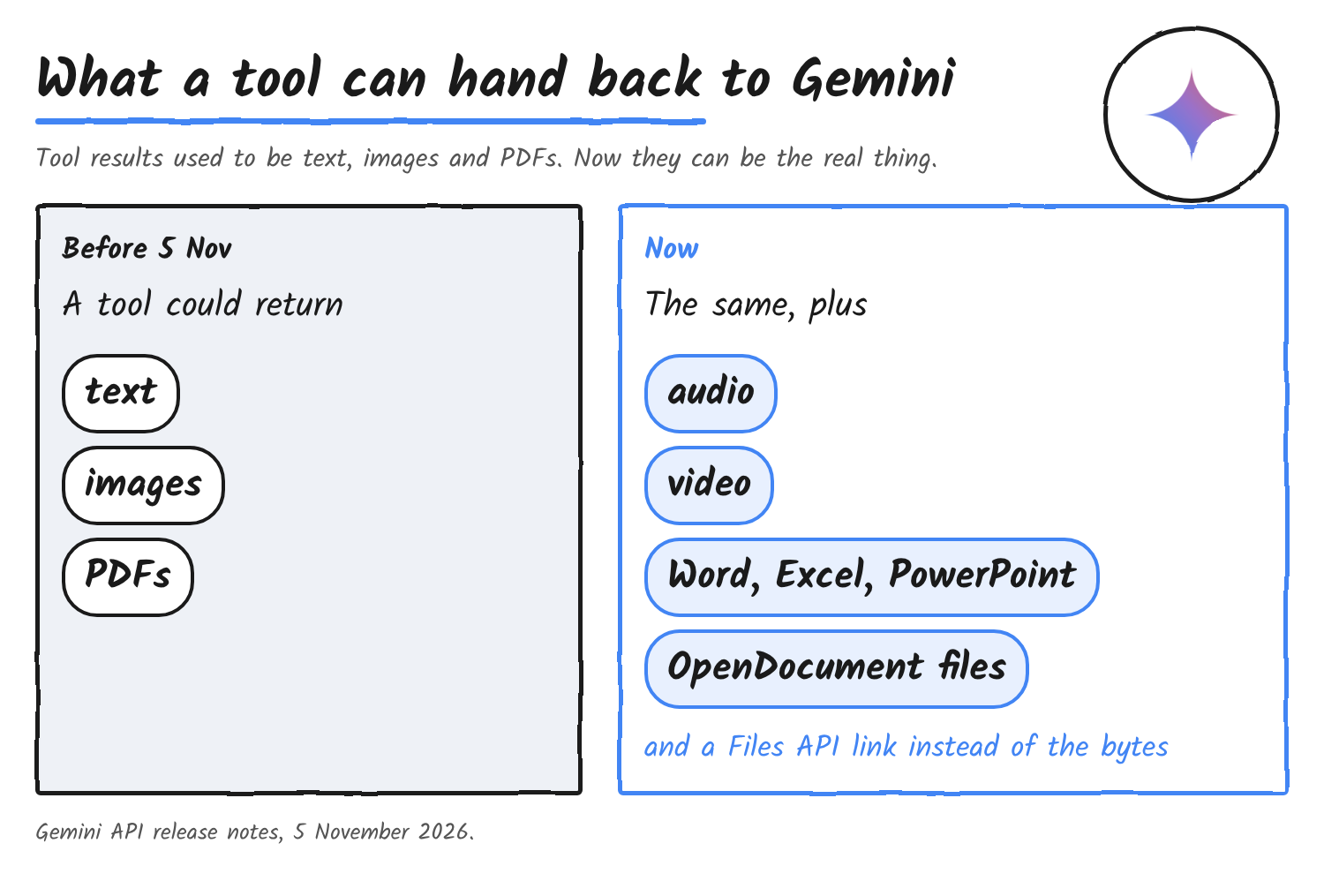
The release notes describe the same change for both of Google’s request formats. On the older GenerateContent API, function response parts accept audio, video and Office or OpenDocument files, take fileData so a tool can return a Files API link, and let video parts set mediaProcessing to static or agentic. On the Interactions API, function_result steps accept document, audio and video blocks next to text and image, by inline data or link. Video blocks there are in v1beta and v1alpha and take a processing field.
Google’s guide says a file in a function result is processed the same way as the same file in a regular input, so the page-range, cell-range and clip controls from the file slicing release carry over. The model also gets a PDF’s page count and a workbook’s sheet names without being told.

How a tool uses it
Google’s own example is a view_file tool that uploads a spreadsheet and a video, then returns both links. Inline data counts toward the request size limit, so Google says to upload large videos, long audio and multi-page documents through the Files API and return the link instead.
{
  "type": "function_result",
  "name": tool_call.name,
  "call_id": tool_call.id,
  "result": [
    { "type": "text", "text": "{\"status\": \"ok\"}" },
    { "type": "document", "uri": sheet.uri,
      "mime_type": "application/vnd.openxmlformats-officedocument.spreadsheetml.sheet" },
    { "type": "video", "uri": clip.uri,
      "mime_type": "video/mp4", "processing": "agentic" }
  ]
}
Source: Google’s function-calling guide, Interactions API. The model in the guide’s examples is gemini-4-hydrogen.
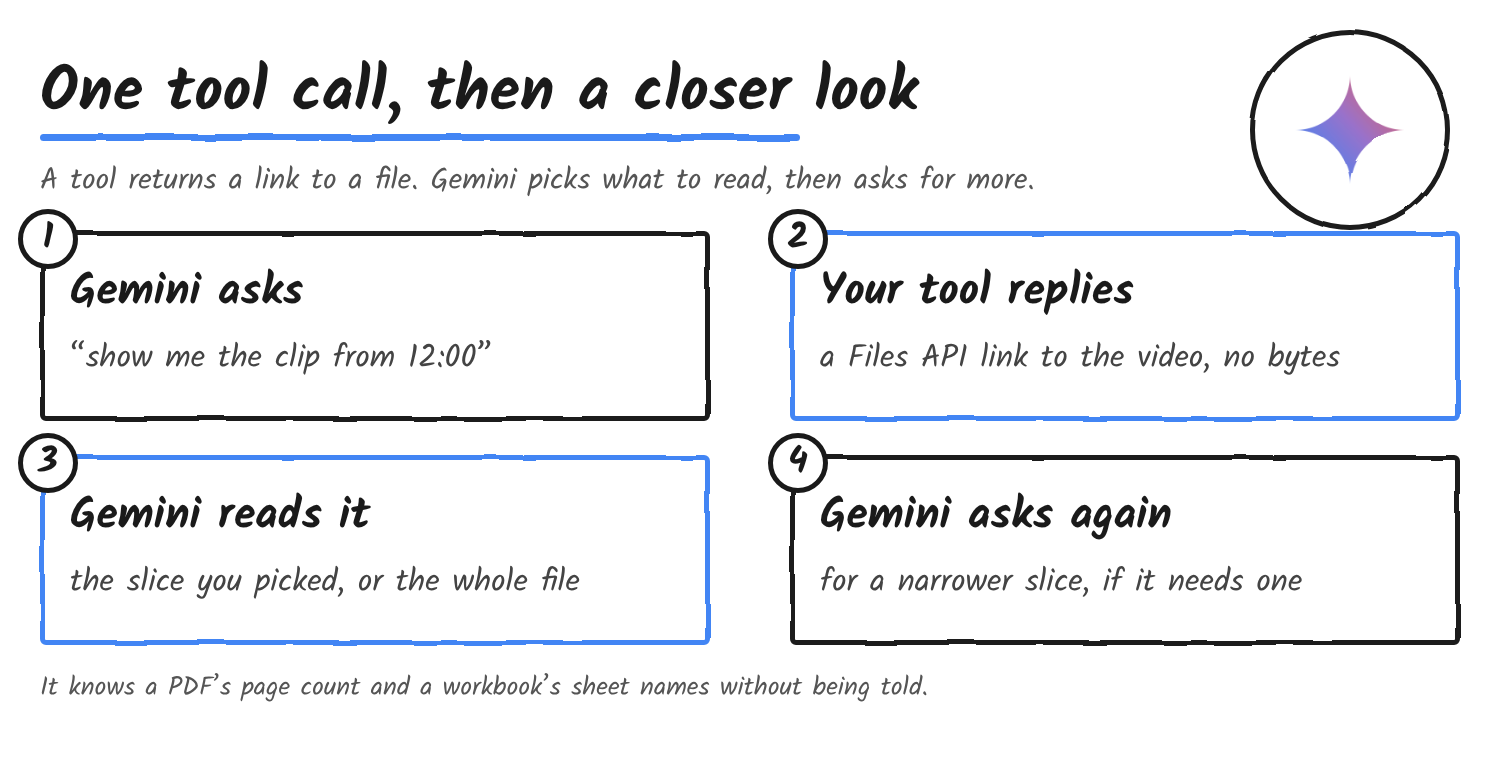
A tool can also do the slicing itself. Google’s example has an inspect_document_pages tool that takes a start and end page from the model and returns that range of a PDF as high-resolution page images. The model can then call it again for a different range.
What it costs
Google’s guide says files in function results are processed like regular input, so its input token rates apply, and so does Gemini 4 Neon’s price of US$3 per million input tokens and US$15 per million output tokens.
32
tokens a second of audio, or 1,920 a minute
~100
tokens a second of video at the default low media resolution
88%
fewer video tokens in agentic mode on long footage, Google says
From those rates, my arithmetic for Neon input:
- A 10-minute audio clip is 19,200 tokens, about US$0.06.
- A five-minute video clip is about 30,000 tokens, about US$0.09.
- An hour of video is about 360,000 tokens, about US$1.08.
- Neon’s output and thinking tokens bill on top, and the model isn’t offered on the free tier.
Those are static-mode figures, where frames are sampled at one a second. Google’s guide says high media resolution roughly triples the video rate. Audio is capped at 9.5 hours a prompt.
Agentic video is the reason to return a link
Static mode loads every sampled frame up front. Agentic mode is opt-in: the model reads a transcript first and loads only the segments it needs. Google says that saves up to 88% of video input tokens on long-form footage and lifts quality by about 7%. It also says agentic mode can raise time to first token and total tokens on clips under five minutes, because of the extra reasoning and tool round-trips. Google’s guide points to static for short clips and agentic for videos over five to ten minutes or needle-in-a-haystack questions.
In a function result, the video block takes the same processing setting. A tool that returns a link to a long recording and marks it agentic hands the model a recording it can search rather than watch end to end. Agentic runs add processing_call and processing_result steps to the response, which you can show as a progress trace, and Google suggests streaming or background execution for long ones.
What Schmid’s four examples need
| Example from the post | What the tool returns | Where the controls help |
|---|---|---|
| Agentic native video editors | Footage and rendered cuts as video | Clip a time range, pick frames or transcript |
| Agentic search that hears tone and pauses | Audio from calls or interviews | Clip audio intervals instead of sending transcripts |
| UI subagents that replay bugs as video | A screen recording of the failure | Frame rate up to 24 for fast UI changes |
| Agentic podcast clippers | Long episodes by link | Transcript first, then the clip |
The second row is the notable one. A transcript throws away tone and pauses, and the audio block keeps them, which is what Schmid means by tool use closer to native user input.
Where this sits
The change lands in the same week as three others. Gemini 4 Neon reached general availability on 18 November, with a 1 million-token window and the same Office and slicing support. Tool Retrieval started loading tool schemas only when the model asks for them. And Google’s file slicing post argued that agents shouldn’t need LibreOffice or ffmpeg in their own harness to prepare files. Returning a link and letting Google render, slice and tokenise the file finishes the job.
Enterprise customers get it on Google Cloud too. The Gemini Enterprise Agent Platform guide for Neon lists the same multimodal FunctionResponse parts, and says Neon there is open to verified enterprise customers in select regions. Our earlier pieces cover Gemini 4 Neon itself.
How others handle tool results
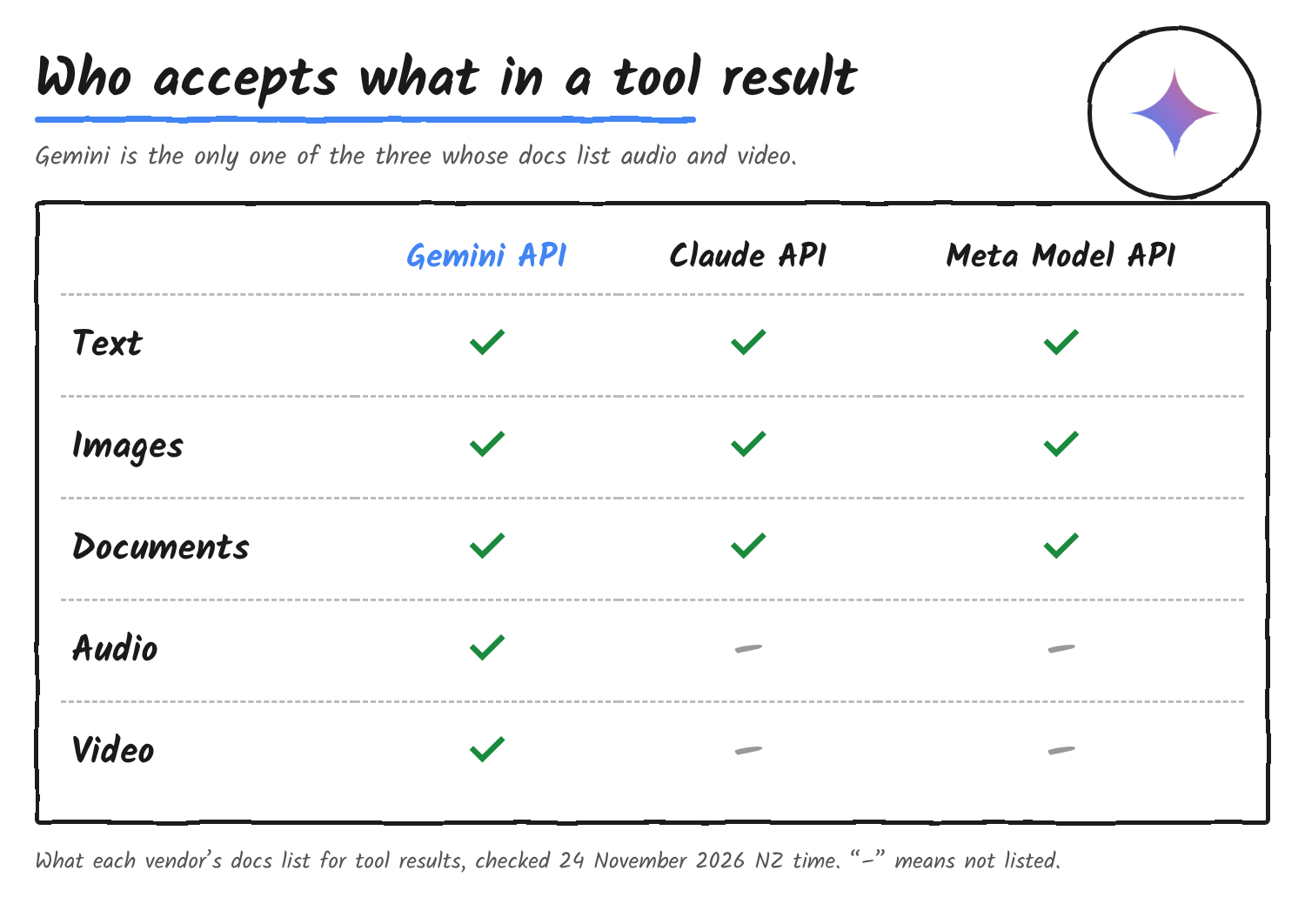
Anthropic’s Claude API lets a tool_result carry text, image and document blocks, and the Messages reference also lists search results. Its docs don’t list audio or video blocks there. Meta’s Model API accepts the same Messages-style tool results, and its schema says blocks other than text, image and document are passed to the model as JSON text. So for audio and video, a tool on either has to transcribe, sample frames or call a separate model first.
Rules and gaps in the docs
- Model support. Google’s guide says multimodal function responses work on Gemini 3 and later models. Schmid’s post names Gemini 4 Neon.
- Match the call. Google’s Neon guide says each function response must match the
id,nameand order of the call it answers, and that media belongs inside the function response, not appended as a separate user-turn part. - Send tools every time. Tool declarations aren’t stored with an interaction, so the
toolsarray goes on every request, including ones that passprevious_interaction_id. - The whole file still has to fit. Upload limits apply to the full file even when the model reads one slice, and Files API uploads sit on Google’s servers for 48 hours.
- The guide’s samples are Interactions API. The GenerateContent route is described in the release notes, not shown in the guide’s examples.
How it got here
- 5 November: release notes add audio, video and Office files, and Files API links, to function responses.
- 12 November: Gemini 4 Hydrogen reaches general availability, the model the guide’s examples use.
- 18 November: Gemini 4 Neon reaches general availability, and the release notes add slicing in prompts and function responses.
- 23 November: Schmid posts the announcement, and Google publishes the file slicing post.
If you’re going to try it
- Upload anything bigger than a few megabytes through the Files API and return its
uri, not inline data. - Set
processingto agentic on long recordings, and leave short clips on static. - For documents, return the page or cell range the model asked for, and let it come back for more.
- Keep the original tool output in your own logs. The model’s read of a clip is an answer, not a record.
- Count tokens on a real clip before you set a budget.
Google’s function-calling guide has the full field list, and its release notes carry the dated entries.
Discover more from Sulat AI & Tech News
Subscribe to get the latest posts sent to your email.