
OpenAI and Cisco have open-sourced Shirudo, a Linux runtime that lets operators block an exploit on a running system while the patch is still being tested and rolled out. In a controlled test, a shield generated with Codex stopped a Java4Shell exploit attempt against a live Elasticsearch service without a restart, according to OpenAI and to Cisco’s Isovalent.
The announcement went out on 23 November (US). The code is on GitHub under a BSD 2-Clause licence, and the repository describes the project as pre-release. Here’s what Shirudo is, how a shield gets from an agent to a live host, what the Java4Shell test showed, where it sits beside the live-patching tools already on the market, and what you need to try it.
- What Shirudo is
- How a shield reaches a live host
- The Java4Shell test
- Where Shirudo sits
- The longer plan
- What you need to run it
4
core capabilities OpenAI and Cisco name for the design
9.5.5
Elasticsearch version used in the Java4Shell test
TPM 2.0
required on production targets, per the repository
BSD-2
licence, with the BPF programs dual-licensed BSD and GPL
What Shirudo is
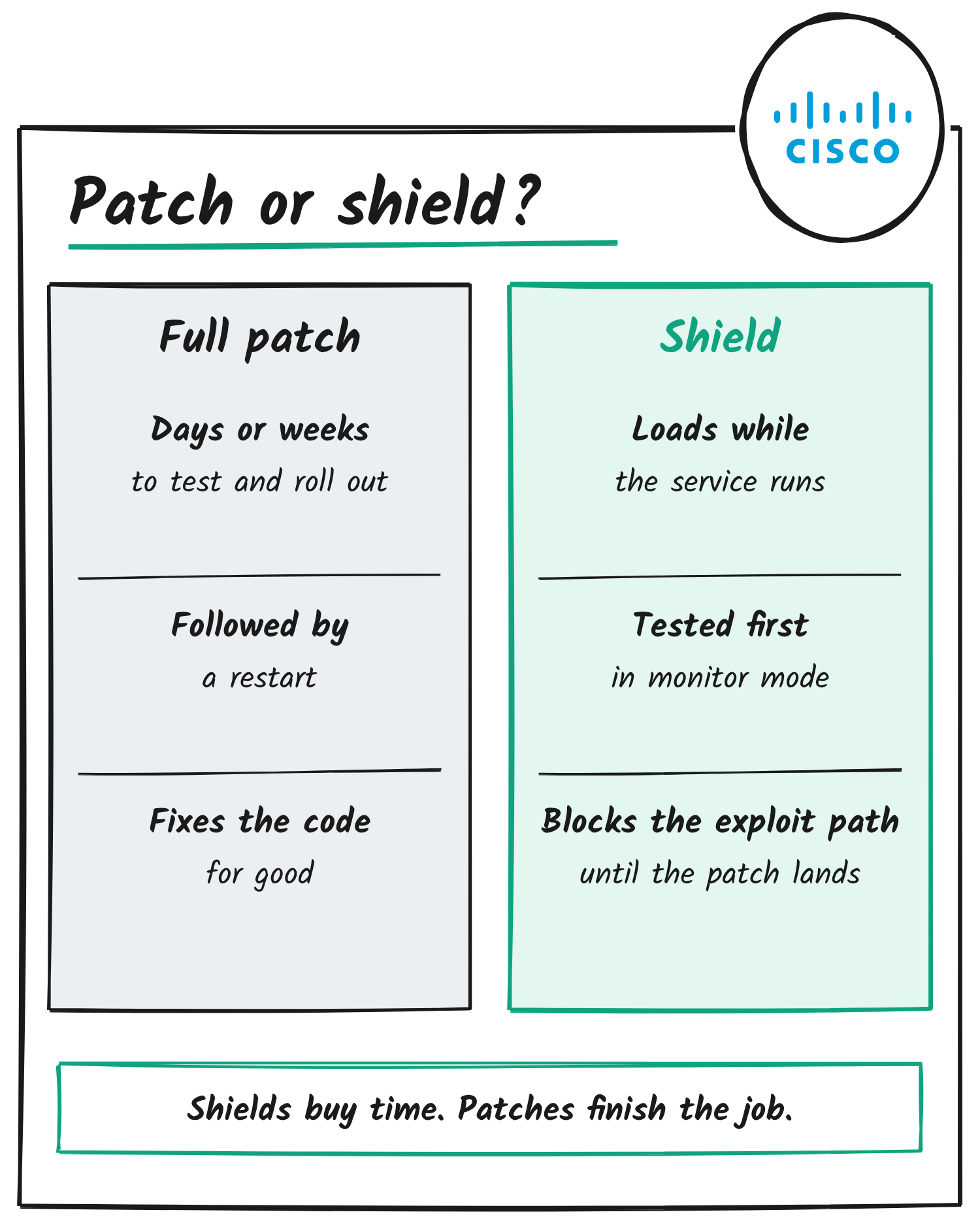
Shirudo is Japanese for shield, and the temporary safeguard it deploys is called a shield too. OpenAI’s framing of the problem is simple. Testing and deploying a patch can take days or weeks, and blocking a risky Linux operation outright can take a service offline, because an exploit and a legitimate request may rely on the same operation.
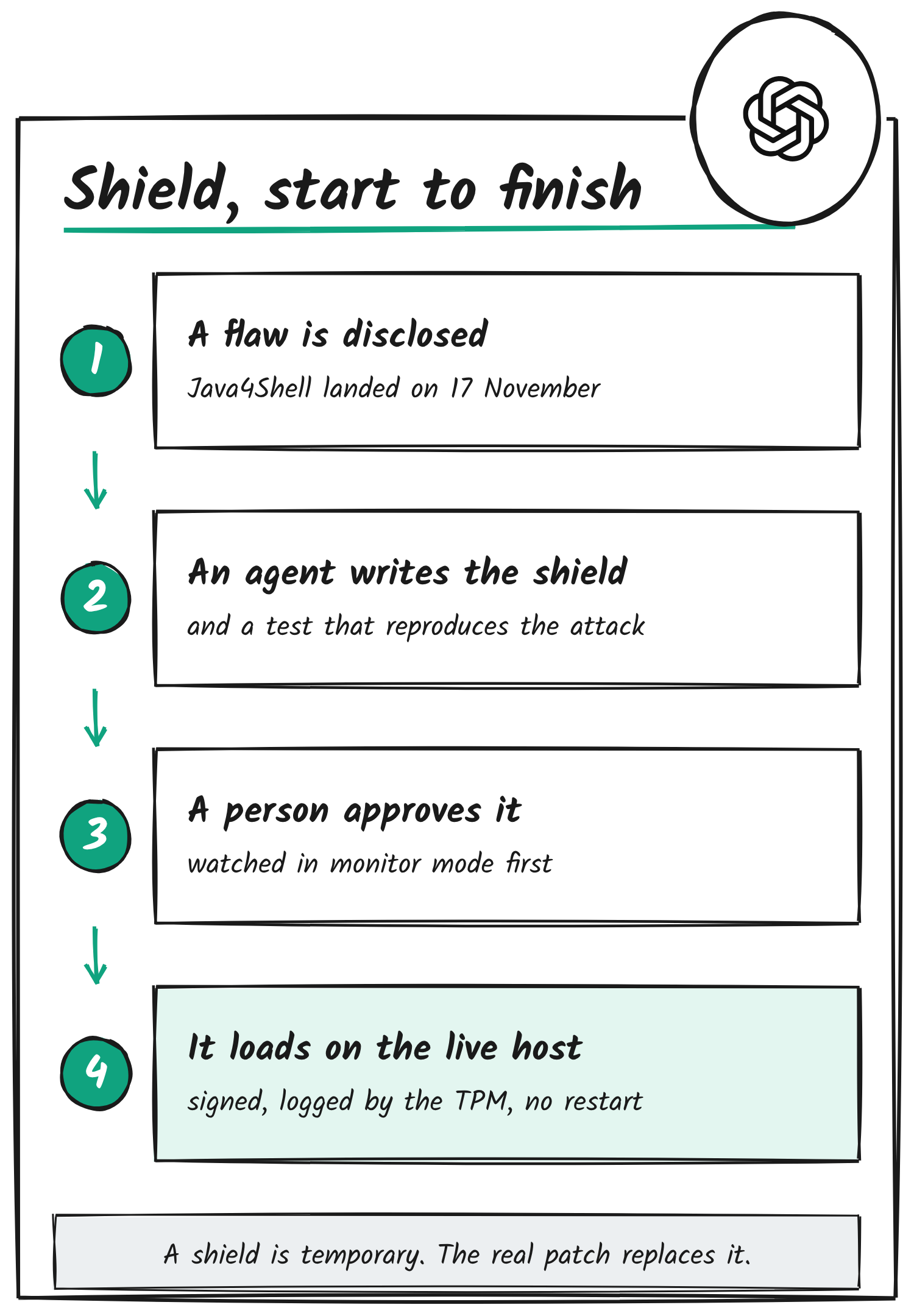
The answer is to test the safeguard first. Teams check whether a shield blocks the behaviour that exposes the flaw while letting legitimate requests through, OpenAI says. Once an operator approves it, it deploys while the service keeps running.
We’re giving defenders better models and tools to find and fix vulnerabilities faster, but finding a bug today doesn’t mean you can patch every system tomorrow. We are partnering closely with Cisco on Shirudo to help teams protect the systems they need to keep running while they build and roll out a fix.
Greg Brockman, President and Co-founder of OpenAI, in OpenAI’s announcement, 23 November 2026
The project has roots in Tetragon, the eBPF security platform Isovalent open-sourced in 2022. Isovalent’s Thomas Graf and Liz Rice write that Tetragon is also the foundation for Cisco’s Live Protect, which mitigates vulnerabilities in Cisco products today. They call Shirudo a rewrite of Tetragon designed for agents.
in order to unlock defense at machine speed with agents, we need to let agents speak their natural language: code.
Thomas Graf and Liz Rice, Isovalent, 23 November 2026
How a shield reaches a live host
Shirudo is a one-shot command line tool, so no daemon runs on the target or on the operator’s machine, Isovalent says. On the operator side it builds shields from eBPF or application bytecode and ships them as signed .bee packages through an OCI registry. Each target pulls a package and checks its signature, using the TPM to establish trust. The control plane on the target is an eBPF program loaded during boot.
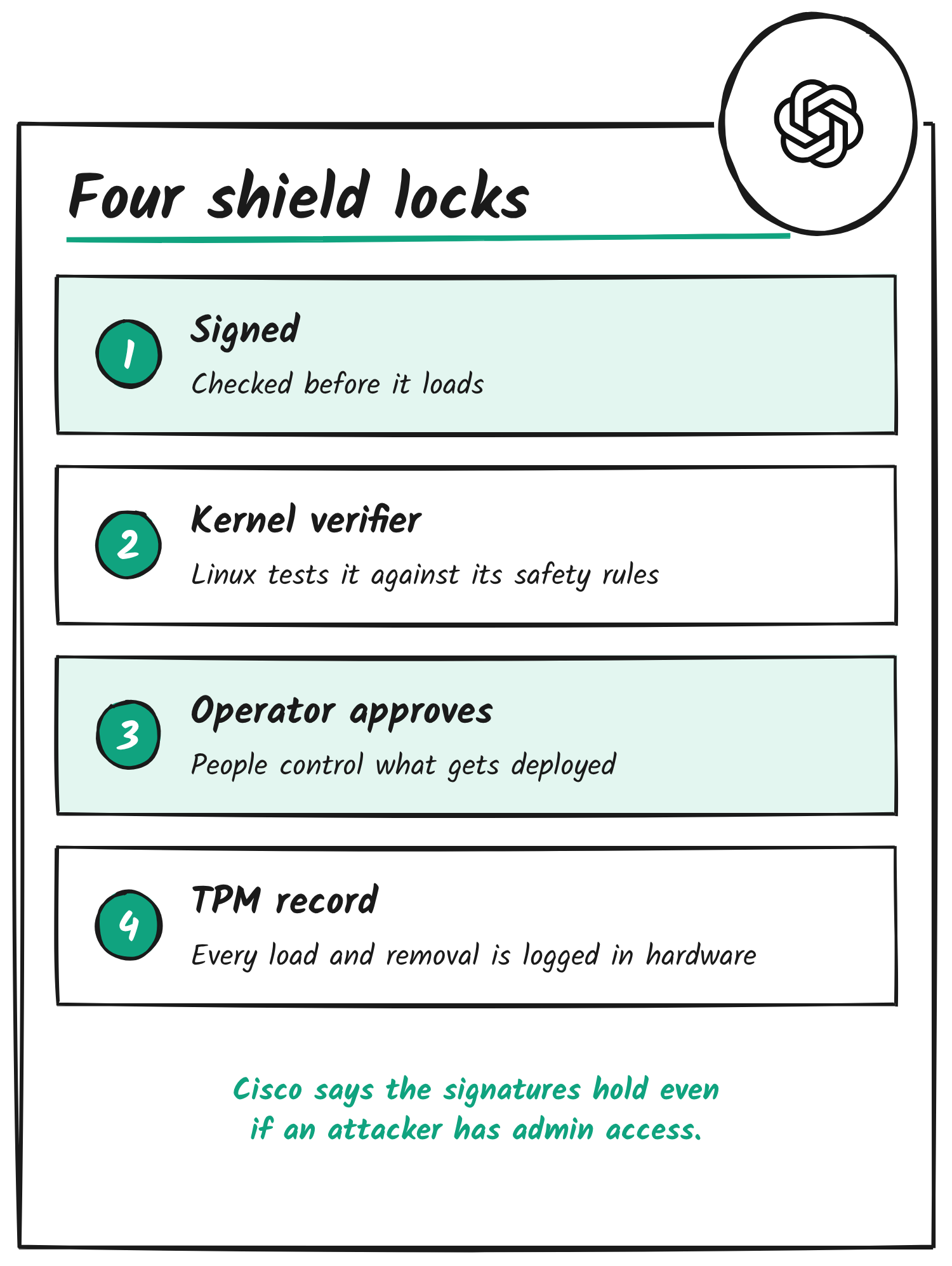
OpenAI lists four capabilities the design is built around.
- Live protection
- eBPF shields can block vulnerable code paths without restarting the system, and security teams can monitor how a proposed shield would affect applications before enforcing it.
- Defence at machine speed
- Agents get programmable controls to investigate vulnerabilities, develop targeted shields and validate them against exploits and real workloads. Security teams control what gets deployed.
- Trusted deployment
- Shields are cryptographically signed and verified before loading. The Linux eBPF verifier checks programs against its safety rules, and kernel security controls restrict unauthorised changes.
- Hardware-backed verification
- A Trusted Platform Module supports a verifiable record of protections being loaded or removed, which operators can use to check whether systems meet their security requirements.
The repository README adds detail. After boot-time initialisation, Shirudo restricts BPF program loads from userspace to signed loaders. Operators ship signed micropatches it calls upatches, and Java upatches are verified in userspace and loaded by configured JVMs at startup. Changes to the loaded set extend a per-boot TPM register, and the shirudo attest command returns evidence operators can verify offline. Targets pull packages from OCI registries and export telemetry to OpenTelemetry collectors.
The quickstart commands, in order
The official quickstart takes one test upatch through its whole life in a virtual machine with a software TPM. These are the core commands from the docs:
operator$ shirudo build testing/fixtures/basic.bpf.c --keys-dir "$KEYS" --vmlinux vendor/linux/vmlinux.h -o basic.upatch
target# shirudo upatch load basic.upatch
target# shirudo attest --nonce=<nonce> --output=/mnt/shirudo-out/ev.json
operator$ shirudo attest verify --evidence="$EV" --nonce="$NONCE" --ak-name="$(jq -r .ak.name "$EV")" --expect-chain=<register-after-events>
target# shirudo upatch unload basic.unload.upatch
The Java4Shell test
Java4Shell is a flaw in OpenJDK’s Base64 decoder, published by Calif. Oracle shipped fixes on 17 November, as I covered when CISA told organisations to patch. Isovalent’s test starts from the gap between that disclosure and a fixed deployment.
The team fed the vulnerability details to the agentic control plane. It produced a mitigation written as Java bytecode that adds validation to the Base64 input used in the exploit. OpenAI says Codex generated the shield. The team ran Elasticsearch 9.5.5, watched the shield attach to the running process, then tried the exploit. The attack failed, and the Elasticsearch log recorded the guard rejecting the input. Isovalent says the shield can be applied to any Java application on OpenJDK and protects it until OpenJDK itself is patched.
The choice of bytecode matters. Isovalent says agents can write Java bytecode changes to protect against classes of vulnerability that eBPF alone doesn’t suit, so a Shirudo shield isn’t limited to kernel hooks.
The two log lines Isovalent published
2026-11-18T12:14:43.334Z WARN  Base64 guard installed on java.util.Base64$Decoder.decode0 (classfile)
2026-11-18T12:14:43.356Z WARN  Base64 guard rejected candidate: length=65, padding=1, remainder=1, alphabet=standard
Both lines come from the Elasticsearch server log of the lab node, as shown in Isovalent’s post. The first is the shield attaching, the second is it refusing the crafted input about 22 milliseconds later.
Where Shirudo sits
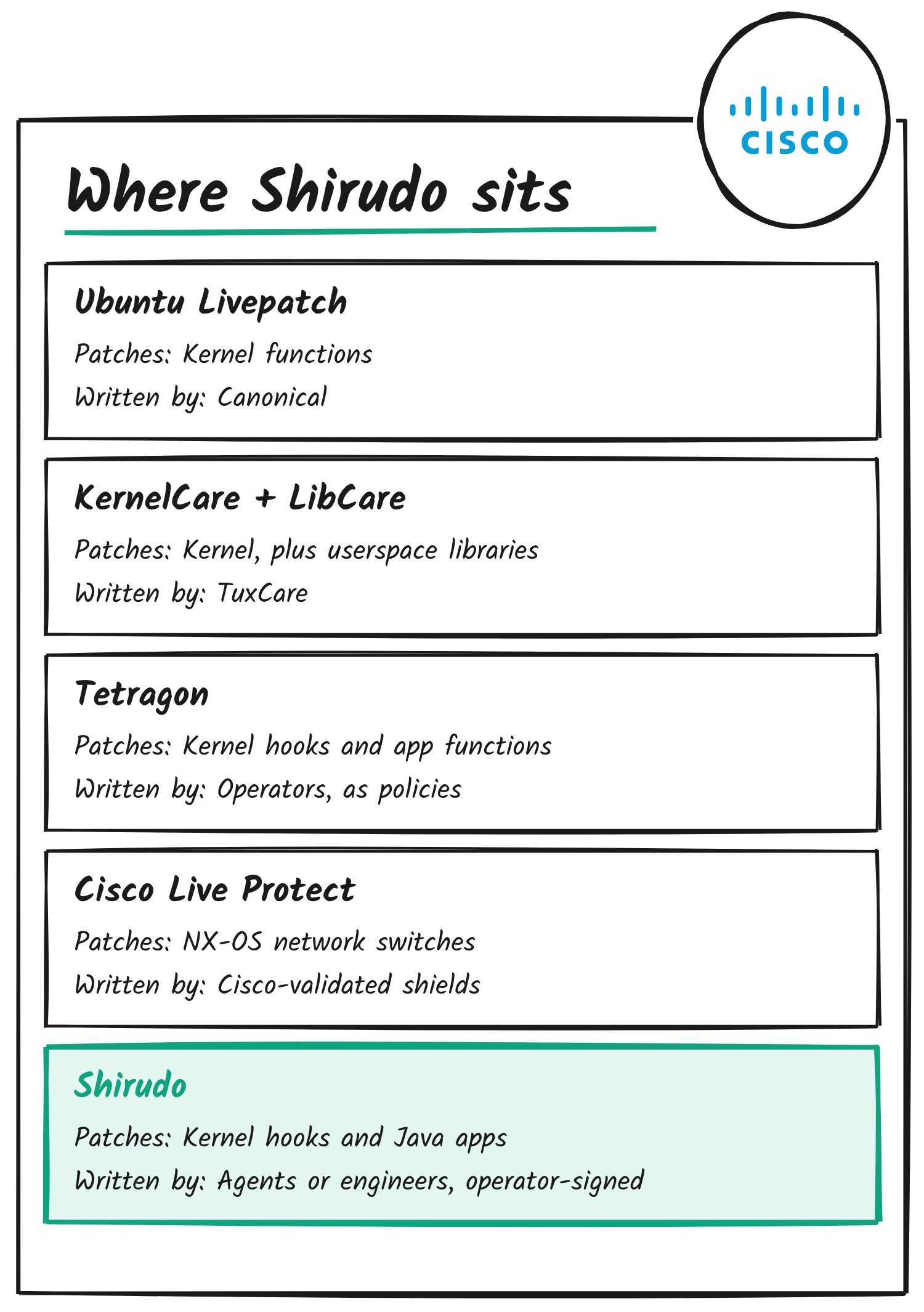
Live patching isn’t new, and each tool covers a different layer. Canonical says Livepatch targets high and critical kernel vulnerabilities, and that some kernel flaws can’t be live patched, in which case it advises a reboot. TuxCare’s LibCare patches OpenSSL and glibc in memory.
| Tool | Maker | What it covers | Who writes the fix | Source |
|---|---|---|---|---|
| Ubuntu Livepatch | Canonical | Kernel, high and critical vulnerabilities | Canonical | Canonical docs |
| KernelCare with LibCare | TuxCare | Kernel, plus OpenSSL and glibc in userspace | TuxCare | TuxCare docs |
| Tetragon | Isovalent (Cisco) | eBPF runtime security and vulnerability defence | Operators, through a policy language | Isovalent |
| Cisco Live Protect | Cisco | Vulnerability mitigation in Cisco products | Cisco | Isovalent |
| Shirudo | OpenAI and Cisco | eBPF shields and Java bytecode shields | Engineers or agents, signed by the operator | Shirudo repository |
The longer plan
OpenAI calls Shirudo a first step. Its long-term goal is for defenders and AI agents to identify affected systems quickly, validate protections and deploy shields that block exploits without disrupting workloads. It also wants tested shields published alongside vulnerability disclosures, so operators can evaluate a temporary protection while a permanent patch is prepared.
Isovalent sets out two principles for that future. Software should be self-augmenting, adjusting itself at runtime as threats change, and hardened by default from the kernel up. It expects TPMs to measure every state change and to ensure the system can only boot into a known good configuration.
The timing sits inside a live argument about how fast patching should go. I’ve covered WIRED’s claim that rushed patching is behind recent outages, the NSA outage the DNI linked to PHP patching and CISA adding a Cisco Expressway flaw to its exploited list. Shirudo’s pitch is a way to buy time in that gap without a restart.
What you need to run it
- The project is pre-release, and its main branch is the development branch, with release tags published on GitHub Releases.
- Production targets need a Linux kernel with the signed-loader ABI and Shirudo’s kernel patches, plus a TPM 2.0.
- The quickstart uses a local virtual machine with a software TPM, on an x86-64 or arm64 Linux host with KVM.
- Building from source needs clang and LLVM 23 with the BPF target and OpenSSL 3.5 or later.
- CI runs all test tiers on x86-64 and host tests on arm64. Target validation for riscv64 is pending.
OpenAI also points to Isovalent’s self-guided lab and a technical webinar on 15 December.
Sources
- OpenAI and Cisco introduce Shirudo, OpenAI, 23 November 2026
- Cisco and OpenAI introduce Shirudo, Thomas Graf and Liz Rice, Isovalent, 23 November 2026
- shirudo-dev/shirudo README, GitHub
- Shirudo quickstart, Shirudo docs
- Livepatch and how kernel live patching works, Canonical
- KernelCare and LibCare live patching, TuxCare docs
Disclosure: I’m an OpenAI, Firecrawl and Devin ambassador.
Discover more from Sulat AI & Tech News
Subscribe to get the latest posts sent to your email.