Jamie, the Berlin company behind the bot-free AI meeting-notes app, has opened Kombucha-1, the speaker diarization model behind all of its production traffic, as a public API at US$0.04 per audio hour. Jamie’s launch post says the model scores 4.1% on its own speaker-mismatch test of 237 meetings, against 7.5% for ElevenLabs Scribe v3, the best offline model it tested.
Diarization is the step that decides who said what in a recording, so a transcript shows “Ana” and “Ben” instead of “Speaker 1” and “Speaker 2”. Jamie announced the API on X on 24 November, and Egor Spirin, who builds Jamie, posted the benchmark charts in a thread the same night. The write-up itself is dated 16 November and is credited to Spirin and Aleksandr Ogaltsov.
- What Kombucha-1 is
- How Jamie ran the test
- The results
- Why the speaker count decides it
- How the rest of the market describes itself
- What the benchmark doesn’t show
4.1%
speaker mismatch across 237 meetings, Jamie’s figure
8 s
median time until a speaker label is final
US$0.04
per audio hour, with US$200 in free credits
86%
of meetings with exactly the right speaker count
What Kombucha-1 is
Jamie started in 2022 as a notetaker that runs on your own device instead of joining the call as a bot. Its about page lists more than 10,000 customers and a team of 25-plus, and names TS Ventures and Superangel as backers. Kombucha-1 is the component in that app that works out who is talking.
The API is a live stream. You open a WebSocket to wss://api.meetjamie.ai/v1/platform/diarize, send 16 kHz mono PCM audio in 100 ms frames at real-time pace, and read back speaker segments in milliseconds of audio time, according to Jamie’s quickstart. Jamie’s platform page puts the live delay at about 10 seconds from audio to a decided speaker, and the launch post gives a median of 8 seconds.
Three design choices come straight from Jamie’s post. Kombucha-1 listens to voices rather than words, so it works in any language, including meetings that switch language mid-sentence. It gives each moment to one speaker, so it doesn’t support overlapping speech. And it keeps no audio: Jamie says it processes audio in the EU and that zero data retention is the API’s default, not an enterprise feature.
What a session looks like
- Claim the free credit on the console. Until you do, new sessions are refused with
402 insufficient_credit. - Create a key. The token is shown once.
- Open the WebSocket with an
Authorization: Bearerheader and wait for thesessionmessage, which can take up to 30 seconds. - Send 3,200-byte audio frames every 100 ms and read the
speakersmessages as they arrive. - When the audio ends, send
{"type":"finalize"}and read untilfinished.
How Jamie ran the test
Jamie compared Kombucha-1 with 23 configurations from 10 providers, open and closed source, on 237 meetings with 121 hours of audio and 1,408 speakers in total. Of those meetings, 112 are Jamie’s own held-out internal meetings, 81 are public meetings from the AMI, AliMeeting and NOTSOFAR sets, and 44 are earnings calls from the public Earnings-21 set. Jamie says Kombucha-1 was trained on a few thousand of its own team meetings, none of them in the benchmark.
The score is speaker mismatch, a metric Jamie chose instead of the standard diarization error rate. It measures the share of each person’s words that end up under the wrong name, averaged over everyone in the meeting. Jamie says the standard metric counts seconds of audio, so a model can score well while folding a quiet participant into the main speaker. If a model merges a real person into someone else, or invents a speaker who isn’t there, that person scores 100% wrong.
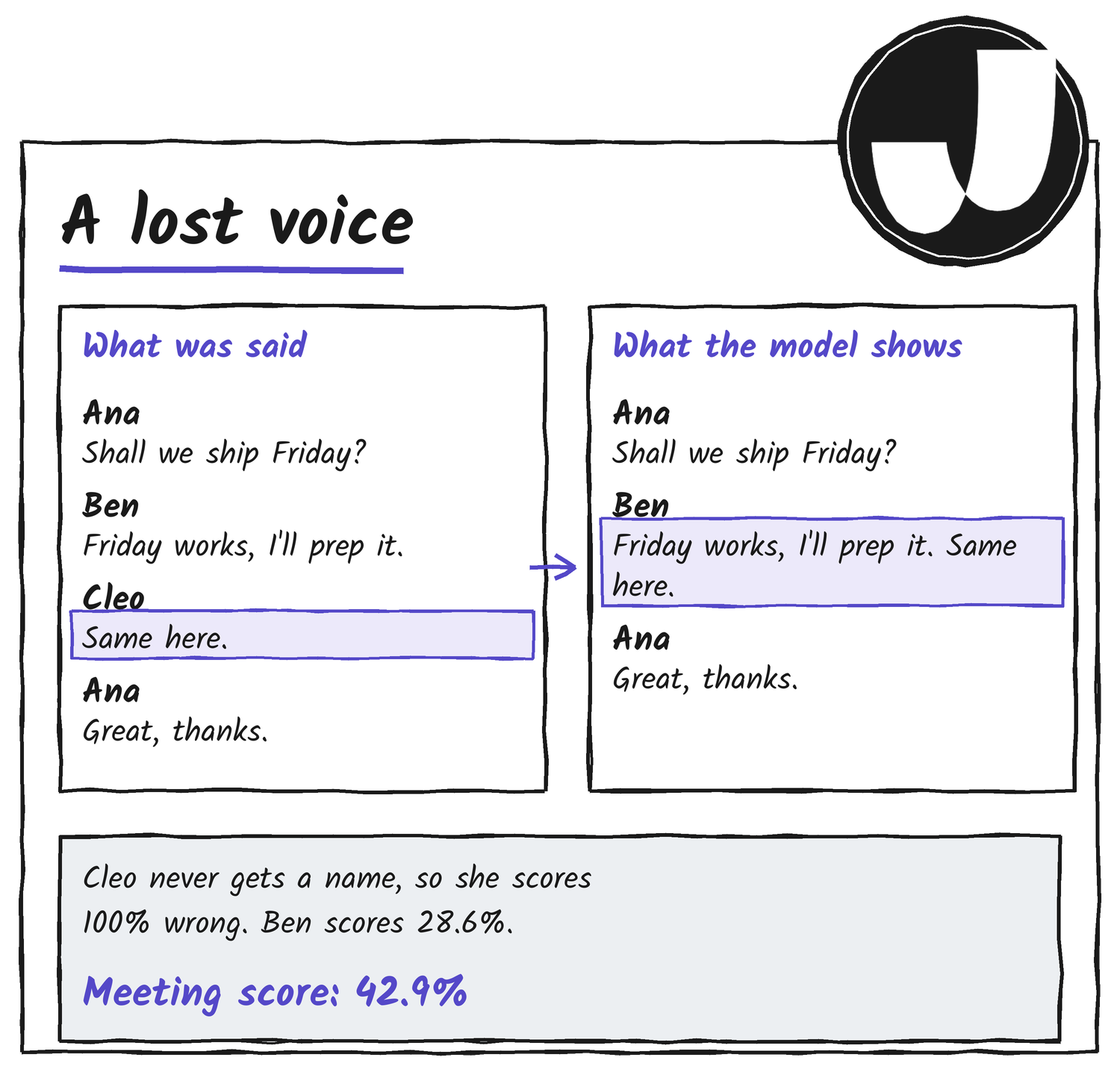
Jamie’s worked example has three speakers. Ana speaks twice, Ben once, and Cleo says “Same here.” If the model folds Cleo into Ben, Ana scores 0%, Ben scores 28.6% because two of his seven shown words are Cleo’s, and Cleo scores 100%. The meeting averages 42.9%.
The results
Kombucha-1 labels speakers while the meeting is still running, and Jamie reports it ahead of every offline model, which get the whole recording before they label anything. Behind Kombucha-1’s 4.1% come ElevenLabs Scribe v3 at 7.5%, pyannote Precision-3 at 11.1% and ElevenLabs Scribe v2 at 11.3%. The best streaming rival, ElevenLabs Scribe v3 Live, scores 16.7%, and NVIDIA’s Nemotron scores 18.4%.
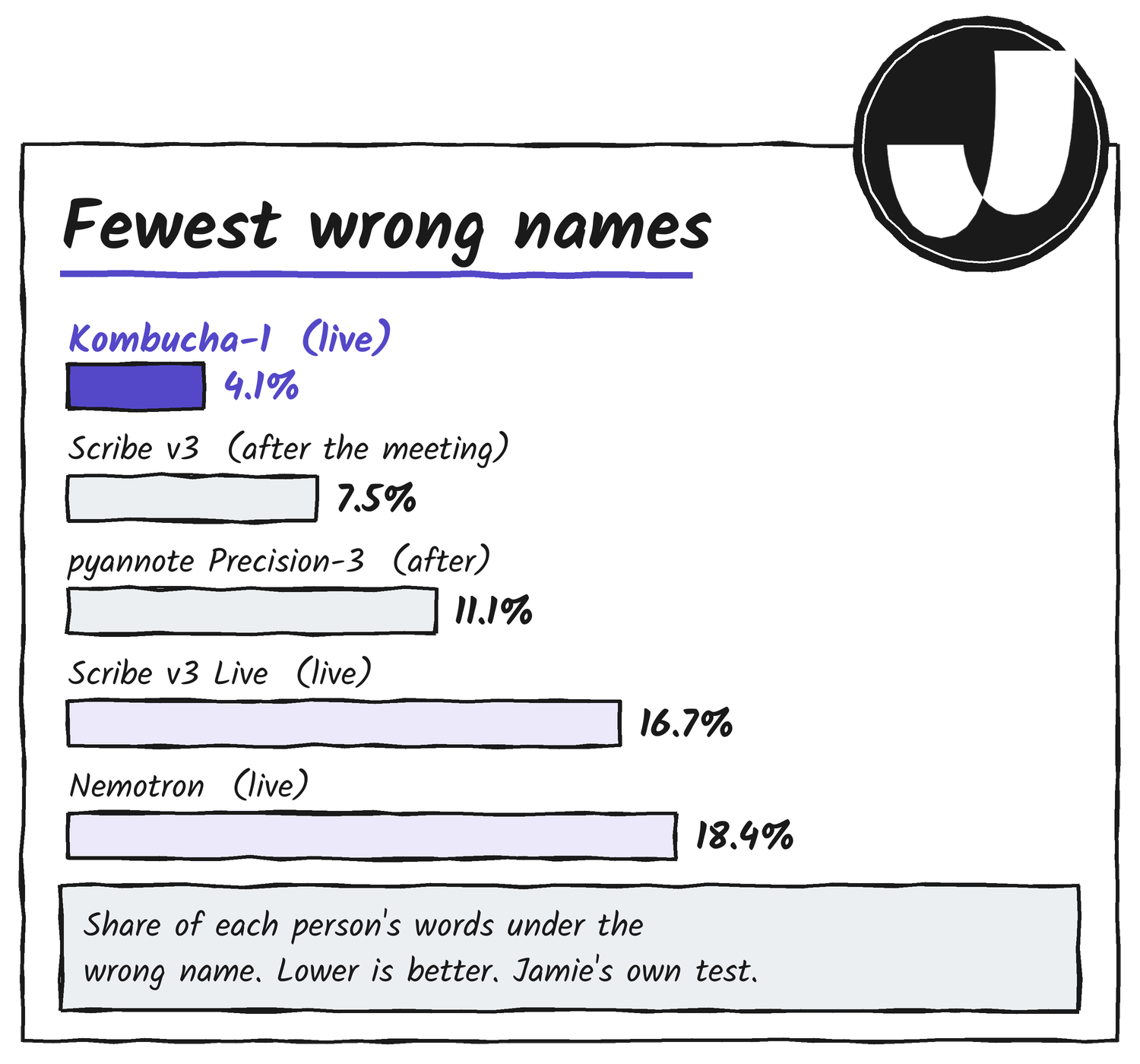
The lead holds across Jamie’s three groups. On its internal team meetings Kombucha-1 scores 4.7% against 7.8% for the next model, on earnings calls 4.9% against 6.6%, and in two-person meetings 3.1%, still the best Jamie measured. With three or more speakers it scores 4.8%, and Jamie says every other streaming model scores at least 23.8%.
On speed, Jamie says Kombucha-1’s labels are final after a median of 8.0 seconds, against 14.4 seconds for Scribe v3 Live and 16.7 seconds for Nemotron’s most accurate configuration. The fastest streaming models decide within a second, Jamie says, and pay for it in accuracy. Its post says no model it tested is more accurate at any delay, offline models included.
Why the speaker count decides it
The main issue we saw with diarization models is the incorrect number of speakers. When a model loses a speaker, everything that person said appears under someone else’s name.
Egor Spirin, on X, 24 November 2026
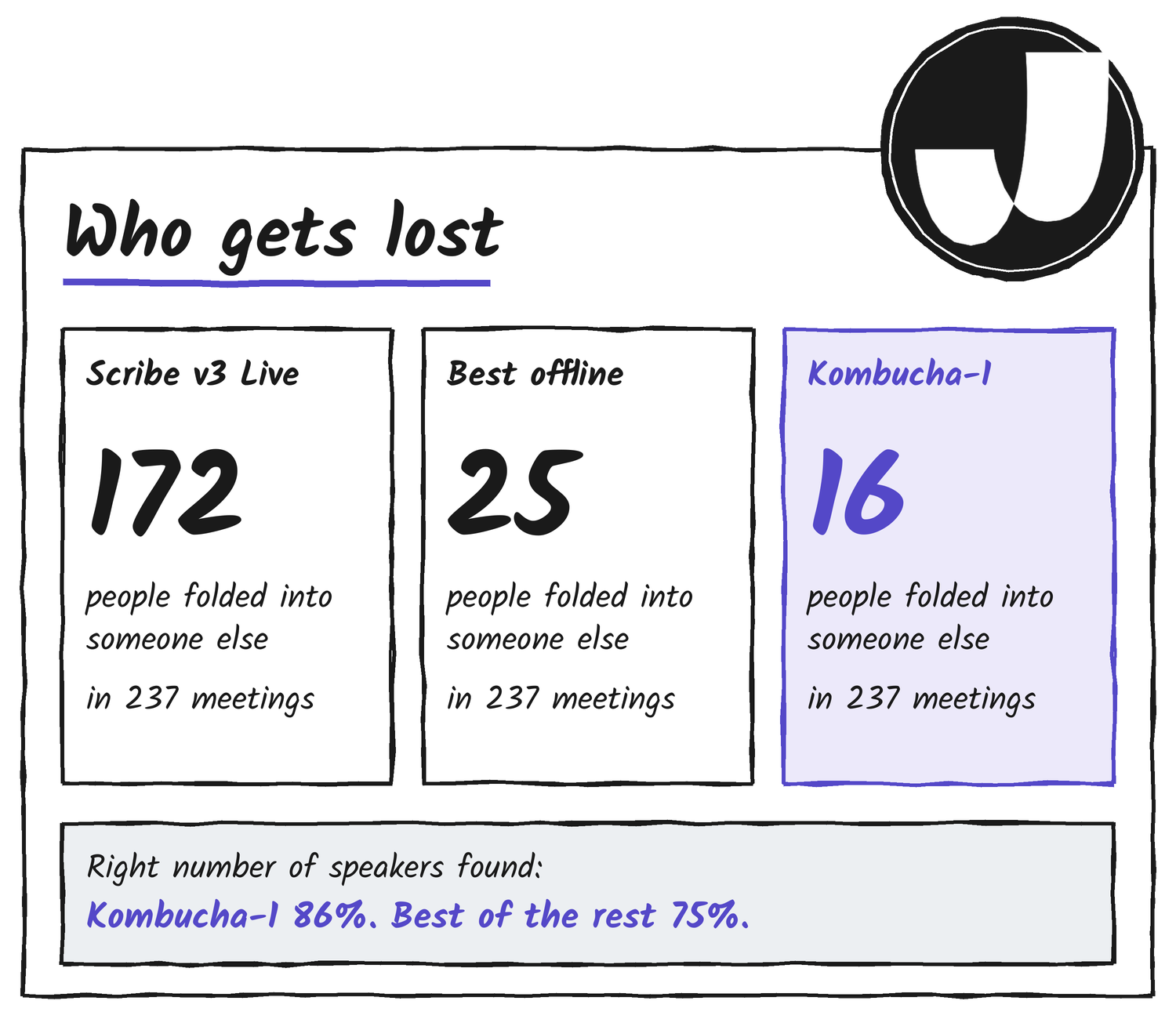
A model can get the count wrong two ways. It can lose a speaker by folding a participant into someone else, or split one person into two or more invented speakers. Jamie says the two errors pull against each other: a model that is careful about opening new speakers loses people, and one that opens them freely splits people.
Across the 237 meetings, Scribe v3 Live lost 172 people, nearly three for every four meetings. The best offline model lost 25 and Kombucha-1 lost 16, about one in every 15 meetings. Kombucha-1 found exactly the right number of speakers in 86% of meetings, and Jamie says no other model, streaming or offline, got above 75%.
Jamie ties the problem to meeting size. Its post charts its own meetings by attendance: 27.1% have two people, 31.2% have three or four, 21.6% have five to seven, and 20.1% have eight or more. Several rivals cap the number of speakers they can separate, and a model with a cap has to merge people in any meeting above it. Jamie says Kombucha-1 has no cap and that it runs on Jamie’s daily company standup, with more than 30 people on the call.
| Model | Labels | Speaker limit | Source |
|---|---|---|---|
| Kombucha-1 | As the meeting runs | None stated | Jamie |
| pyannote Live-1 | As the audio streams | 8 | pyannote docs |
| NVIDIA Nemotron 3 Diarization | Streaming or offline | 8 | NVIDIA, Hugging Face |
| AssemblyAI streaming | As the audio streams | max_speakers from 1 to 10 | AssemblyAI |
| ElevenLabs Scribe v3 | After the recording | 32 | ElevenLabs docs |
How the rest of the market describes itself
ElevenLabs, NVIDIA and pyannote each published a benchmark this month that puts their own model first. ElevenLabs reported on 10 November that Scribe v3 Live has a 3.1% diarization error rate on the English part of its own 16-language dataset, against 5.9% to 7.3% for other realtime models, and launched Scribe v3 and Scribe v3 Live as its most accurate speech-to-text models. Jamie puts the same Scribe v3 Live at 16.7% on its own measure.
NVIDIA’s Nemotron 3 Diarization paper, posted on 9 November, claims a new state of the art on DIHARD III and CALLHOME in diarization error rate. On 20 November, pyannote published a streaming benchmark on DIHARD III saying its Live-1 model records the lowest error rate in all 11 English domains against Deepgram, AssemblyAI and Speechmatics. Each uses a different metric, dataset or scoring rule, so none of the figures line up with Jamie’s.
On price, pyannote lists Live-1 at €0.198 an hour on its developer plan and €0.170 on Starter, according to its changelog. Fora Soft’s pricing roundup puts AssemblyAI’s streaming diarization at an extra US$0.12 an hour. Kombucha-1’s US$0.04 is below both, and new accounts get US$200 in credit, which Jamie says covers 5,000 hours of audio.
What the benchmark doesn’t show
Jamie wrote the test, chose the metric and ran every model on it, and the post names no outside auditor. Jamie’s own internal meetings make up 112 of the 237, 47% of the set. They’re the same kind of audio Kombucha-1 trained on, though not the same meetings.
Jamie picked the 81 public meetings for having under 3% overlapping speech, and Kombucha-1 doesn’t support overlap, so the public set avoids the case the model can’t handle. Kombucha-1’s results also come from the setup Jamie runs in production, alongside a streaming transcript, and the post doesn’t publish a diarization error rate for any model.
The API is open now at platform.meetjamie.ai, with a playground that streams a microphone or audio file and stops each session after five minutes.
Sources
- Jamie, Introducing Kombucha-1, 16 November 2026
- Jamie Platform quickstart and platform page
- Egor Spirin’s thread on X, 24 November 2026
- ElevenLabs, Introducing Scribe v3 and v3 Live, 10 November 2026
- NVIDIA Nemotron 3 Diarization and its paper
- pyannoteAI changelog, models page and streaming benchmark
- Fora Soft, Speaker Diarization API comparison
Discover more from Sulat AI & Tech News
Subscribe to get the latest posts sent to your email.