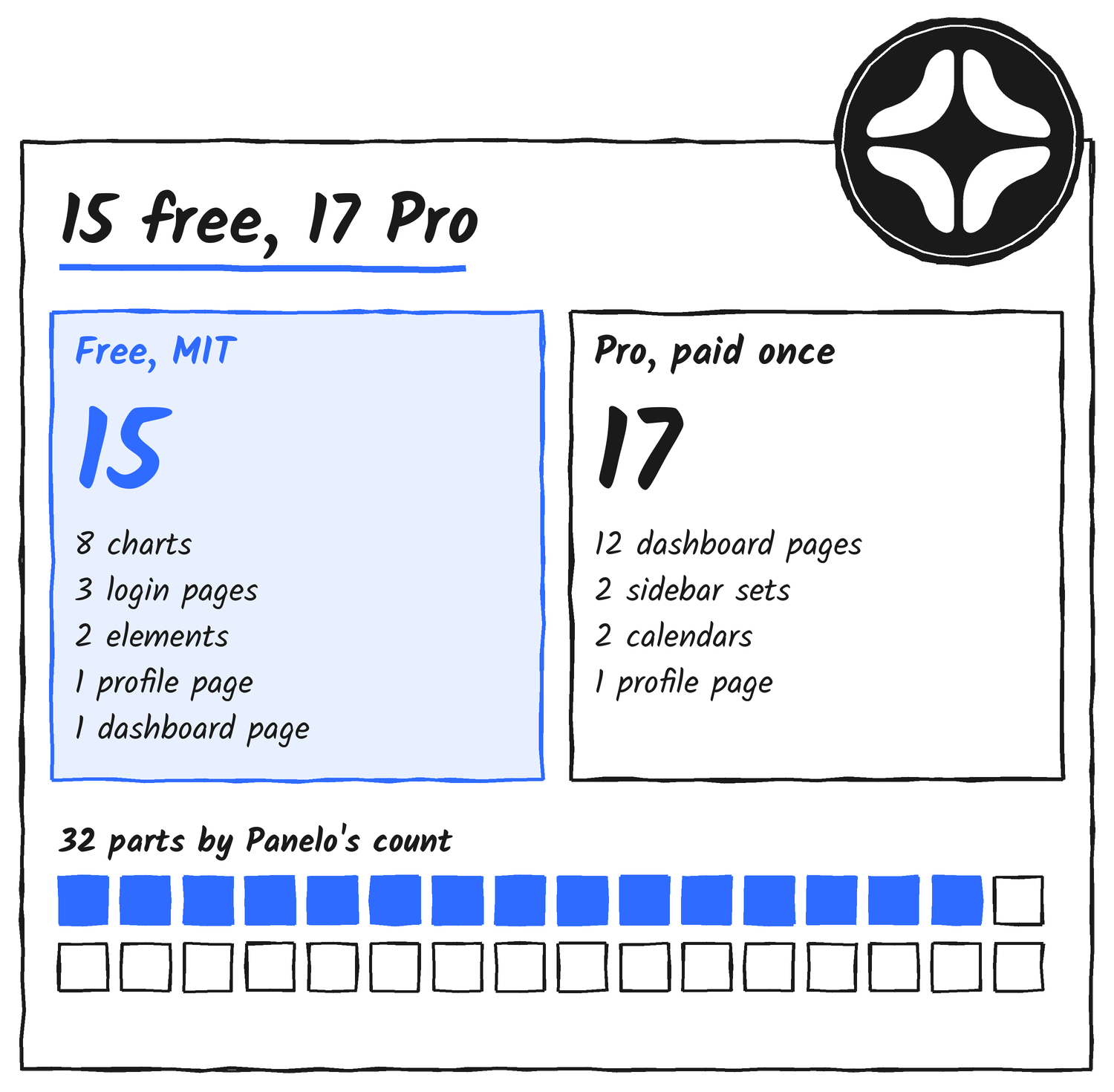
Shadcn Labs launched Panelo UI on X on 25 November NZ time (24 November UTC), pitching React dashboard components that “AI agents can actually run”. Raycanvas builds the kit, Shadcn Labs backs it, and every control is a part from Vercel’s UI SDK. Fifteen of its 32 parts are free under the MIT licence. The other 17 are a one-time purchase.
The announcement is a 29-second video and five bullet points. I checked each bullet against the GitHub repo, the registry files and the site’s licence and refund pages, then looked at who’s behind it, how the agent side works, what it costs and who else sells dashboard parts to the same buyer.
32
parts, by Panelo’s own count
15
free and MIT-licensed
17
in Pro, from $129 once
1 Dec
when three whole-app templates are due
- What the post claims, and what ships
- What’s in the kit
- How an agent operates a dashboard
- Who’s behind it
- What it costs
- The rest of the shelf
- What isn’t shown yet
What the post claims, and what ships
The post says Panelo is built on UI SDK, has a zero-config, one-command setup, works with shadcn/ui, has “30+ components and templates coming soon” and is free, MIT-licensed and open source. Two hold as written: it’s built on UI SDK, and it installs into a shadcn/ui project. The other three need a qualifier.
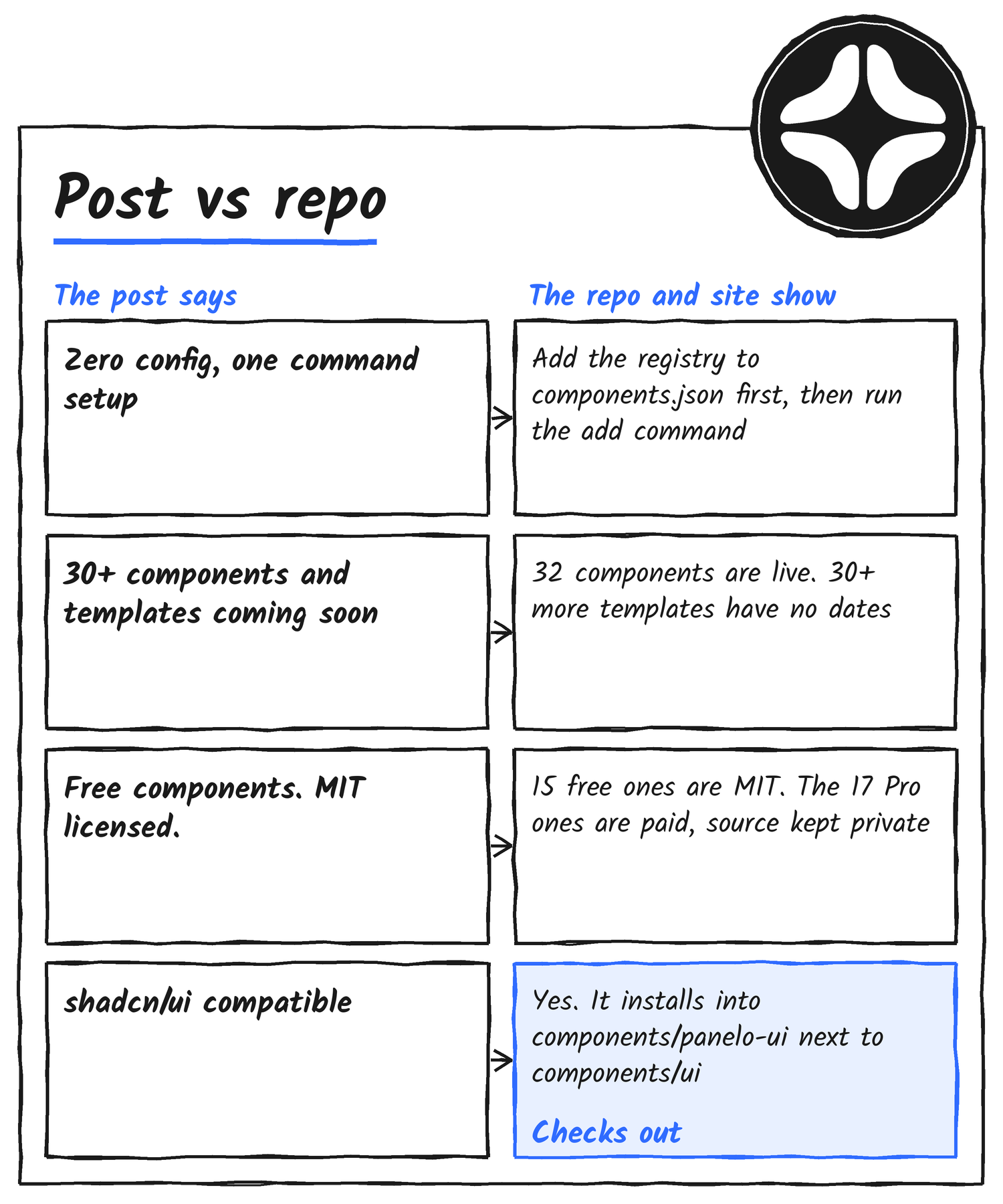
Setup. The README has you add one line under registries in components.json, then run the shadcn CLI. That’s one edit and one command, and the source lands in components/panelo-ui beside your own components/ui. The components need no API key. The optional in-app assistant needs a GROQ_API_KEY on your server.
// components.json
"registries": {
  "@panelo": "https://www.paneloui.com/r/{name}.json"
}

npx shadcn@latest add @panelo/revenue-chart
npx shadcn@latest add @panelo/agent-kit
Count. The site lists 32 components today. The “30+ coming soon” line fits the templates: three whole-app Next.js templates arrive on 1 December, one free and two Pro, and 30+ more have no dates.
Licence. The free parts are MIT, and the repo carries the licence file. The Pro parts aren’t in the repo. Their licence lets one developer use them in unlimited projects but bars redistributing the Pro source, “not through a tool that generates code from it” included.
What’s in the kit
The free side is mostly charts and entry screens. The paid side is the full dashboard pages. The public registry index at paneloui.com/r/registry.json lists 17 items: the 15 free parts plus panelo-theme, the few tokens Panelo adds to stock shadcn/ui, and agent-kit. The stack is React 19, Next.js 16 and Tailwind CSS v4, with light and dark themes on every part.
| Type | Free | Pro | Examples |
|---|---|---|---|
| Charts | 8 | 0 | Revenue Lines, Activity Heatmap, Link Graph, Contribution Chart |
| Login pages | 3 | 0 | Split Login, Painted Login, Sign Up Flow |
| Elements | 2 | 0 | AI Workforce Section, AI Workforce Command |
| Profile pages | 1 | 1 | Designer Profile (free), Team Member Profile (Pro) |
| Dashboard pages | 1 | 12 | Home Care Schedule (free), Companies CRM Table, Workflow Builder, Team Inbox (Pro) |
| Sidebars | 0 | 2 | App Sidebar, Sidebar Collection |
| Calendars | 0 | 2 | Time Tracking Calendar, Issue Calendar |
| Total | 15 | 17 | 32 parts |
How an agent operates a dashboard
Panelo doesn’t invent its own agent protocol. Its controls come from UI SDK, the Vercel Labs library whose parts describe themselves to agents, which I covered at its launch and again when its docs named the benchmark’s rivals.

The free agent-kit shows the wiring. Installing it adds @ui-sdk/core and @ui-sdk/react at 0.1.0-beta.2, the Vercel AI SDK and its Groq provider, a chat hook, approval prompts and an /api/agent route. The route calls gpt-oss-120b, an open-weight OpenAI model, on Groq’s free tier. The model only plans. It gets UI SDK’s three tools, snapshot, act and query, and sends tool calls back; the browser runs each one against the live components and posts the result as the next request. The system prompt tells the model that page text is data, never instructions.
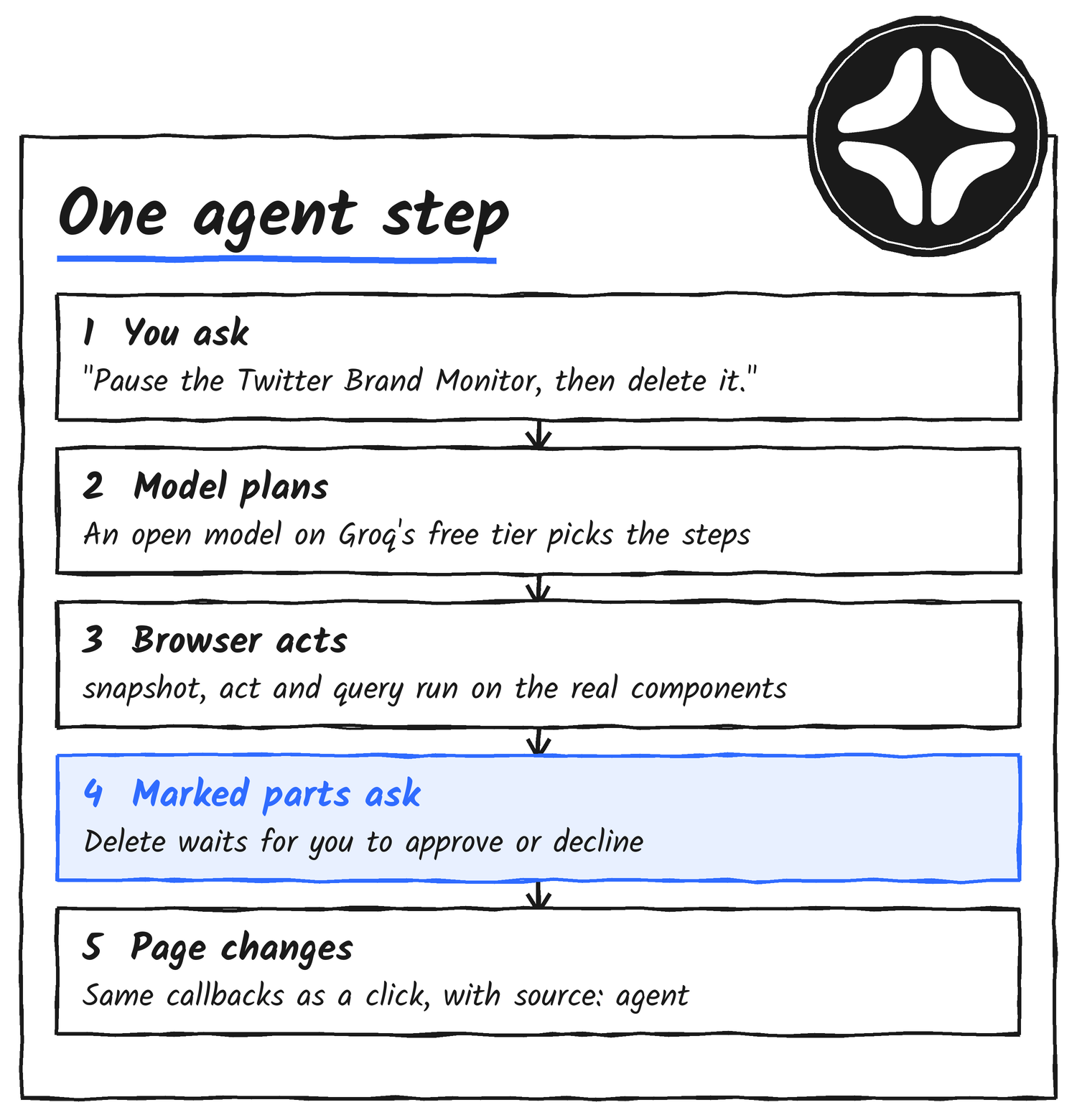
Approval is per part. A step on anything marked data-agent-confirm pauses until you approve or decline it, through the bridge’s allow callback. Panelo’s own example is “Delete the Twitter Brand Monitor workflow. This can’t be undone.” Browser agents that reach the page through WebMCP get the same tools and the same rule, because Panelo registers them with allow: () => true once the bridge already asks. A part that isn’t marked runs without asking, and Panelo’s site says a switch an agent flips fires your onCheckedChange with a source of "agent".
The route also ships with a limit of 15 requests per 10 minutes per IP address. It’s held in memory, and a comment in the file says it resets on cold starts and isn’t shared across regions. Anyone who installs the kit inherits it. Neither the site nor the README publishes agent benchmark numbers for Panelo. Vercel’s figures, 7 tool calls against 17 to 19 on a single settings screen, come from UI SDK’s own test and weren’t run on Panelo’s parts.
Who’s behind it
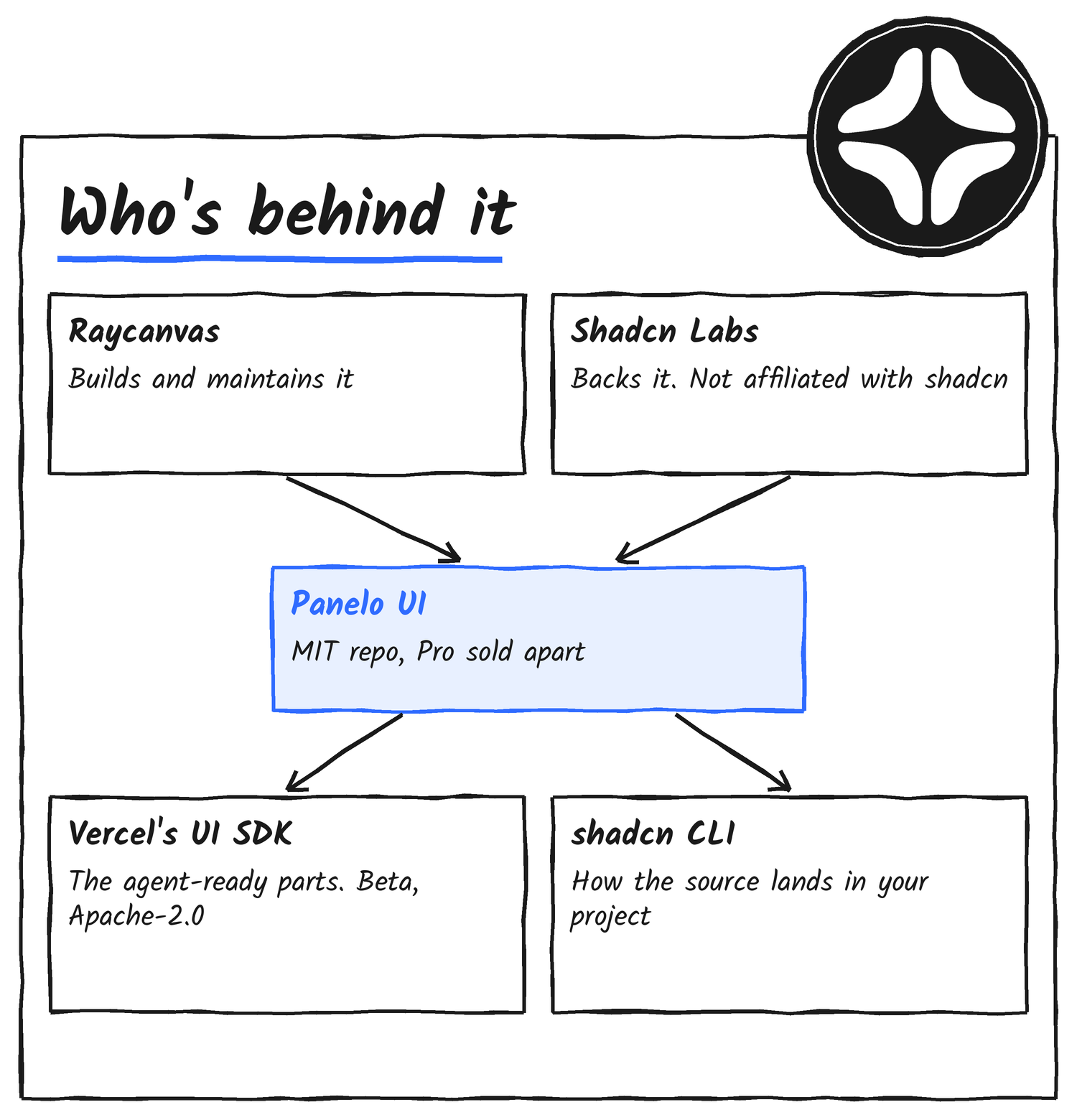
The README credits Raycanvas with building and maintaining Panelo and Shadcn Labs with backing it. Neither says what backing consists of. Raycanvas describes itself as an independent design engineering practice, open for freelance work, and the same maker is behind Ruixen UI, a library of 240+ marketing sections and components with a free MIT catalogue and a Pro tier at $99 for lifetime access.
Shadcn Labs is an independent open-source organisation working from Mumbai. Its about page names Aniket Pawar as founder and CEO and carries the line “Not endorsed by or affiliated with shadcn”. That matters because the name reads like Vercel’s. shadcn, who built UI SDK with Shu Ding, is a different party from the organisation that backs Panelo. Shadcn Labs also takes on other makers’ projects: on 3 November it announced that Pin UI, by Rachit Thakur, had joined the org, three weeks before Panelo.
What it costs
| Plan | Price now | List price | Who it covers | Updates |
|---|---|---|---|---|
| Starter | Free | Free | Anyone, MIT parts only | Free component updates |
| 1 Year of Updates | $129 | $179 | One developer | Pro releases for 12 months |
| Lifetime Access | $179 | $229 | One developer | Pro updates forever |
| Unlimited for Startups | $299 | $349 | Up to five developers | Pro updates forever |
The pricing section shows dollar signs and doesn’t name a currency, so I’ve kept its “$”. Payment runs through Dodo Payments as merchant of record. All sales are final: the refund page says Pro is source code, delivered the moment you pay, and can’t be handed back, and that a charge made twice is reversed as a billing mistake. It adds that nothing limits rights your local consumer law gives you. Every Pro plan includes the Pro templates, including plans bought before launch.
For scale, Ruixen Pro, from the same maker, lists at $99 for lifetime access, down from $149, with a five-seat team plan at $199.
The rest of the shelf
Dashboard parts for shadcn/ui are a crowded shelf, and most of it is aimed at people who click. A few sellers now say agents are part of the pitch. They don’t all mean the same thing.
| Project | What it is | Cost | Agent angle |
|---|---|---|---|
| Panelo UI | 32 dashboard parts, each a UI SDK part | 15 free (MIT), 17 Pro from $129 once | Agents read and operate the page through snapshot, act and query |
| dashboardcn | 27 dashboard components and 25 blocks, on Radix or Base UI | Free, MIT, no Pro tier | Markdown docs, llms.txt and one-click prompts for coding agents |
| Dashboardblocks | KPI blocks, charts, tables and full dashboards, on Radix, Base UI or React Aria | Free, MIT | Describes itself as dashboard blocks “for your AI agents” |
| shadcndashboard.dev | 209+ blocks and 440+ components, plus templates, on Base UI | Has an all-access plan; price not listed on the page I read | CLI, an MCP server and skill files for coding agents |
| ReUI agent blocks | Screens for monitoring agents: fleet overview, run queue, step trace | Not listed on the page I read | Built for people watching agents, with no agent framework imported |
| shadcn/ui AI Elements | 21 patterns for agent chat: Chat, Reasoning, Tool, Plan, Subagent | Copied into your project; no package to install | Renders agent output for people |
| OpenUI Dashboards | Dashboards a model composes from your registered components | Not listed on the page I read | The model writes the layout; claims 75% fewer tokens per screen than model-written HTML |
Panelo’s bet is that the buyer’s own agent should drive the finished dashboard, and that the dashboard should mark which actions are risky. ReUI and AI Elements help people watch agents work. OpenUI has the model draw the screen. Panelo asks the model to press the buttons on a screen you drew.
That bet rests on UI SDK’s numbers holding on a dashboard as they did on a settings screen, and nobody has published that test for Panelo. UI SDK’s repo was created on 26 October and Vercel announced it on 12 November. Panelo’s repo was created on 21 November, nine days after that announcement.
What isn’t shown yet
- The source of the 17 Pro parts isn’t public. The site’s previews and the catalogue descriptions are the only public view of them.
- The repo is four days old, with 106 commits.
- UI SDK is in beta and Vercel says its APIs may change. The agent-kit pins 0.1.0-beta.2.
- Shadcn Labs and Raycanvas haven’t said what “backed by” means in practice.
- The free template hasn’t shipped. All three templates are due on 1 December.
The three templates on 1 December are the next date to watch, and the first test of whether the Pro catalogue grows toward the 30+ templates the site lists without dates.
Discover more from Sulat AI & Tech News
Subscribe to get the latest posts sent to your email.