
Supabase has launched a Knowledge Base at supabase.com/kb, a separate home for migration guides, troubleshooting articles, FAQs, tutorials and community guides, and says every page is built to be read by coding agents as well as people. Supabase’s launch post, dated 25 November 2026, says the docs stay focused on how the product works, while the kb holds “applied knowledge”: how Supabase fits a particular use case or setup.
Supabase announced it on X on 25 November, NZ time, with a link to the post. The kb’s source sits in the open-source supabase/supabase repository, and the pages are already live.
- What’s in it
- Docs or kb
- Built for agents
- Supabase writes the comparisons
- Why now, and who else is doing it
- Where it meets the vibe-coded apps
- What the launch doesn’t say
What’s in it
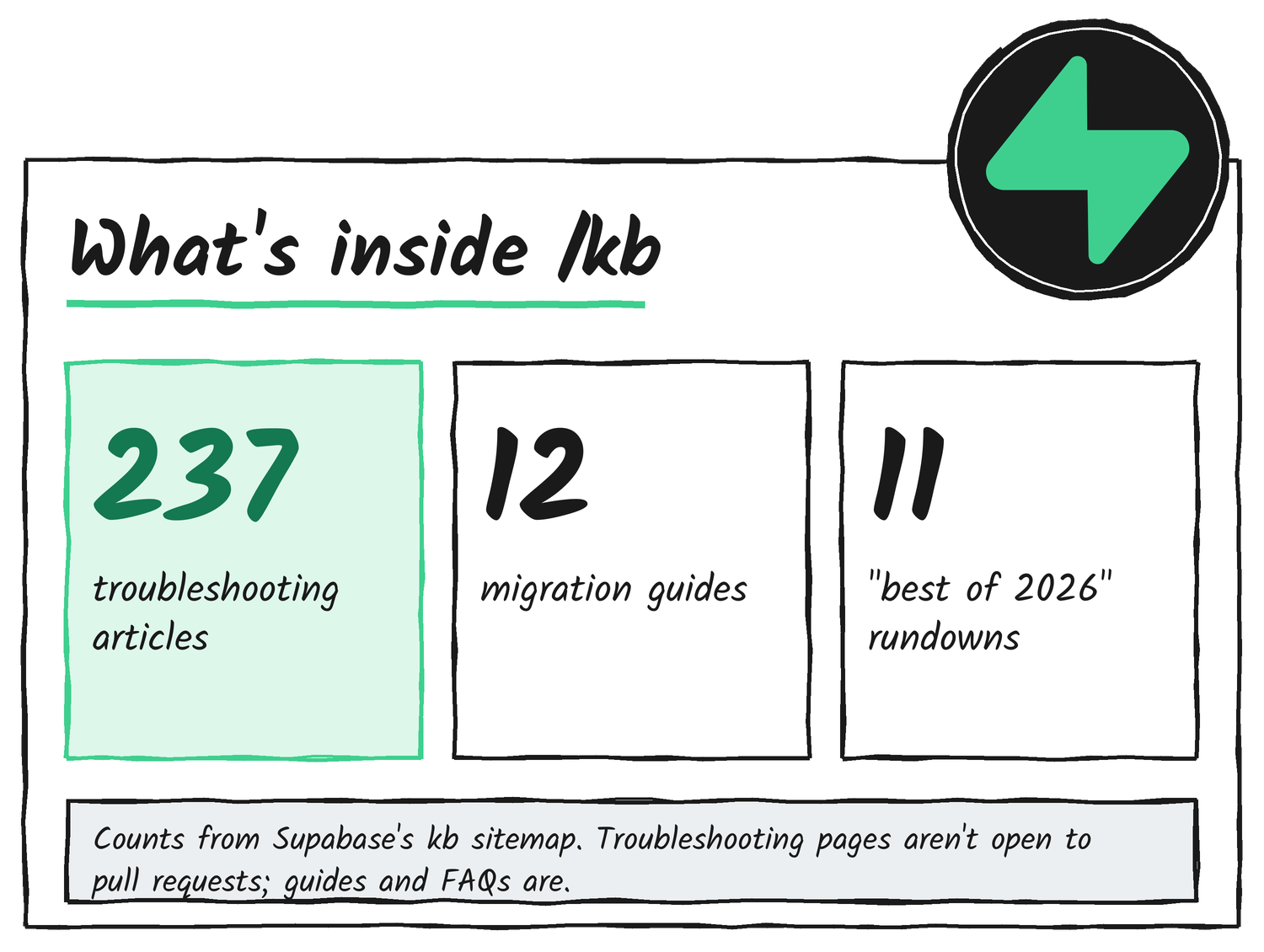
Supabase pitches the kb at two groups: people comparing it with other tools or moving an app over from another stack, and people already building who hit something the docs don’t cover. The kb’s sitemap, which is published as plain Markdown, lists 237 troubleshooting articles and 12 migration guides. A further 11 “best providers in 2026” rundowns sit under their own topic.
| Content | What it covers | Open to pull requests |
|---|---|---|
| Migration guides | Moves from Amazon RDS, Auth0, Firebase (Auth, Firestore and Storage), Heroku, MSSQL, MySQL, Neon, Postgres, Render and Vercel Postgres | Yes |
| Troubleshooting | Specific errors and problems, often written by Supabase’s support team | No; fetched from a private repo at build time |
| FAQs | Short answers, such as whether Firebase Auth works with Supabase | Yes |
| Tutorials | Guides to one build, such as Better Auth with Supabase declarative schemas | Yes |
| Community guides | Links to write-ups by community members; the kb hosts none of them | Yes, as a link |
The migration guides are step-by-step. The Neon one is a pg_dump and psql walkthrough, and it warns that a database over 6 GB should move to at least a Large compute add-on first. It also calls Supabase “one of the best free alternatives to Neon”.
Docs or kb
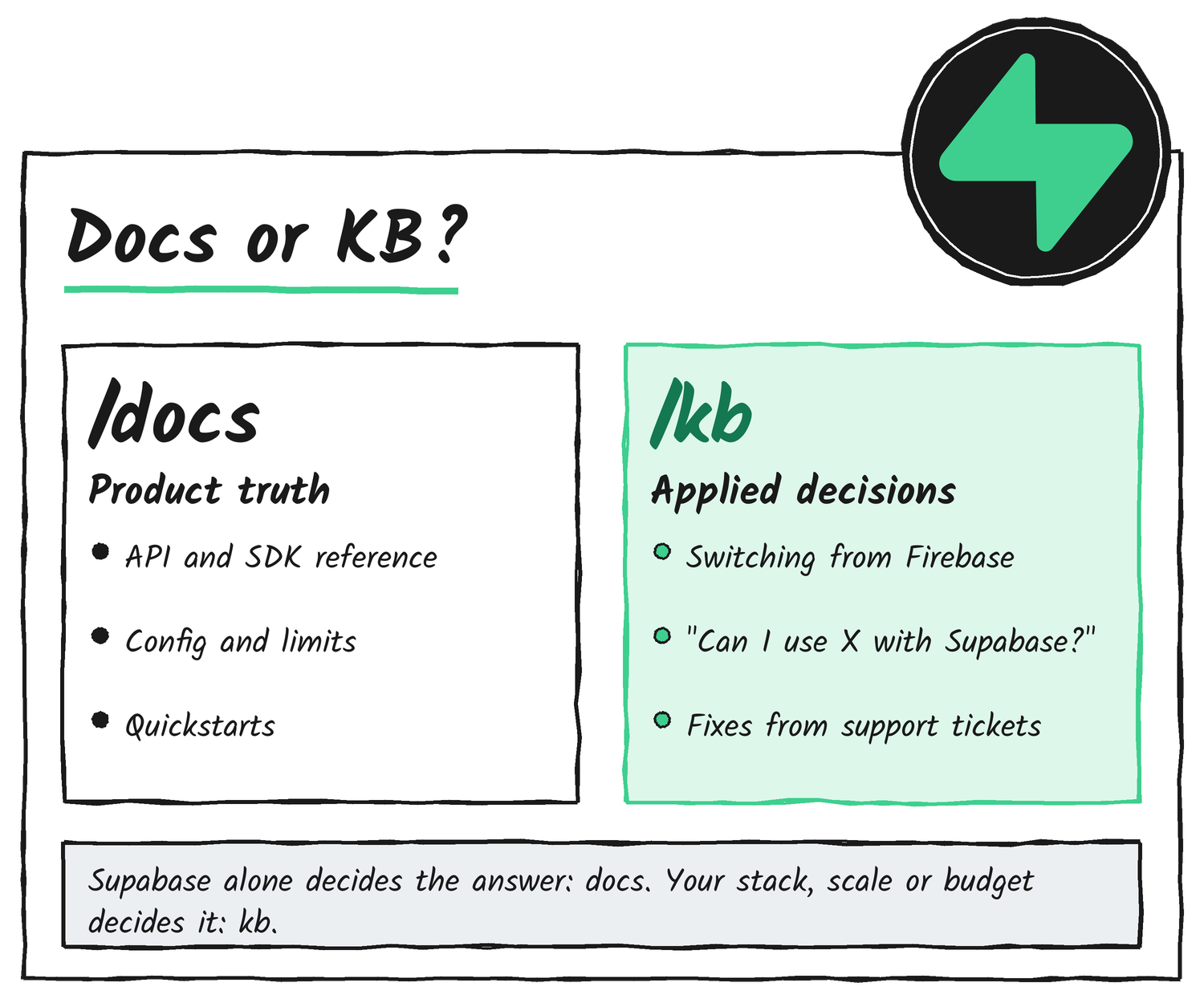
The kb README draws the line. The docs own “product truth”: API and SDK reference, configuration, supported behaviour and limits, quickstarts. The kb owns “applied decisions and applied experience”, meaning any answer that depends on scale, budget, the existing stack or the alternatives. The two link to each other for the product facts.
Built for agents
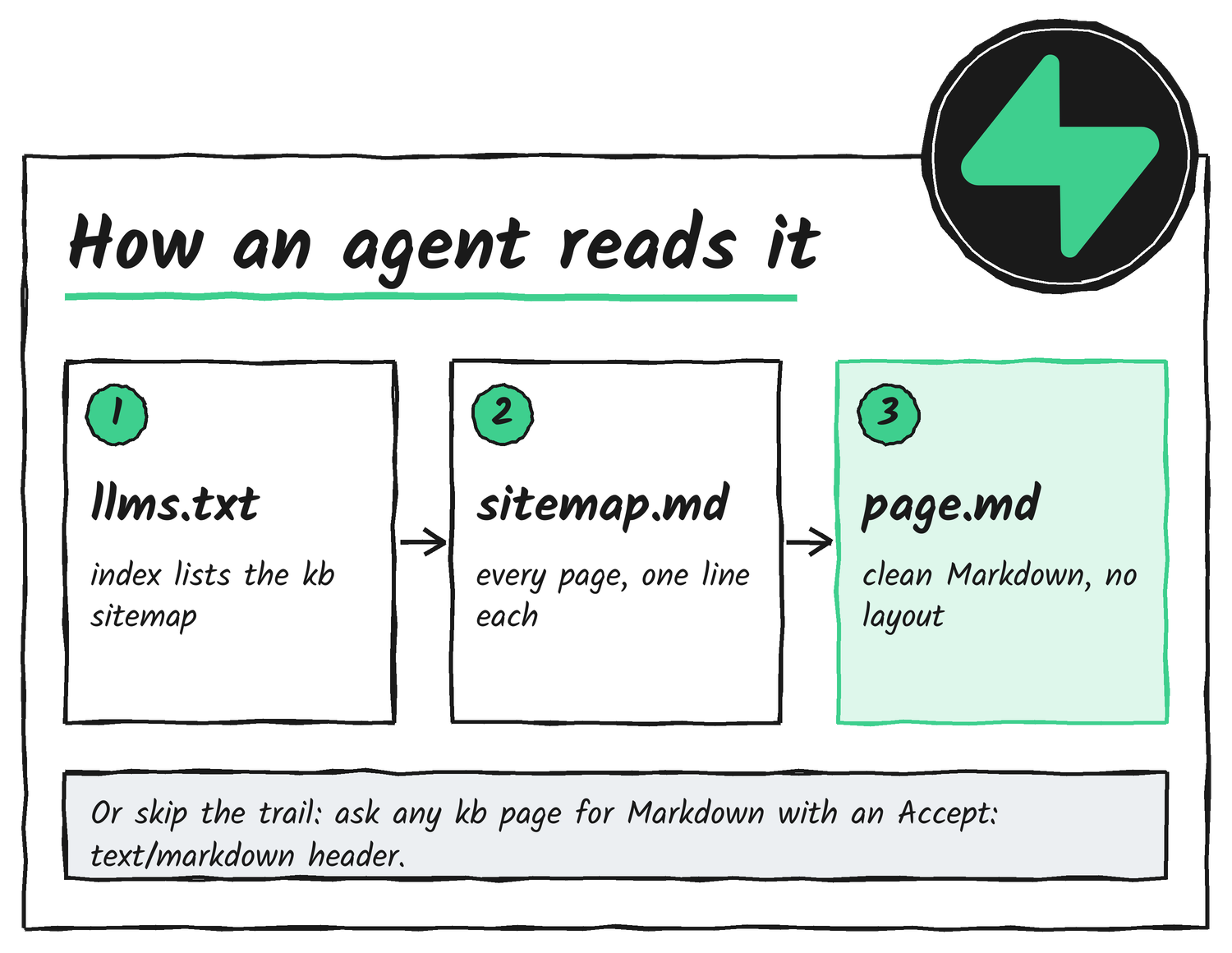
Supabase’s post gives the reason in one line: “more and more of you ask an AI assistant first, and more coding agents pick tools on their own.” Every kb page has a Markdown version, and a request that sends an Accept: text/markdown header gets the Markdown directly, according to the README. The kb is listed in Supabase’s llms.txt, which links its sitemap, and Supabase says the site is open to search engines and AI crawlers, “including the ones that train large language models”.
One FAQ answers the question an agent is likely to ask first: can an AI coding agent create and manage a Supabase database? Yes, through the Supabase MCP server. The page says you can scope the server to one project with project_ref, turn on read-only mode with read_only=true, and ask for manual approval of costs and destructive SQL.
Supabase writes the comparisons
The rundowns are published by Supabase, on supabase.com, and in the four checked here Supabase is the first entry. The mobile-backend page calls it “the best choice” if you want data, users, files and server-side logic in one open-source Postgres platform, then points to Firebase for a NoSQL database in Google’s ecosystem, Appwrite for a self-hostable backend and AWS Amplify for teams already on AWS. The authentication page covers Clerk, Auth0, Firebase Auth, WorkOS and Better Auth. The vector database page covers Pinecone, Qdrant, Weaviate and Milvus, and the queue page covers Amazon SQS, Cloudflare Queues, Upstash QStash and CloudAMQP.
Each page ends with a “when to choose” list that gives the rival a use case, such as SQS for teams already on AWS. A separate Comparison topic, described as how Supabase compares to other databases and platforms, listed no guides when checked. Appwrite, one of the rivals named, is itself rewriting its server from PHP to Rust.
Why now, and who else is doing it
Nearly 10M
developers build on Supabase, it said in June
60%+
of new databases launched by an AI tool, per Supabase
1M+
databases launched a week, Supabase said in October
Those figures are Supabase’s own, from its 4 June Series F post and its 2 October Turso post. The Series F was US$500 million at a US$10 billion pre-money valuation, led by GIC, and on 2 October Supabase said it is acquiring Turso, which builds a Rust rewrite of SQLite, to give agents their own databases. The June post says growth has accelerated since January “as Claude Code and Codex expand the number of people who can build”. The kb’s agent-readable pages are pitched at that same crowd.
Supabase isn’t the first database platform to publish for agents. Neon and Vercel, whose database products both appear in Supabase’s migration list, have each written up their own approach.
| Company | Markdown for agents | Discovery |
|---|---|---|
| Supabase | A Markdown version of every kb page; Accept: text/markdown returns it | llms.txt links the kb sitemap |
| Vercel | Append .md to a Knowledge Base guide URL | llms.txt, a kb sitemap.md and a vercel kb search command |
| Neon | About 1,400 Markdown files converted from its MDX docs | llms.txt rebuilt with sub-indexes |
Neon’s post also scanned more than 250 documentation sites. It found 93% had an llms.txt, 53% served Markdown by appending .md to a URL, and 41% honoured Accept: text/markdown. By that count, the kb matches what most documentation sites already do.
Where it meets the vibe-coded apps
The kb also has pages for people who reach Supabase through app builders. In the Crissy Field research covered here earlier, 34,545 of 159,041 Lovable projects used Supabase, and 24,664 of those sent database records to the browser with no login. Lovable called the problem industry-wide.
Those pages include “RLS Simplified” and “RLS Performance and Best Practices” on row-level security, the database rules that decide who can read which rows, plus “Can’t Access Supabase Project When Using Lovable Cloud”, “Identifying Lovable backend: Lovable Cloud or Supabase” and a fix for a project provisioned through Bolt that doesn’t show in the dashboard. The launch post doesn’t mention Lovable, Bolt or security.
What the launch doesn’t say
Supabase hasn’t published traffic, page counts or how many agent fetches the kb gets. Its post says the kb is “open to community contributions”, but the README says troubleshooting articles, the largest section, aren’t open to direct pull requests; readers can comment on an article’s GitHub Discussion or open an issue.
Sources
- Supabase, Introducing Supabase Knowledge Base, 25 November 2026
- Supabase Knowledge Base README, supabase.com/kb and its sitemap
- Supabase llms.txt
- Supabase Series F, 4 June 2026, and Supabase is acquiring Turso, 2 October 2026
- Vercel, Markdown and Agent Discovery
- Neon, Agents grew up, so did our docs, 23 April 2026
Discover more from Sulat AI & Tech News
Subscribe to get the latest posts sent to your email.