
The UK Financial Conduct Authority has told anyone building AI agents that handle money that the existing rules already apply to them. Its new page, Our approach to Agentic AI, went up on 24 November 2026 and speaks to three groups: regulated firms, technology providers and social media platforms.
The message to each group is different. Regulated firms keep full responsibility for any agent they build or buy. Technology companies are told to check whether their agents are already doing regulated work. And the FCA says it has the powers to act, and won’t hesitate to use them, where regulated services are offered without authorisation.
What the FCA said
The regulator opens with the state of play: across financial services, firms are “moving from experimentation to deployment of AI agents”, and it’s already talking to companies that want to offer personal agent products to UK consumers. The risk it names is agents moving beyond information into “initiating transactions, moving money, arranging borrowing or making investment decisions, all at speed and scale”. Products like that, it says, “can also blur the boundary between regulated and unregulated activity, and the protections consumers receive in relation to their finances and data.”
For regulated firms
- Responsibility stays with the firm and its senior managers, whether the agent is built in house or supplied by a third party.
- Firms must be able to show they understand the systems they use, how much autonomy those systems have, the risks they create and the controls needed “in real time and in stress situations”.
- The Consumer Duty applies in full: avoid foreseeable harm, give customers the information they need, and support them in pursuing their financial goals.
- When a customer’s own agent contacts the firm, the firm needs an answer to four questions: how it knows it’s dealing with an agent, what consents are in place, what the agent is allowed to do, and how the customer gets help if something goes wrong.
- Firms should weigh the liabilities that come with accepting an agent’s instructions, and whether to accept payments instructed by an agent or from a digital wallet an agent controls.
For technology providers and social platforms
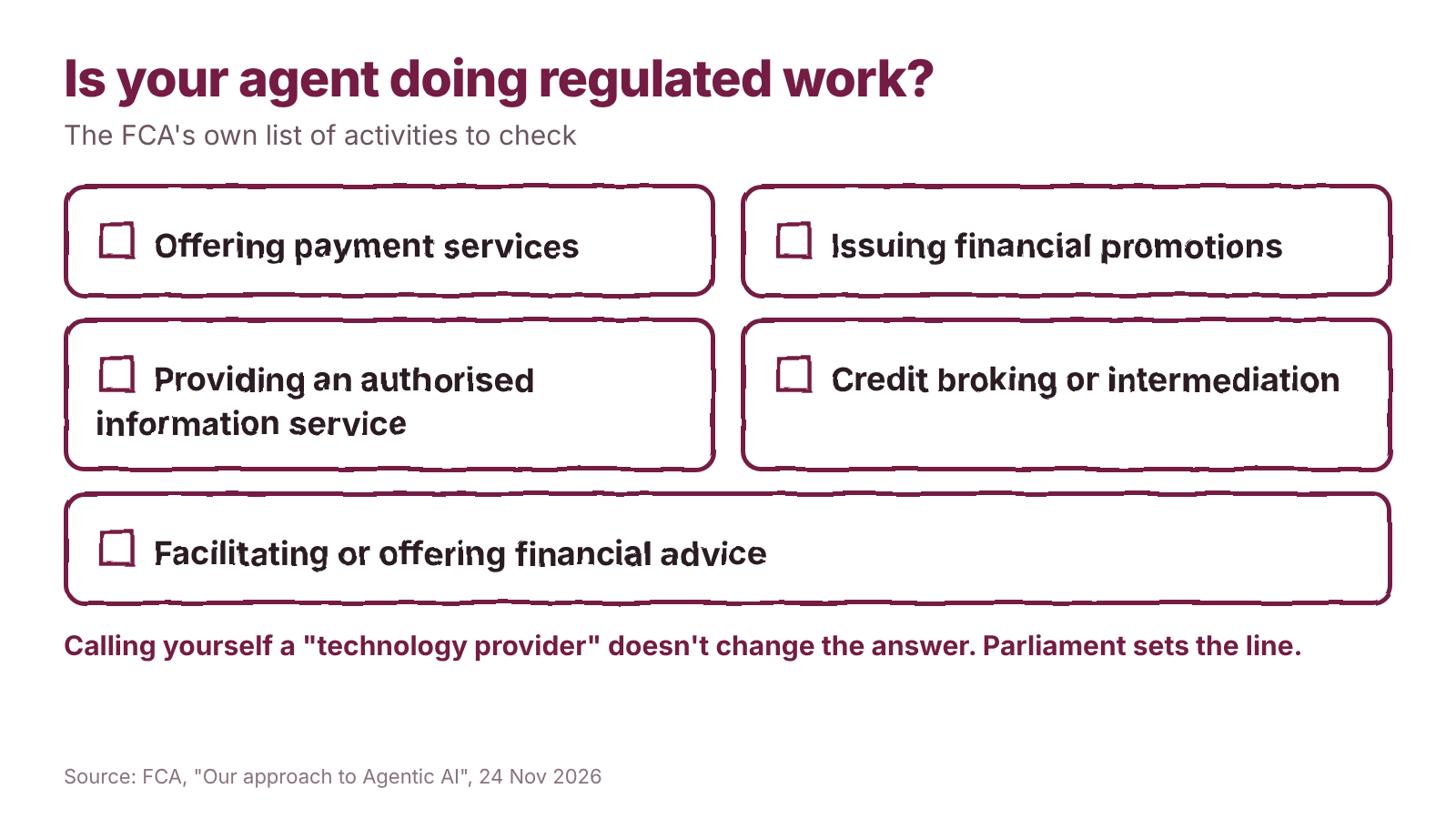
Just because a business describes itself as a technology provider does not mean that they do not need to be authorised by us to provide financial services in the UK.
FCA, Our approach to Agentic AI
That’s the page’s central line for anyone outside the regulated sector. The FCA adds that “this boundary is set by Parliament”, and lists the activities a company should test itself against: offering payment services, issuing financial promotions, providing an authorised information service, credit broking or intermediation, and facilitating or offering financial advice. It also flags that personalised context, which some large language models rely on, can make those questions harder to answer.
Model makers get a separate expectation. The FCA wants AI providers to help people understand the limits of the financial information and advice their models produce, using “clear, proportionate and consistent disclaimers” backed by “effective operational safeguards”. It also says it will keep assessing what agentic products do as they develop, not only at launch.
What the page doesn’t do
It names no company, sets no deadline and announces no enforcement action. It adds nothing to the FCA Handbook. The regulator’s wider AI page states plainly that it does “not plan to introduce extra regulations for AI” and will rely on existing frameworks, chiefly the Consumer Duty and the Senior Managers and Certification Regime.
What it adds is a route in. Companies can use the FCA’s innovation services and its pre-application support service, and the FCA intends to launch a dedicated Agentic Policy Sprint through its AI Lab for firms, policymakers and tech providers. Expressions of interest go to [email protected]. The FCA says it will post regular updates on the same page, and it has given no date for the sprint.
How it got here: ten months of build-up
The page is the latest step in a run of UK publications, and it reads as the point where the FCA moves from analysis to expectations for firms.
| When | What happened |
|---|---|
| January 2026 | The FCA launches a review into the implications of advanced AI for consumers, retail markets and regulators, led by executive director Sheldon Mills. |
| 15 May | FCA, Bank of England and Treasury publish a joint statement on frontier AI models and cyber resilience. |
| 6 July | The Mills Review is published with seven recommendations, among them securing the regulatory perimeter and enabling “the foundations for agentic finance”. |
| July | The Government’s Financial Services AI Adoption Plan recommends the FCA review the impact of advice-like outputs from general-purpose language models. |
| 19 October | The FCA publishes AI good practice and areas for improvement, including keeping a central inventory of live agents and their owners. |
| 26 October | The Bank of England and FCA publish their fourth AI survey of UK financial services. |
| 30 October | The CMA, FCA, ICO and Ofcom issue a joint statement on personal AI agents. |
| 24 November | The FCA publishes Our approach to Agentic AI. |
The Mills Review is the piece that frames the agent question. The FCA calls it the first review of its kind started by a regulator anywhere. It found that a fifth of UK consumers, about 11 million adults, are likely to use AI that acts on its own within goals they set, based on a survey of more than 5,000 people by Yonder Consulting in April. Those same consumers told the researchers they worry about trust and control.
The 30 October DRCF statement set the tone for the 24 November page. The four regulators wrote that “an AI agent’s autonomy does not diminish the responsibility of organisations that deploy it to comply with applicable law and relevant regulation”, and that where they suspect a breach that risks harm they “will not hesitate to use our powers”. The FCA’s page is the financial-services version of that sentence. On 22 November the FCA also launched its AI Spotlight Observatory, an online catalogue of AI use cases from more than 200 organisations.
Where UK firms are today
The Bank of England and FCA survey, published on 26 October, drew answers from 196 firms. Of those, 105 completed the full questionnaire, and that group supplies the agent figures. Eighty per cent have AI agents deployed and another 14 per cent plan to within 12 months. But 80 per cent describe those agents as decision support, where the agent recommends and a person decides and executes. Only 2 per cent run agents with broad autonomy.
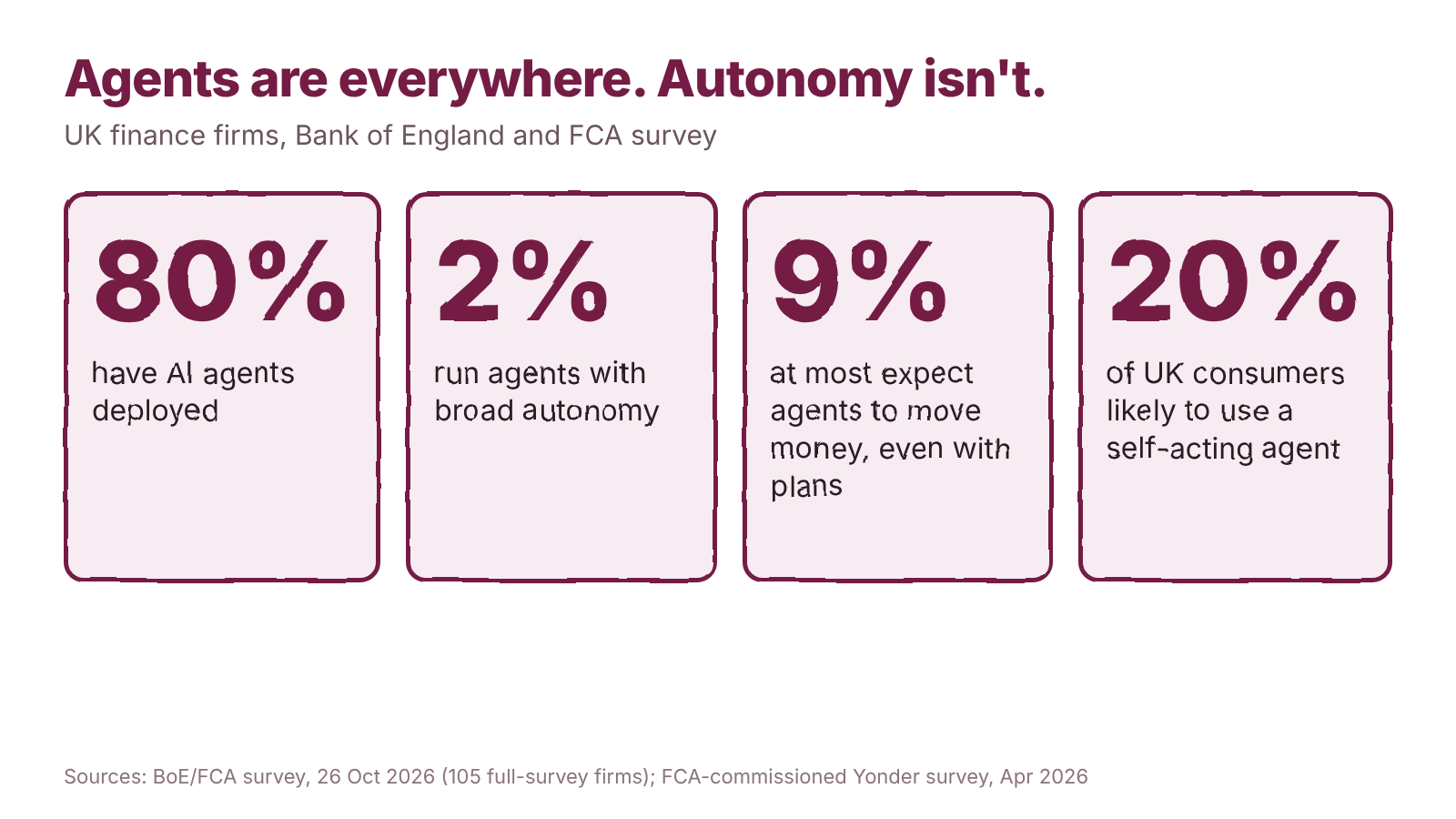
The sensitive tasks are where firms hold back. Even counting plans for the next 12 months, no more than 9 per cent of respondents expect agents to approve or decline customer outcomes, execute trades, initiate or block payments, or change limits and controls. Customer communications are further along: 16 per cent use agents for them now, rising to 34 per cent with planned deployments.
Third parties matter here too, which is why the FCA’s line on vendors carries weight. Third-party systems made up 39 per cent of all reported AI systems and 53 per cent of those firms rated high materiality, up from 35 per cent in 2024. The 24 November page says responsibility for those systems doesn’t move to the supplier.
What other regulators are doing
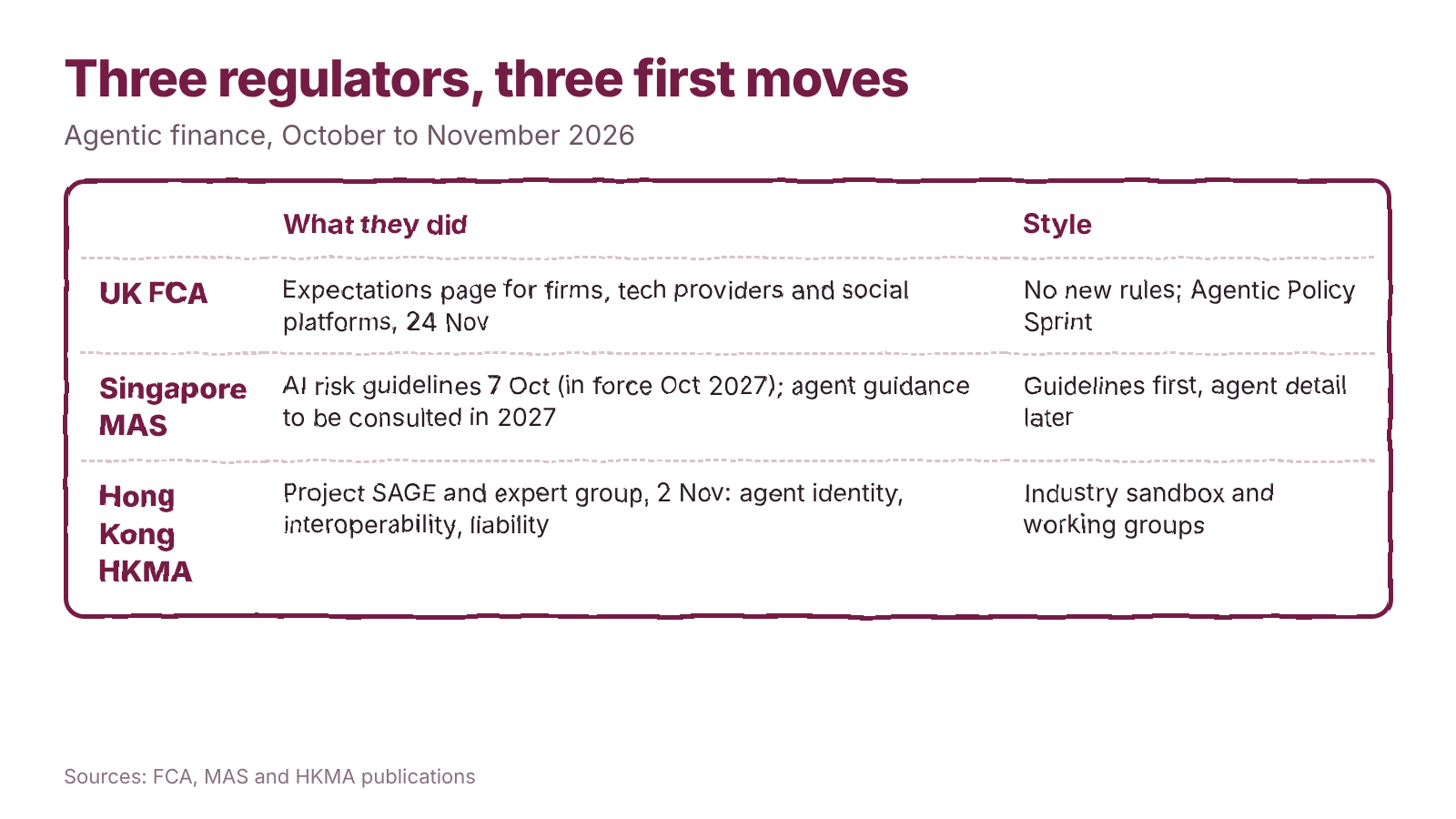
Hong Kong. The HKMA launched Project SAGE on 2 November, with an Agentic Finance Expert Group of banks, technology providers, professional firms and academics. It covers four areas: market use cases such as agentic commerce and everyday payments, agent identity (including “Know Your Agent” practices), interoperability standards, and legal questions including liability and consumer protection. HKMA chief executive Eddie Yue said agentic finance “has the potential to transform how financial services are delivered and utilised”. The FCA asks regulated firms how they’d establish they’re dealing with an agent; SAGE’s identity workstream is the same problem approached from the infrastructure side. I covered the launch in Animoca’s agents shopping on Visa’s network as the HKMA opened Project SAGE.
Singapore. MAS issued its Guidelines on AI Risk Management on 7 October. They apply to all forms of AI, including agents, and take effect on 7 October 2027, with lifecycle controls phased in by October 2028. MAS says it intends to consult the sector in 2027 on what extra guidance on agentic AI would help. In July it also published, with banks and fintechs, the SAFR white paper, which proposes governance checkpoints that verify and record an agent’s proposed action before it runs.
Payments networks. The industry side is moving on its own timetable. Visa says it expanded its Agentic Ready programme this month to the acceptance side, with more than 140 participants including Adyen, Checkout.com, Fiserv, Global Payments and PayPal, joining 175-plus issuers across 45 markets. Its stated aim is to help merchants, payment providers and acquirers prepare for agent-initiated transactions.
Put side by side, the three regulators have made different choices. Singapore wrote general AI guidelines first and left agent detail for 2027. Hong Kong opened a sandbox and working groups before writing rules. The UK has no new rules at all, and the FCA is leaning on authorisation law that already exists. That puts the most immediate pressure on a company shipping an agent product in London, because the question it faces today is a legal one about its own activities.
What it affects
Anyone building agents that touch money for UK users now has a written FCA position to measure against. The practical read of the page is a short list of checks:
- List what the agent actually does for the user: pays bills, arranges cover, compares or recommends products, passes users to lenders, or tells them what to buy.
- Map each action to the five activities the FCA names, and speak to the regulator through its innovation services or pre-application support if any of them fits.
- For regulated firms, name the senior manager who owns each agent, keep an inventory of live agents, and write down how customer-side agents are identified and what they can do.
- Decide a policy on payments instructed by an agent or from an agent-controlled wallet before the first request arrives.
- Add disclaimers about the limits of financial information, and pair them with operational limits such as spending caps and confirmation steps.
Agents that shop for people are already being tested at scale. a16z’s study of 11,307 agent shopping runs, which I covered earlier today, found price and reviews decide which product an agent picks. Once agents move from picking products to paying for them, this FCA page is the document UK firms will be asked about.
Discover more from Sulat AI & Tech News
Subscribe to get the latest posts sent to your email.