Minds, the AI agent platform from Hong Kong’s Animoca Brands, has completed a live pilot on Visa’s network in which its agents find card rewards and buy things for users. The Hong Kong Monetary Authority (HKMA) launched Project SAGE on 2 November to support the responsible development of agentic finance, including how agents are identified and governed. The South China Morning Post’s analysis on 21 November puts the two side by side: agents are getting wallets, and the city is deciding whether it’s ready.
What Minds actually did
Animoca announced the pilot on 8 July. Minds agents got two new skills built with Visa. One uses Visa Intelligent Commerce to complete purchases for a user inside preferences and spending limits the user has set in advance. The other reads a cardholder rewards and benefits directory, so the agent can surface Visa Hong Kong and China offers that match the user’s eligible cards. The first merchant is the Bruce Lee Club Ltd eShop, and Animoca showed the purchasing skill at its LEAP East booth in Hong Kong from 8 to 10 July.
Minds is a platform for persistent, always-on agents that users deploy without running servers. A marketplace called Bazaar lets users add tools and skills, and several agents can work together on one task.
“Agentic commerce introduces a more fundamental shift by allowing an AI agent to act on a user’s behalf within clearly defined permissions.”
Yat Siu, chairman and co-founder, Animoca Brands
Animoca says Visa supplies the tokenised payment credentials, authentication, transaction controls and fraud protections, and that users stay in control of when, how and under what conditions an agent acts.
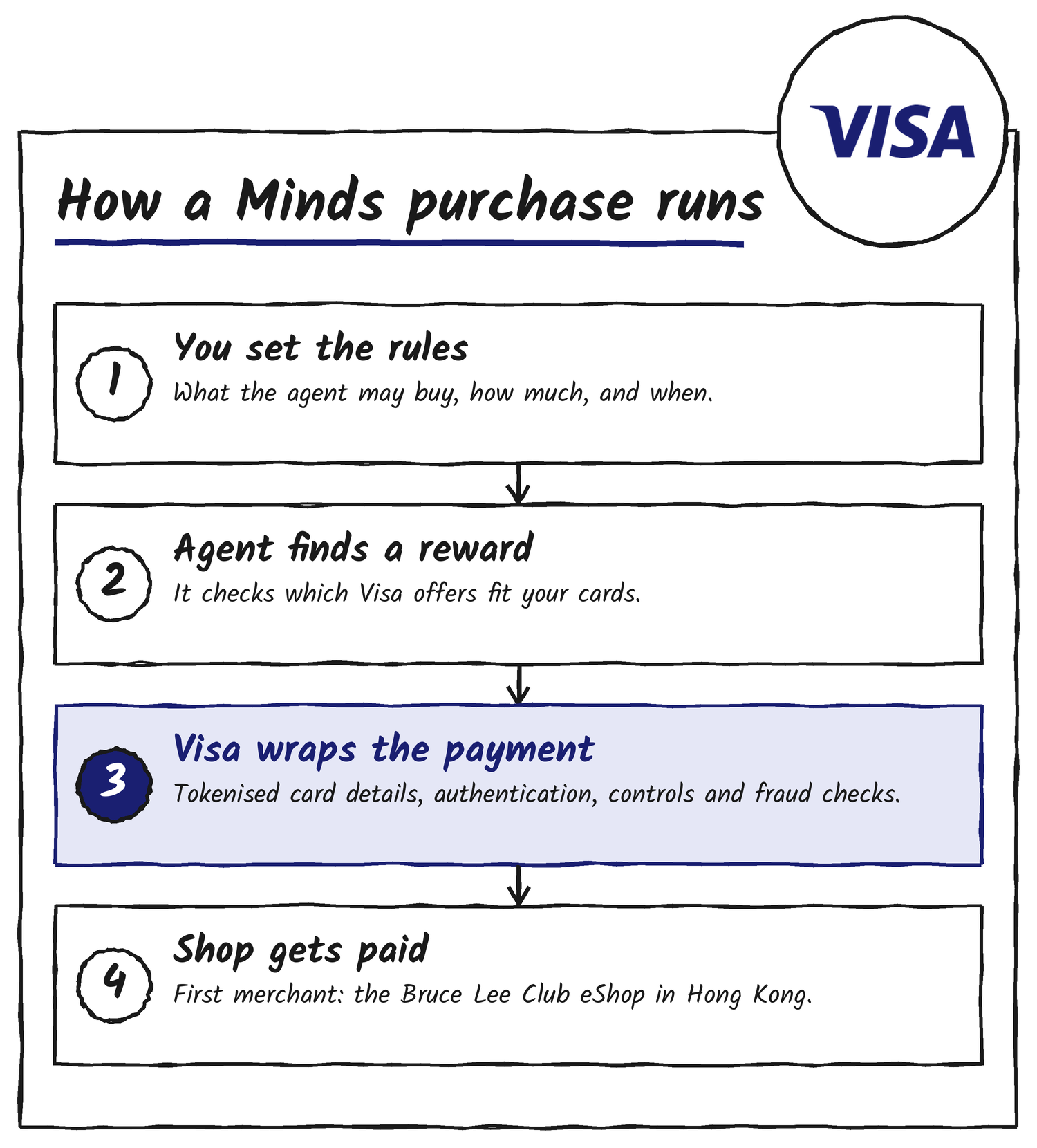
Animoca’s release gives no transaction counts, spend figures or user numbers. It names one merchant. The company’s 6 August shareholder update puts direct agent transactions on the Minds roadmap and says Minds “will soon transact directly on a Steward’s behalf.” On 8 October, Animoca’s AIR identity layer and Minds announced a tie-up with Reap and Pivota. Reap would issue payment credentials scoped to specific merchants, amounts and timeframes, and the first demonstration would use a single merchant the announcement doesn’t name.
Visa’s side of the ledger
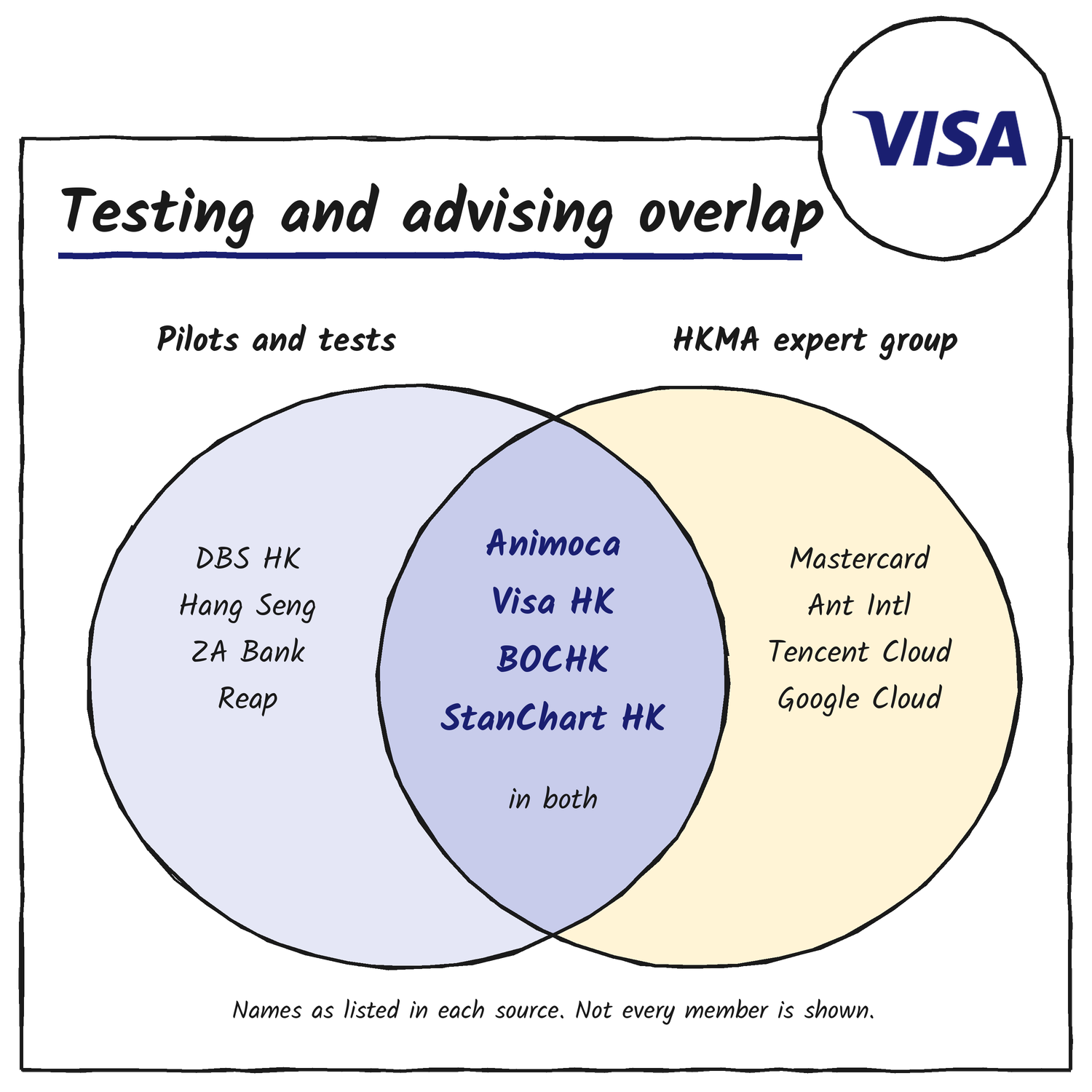
Minds is one of several Hong Kong tests on Visa’s rails. Visa launched Visa Agentic Ready in Hong Kong on 30 April with a first cohort of Bank of China (Hong Kong), DBS Hong Kong, Hang Seng Bank, HSBC Hong Kong, Reap, Standard Chartered Hong Kong and ZA Bank. In June, Visa announced it had completed an end-to-end agent-initiated card payment with Bank of China (Hong Kong) as issuer in testing. The agent arranged a business trip, picked a local souvenir and organised transport to Hong Kong International Airport, paying with a BOC Visa card with consent and authentication at every step.
At Hong Kong FinTech Week in November, Visa described what it’s building as a trust layer: “the ability to establish who the agent is, who it represents, what it has been authorised to do and how the transaction is protected.” Fintech News Singapore reported on 18 November that Agentic Ready’s second phase turns to acceptance, with acquirers, payment service providers, gateways and selected merchants, and more than 50 participants.
What is Visa Intelligent Commerce?
Visa describes it as a portfolio of initiatives and solutions for trusted, AI-driven commerce at scale. It brings together identity, authentication, tokenisation, risk management and controls for interactions between consumers, AI agents and merchants.
| Date (2026) | What happened | Source |
|---|---|---|
| 30 April | Visa launches Agentic Ready in Hong Kong with seven first-cohort members | Visa |
| June | Visa and Bank of China (Hong Kong) complete an agent-initiated card payment test | Visa |
| 8 July | Animoca announces the completed Minds pilot on Visa Intelligent Commerce | Animoca Brands |
| 6 August | Shareholder update puts direct agent transactions on the Minds roadmap | Animoca Brands |
| 8 October | AIR and Minds partner with Reap and Pivota on identity-based agent purchases | Animoca Brands, Reap |
| 2 November | HKMA launches Project SAGE and the Agentic Finance Expert Group | HKMA |
| 17 November | HKIMR publishes its AI adoption survey of financial institutions | HKMA, HKIMR |
| 21 November | SCMP publishes its analysis of the Minds pilot and Hong Kong’s agentic push | SCMP |
What the HKMA has put on the table
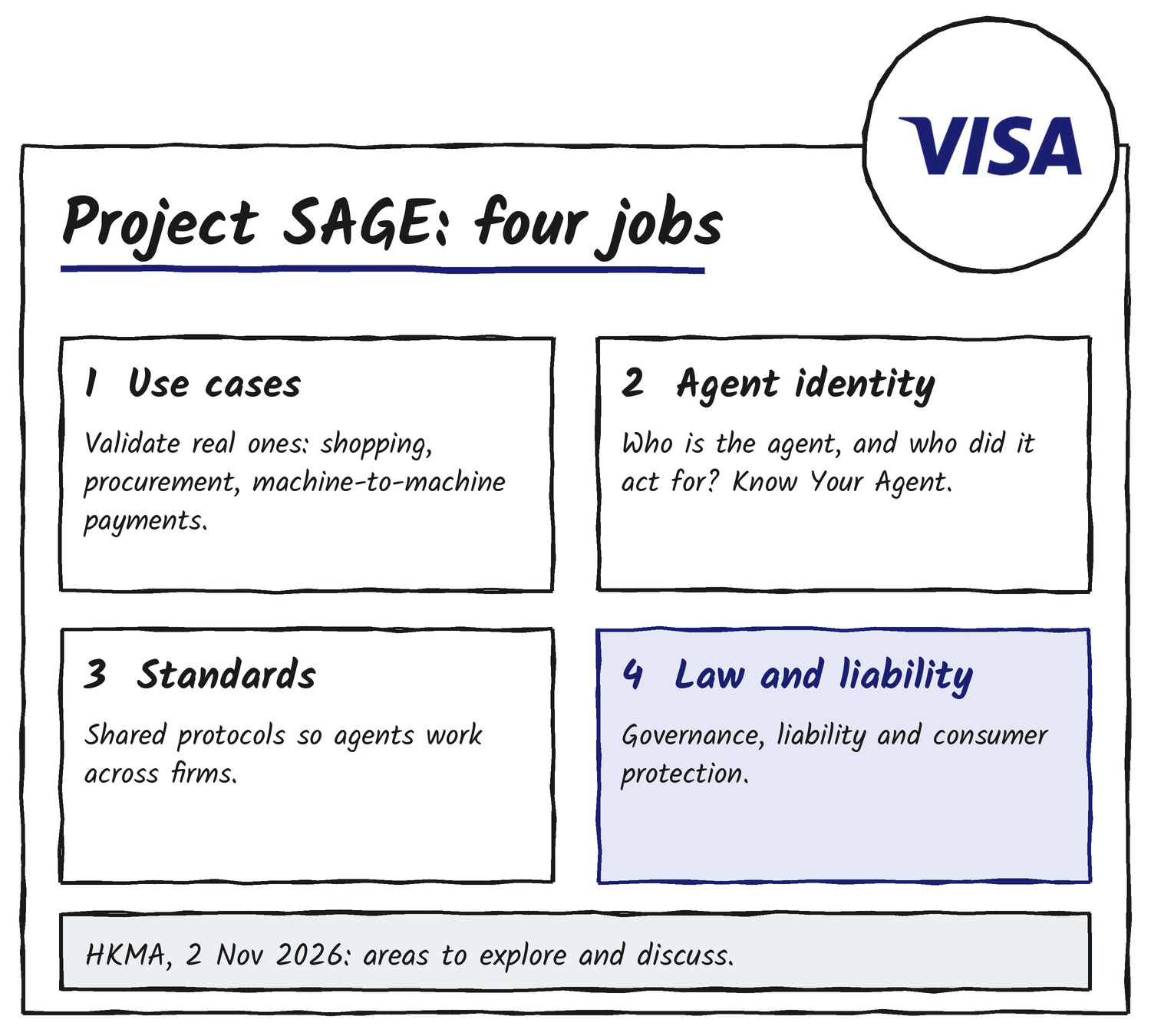
SAGE stands for Securing Agentic Finance with Governance and Enablement. The HKMA’s release lists four focus areas:
- Market development and use cases, including agentic commerce and everyday payments, procurement and treasury, and usage-based payments between machines.
- Agent identity, including Know Your Agent practices and authentication for verifying an agent’s identity and delegated authority.
- Interoperability standards and protocols.
- Legal and regulatory frameworks, covering governance, liability and consumer protection.
HKMA chief executive Eddie Yue said: “Agentic finance has the potential to transform how financial services are delivered and utilised.”
The Agentic Finance Expert Group has 22 members, according to the HKMA’s annex: 11 financial institutions, 7 technology providers, 3 professional-services firms and one academic. Animoca Brands sits with the technology providers and Visa Hong Kong with the financial institutions, alongside Mastercard, UnionPay International, Ant International, AWS, Google Cloud and Tencent Cloud. Bank of China (Hong Kong) and Standard Chartered Bank (Hong Kong), both in the Agentic Ready cohort, are members too.
Is Hong Kong ready?
The plumbing exists: a card network with an agent framework, issuers testing it and a live consumer pilot. The rules don’t yet. The HKMA’s release sets no rules, deadlines or licensing requirements. Under legal and regulatory frameworks, the group will “exchange views” on governance, liability and consumer protection.
The Hong Kong Institute for Monetary and Financial Research, the research arm of the Hong Kong Academy of Finance, surveyed financial institutions and technology and Regtech providers between January and July. It found concerns about explainability and security are still holding adoption back.
90%
have adopted or plan to adopt generative AI, up from 75% in 2025
13%
have already implemented agentic AI
56%
plan to implement it
Visa’s trust layer and the HKMA’s agent identity work name the same problem: proving who an agent is and what it may do. Animoca’s pilot shows an agent can already pay inside a user’s limits. Who carries the loss when one pays wrongly is on the HKMA’s list of topics, and nothing in its release answers it yet.
Primary sources: the HKMA’s Project SAGE release and expert group annex, Animoca Brands’ 8 July announcement, and Visa Hong Kong’s Agentic Ready and FinTech Week releases.
Discover more from Sulat AI & Tech News
Subscribe to get the latest posts sent to your email.