Pawel Huryn has scored Z.ai’s GLM-5.4 on Bug Hunt Bench: 28 of 105 planted bugs fixed, from a single run at max effort. GLM-5.3 scored 19 on the same board. Huryn posted the result on X at 12:40am NZDT on 25 November 2026, and said getting the run through Z.ai’s API was the harder part.
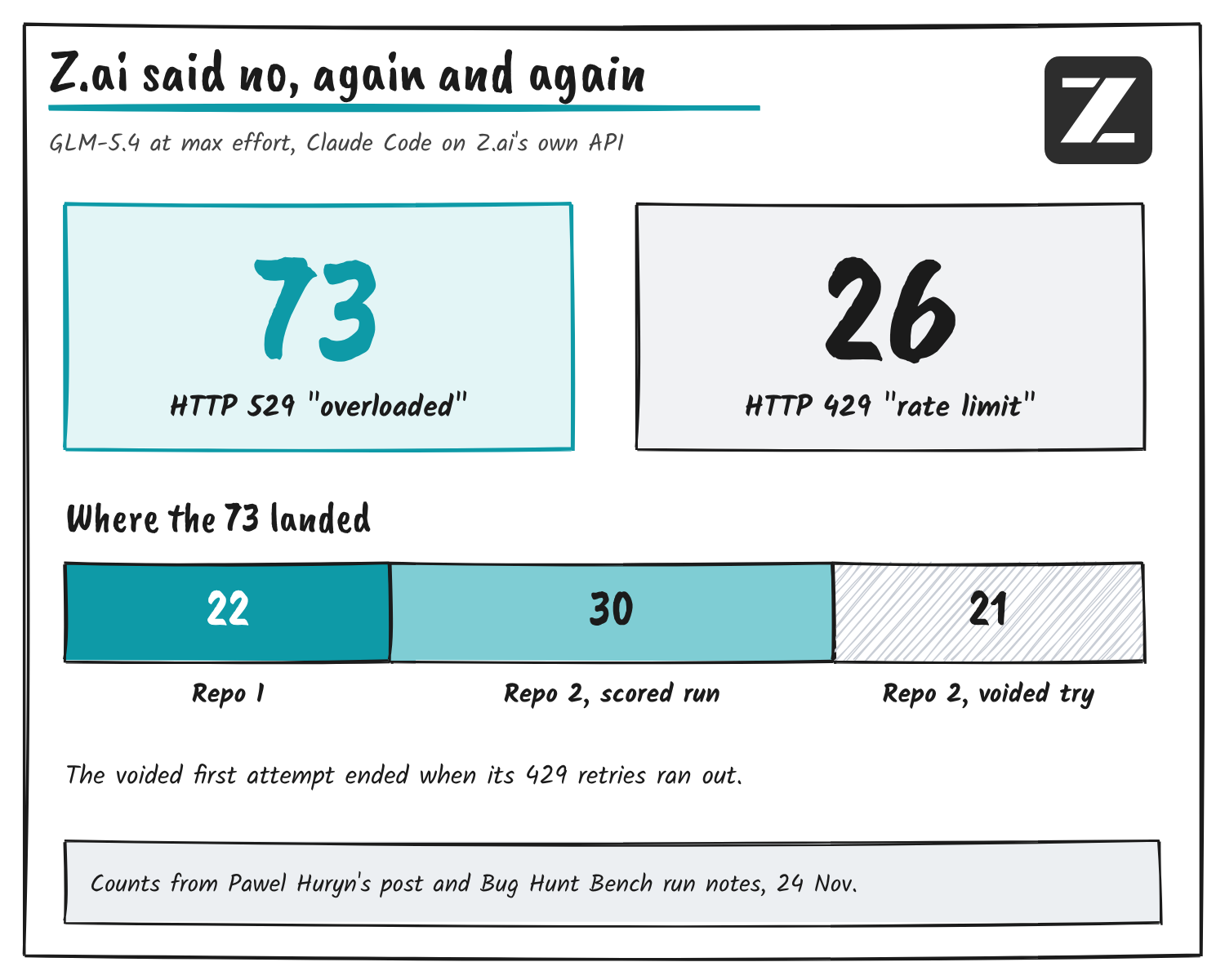
Making this model work on a @Zai_org infrastructure felt harder than proving the Riemann hypothesis: 73 times I got 529 “overloaded” error. 26 times I got 429 “rate limit” errors
Pawel Huryn, on X, 25 November 2026 NZDT
28/105
planted bugs fixed by GLM-5.4
19/105
fixed by GLM-5.3, one run
73
HTTP 529 “overloaded” replies
26
HTTP 429 “rate limit” replies
What was run
Bug Hunt Bench hides 105 planted bugs in two production repos: 45 in repo 1 and 60 in repo 2. Each model gets one prompt per repo and works in its own agentic command-line tool. An independent judge grades every diff against an answer key the model never sees.
The run notes on Huryn’s GitHub repo record how GLM-5.4 was set up. It ran in Claude Code 2.1.321 against Z.ai’s own Anthropic-compatible API, using a GLM Coding Plan Pro key, with each repo on its own Linux cloud machine. Claude Code sent max effort, which Z.ai’s docs treat as its top tier and its default. Grok 4.7 judged the diffs blind, and the notes say no model may judge itself or a sibling.
| Measure | GLM-5.4 (max) | GLM-5.3 (max) |
|---|---|---|
| Planted bugs fixed | 28 of 105 | 19 of 105 |
| Repo 1, of 45 | 13 | 9 |
| Repo 2, of 60 | 15 | 10 |
| Real extras fixed, never scored | 3 | 2 |
| Wall clock, working time only | 70.4 minutes | 40.4 minutes |
| Cost | None published | US$15.93, list-rate estimate |
| Runs behind the score | 1 | 1 |
The score counts planted bugs only. The three extras are real, unplanted defects GLM-5.4 fixed along the way, and the board counts them separately. GLM-5.4 has no published per-token price, and the run used subscription credits, so the notes carry no cost for it.
What the refusals did to the run
The run notes put the 529s at 73 in total: 22 on repo 1 and 51 on repo 2. Of the repo 2 figure, 21 fell in a first attempt that Huryn voided. Claude Code retries a 529, and repo 1 finished on its retries.
Repo 2 took longer. Its first attempt ended with no report once Z.ai’s 429 rate-limit retries ran out, and the notes void it. The rerun stopped at 04:45 Warsaw time when Claude Code gave up on the 529s. Z.ai kept refusing the requests sent to resume it from 08:15 to about 10:15. Once Z.ai accepted requests again, the leg carried on in its own conversation after a short continue message and finished.
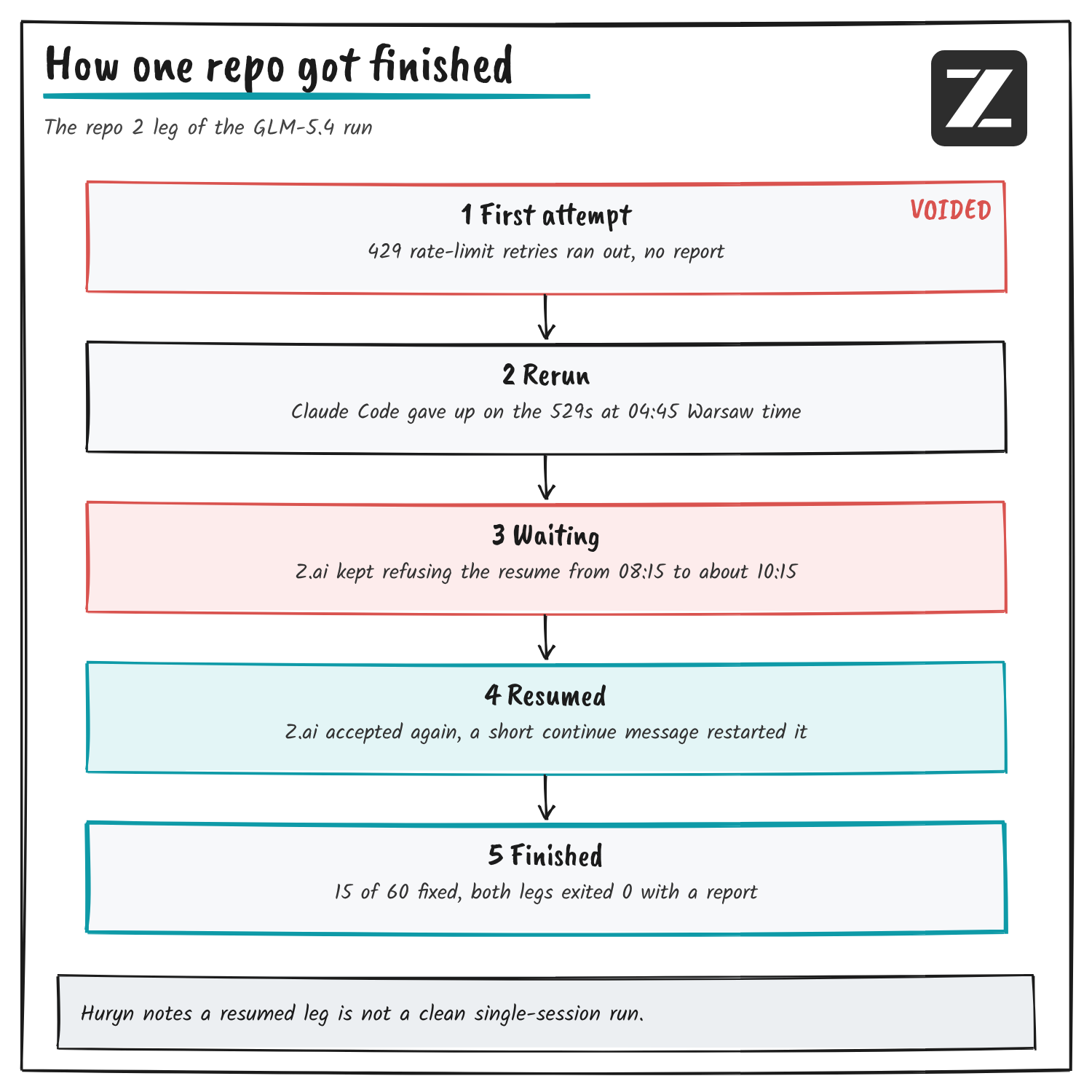
The notes say a resumed leg is not a clean single-session run. The 70.4 minutes of wall clock is the agent’s running time only: 36.7 minutes on repo 1 and 33.7 on repo 2, with the waits removed. Those waits included time for the plan’s five-hour credit window to refill and for Z.ai to start accepting requests again. The run took 430 turns, and the notes record that both legs exited 0 with a report written.
The notes give no cause for the 529s. A separate launch-day guide from Logeshwaran says a developer reported to Z.ai on 23 November that glm-5.4 answers requests carrying an anthropic-beta header with a 529 and code 1305, while GLM-5.3 accepts the same request. The guide says Claude Code sends those headers on every call, and suggests setting CLAUDE_CODE_DISABLE_EXPERIMENTAL_BETAS=1. That report is the guide’s account of a third party’s bug report, and Huryn’s notes don’t say it applies to his run.
Where 28 sits on the board
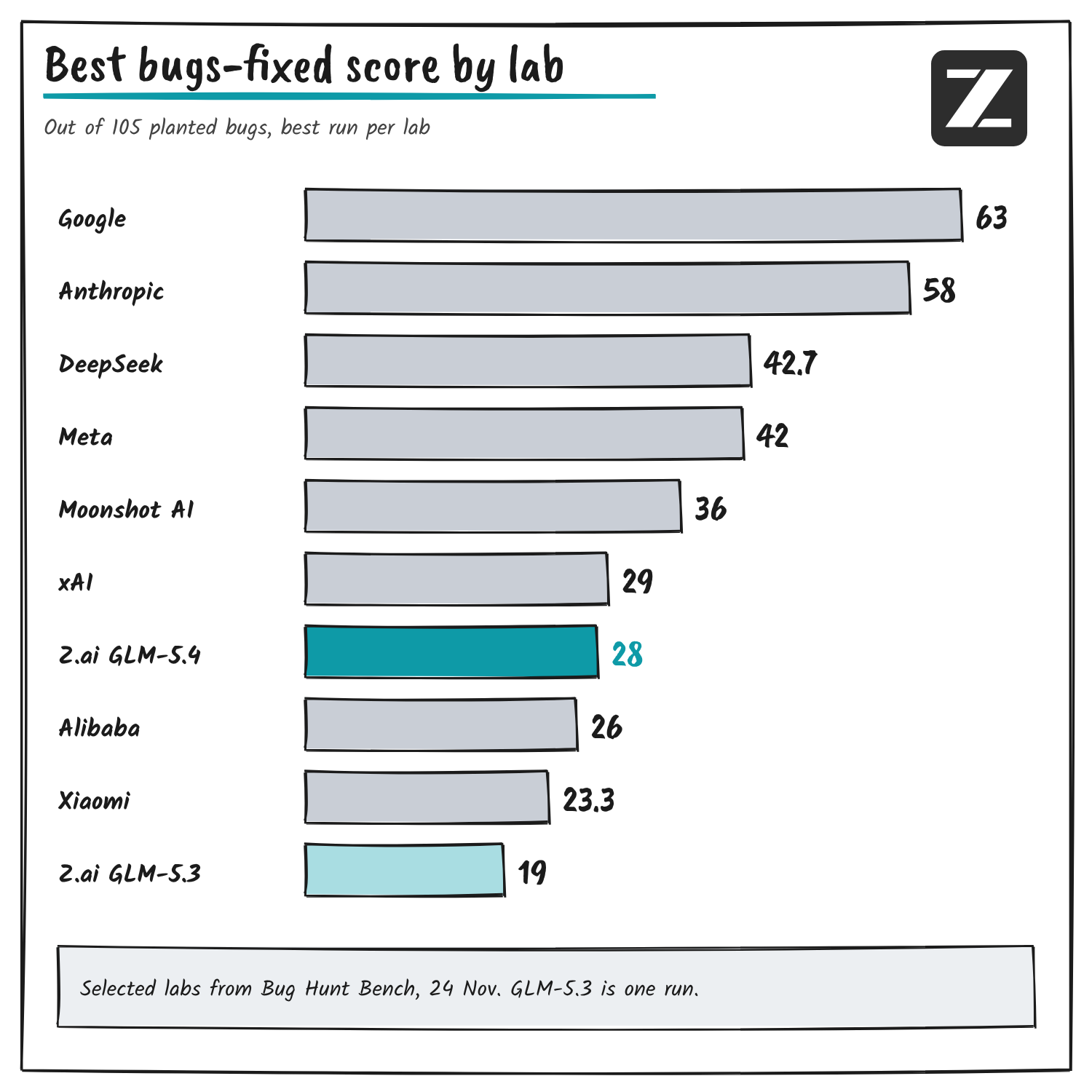
In the featured view Huryn posted, with 23 of 151 runs, GLM-5.4 is second from the bottom, ahead only of GLM-5.3. Across the whole board, the best run for each lab puts Z.ai ninth of 13: Google’s Gemini 4 Neon leads at 63, and Anthropic’s Fable 5.2 follows at 58. GLM-5.4’s 28 is one point under xAI’s Grok 4.7 and two above Alibaba’s Qwen3.8-Flash.
| Lab and model | Fixed of 105 | Tool |
|---|---|---|
| Google, Gemini 4 Neon (xhigh) | 63 | Antigravity CLI |
| Anthropic, Fable 5.2 (max) | 58 | Claude Code |
| DeepSeek, V4.1 Flash 1017 (max) | 42.7 | DeepSeek harness and API |
| Meta, Muse Wonder Full 1.0 (max) | 42 | Muse Code and Meta API |
| Moonshot AI, Kimi K3.1 Pro (max) | 36 | Claude Code and Moonshot API |
| xAI, Grok 4.7 (xhigh) | 29 | Grok Build CLI |
| Z.ai, GLM-5.4 (max) | 28 | Claude Code and Z.ai API |
Two cautions come from Huryn’s own board. Both Z.ai rows are single runs, and his variance note says repeat runs of one configuration moved a median 1.7 points from the first run, by more than 5 points in 5 of 69 cases. The nine-point gap between GLM-5.3 and GLM-5.4 is wider than that. The board also lists 19 bugs that no model in any run has fixed.
The harness differs from row to row, and it matters. GLM-5.4 and Kimi K3.1 Pro ran through Claude Code against their makers’ own APIs, while Gemini and Grok ran in their vendors’ tools. Costs on the board are list-rate estimates unless marked, so GLM-5.4’s missing figure can’t be set against the others.
Why the run went through a plan key
GLM-5.4 reached GLM Coding Plan subscribers on 23 November, and Z.ai’s blog lists the standard API as coming soon, with open weights planned after safety hardening. That’s why Huryn ran it on a Coding Plan Pro key, which Z.ai’s plan docs give 12,000 credits per five hours and 60,000 per week. A run that hit its five-hour window had to wait for it to refill, which the notes count among the pauses.
Zixuan Li, the head of Z.ai, announced the launch with 50% more weekly quota than GLM-5.3. Our launch coverage sets out the architecture, the credit rates and what Z.ai has said so far.

Who runs the bench
Huryn runs Bug Hunt Bench himself and writes The Product Compass, a newsletter on AI for product managers and builders. His GitHub repo says the 24 November update covers 222 rows from 341 scored runs across 56 models, and publishes every run’s receipts and notes. We covered an earlier cut of his data, on what AI subscriptions buy against API prices.

Terms used in this piece
- HTTP 529
- A server-busy reply. Z.ai’s version reads “The service may be temporarily overloaded”.
- HTTP 429
- A rate-limit reply. Z.ai also uses it for usage caps and overload, so the code inside the message says which.
- Planted bug
- A defect Huryn put in a repo on purpose, with a withheld answer key. Only these count towards the score.
- Extras
- Real, unplanted defects a model fixed on the way. The board counts them and never adds them to the score.
- Max effort
- The top reasoning tier a run asks for. Z.ai’s docs map xhigh, max and ultra to max.
- Harness
- The command-line tool a model runs in, such as Claude Code or Antigravity CLI.
Sources
- Pawel Huryn’s post on X, 25 November 2026 NZDT
- Bug Hunt Bench live board and the Bug Hunt Bench GitHub repo, including its run notes
- Z.ai’s GLM-5.4 blog post and the GLM Coding Plan overview
- Logeshwaran’s GLM-5.4 setup and troubleshooting guide, 24 November 2026
Discover more from Sulat AI & Tech News
Subscribe to get the latest posts sent to your email.