A developer who posts as Chen Dahuang said on X on the night of 24 November that T3 Code, the open-source app for running coding agents, has collected usage data by default since March, removed its homepage promise of no telemetry without telling anyone, and hashes the account IDs it finds in users’ Codex and Claude Code logins. The GitHub record and T3’s own docs support the core of it. They also show where Chen’s post is behind: T3 now documents what it collects, and Theo Browne, T3’s chief executive, has said in public that users can opt out.
Theo’s answer predates Chen’s post. He gave it on 4 November, in reply to a user whose pull request had been auto-closed.
Sorry about the auto-close, we’re aggressive with those due to the 800+ PRs getting opened daily 💀 To be VERY clear, you can absolutely disable our anonymous telemetry. It is an env var you can set, preventing us from even being informed of the initial boot (literally nobody else does this afaik). We even detail this during the onboarding now! fwiw, this kinda bums me out. We’re not collecting much by default. It’s pretty basic anonymous (fully auditable!) telemetry. We use it to steer product, gain credibility, better understand how people use T3 Code, and to let us get enough funding to continue giving it out for free. Every single harness people use in T3 Code gets 100x more data than we do. And most of them aren’t open source 🙃
Theo Browne on X, 4 November 2026
What the record shows
Every date below comes from a GitHub page, an archived copy of the homepage or T3’s docs. I haven’t run T3 Code or captured its network traffic.
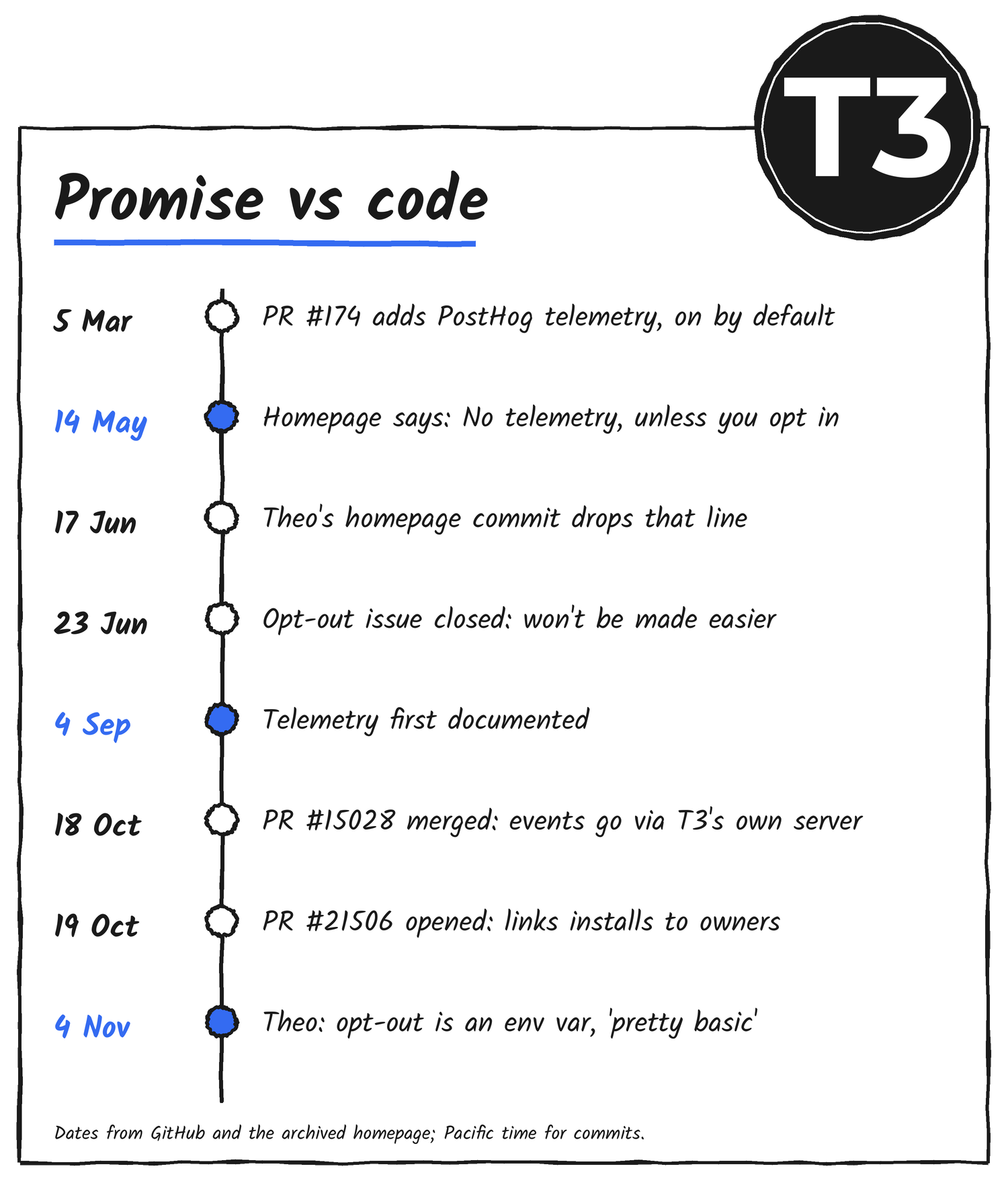
5 March. Pull request 174, written and merged by Julius Marminge, one of T3 Code’s builders, added anonymous PostHog telemetry, on by default. It used a hashed Codex account ID where there was one and a stored anonymous ID where there wasn’t. A switch, T3CODE_TELEMETRY_ENABLED=false, existed from the start but wasn’t documented.
14 May. An archived copy of the T3 Code homepage carries a tile that reads “No telemetry. Unless you opt in. Full stop.” Collection had been on by default for more than two months.
17 June. Commit 3bdaa6e removed the tile. Theo authored it at 11:23pm Pacific time on 17 June, which is 18 June in UTC, and titled it “Polish marketing homepage: nav, hero, and endorsements (#3137)”. The title doesn’t mention telemetry. Claude Opus 4.8 is listed as a co-author.
23 June. A user had asked on 25 March, in issue 1397, for an opt-out toggle. Julius answered on 23 June: “We only collect data so we know what platforms people are using and how many users we have. There is no personal data, agent runs etc captured. We will not make this easier to opt out of, it is crucial for us to know how many users we have.” He closed the issue as not planned. It carries 12 thumbs-down reactions.
18 July to 4 November. A user named salixhost opened issue 4123 on 18 July asking why the no-telemetry promise had been made. On 21 October the t3dotgg account replied in a comment signed “Claude Opus 5.5 responding on behalf of Theo”. One part was fixed, it said, in pull request 14413, which made the env var stop relay tracing too. Default-on collection, consent, disclosure and policy were still open. The issue was closed, reopened on 22 October and closed again on 4 November. A commenter on it dates T3’s first telemetry documentation to 4 September, six months after collection began.
The October changes
Two pull requests from Theo’s account reshaped the pipeline. Number 15028, made by Claude Opus 5.5 and merged on 18 October, changed the default destination to https://ingest.t3.codes. That endpoint archives every event and forwards it to PostHog. Events flush every 10 seconds.
Number 21506, opened on 19 October, adds an installId and an install.owner_observed event with three fields: ownerSource, ownerId and observedBy. The owner can come from four places.
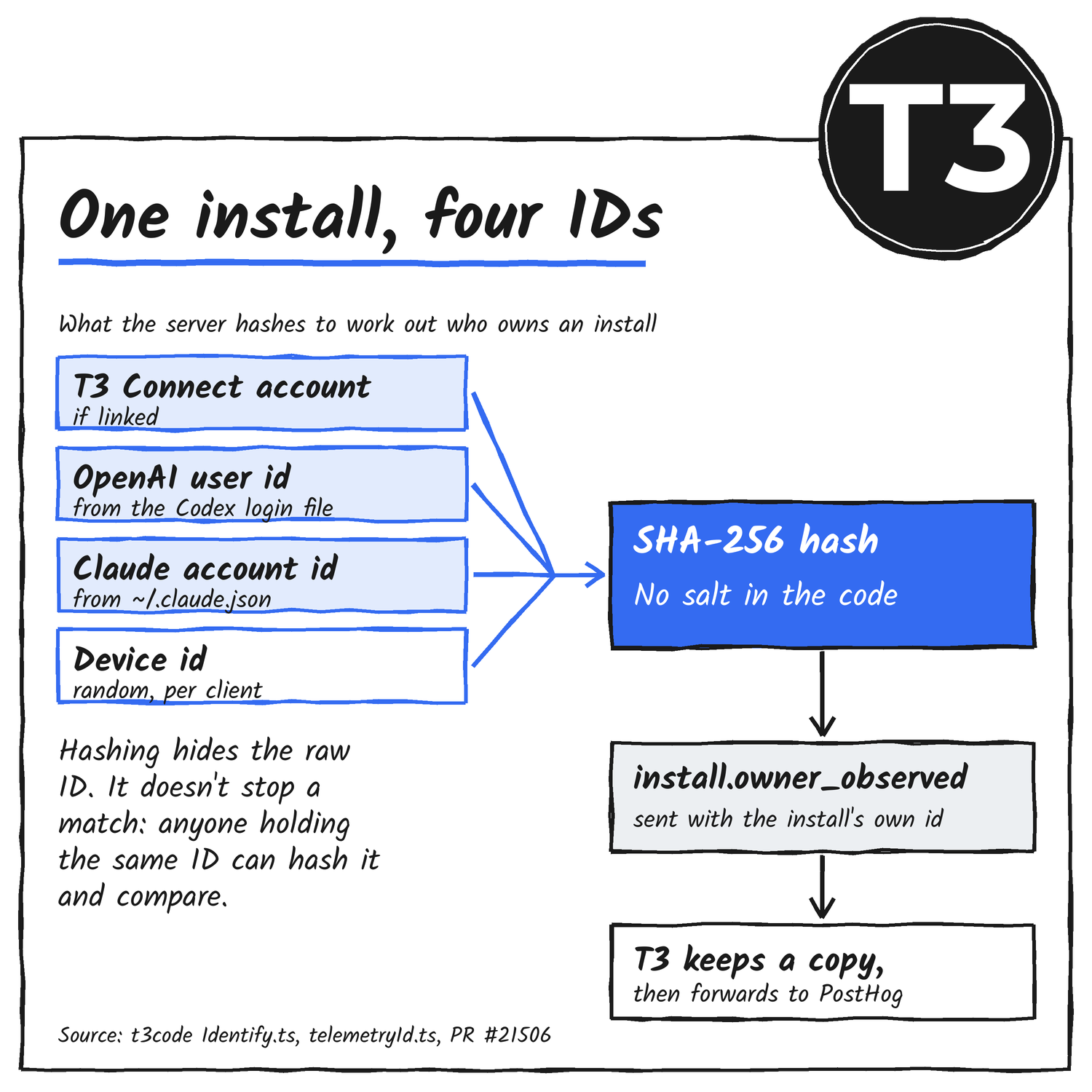
connect: the T3 Connect account.openai: theuser_idclaim in the Codex CLI’s login token.claude: theoauthAccount.accountUuidin~/.claude.json.device: a random ID for the client.
Clients send only SHA-256 hashes, and the main distinct_id is unchanged. In the code, hashTelemetryId in packages/shared/src/telemetryId.ts is a plain SHA-256 of the UTF-8 value, returned as hex. There’s no salt. Anyone who already holds an account ID can hash it and check for a match. That’s a property of the method, and I have no evidence that T3 or anyone else has done it. The code that reads the Codex auth.json and ~/.claude.json from the home directory is in Identify.ts.
T3’s current telemetry page, docs/user/telemetry.md, says this plainly. Product events go to ingest.t3.codes “associated with a hashed account or installation identifier”, and the hashed Connect, OpenAI, Claude and device IDs are sent “to count how many installations one person uses”. It lists what events carry: provider, model, effort, permission mode, results, duration, release channel and token counts. It says they exclude prompts, responses, file contents, auth tokens, conversation IDs and raw provider events.
So Theo’s tweet and the docs are both T3’s, and the docs are the more specific. “Pretty basic anonymous” sits beside hashed account identifiers that T3 uses to link one person’s machines. Chen’s claim that T3 reads the login files even with telemetry switched off isn’t one I could confirm.
Turning it off, and what stays on
Both commands below are in T3’s docs. Set them in the shell profile that launches the app, since the desktop app reads the variable from there.
export T3CODE_TELEMETRY_ENABLED=false
export T3CODE_OTEL_SDK_DISABLED=true
The first stops product events and relay tracing from the server. The second, or OTEL_SDK_DISABLED, also stops relay tracing. A managed policy can disable product events and relay tracing for server and desktop, and users can export diagnostics to their own OTLP receiver. Relay connection traces go to Axiom, not PostHog.
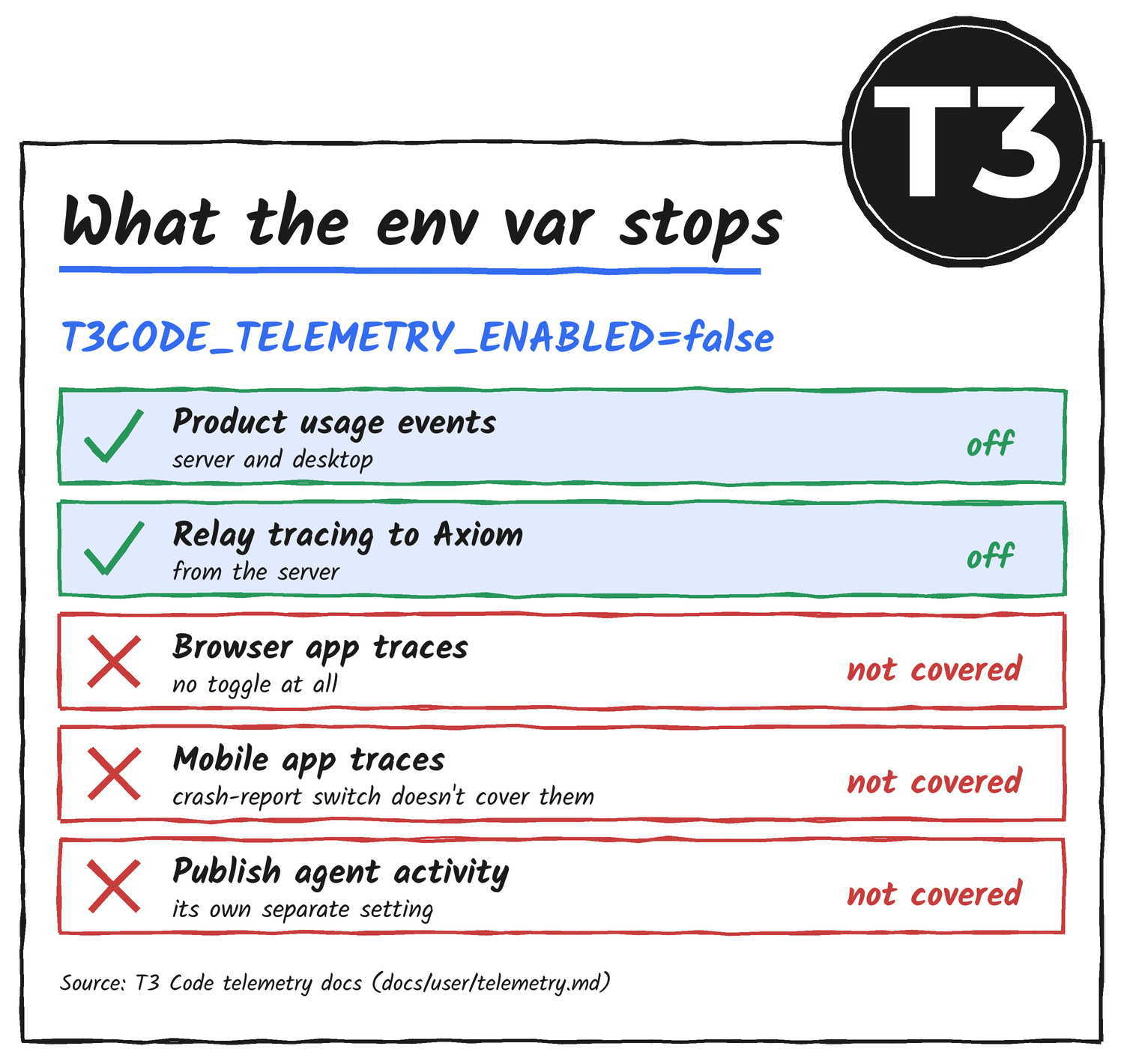
The docs list what the switch doesn’t reach. The browser web app doesn’t read the variable and has no toggle. Mobile has a “Send crash reports” toggle that doesn’t cover relay traces. “Publish agent activity”, which shares items such as project and thread titles, is a separate setting that the opt-out doesn’t disable. It’s opt-in, so it’s off unless a user turns it on.
Three outside pull requests proposed an in-app switch. Number 16763, by wukko, was marked not approved by the Macroscope review bot. Number 21248, by cbangera2, was closed with a pointer to issue 1397. Number 27077, by inayayousfi, adds a Settings toggle and a t3 telemetry on|off|status command and passed Macroscope’s review, but I couldn’t confirm its final state.
Other tools collect by default too
Theo’s defence is that every harness people run in T3 Code collects far more than T3 does, and that nobody else lets users stop even the initial boot ping. I didn’t measure how much data any tool sends. I checked whether collection by default is unusual, using the tools’ own docs, and it isn’t.
| Tool | Collection | How to opt out |
|---|---|---|
| T3 Code | Product events on by default, with hashed Connect, OpenAI, Claude and device IDs; ingest.t3.codes keeps a copy | Env var or managed policy; no toggle in the web app |
| Claude Code | Usage metrics sent to Anthropic, on by default on the Claude API, off by default on Bedrock, Vertex and Foundry; docs say metrics never include code, prompts or file paths | DISABLE_TELEMETRY=1; error reporting has its own switch |
| Zed | Diagnostics and metrics both default to true; usage data tied to a random telemetry ID, linked to an email if signed in | Settings UI; a Telemetry Log viewer shows what is sent |
| Cline | On by default, with a per-install device ID plus account or organisation when signed in | Toggle in settings; telemetryOptOut in the CLI settings file |
| Warp | Governed by a “Help improve Warp” setting; I didn’t check the default | Settings, then Privacy |
What the record does show as particular to T3 Code is the withdrawn homepage promise, the gap of about six months before collection was documented, and identifiers drawn from other vendors’ login files. T3’s page doesn’t say how long the copy at ingest.t3.codes is kept.
Chen’s other claims, checked
Chen posted follow-ups the same day. Two are real issues with different states.
Delete doesn’t delete. The sidebar’s delete dialog said it permanently clears conversation history, but the newer orchestrator only soft-deleted threads. Issue 17845 was opened on 10 October by a user called only21mil. Pull request 32378, which purges the projection content of threads deleted more than a day ago and keeps a tombstone, was still in review, and a pipeline on it stopped on 23 November. Commits referencing a fix appeared on 24 November. A separate change, 24924, fixed the dialog’s wording, and issue 39199 notes that subagent threads were left live.
Auto mode skips ask rules. Issue 15353 was opened on 3 October by TonybynMp4: in Claude’s Auto mode on orchestrator v2, commands that match an ask rule run without a prompt. Julius’s triage confirmed it reproduces. On 15 November it was still open, with fix pull request 15360 pending, and a commenter reported Auto not prompting even for git push --force. Chen says it has gone 52 days unfixed. The issue stays open.
A third thread alleges a fork dispute over the MIT licence. I haven’t verified it and haven’t reported it.
The company behind it
T3 Code is MIT-licensed and comes from Ping Labs, which trades as T3 Tools Inc. The repository was created on 8 February 2026. Theo is chief executive, Julius builds it and Mark Florkowski is chief technology officer. It drives Claude Code, Codex, Cursor, OpenCode, Grok, Antigravity and other agents, and its README says it “does not resell tokens”. T3 Connect, a relay for reaching your agents remotely, launched on 29 July, and there are iOS and Android apps.
The size claims vary by source. The homepage says “Tolerated by over 500,000 devs” and “75k+ stars”. A third-party count showed 54,963 stars on 10 November. Julius said the user count is crucial to T3, and Theo lists gaining credibility and funding among the uses of the data. Earlier T3 Code coverage on Sulat includes the team guide, the Neon usage piece and the Threadbear comparison.
How I checked
I read the pull requests and issues cited above on GitHub, including the diff for pull request 174 and the code in telemetryId.ts and Identify.ts. I compared the archived homepage of 14 May with commit 3bdaa6e, read the current docs/user/telemetry.md, and pulled the peers’ claims from their own docs. I didn’t run T3 Code, inspect its network traffic or test the opt-out, so anything about runtime behaviour comes from the docs and the code.
As of the docs read on 25 November NZ time, T3 Code still collects product events by default. The docs name two ways to stop it, an environment variable and a managed policy, and Theo says onboarding now mentions the variable. I haven’t run onboarding to check. The homepage line from 14 May hasn’t been restored.
Discover more from Sulat AI & Tech News
Subscribe to get the latest posts sent to your email.