The US Commerce Department has added Megaspeed and six related companies in Singapore, Malaysia and Thailand to its Entity List, the trade blacklist that bars US exporters from supplying a listed party without a licence. The Bureau of Industry and Security (BIS) final rule, Federal Register document 2026-23999, went on public inspection on 23 November (US time), is scheduled for publication on 25 November and takes effect from the public inspection date.
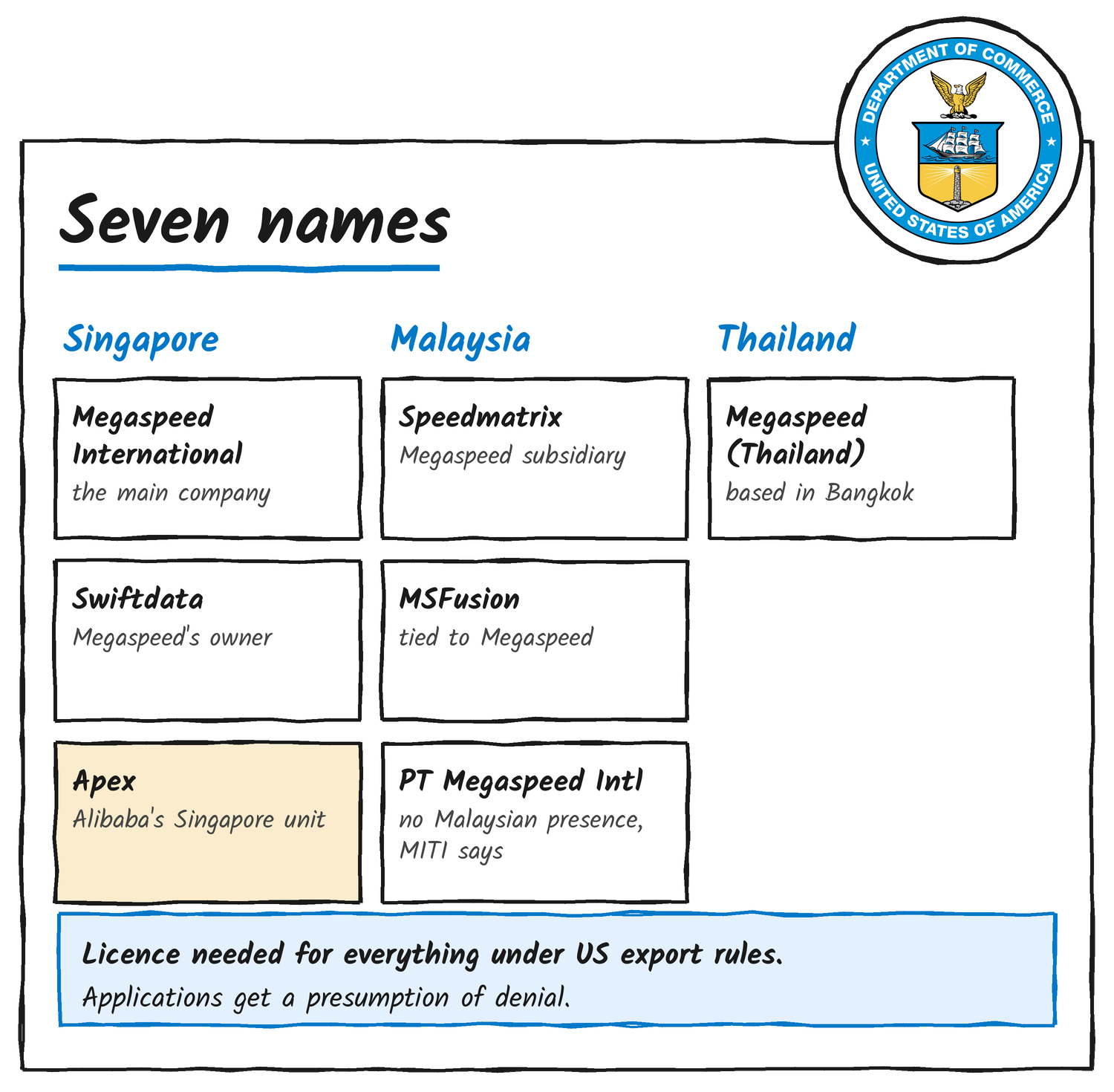
All seven entities get a licence requirement for every item subject to the Export Administration Regulations (EAR), and applications are reviewed under a presumption of denial. BIS says it acted because of “the significant risk of these entities being or becoming involved in the diversion of advanced computing commodities to unauthorized end uses or end users”. One of the seven, Apex Enterprise Solutions (Singapore), is an Alibaba subsidiary, and Alibaba calls the listing “erroneous”.
This piece covers what the filing says, what a listing does and doesn’t do, the Alibaba dispute, the road from a 2024 investigation to this week, the pressure inside Washington, the reaction in Singapore, Malaysia and Congress, what it means for suppliers and data centres, and what is still open.
- What the filing says
- What a listing does and doesn’t do
- Alibaba and Apex
- The road to the listing
- Why now
- Reaction in Singapore, Malaysia and Congress
- What it means for suppliers and data centres
- What is still open
What the filing says
7
entities added, across three countries
All items
subject to the EAR now need a licence
Denial
is the presumption for every application
30 days
savings clause for shipments already en route
Three of the entities are in Singapore, three in Malaysia and one in Thailand. The filing gives each its addresses and, where it has them, aliases. Megaspeed International Pte. Ltd. carries four, including “7Road International”, which the Thai entity also uses.
| Entity | Country | Aliases in the filing | First listed address |
|---|---|---|---|
| Megaspeed International Pte. Ltd. | Singapore | Megaspeed; Megaspeed International; 7Road International; 7Road International Pte. Ltd. | 152 Beach Road |
| Swiftdata Pte. Ltd. | Singapore | None | 26 Sin Ming Lane, Midview City |
| Apex Enterprise Solutions (Singapore) Private Limited | Singapore | Apex | 51 Bras Basah Road, Lazada One |
| MSFusion Sdn. Bhd. | Malaysia | None | Taman Mount Austin, Johor Bahru |
| Speedmatrix Sdn Bhd | Malaysia | Speedmatrix | B0342 Blok B Eko Galleria, Johor |
| PT Megaspeed International | Malaysia | None | B0342 Blok B Eko Galleria, Johor |
| Megaspeed (Thailand) Co., Ltd. | Thailand | 7Road International; 7Road International Pte. Ltd. | Siam Piwat Tower, Bangkok |
Two details stand out. PT Megaspeed International and Speedmatrix list the same three Malaysian addresses. And the filing is signed by Julia Khersonsky, Deputy Assistant Secretary for Strategic Trade, and doesn’t record a vote count. It says only that the End-User Review Committee made the decision, and the committee adds an entry by majority vote.
What a listing does and doesn’t do
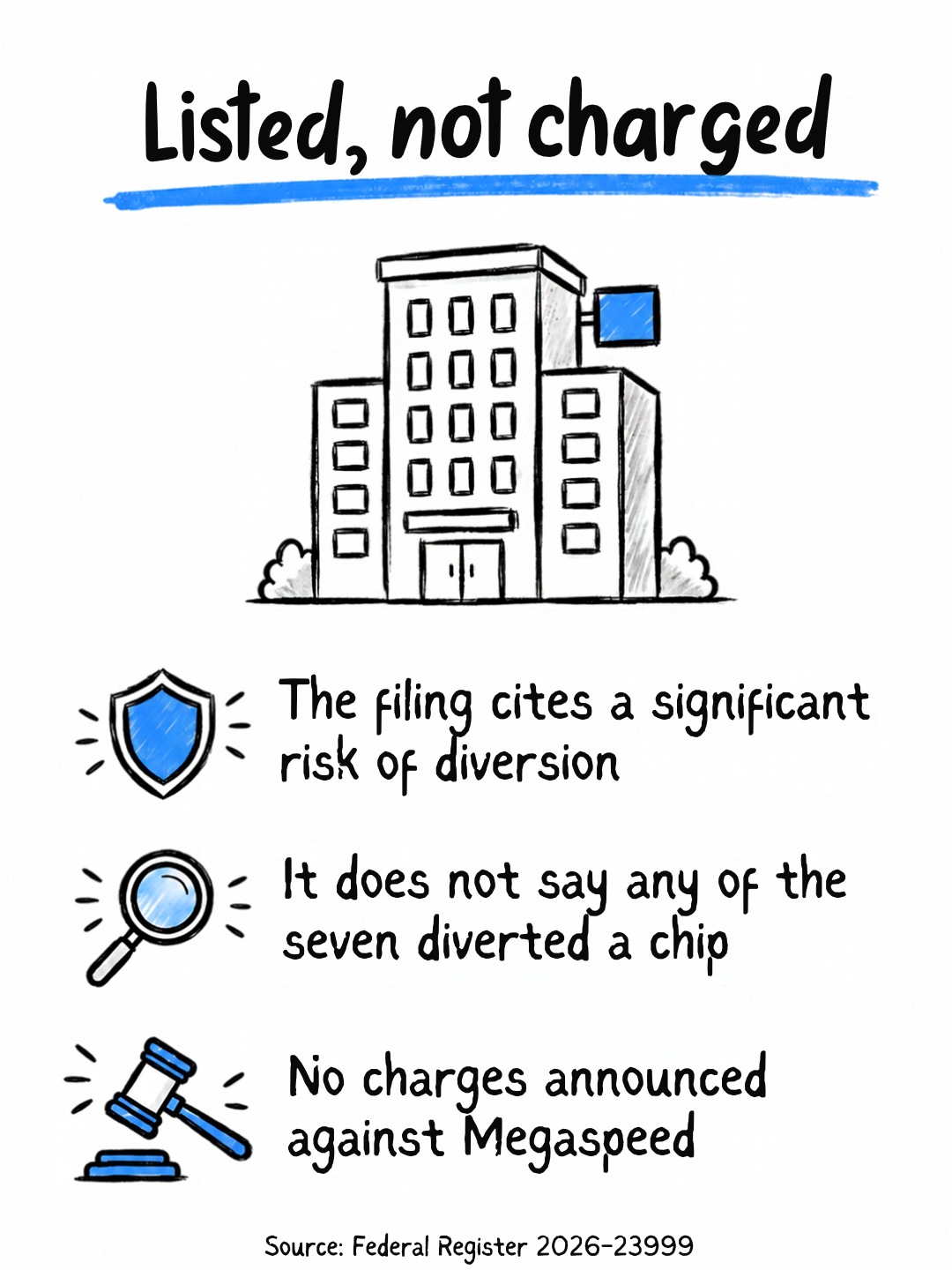
The Entity List applies where there is “reasonable cause to believe, based on specific and articulable facts” that an entity has been, is, or poses a significant risk of being involved in activity contrary to US national security or foreign policy interests. That is a lower bar than a criminal charge, and the filing doesn’t say any of the seven has diverted a chip. It says there is a significant risk they will be, or are.
In practice, an exporter needs a licence to export, reexport or transfer in-country anything subject to the EAR to a listed party, and most licence exceptions are limited. Because the licence requirement here covers all items, it reaches servers, components, software and technology, not only the most advanced Nvidia chips. A shipment already en route when the rule went on public inspection can still arrive under the old terms if it’s completed within 30 days.
What is the Entity List?
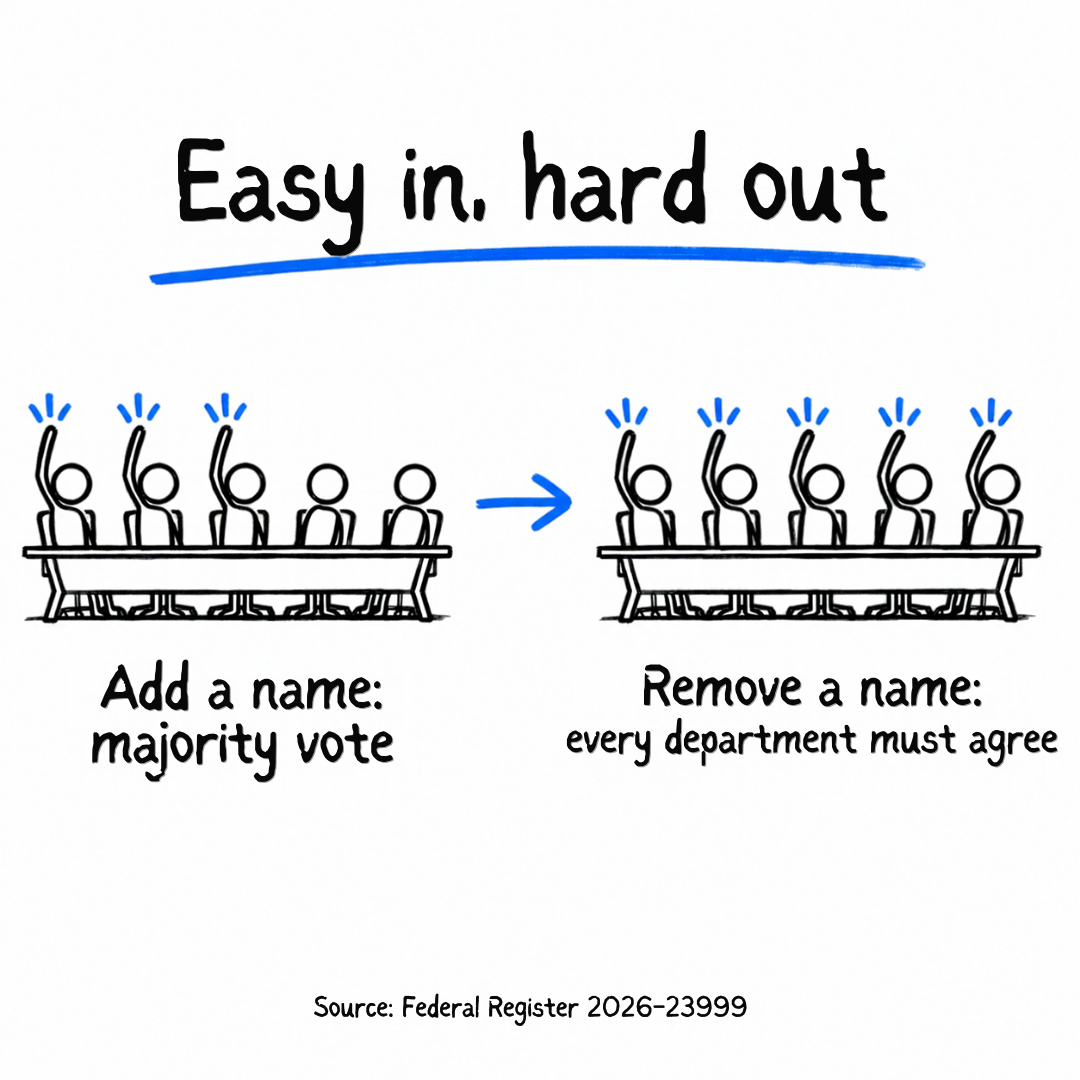
BIS first published the list in 1997 to warn the public about parties that could contribute to the diversion of items to weapons of mass destruction programmes, according to The Straits Times. Its scope has since widened to activities contrary to US national security or foreign policy. The End-User Review Committee, made up of Commerce (chair), State, Defense, Energy and, where appropriate, Treasury, decides by majority vote to add an entry and by unanimous vote to remove or change one.
That asymmetry matters for anyone who wants off the list. Adding a name needs a majority of the committee, while removing it needs every member department to agree.
Alibaba and Apex
Apex is the surprise on the list. An Alibaba spokesperson told The Straits Times on 24 November:
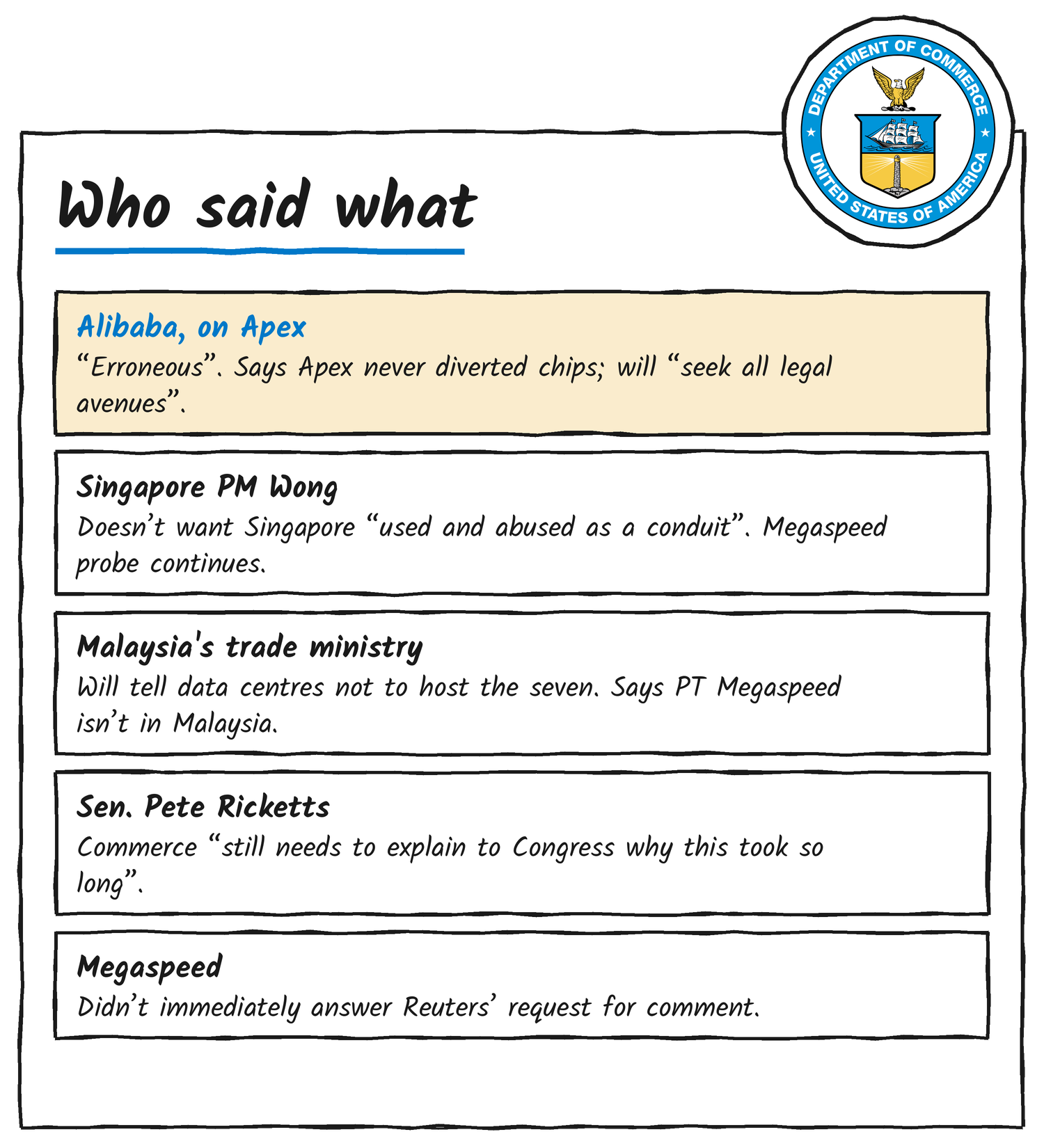
Adding Apex Enterprise Solutions to the Entity List is erroneous because Apex has never diverted advanced computing chips subject to US export restrictions. We will seek all legal avenues to protect our rights and reputation.
Alibaba spokesperson, statement to The Straits Times, 24 November
The Straits Times reports from corporate records that Apex was incorporated in Singapore in July 2023, that its registered address is at Lazada One, which Alibaba and its Southeast Asian shopping unit Lazada lease, and that its immediate parent is Cloud Intelligence (Cayman) Holding, with Alibaba Group Holding as the ultimate holding company. The same records show Speedmatrix pledged IT and network equipment, intellectual property and related rights to Apex under an 18 June 2024 agreement, as security for certain contractual obligations. Alibaba’s quoted statement doesn’t describe that arrangement.
The Financial Times reported, per The Business Times, that Megaspeed used its relationship with Alibaba to be designated an official Nvidia cloud partner. That’s a newspaper’s report, and the filing says nothing about it. BIS explains Apex’s listing in the same words as the other six: significant risk of diversion.
The road to the listing
Megaspeed’s path to the list is longer than this month’s news. Commerce and Justice set out the enforcement history in a joint statement dated 17 November, and Singapore has given its own account.
| Date | What happened | Source |
|---|---|---|
| 2024 | Commerce opens an export-control investigation into Megaspeed after proactive monitoring flags suspicious activity | Commerce and Justice |
| February 2025 | Singapore police and customs begin investigating several companies including Megaspeed over possible inaccurate declarations on server purchases | Singapore Ministry of Home Affairs, via The Straits Times |
| May 2025 | Commerce investigators ask Nvidia for records of direct or indirect sales to Megaspeed | Commerce and Justice |
| June 2025 | Nvidia puts Megaspeed on its “no sell” list; BIS agents and Singaporean officials make an on-site end-use check and interview Alice Huang; Justice takes the lead on the criminal case | Commerce and Justice |
| 13 November 2026 | Treasury Secretary Scott Bessent complains publicly that Commerce hasn’t yet listed Megaspeed | Reuters, via The Business Times |
| 17 November 2026 | Commerce and Justice issue the joint statement; Senator Pete Ricketts introduces the MEGA Act to force a listing decision within 30 days | Ricketts |
| 23 November 2026 | Nvidia reinstates Jensen Huang; the Entity List rule goes on public inspection | CNBC |
| 25 November 2026 | Scheduled Federal Register publication | Federal Register |
Megaspeed says it runs a legitimate, lawful business that complies with US export controls, and that Alice Huang left in August 2025, per Reuters. It didn’t immediately respond to Reuters’ request for comment on the listing. No charges have been announced against the company, and Commerce and Justice say they’ll “bring the full extent of the law against Megaspeed for any criminal conduct that may have occurred”.
Why now
Semafor broke the plan on 23 November, citing anonymous sources, and reported that Commerce Secretary Howard Lutnick had been under pressure from others in the administration to list Megaspeed. The filing confirms the listing, but not the pressure. Ricketts’s office, citing “recent reporting”, says State, War, Energy and Treasury supported listing the company. That’s the senator’s summary of press reports, and the committee’s votes aren’t public.
Two public pressure points are on the record. Bessent said on 13 November that the real question was whether Nvidia knew its client and whether there was a robust effort to stop leakage to “obviously pass-through shell companies”. And Ricketts introduced a bill on 17 November that would have given Commerce 30 days to decide. The listing came six days later, and the filing doesn’t mention the bill.
It also lands alongside the remote-access rule that took effect on 19 November and requires licences for advanced chips going to Indonesia, Malaysia, Singapore, Thailand and Brazil. That rule works by country and by customer headquarters. This one works by name. Together they cover both the route and the company, as we covered in our look at the squeeze on Southeast Asian cloud. Reuters notes the last time Commerce added any entities was October 2025.
Reaction in Singapore, Malaysia and Congress
Singapore’s Prime Minister Lawrence Wong spoke hours after the listing, at a press conference in Canberra with Australia’s Anthony Albanese. The Straits Times reports he said Singapore is working with Washington on a mechanism for US enforcement, and that its own investigation of Megaspeed for possible breaches of Singapore law continues.
America has export controls on its chips. We do not enforce America’s export controls, but we do not want Singapore to be used and abused as a conduit by companies to circumvent America’s export controls.
Lawrence Wong, Singapore prime minister, 24 November
Asked whether the US had helped enough, Wong said: “We did ask for some information – not all of it was forthcoming.” Singapore says its investigation into Megaspeed and six other individuals is ongoing.
Malaysia’s trade ministry put out a statement the same day. Bernama reports that MITI says only two of the seven are listed under Malaysia, Speedmatrix and MSFusion, and that the Malaysian Investment Development Authority’s records show PT Megaspeed International is “not an entity in Malaysia”, nor a data centre operator or tenant there. The filing lists three entities under Malaysia, including PT Megaspeed International with Johor addresses, so the two accounts differ. MIDA will tell all Malaysian data centre operators not to host, lease space to or provide services to the seven.
In Washington, Ricketts said on X that Commerce “still needs to explain to Congress why this took so long”, and Senator Maria Cantwell said the listing “does not absolve Commerce from answering to Congress”, per Reuters. House Democrats opened a probe last week into whether Nvidia influenced Commerce’s handling of the investigation. We found no Nvidia statement on the listing.
What it means for suppliers and data centres
This section is our analysis, not reporting. Nvidia has had Megaspeed on its “no sell” list since June 2025, so a direct Nvidia shipment was already off the table. The listing’s bite is wider. It makes any US-origin item a licence question for the seven companies, including from server makers, resellers, software vendors and cloud providers that never sat on Nvidia’s list. And because the licence requirement covers in-country transfers, it reaches equipment already in Southeast Asian racks if it moves.
Data centre operators are the other group to watch. Landlords that host a listed tenant now carry the compliance risk, and MIDA’s notice in Malaysia shows regulators will push that through quickly. We covered the earlier exposure in the Southeast Asian data centre market in our reports on the Wall Street Journal findings and the export-control committee Nvidia created, and the pattern is consistent: Washington is moving from country-level rules to named companies.
What is still open
- Criminal case. Justice leads it and has announced no charges against Megaspeed or anyone linked to it.
- Alibaba’s challenge. It says it will “seek all legal avenues”, and removal needs unanimity on the committee.
- Huang’s appearances. A closed-door House Foreign Affairs interview is expected on 1 December, and the Senate Banking Committee hearing is on 3 December, ABC News reports.
- Singapore and Malaysia. Singapore’s investigation is running and MIDA’s notice to data centre operators is due.
- Licence deadline. Data centres already serving covered Chinese customers need licences by 17 February 2027.
Discover more from Sulat AI & Tech News
Subscribe to get the latest posts sent to your email.