
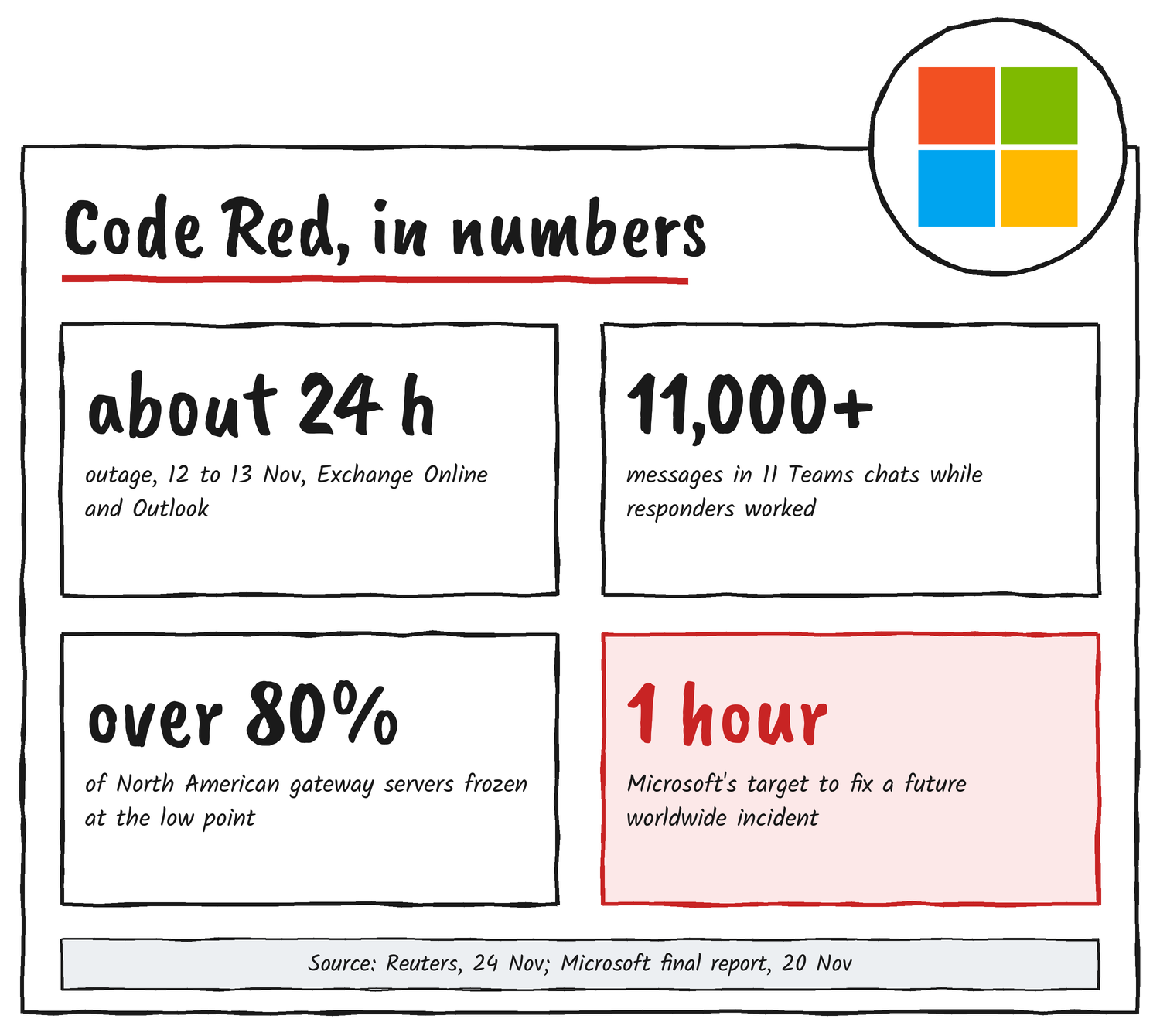
Microsoft has declared a Code Red, the most urgent alert it has, to overhaul how it prevents and responds to major outages, Reuters reported on 24 November (US time), citing internal memos it reviewed. The trigger was the 12 and 13 November failure, which knocked Exchange Online, Outlook, Teams and Copilot offline for about 24 hours. Jason Henderson, who runs Microsoft 365 Core, told staff it was the most customer-impacting incident in Exchange Online’s history. Next time, Microsoft wants a worldwide fix inside an hour.
Code Red means that this is the highest priority work for our team.
Jason Henderson, M365 Core President, in a memo to staff on 20 November, as reported by Reuters
What the memos say
Reuters saw memos from Friday and Monday, plus one from earlier in the month. Henderson’s Friday memo is dated 20 November, the day Microsoft published its final post-incident report. In it he said so many customers had never been without email for so long, and that he’d reviewed the organisational and structural problems behind the failure.
Unfortunately, all the work we have done over the years was not sufficient to protect us on Thursday.
Jason Henderson, memo to staff, per Reuters
Amanda Silver, a corporate vice president who oversees M365 Core and Work IQ, wrote the second memo on Monday 23 November. Responders, she wrote, worked through a “fog of war”. Despite top engineers on the job, they traded more than 11,000 messages across 11 Teams chats and couldn’t keep one shared picture of their theories and decisions, because the diagnostic data was spread over fragmented internal tracking systems.
Silver’s memo also records a line from Charles Lamanna, Microsoft’s executive vice president for Copilot, Agents and Platform. He told a Code Red review that the affected component had experienced “roughly ten years’ worth of acceptable failures”. Reuters doesn’t say what that measure counts.
Silver set out five workstreams. Reuters names three: load shedding, geographic traffic partitioning and faster recovery mechanisms. The target is worldwide resolution within an hour during future incidents, and Microsoft plans to use AI agents to help engineers read system health data faster. Henderson will hold daily meetings with the Substrate leadership team, which oversees the engineering group behind Microsoft 365’s underlying services, plus weekly reviews. A company spokesperson told Reuters that “our work doesn’t end when service is restored” and that teams are working around the clock to apply the lessons.
What Microsoft’s own report had already admitted
The Code Red memos sit beside Microsoft’s final post-incident report, which administrators can read in the Microsoft 365 admin centre under EX1550543 and MO1550821. It names four factors. A Windows update on the gateway servers that front Microsoft 365 carried a latent defect: under load, tasks inside one process waited on each other until the machine ran out of processor and memory. The update began rolling out in July and ran worldwide for more than three months without trouble. It hit only Microsoft’s newer servers, which have more cores and so more contention, and Microsoft’s load tests ran on older hardware.
Three routine conditions then lined up on 12 November. Nearly 14% of the gateway’s server capacity was out for planned maintenance. A routing problem in the US East region had shifted Teams traffic onto the gateway that also serves Exchange Online at 1:07am UTC. And North American traffic was climbing to its daily peak. Servers froze, Microsoft’s traffic systems pushed their load onto the healthy ones, and the same defect hit those in turn. In under two hours a significant part of the North American fleet was affected, and more than 80% of servers were unresponsive at the lowest point.
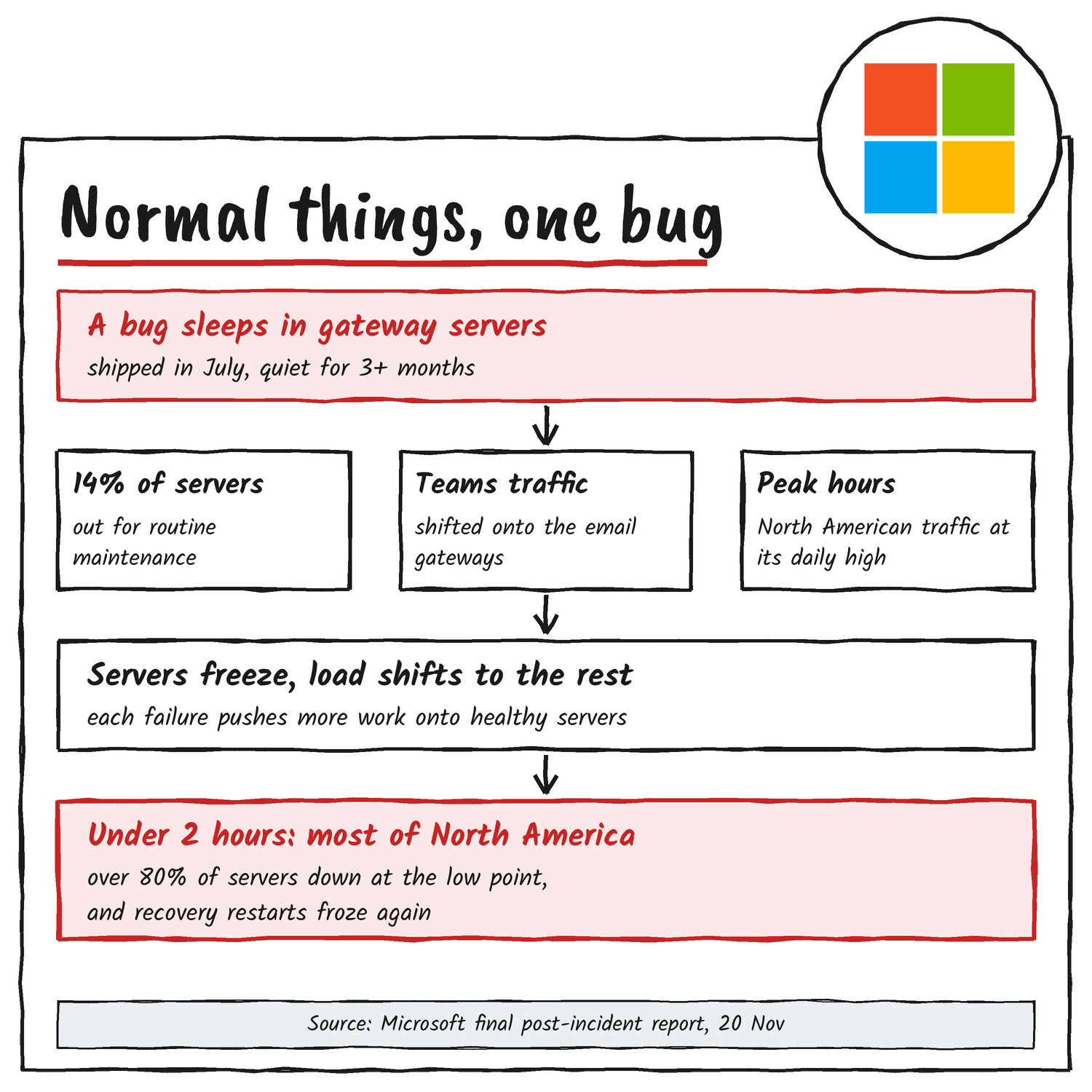
Recovery was slow for a second set of reasons. Servers that came back were swamped by waiting clients and froze again. Fixing one meant taking it out of service, restarting it from its failed state, patching it, restarting it again and putting it back, across thousands of capacity units. And because the bug came from a change made months earlier, the usual safeguards for recent changes couldn’t quickly undo it. Microsoft says no enterprise mail was lost and extended its delivery retry window from 24 to 48 hours. Some delayed messages to consumer mailboxes that had been inactive for more than 30 days expired, and their senders received bounce notices.
The report lists 13 next steps. Four are due by the end of 2026, five by the end of March 2027, and four have no date.
| Due | Fixes |
|---|---|
| End of 2026 (four) | Stop failures cascading across regions; fail Teams over only in the affected region, not worldwide; detect extended capacity loss; speed up the first customer notice, which went out about 20 minutes after broad impact |
| End of March 2027 (five) | Split the gateway into pools for different workloads; load test on the newest, highest-core hardware with production-like traffic; add capacity headroom; improve diagnostics and change auditing for Windows changes; improve recovery across the fleet |
| No date (four) | Smaller fault zones; failover drills that cover peak conditions; gradual traffic ramp-up when servers rejoin; better retry and back-off behaviour |
The report also says what the outage wasn’t: “This incident was confirmed not to be caused by a cyberattack, and we found no evidence of malicious activity. This change was not caused by AI tooling.” Reuters carries the same denial.
The patching admission
The most telling line comes from another Henderson memo, written earlier in November. Urgent patches to M365 Core services, he said, took too long to deploy worldwide.
In a separate recent incident, an urgent production fix took five to six days to reach worldwide saturation. For our most urgent security issues, we need to get from detection to safe worldwide deployment in an hour. Needless to say, we aren’t here yet.
Jason Henderson, earlier memo, per Reuters
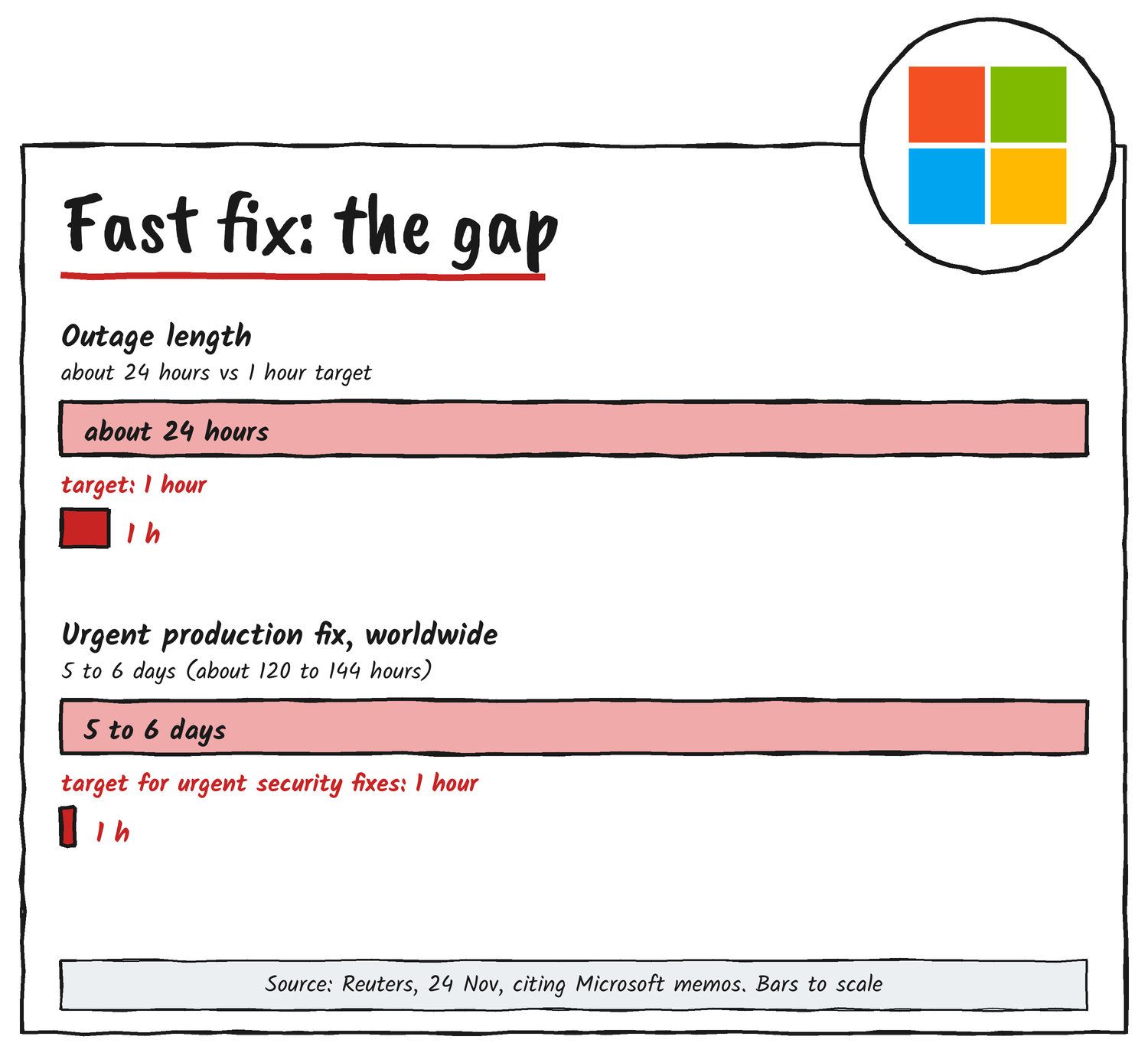
Reuters doesn’t name the incident Henderson means. His point drops into a debate Microsoft’s CEO has already joined. Satya Nadella said at the New York Times DealBook Summit that AI is finding software flaws faster than companies can safely fix them, so patches now go “instantly from being available to being patched in production, because it’s being exploited in the wild”, which he said creates instability. He also said the outage had no direct link to that problem, calling it “a latent bug that was there” and “one of those perfect storms”, according to The Next Web. Our earlier piece on the claim that rushed patching is behind the wave of outages sets out what the primary records tie to patching, and Microsoft’s report says its own change wasn’t AI-made.
Nadella told CNBC on 18 November that Microsoft could have done more: “Of course, we should have done the testing before. We should have figured out how to have the bulkheads such that you didn’t have a global outage.” At Ignite he said: “I know we have work to do to provide that resilience that you can count on.”
How far it reached
74
countries affected, at least, per the BBC
7.4M
Downdetector reports worldwide, per Reuters
US$300m-500m
estimated insured losses, per Morningstar DBRS
Reuters says the outage hit governments from Australia and Japan to the United States, delayed trading firms and disrupted airline communications. The BBC’s roundup has Australia’s ASIO and federal police affected, Japan’s shared government IT platform disrupted, Singapore’s courts without email, and Euronext telling listed companies to use the phone. Taiwan’s securities firms and insurers had fund management disrupted, and two companies, Workhorse Group and Richemont, reported results late, according to StockAnalysis. Microsoft shares were down 2.9% in premarket trading on 13 November, when analyst Josh Gilbert of eToro said investors would likely look past it because “very few of these customers can realistically walk away from the Microsoft ecosystem overnight”.
New Zealand felt it from about 6.30am on Friday 13 November. The Post reported that Health NZ staff fell back on phone, fax and printed forms with what a spokesperson called minimal disruption, that the Ministry of Social Development lost Outlook, and that visa processing at MBIE halted. Immigration New Zealand says the outage pushed system changes planned for 16 November back to 23 November. In the UK, Minister Ian Murray told MPs on 16 November there were no major critical service impacts and that the incident could have been more serious had it lasted longer, openDemocracy reports. The Competition and Markets Authority found last year that Microsoft and AWS each hold up to 40% of UK cloud customer spend.
The Australian Computer Society used the week to renew its call for a national review of sovereign risk in Australian IT, Australian Cyber Security Magazine reports. Its CEO, Prins Ralston, asked where the direct updates to Australian customers were, and noted that service credits “won’t make up for a lost morning of trade for a small business”.
Code Red in context: peers and precedent
The label isn’t new. Google’s management declared one in December 2022 to redirect teams after a rival’s chatbot launched. Microsoft’s own closest precedent is the Secure Future Initiative, launched in November 2023 and widened in May 2024 when Nadella told staff security came above everything else and tied part of senior leaders’ pay to it. Reuters doesn’t report any pay link for the Code Red.
The nearest outage peer is Cloudflare. After global outages on 18 November and 5 December 2025, it declared “Code Orange: Fail Small” on 19 December, pausing other work to require controlled rollouts for configuration changes, test failure modes and remove circular dependencies in its emergency procedures. Its post of 1 May 2026 says that after “two and a bit quarters” the work that would have avoided both outages is finished. Microsoft’s own dated items run to March 2027. Several of Microsoft’s 13 fixes, such as smaller fault zones and a gradual ramp-up when servers rejoin, aim at the same weakness: one failure spreading everywhere at once.
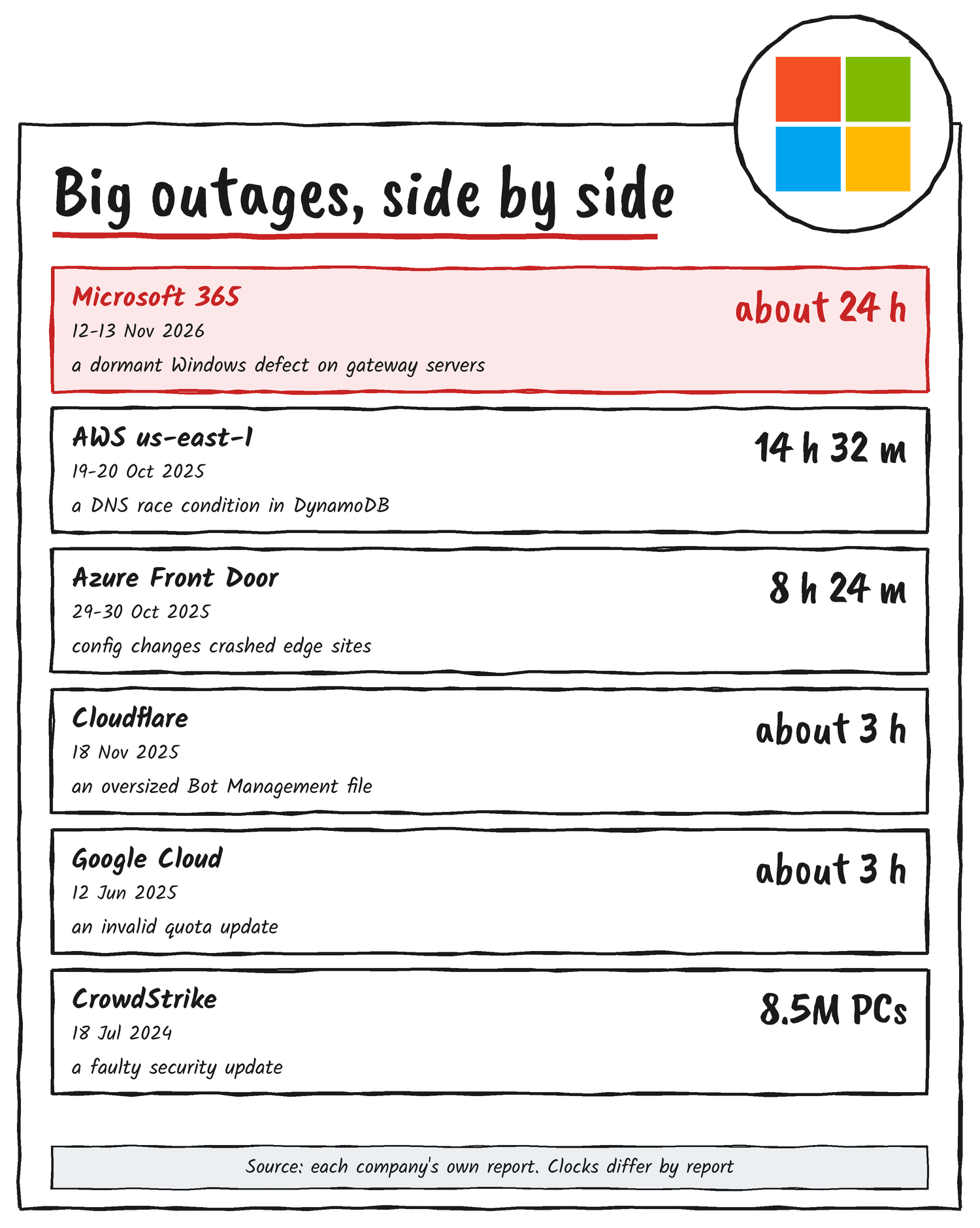
Look at the other big cloud failures of the past 18 months and the pattern repeats. AWS’s October 2025 outage came from a race condition in DynamoDB’s DNS management. Azure Front Door’s outage on 29 October 2025 came from valid customer configuration changes that produced incompatible metadata and crashed edge sites, a gap Microsoft’s own review traced to pre-production validation. Cloudflare’s 18 November 2025 outage came from a database permissions change that doubled a Bot Management file, and Google Cloud’s 12 June 2025 outage from an invalid automated quota update. The durations in the graphic come from each company’s own report and count different things, so they’re a guide, not a league table. CrowdStrike’s July 2024 update reached about 8.5 million Windows devices, which Microsoft put at under 1% of all Windows machines.
On cost, Morningstar DBRS’s Mario De Cicco estimated insured losses from this outage at US$300 million to US$500 million, below the US$400 million to US$1.5 billion he put on CrowdStrike, according to Reuters via RNZ. Reuters counts this as Microsoft’s second 365 disruption of 2026, after one in January.
What it means if you run Microsoft 365
Microsoft’s service level agreement pays in credits, not cash. Office 365 for IT Pros sets out the tiers: 25% for monthly uptime under 99.9%, 50% under 99% and 100% under 95%. Credits are the “sole and exclusive remedy” and come off future fees, and most organisations buy bundles such as E5 rather than Exchange Online alone, so the maths follows the service that failed. Office Watch works through a 50-user office and says the most a 50% credit could be worth on Business Standard is $350 a month, with a figure nearer $100 if it’s measured against an Exchange Online Plan 1 price. Only time users truly couldn’t send or receive counts, because the agreement excludes slowness that isn’t unavailability.
- Check your own agreement for how and when to claim, and gather timestamps and screenshots now.
- Decide before the next outage how staff reach each other when email is down. Euronext used the phone, and some organisations went back to fax.
- Watch Microsoft’s dated fixes. The end-2026 items include a faster first notice and regional Teams failover.
How does one bug take down so many servers? A plain-words version
Picture ten shop tills sharing a queue. If three break, customers move to the other seven. Those seven now work harder, and if the hard work is what breaks tills, more fail, and the queue moves to the few left. Microsoft’s gateway behaved like that: each failure made the next one more likely, and tills that came back were mobbed by the waiting queue and broke again.
What isn’t public
Microsoft hasn’t published the memos. Everything above from them comes from Reuters, which reviewed them. Reuters names three of the five Code Red workstreams. Microsoft hasn’t said when the Code Red ends, what its AI agents will do for engineers, or what the “ten years’ worth of acceptable failures” counts. Four of the 13 fixes have no date.
Earlier coverage

Discover more from Sulat AI & Tech News
Subscribe to get the latest posts sent to your email.