Lizard, a cloud-sandbox company founded this year, has released lzs, a free MIT-licensed command-line tool that starts Claude Code, Codex or OpenCode in cloud sandboxes, up to 50 at once, and keeps them running while a laptop sleeps. Lizard’s post on X says the job is “42x cheaper” than on Vercel Sandbox. The sum behind that figure compares a machine half the size of Vercel’s smallest.
The post went up at 6:19am NZ time on 25 November (17:19 UTC on 24 November). It quotes Pranit Sharma, a Vercel engineer, who had published his own tool for running agents in Vercel Sandboxes a day earlier.
What lzs does
Run lzs in a repo and it uploads the code, uncommitted work included, starts the agent in tmux inside a fresh sandbox and attaches your terminal to it. Close the lid and the agent keeps working. lzs can send a notification through ntfy, Slack, Discord or Telegram when an agent finishes or needs an answer.
Setup happens once. lzs init installs tmux, Claude Code, Codex and OpenCode in a build sandbox, copies your agent settings with secrets stripped, saves the result as a snapshot and deletes the build sandbox. Every session then boots from that snapshot. The README says that takes about 3 seconds, and its sample output shows five sessions starting in 3.1 to 3.6 seconds each.
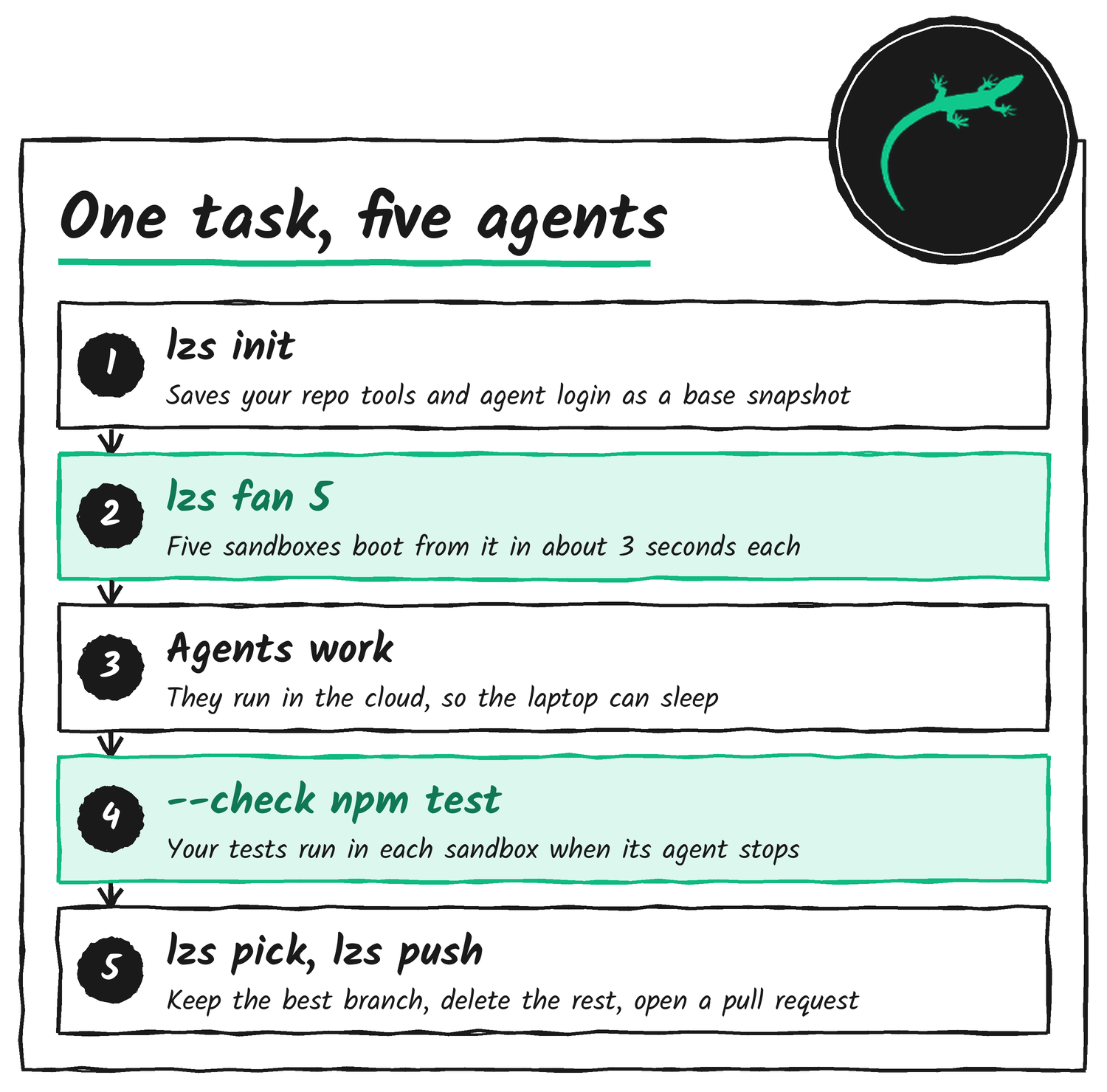
The workflow the README is built around is best of N. One command starts five agents on one task. When an agent stops, lzs runs your tests in its sandbox, and lzs diff lists the results with passing ones first. lzs pick keeps one as a branch and deletes the rest, and lzs push opens a pull request. The fan command starts at most 50 sessions and asks for confirmation above 20.
A session pauses itself after 30 idle minutes and wakes in about 3 seconds with the conversation intact. Paused sessions don’t pay for compute. Every session stops after 24 hours of running. lzs needs macOS, Linux or WSL, Node.js 18 or newer, git, a Lizard account and a login for whichever agent you use. Native Windows isn’t supported.
Where it came from: fxs and Vercel
The README closes with “Inspired by fxs” and credits Pranit Sharma’s repository, created on 23 November under an MIT licence. fxs runs fx, Claude Code, Codex or OpenCode in Vercel Sandboxes, with a snapshot-backed start, sessions that survive laptop sleep and a sandbox that stops after 30 idle minutes. lzs carries over the same shape, down to a group command that opens several sessions side by side.
Sharma’s site and GitHub profile list him as a Vercel engineer. He builds fx, Vercel Labs’ open-source coding agent, written in Zig and released in August. fxs sits in his personal GitHub account, not Vercel’s.
Lizard’s reply says the Mac “shouldn’t be the bottleneck for running agents, and neither should the price”. Vercel has leaned into the same use. Conductor, a desktop app for running coding agents in parallel, built its cloud workspaces on Vercel Sandbox, according to a Vercel customer story from 27 May. Rex’s cloud option runs on it too, as covered in our earlier deep dive on Rex.
How the 42x is built
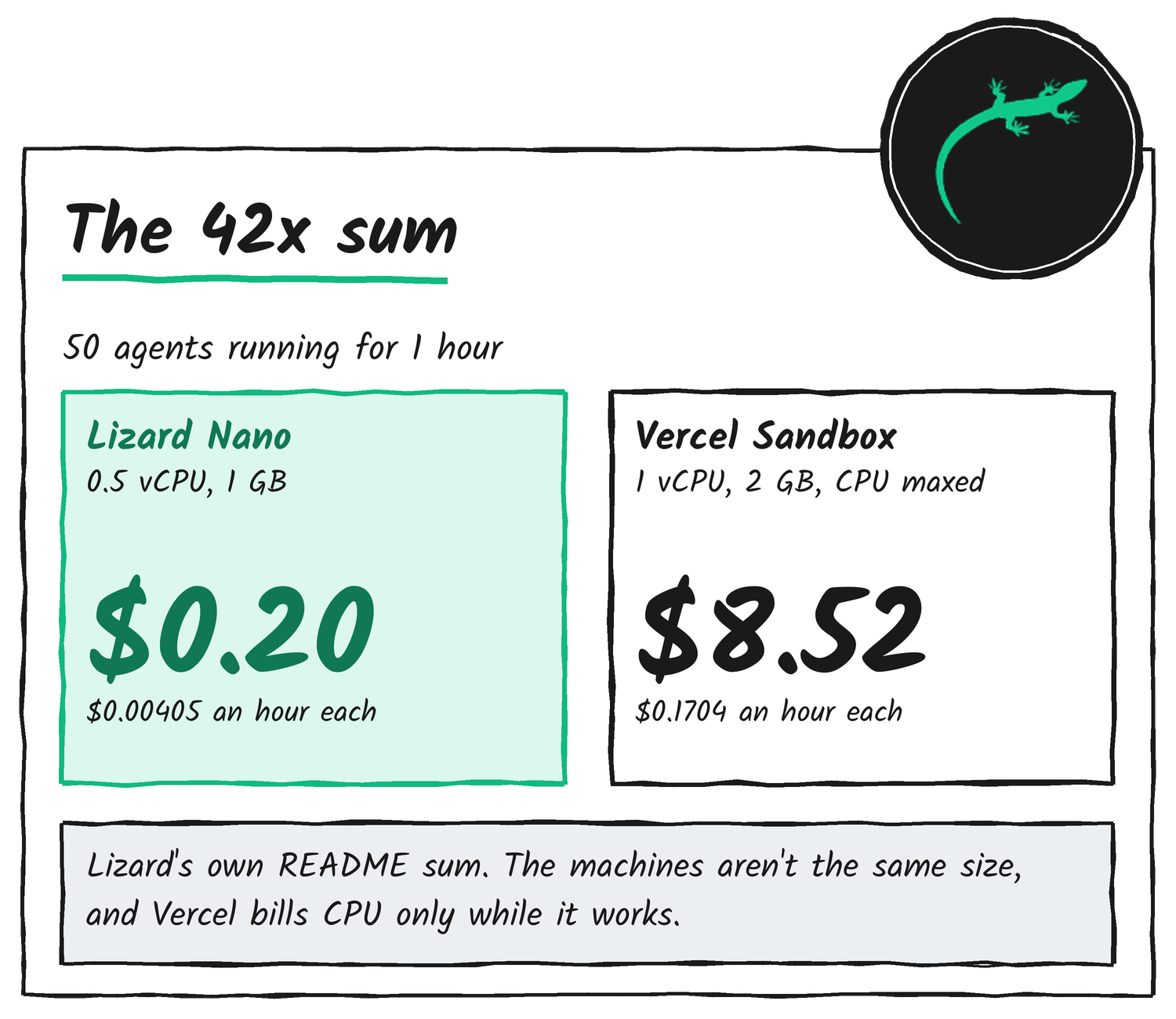
The README shows its working. Lizard’s Nano size is half a vCPU and 1 GB at $0.00405 an hour, so 50 sandboxes for an hour cost $0.20. For Vercel it takes the smallest sandbox, 1 vCPU and 2 GB, at Vercel’s published $0.128 an hour for active CPU and $0.0212 per GB-hour of memory, with the CPU busy the whole hour. That’s $0.1704 an hour each, or $8.52 for 50. I checked both sums against the two companies’ pricing pages and they hold.
The comparison isn’t like for like. Nano is half the size of Vercel’s smallest. Lizard’s Mini size, 1 vCPU and 2 GB at $0.0081 an hour, matches it, and against Mini the same sum gives 21x. Vercel also bills CPU only while code runs. Its docs example puts a 1 vCPU, 2 GB sandbox idling at 1% CPU at $1.05 a day, about $0.044 an hour. That’s 5.4 times Mini and 10.8 times Nano. Lizard’s README itself says about 18x for a typical agent.
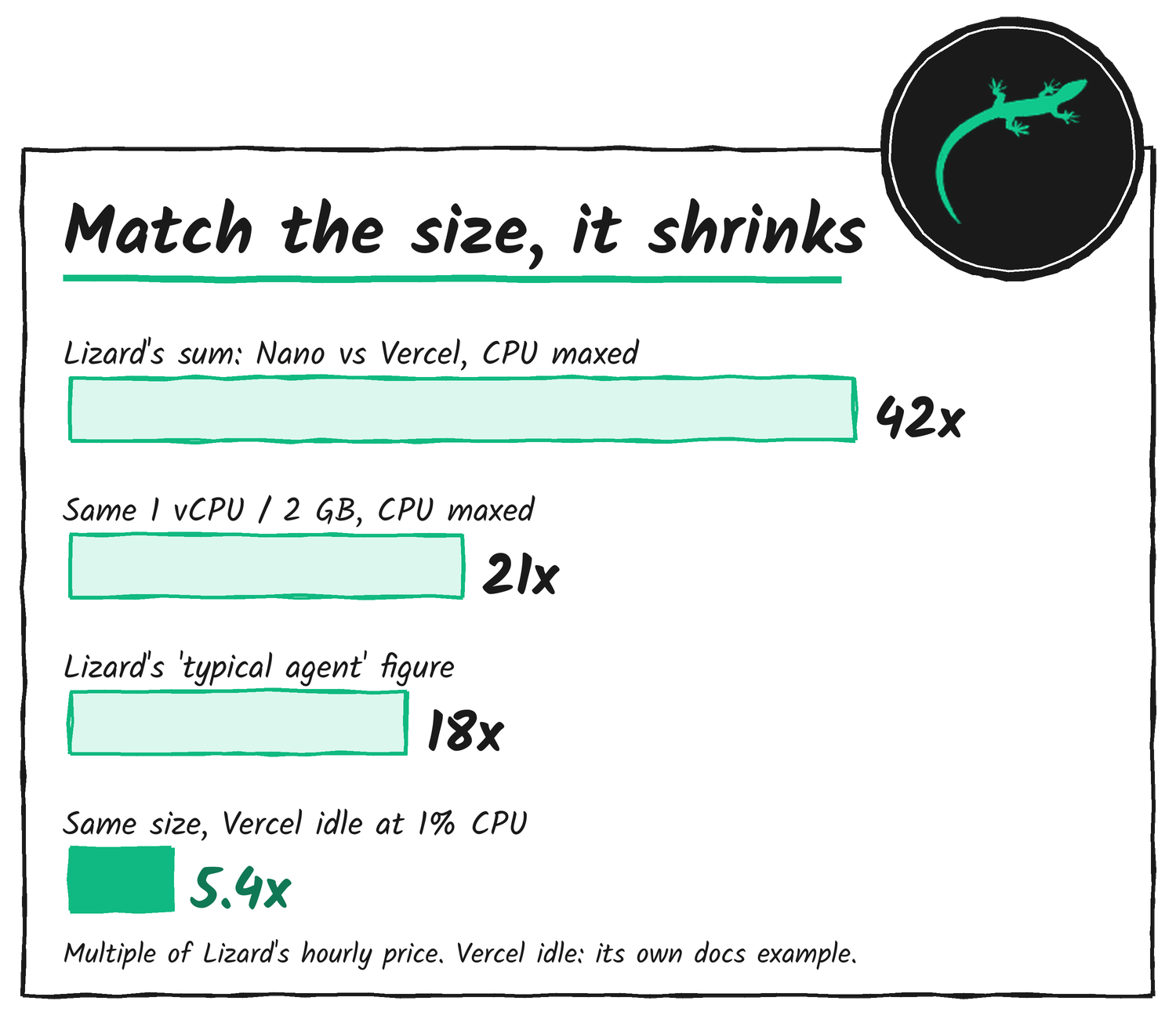
| Comparison | Lizard | Vercel | Gap |
|---|---|---|---|
| Lizard’s headline (Nano vs 1 vCPU/2 GB, full CPU) | $0.00405/h | $0.1704/h | 42x |
| Matched size (Mini vs 1 vCPU/2 GB, full CPU) | $0.0081/h | $0.1704/h | 21x |
| Idle agent (Mini vs 1% CPU) | $0.0081/h | about $0.044/h | 5.4x |
| Lizard README, “typical agent” | n/a | n/a | about 18x |
Two more details change the sum. Lizard bills the full running time at a flat rate, idle included, while Vercel bills active CPU plus provisioned memory. Lizard’s own comparison guide says that for an agent waiting on a model, providers that bill active CPU can narrow the gap. The plan limits also disagree. The lzs README says Pro, at $19 a month, runs 40 Nano sessions at once and the $99 plan runs 220, so 50 agents needs the $99 plan. Lizard’s pricing page lists 100 Nano at once on Pro. Neither sum includes plan fees: Lizard Pro includes $19 of usage, and Vercel Pro includes a $20 credit.
Three seconds or 200 milliseconds
The post says a new agent starts in a sandbox in 200 ms. That measures something different from the 3 seconds in the README. The 200 ms-range figure comes from Lizard’s own benchmark of 12 October, where the median time from a create request to the first verified Python output was 228 ms. E2B took 264 ms, Daytona 819 ms and Modal 929 ms, over 300 starts each from a Railway server in US East. Lizard’s page notes the providers used different regions, templates and sizes, and that starts can use prepared capacity. Vercel Sandbox wasn’t in the test. The 3 seconds is lzs bringing up a full session from a snapshot, with your repo and agent.
What “open source” covers
The post calls lzs open source, and it is: the repository is MIT-licensed, and Lizard’s SDK is Apache-2.0. Lizard’s GitHub organisation also holds public repositories for its command-line tool, an MCP server and integrations with ADK, smolagents, Inspect AI and Mastra. I haven’t checked the licences on those.
What isn’t open is the part that runs the sandboxes. Lizard’s site lists self-hosting under “Not on Lizard yet” and says every sandbox runs in Lizard’s cloud, in US East or EU West. lzs is a client for that service and needs a Lizard account to do anything.
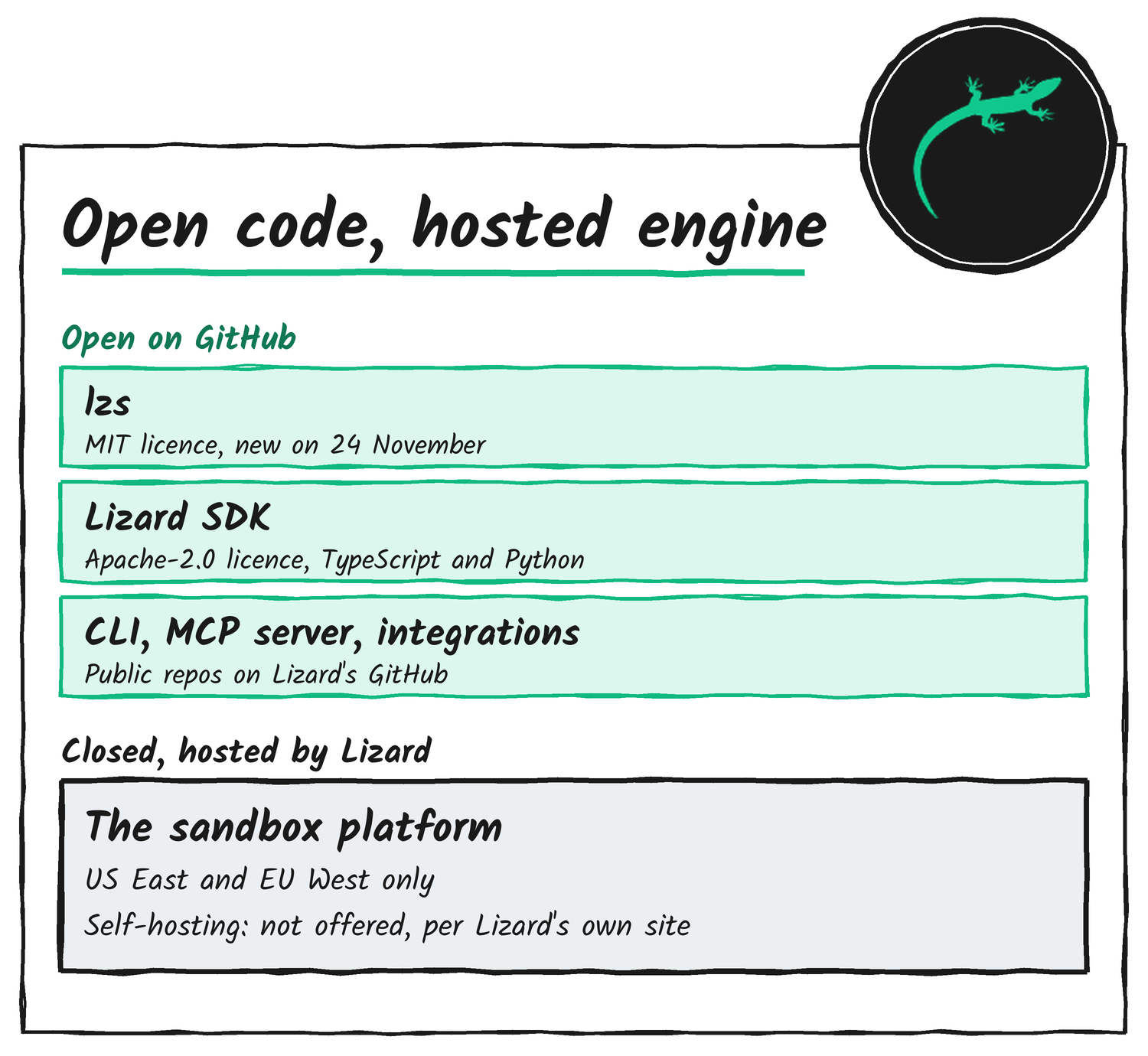
Peers differ here. Vercel open-sourced its Sandbox SDK and command-line tool when Vercel Sandbox reached general availability on 30 January 2026. Lizard’s comparison guide lists E2B as publishing its runtime under Apache-2.0, and Kubernetes Agent Sandbox as the self-hosted option. It lists no self-hosting for Vercel.
Limits and risks
lzs runs agents with their permission prompts off. The README tells users to assume anything in a session, including a repository that instructs the agent, can run any command there as root. The sandbox holds a Lizard key scoped to the project, and snapshots are readable by project members, so the README advises a dedicated project.
The free trial is tight for this workflow. It needs a card, includes $5 of usage, runs 2 sessions at once, and deletes every sandbox an hour after it starts, even a paused one. The README says to pull your work before the hour is up.
Who Lizard is
Lizard is the trading name of Dragon Labs LLC, a Delaware company, according to the sandbox directory Botperch. Botperch names Yura Dubinin, co-founder and president, and Mikhail Erin as the founders, says Lizard was founded in 2026 with no funding announced, and says its infrastructure runs on OVHcloud in Germany and the US. LinkedIn lists two employees, and Lizard’s site claims 470 developers. Botperch also says Lizard publishes no SLA outside Enterprise, lists SOC 2 as coming soon and offers no BAA.
A vendor’s table of 12 sandbox providers
Dubinin wrote Lizard’s 16 November comparison guide, which compares 12 sandbox providers at 2 vCPU and 4 GB using each provider’s own pricing page, read on 15 November. It says Lizard sells one of the 12 products, and Lizard ran no speed test of the other 11. I cross-checked the E2B, Daytona and Modal rates against a pricing guide from Fly.io, itself a competitor, and the per-vCPU and per-GB rates match.
The other side of the table
Vercel’s pitch runs the opposite way. Its Sandbox page says Active CPU pricing gives up to 95% lower cost for workloads with bursty or I/O-bound patterns, and its Pro plan allows 10,000 sandboxes at once, against 600 Small sandboxes on Lizard’s top self-serve tier. An agent that spends most of its time waiting on a model is that kind of workload, which is why the idle row in the table above matters more than the headline.
The 42x is Lizard’s arithmetic, and it’s correct for the two machines it chose. For most people running one agent at a time, the number to plan around is the matched-size 21x, or lower if the agent mostly waits. The lzs README holds the commands and limits, and both vendors’ pricing pages hold the rates used here.
Discover more from Sulat AI & Tech News
Subscribe to get the latest posts sent to your email.