Anthropic’s ClaudeDevs account has posted a recorded conversation about Claude Managed Agents, in which the product manager and two engineers behind it say Anthropic built the infrastructure three times before turning it into a platform for customers. The video, “Lessons from building agents on the Claude Platform”, went up on Claude’s YouTube channel on 24 November 2026, US time.
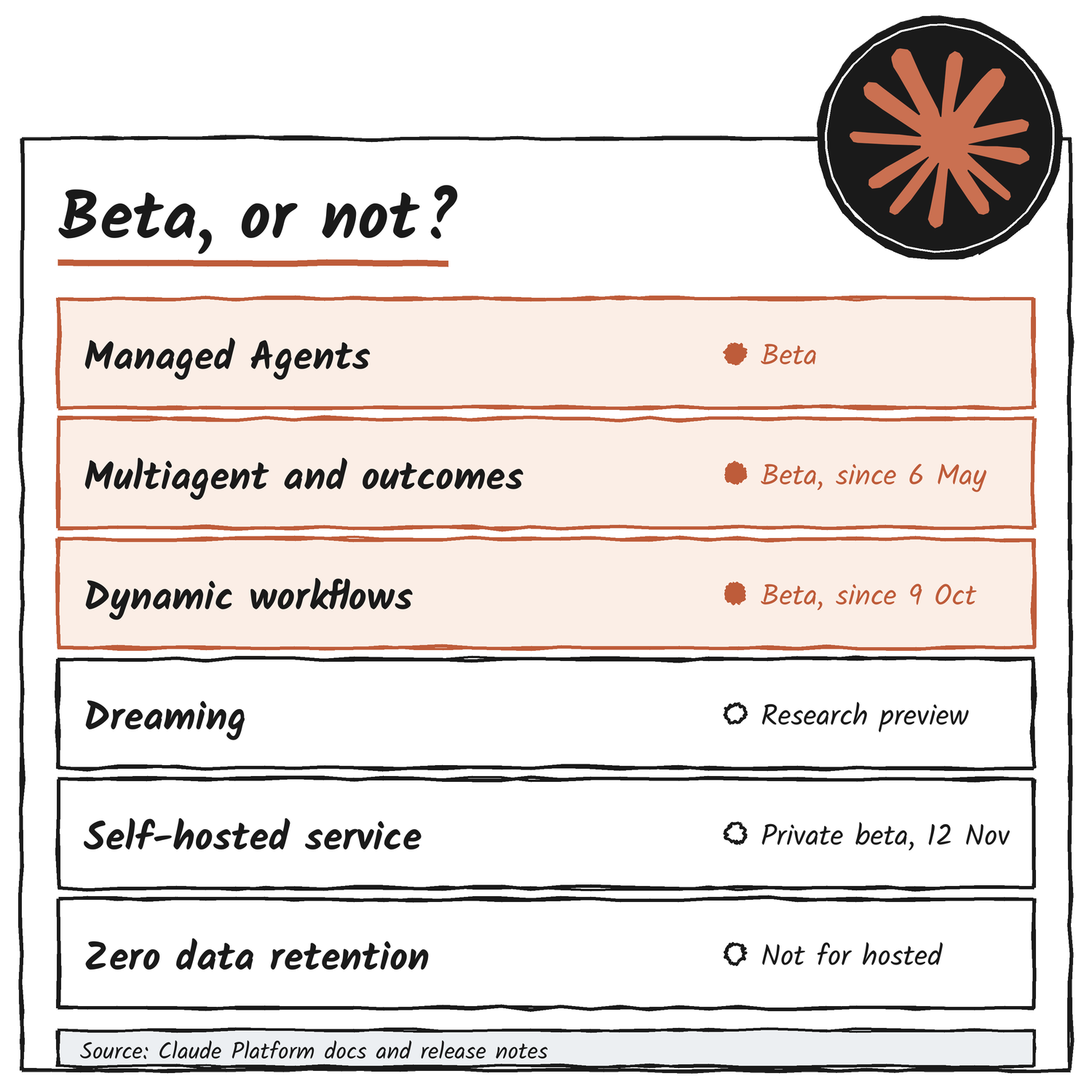
The speakers are Jess Yan, product manager for Claude Managed Agents; Michael Cohen, a member of technical staff on Managed Agents; and Lance Martin, a member of technical staff on the Claude Platform. Anthropic’s chapter list covers why it built the product, keeping up with new models while managing cost, dynamic workflows and multi-agent harnesses, separating the “brain” from the “hands”, how customers build with it, and how dreaming and agent memory work. A footnote in the description says Managed Agents and dynamic workflows are in beta and dreaming is a research preview.
The figures below come from Anthropic’s written engineering post, docs and release notes. The talk’s own numbers aren’t quoted here.
What Managed Agents is
Managed Agents is Anthropic’s hosted service for long-running agents. You define an agent and an environment once, then run sessions against them. Each session gets its own isolated sandbox, and the platform stores its event history, sandbox state and outputs on Anthropic’s servers, so work can pause and resume. The built-in tools are bash, file operations, web search and fetch, and MCP servers. Every endpoint needs the managed-agents-2026-04-01 beta header, and every API account has access by default.
It’s the same product covered in the earlier piece on self-hosted Claude Managed Agents. That story was about where the service runs. This one is about why it’s built the way it is.
The pet that became cattle
Anthropic’s engineering post of 8 April 2026 describes the first design. The session, the agent harness and the sandbox all lived in one container. Anthropic calls that a “pet”, in the infrastructure sense of a server you can’t afford to lose: if the container failed, the session was lost, and debugging a stuck one meant opening a shell inside a container that also held user data. Customers who wanted Claude to work against resources in their own virtual private cloud had to peer networks with Anthropic or run the harness themselves.
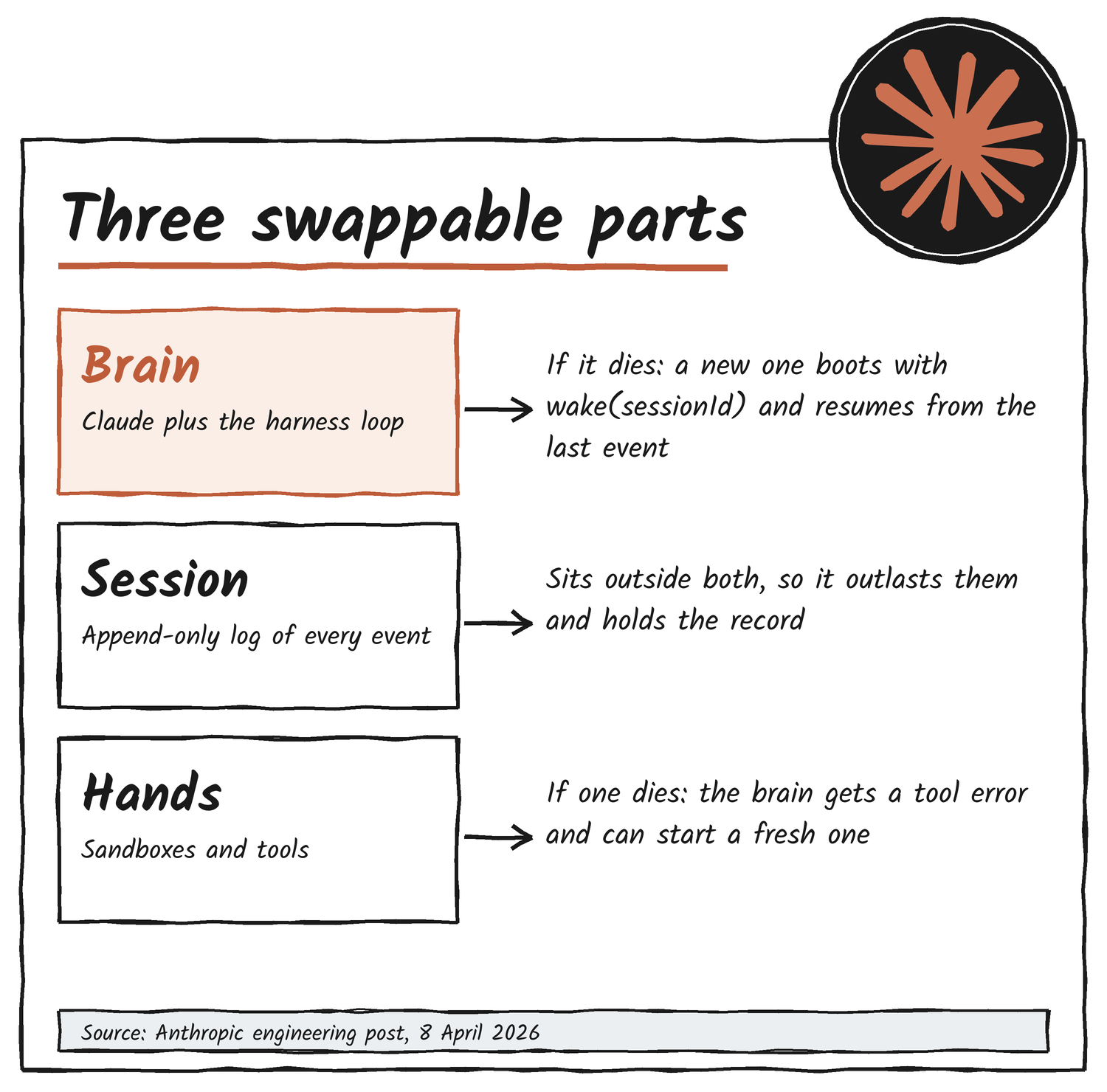
The fix was to split the agent into three parts. The brain is Claude plus the harness, the loop that calls the model and routes its tool calls. The hands are the sandboxes and tools. The session is an append-only log of every event, stored outside both. If a sandbox dies, the harness sees a failed tool call and Claude can start a fresh one. If a harness dies, a new one boots with wake(sessionId), reads the log and carries on from the last event.
The split also changed security. In the coupled design, code Claude wrote ran in the same container as the credentials, so a prompt injection only had to persuade Claude to read its own environment. Now the tokens sit outside the sandbox. Git credentials are wired in at setup, and MCP calls go through a proxy that fetches the credential from a vault, so the harness never sees it.
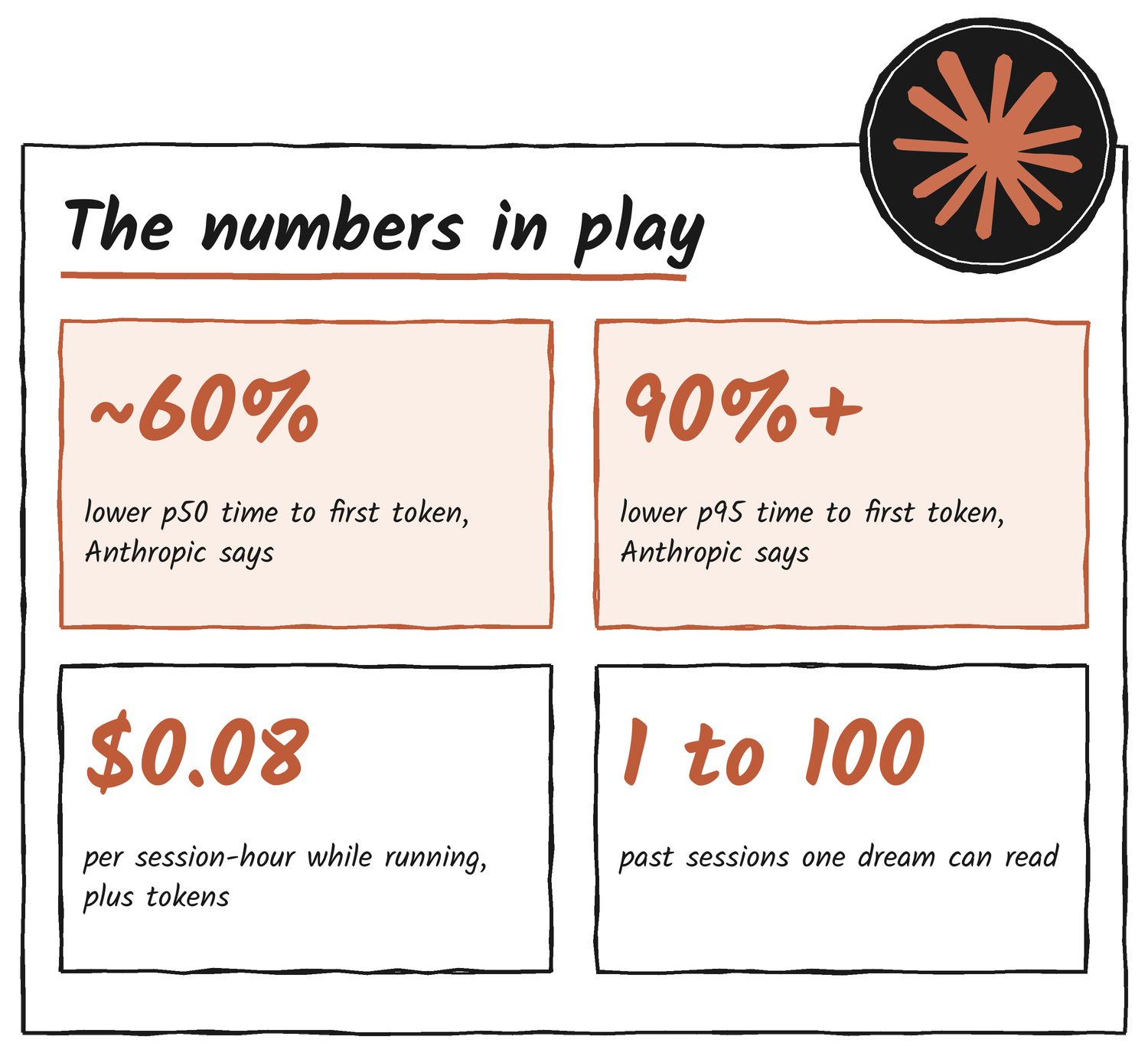
Latency improved too. A container is only provisioned when a tool call needs one, so a session that doesn’t need a sandbox right away no longer waits for it. Anthropic says its median time to first token dropped by roughly 60% and the 95th percentile by more than 90%.
What’s been added since launch
| Date | Change | Status |
|---|---|---|
| 8 Apr 2026 | Engineering post describes the brain, hands and session split | Beta |
| 6 May 2026 | Multiagent orchestration, outcomes and webhooks | Beta |
| 6 May 2026 | Dreams, which curate memory from past sessions | Research preview |
| 9 Oct 2026 | Dynamic workflows, where the agent writes a program that runs many agents in phases | Beta |
| 12 Nov 2026 | Self-hosted Managed Agents | Private beta |
Outcomes let you write a rubric, and a separate grader scores the agent’s work against it in its own context window. Anthropic’s 19 May post says outcomes lifted task success by up to 10 points over a standard prompting loop in its tests, with gains of 8.4% on Word documents and 10.1% on PowerPoint files in internal benchmarks.
A dream is an asynchronous job. It takes an existing memory store plus 1 to 100 past sessions and writes a separate, reorganised output store, with duplicates merged and stale entries replaced. Dreams are billed at standard token rates for the model you pick, and access is by request. Anthropic’s cookbook, published on 2 November, shows a nightly version built with a dynamic workflow. The same May post says the legal AI company Harvey saw completion rates rise about sixfold in its tests with dreaming, and that Wisedocs document reviews now run 50% faster using outcomes.
Dynamic workflows are for work with many pieces, such as reviewing hundreds of documents. You switch them on in the agent’s multiagent field, tell the agent in its system prompt when to start a run, and follow progress through workflow_run.* events on the session’s event stream.
What it costs, and what it doesn’t cover
Anthropic’s session budgets page prices a session at public list rates: model tokens, web searches at US$10 per 1,000, and US$0.08 for each hour a session is running. You can set an optional hard ceiling, and the platform stops issuing new model requests once the session’s list cost reaches it.
The hosted service isn’t eligible for zero data retention or for a HIPAA business associate agreement, because sessions are stateful and their transcripts persist until you delete them. Self-hosted Managed Agents is the exception for zero data retention. For Anthropic’s wider programme, see the earlier piece on its zero-data-retention safeguards.
How the other clouds’ agent runtimes compare
Amazon and Microsoft both sell managed runtimes for agents, and both isolate each session. The difference is who writes the agent loop. Anthropic’s service runs Claude’s own harness. AWS and Microsoft host agent code you bring, in whatever framework you use. AWS also offers a managed harness of its own, and Anthropic lists Claude Platform on AWS, launched on 11 May, as a way to reach Managed Agents through AWS billing and IAM.
| Service | Isolation | Agent loop | Billing | Idle and lifetime |
|---|---|---|---|---|
| Claude Managed Agents | An isolated sandbox per session | Claude’s harness, with built-in tools | Tokens plus US$0.08 per running session-hour | Sessions persist and resume after pauses |
| Amazon Bedrock AgentCore Runtime | A dedicated microVM per session | Your code, any framework or model | Per second for CPU and memory used; US$0.0895 per vCPU-hour on v1 | Ends after 15 minutes idle or 8 hours total |
| Microsoft Foundry hosted agents | A VM-isolated sandbox per session | Your container, any framework | CPU and memory used during active sessions | Idle timeout 2 minutes to 4 hours, default 15; deleted after 30 days idle |
Microsoft said at Ignite that it will let Foundry’s agent runtime run on a customer’s own AKS cluster, in a public preview it targets for early December. That puts it alongside Anthropic’s self-hosted option in letting some of the hosting move onto the customer’s side.
Anthropic hasn’t said when Managed Agents leaves beta. Product updates from the team appear on the ClaudeDevs account, and the docs list the beta header and the access form for dreaming.
Discover more from Sulat AI & Tech News
Subscribe to get the latest posts sent to your email.