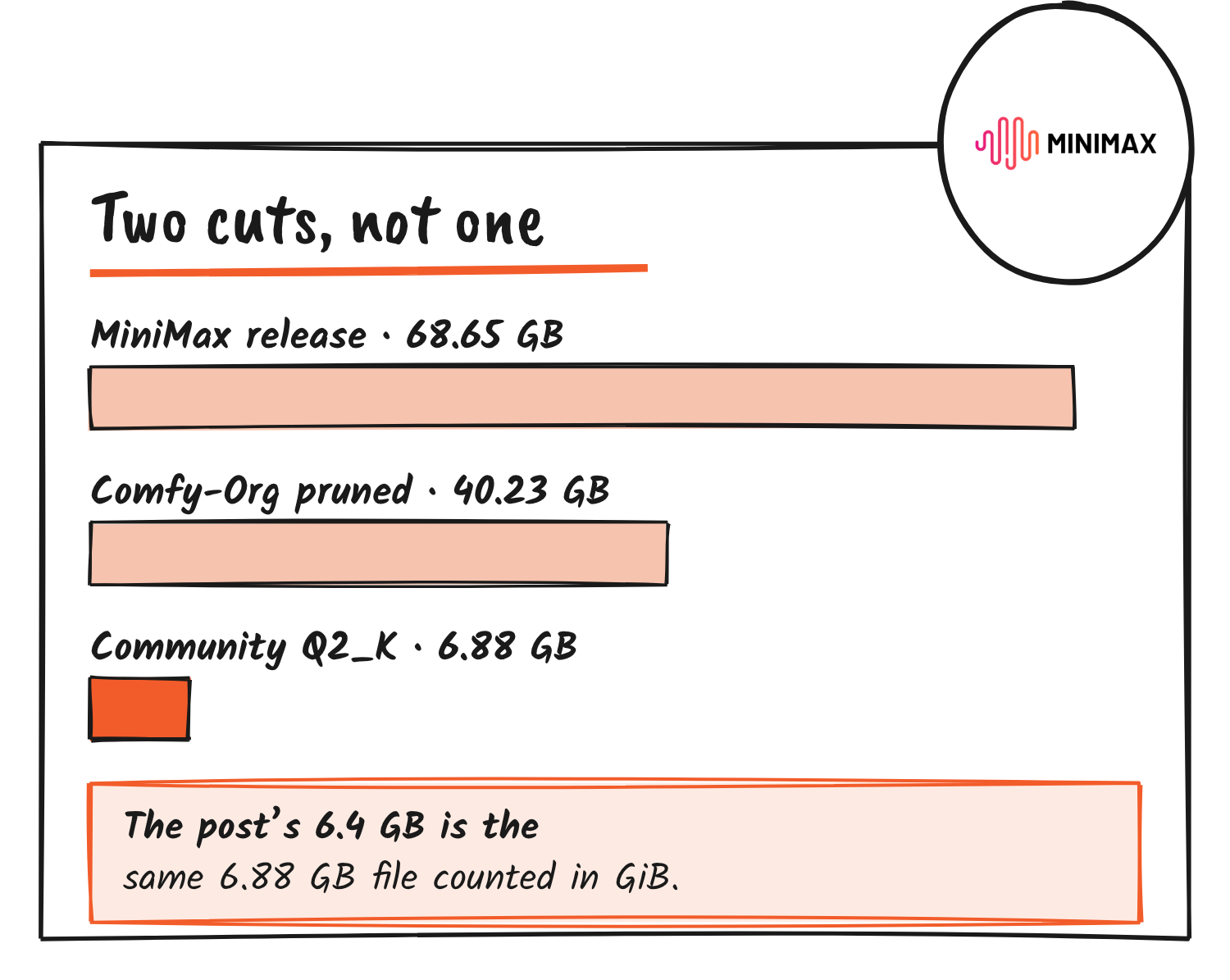
A viral X post says the open-weight image model MiniMax-H3-Image now fits in 6.4 GB. The number holds for one community file, a 6.88 GB Q2_K quantisation by Hugging Face user Abiray, counted in gibibytes. It covers only the image model, not the 12 GB text encoder the model needs to read a prompt.
DeepTechTR, a Turkish-language tech account on X with more than 31,000 followers, posted on 15 November (NZ time) that the open-source community had cut MiniMax-H3-Image from 68.65 GB to 6.4 GB. The post lists 33.1 billion parameters, a 10.78 GB Q4 version, native 4096 by 4096 output, six-step generation and 16 reference images for character consistency. It calls the result a big opportunity for people with 8 to 12 GB graphics cards, and links Hugging Face’s list of quantised versions.
Where each number comes from
The model figures are MiniMax’s. Its model card lists a 33.1-billion-parameter diffusion transformer, 6 sampling steps, up to 16 reference images, output of about 16 megapixels (4096 by 4096 for a square image) and a BF16 checkpoint of 68.65 GB. MiniMax released the weights on 10 November.
The 6.4 and 10.78 come from Abiray’s GGUF files, a compressed file format used by tools such as ComfyUI and stable-diffusion.cpp. Hugging Face lists the Q2_K file at 6,876,632,704 bytes and the Q4_K_M file at 11,573,106,304 bytes. Divided by 1,073,741,824 bytes, the size of a gibibyte, those give 6.41 and 10.78. The post’s figures are the same files in binary units, written as GB.
| Abiray file | Bytes | Decimal GB | GiB | Post says |
|---|---|---|---|---|
| Q2_K | 6,876,632,704 | 6.88 | 6.41 | 6.4 GB |
| Q4_K_M | 11,573,106,304 | 11.57 | 10.78 | 10.78 GB |
The 68.65 GB end of the comparison is MiniMax’s BF16 release, and Abiray’s files didn’t start from it. The card says they were converted from a structurally pruned BF16 checkpoint published by Comfy-Org, the ComfyUI team, which is 40.23 GB. Pruning, not quantisation, took the first 28 GB off.
What the 6.4 GB leaves out
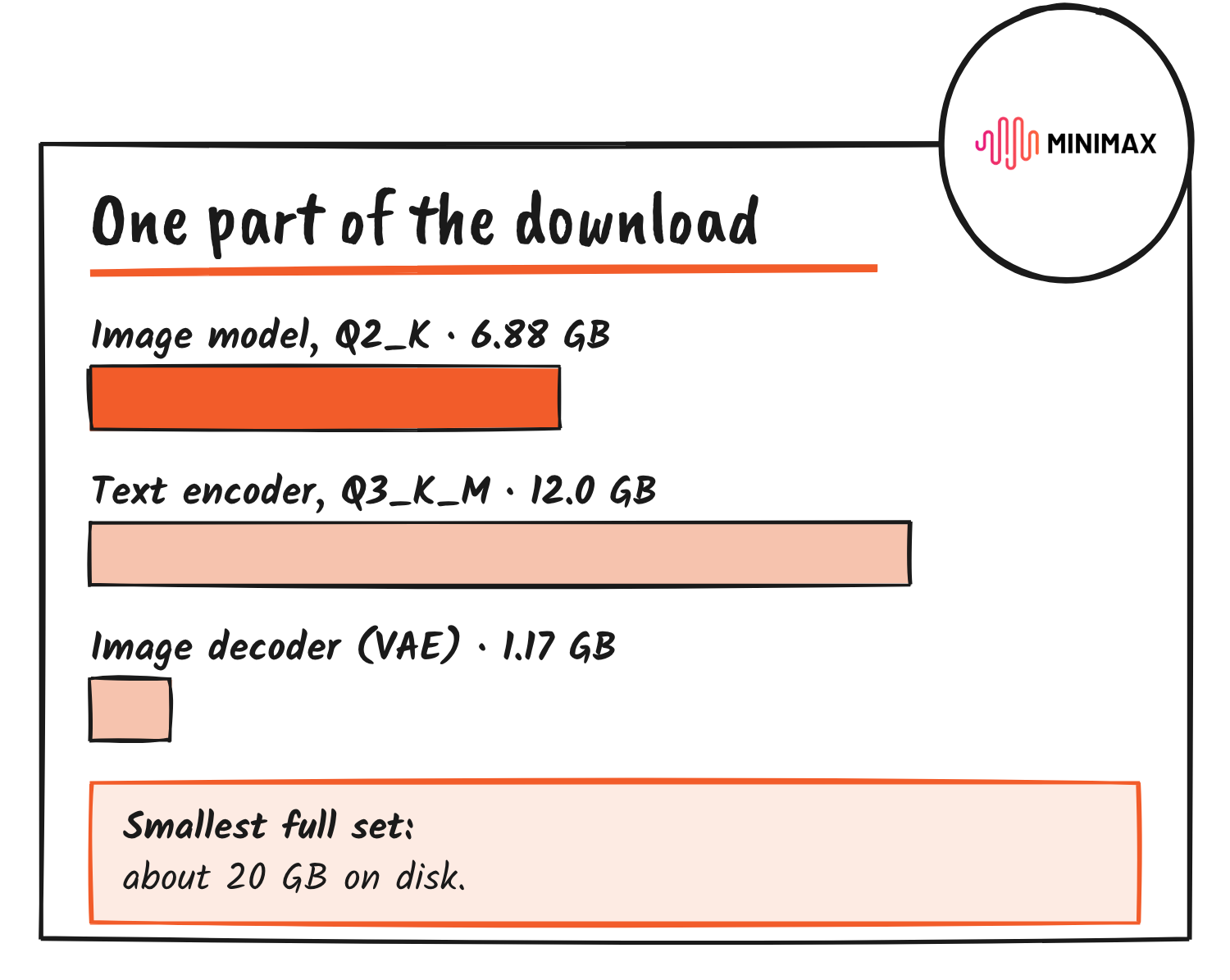
A local setup needs three files. The Q2_K file is the image model, the diffusion transformer that draws the picture. The prompt is read by MiniMax’s Qwen3-VL-32B text encoder, and a VAE, the decoder that turns the model’s output into pixels, finishes the image. Abiray’s card links a 12 GB Q3_K_M encoder and a 14.6 GB Q4_K_M encoder, plus Comfy-Org’s 1.17 GB fp16 VAE.
With the smallest encoder, the full set comes to about 20 GB on disk. With the Q4_K_M model and the Q4_K_M encoder it’s about 27 GB. The card pairs Q2_K with 8 to 10 GB of video memory, Q3_K_M with 12 GB and Q4_K_M with 16 GB. It doesn’t publish measurements behind those figures.
What a measured comparison shows
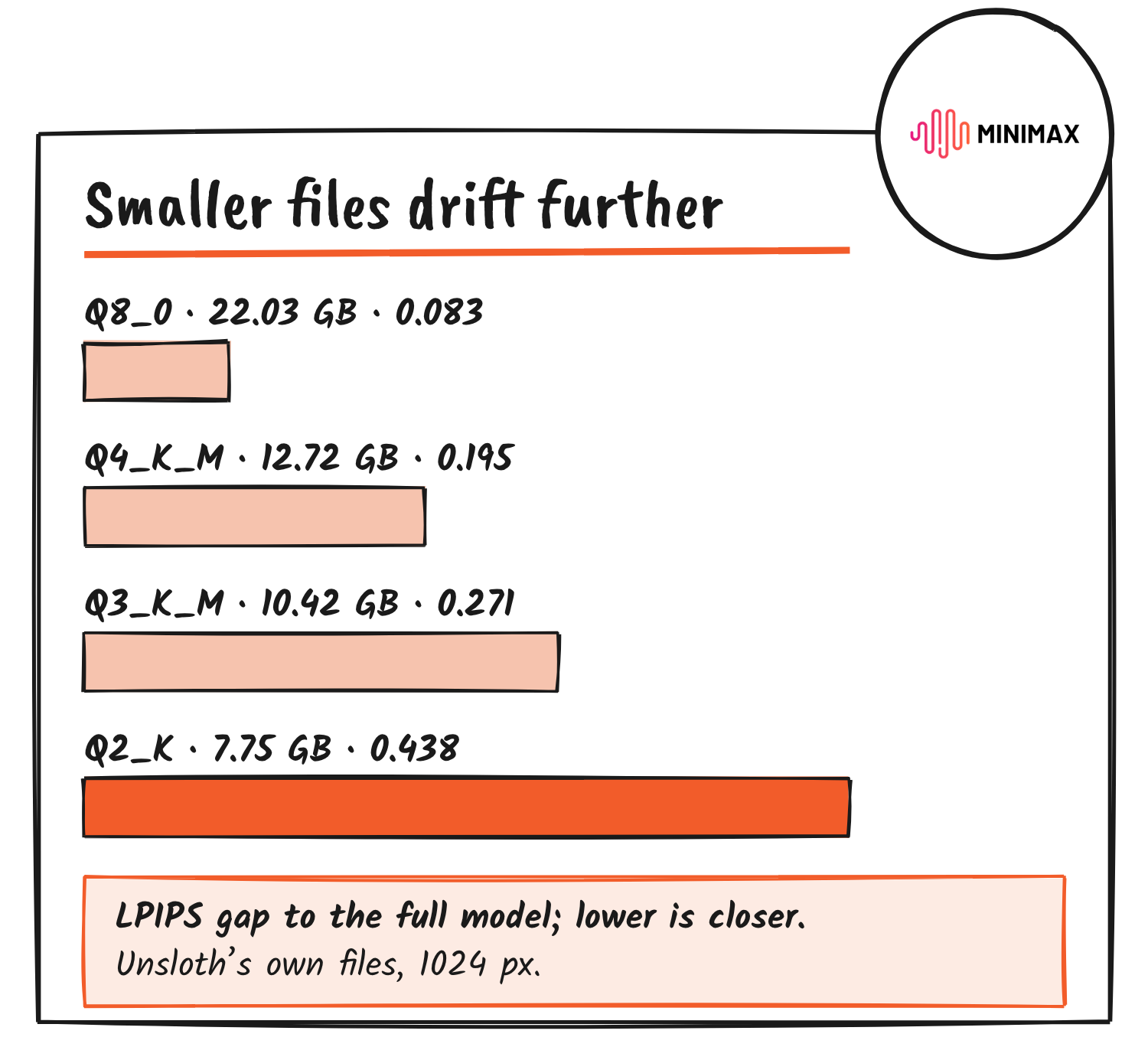
The post asks whether the model keeps its quality at this size. Abiray’s card calls Q4_K_M “near-lossless” and Q5_K_M “indistinguishable from full BF16”, and doesn’t include a comparison. Unsloth, another quantiser, publishes one for its own files. It uses LPIPS, a score of how far an image sits from the one the full model makes from the same seed, where lower is closer.
At 1024 by 1024, Unsloth’s card gives Q8_0 an LPIPS of 0.083, its recommended UD-Q4_K_XL 0.172, Q4_K_M 0.195, Q3_K_M 0.271 and Q2_K 0.438, the highest of its 14 files. Unsloth says its UD-Q2_K_XL, at 0.347, is “clearly ahead of” plain Q2_K. Its peak video memory at 1024 by 1024 was 9.4 GiB for Q2_K, 11.9 GiB for Q3_K_M and 14.0 GiB for Q4_K_M.
Those are Unsloth’s files, and its Q2_K is 7.75 GB, not Abiray’s 6.88 GB file. The tests ran at 1024 and 2048 pixels, not the 4096 by 4096 size the post calls native. Unsloth’s card also says that with --max-vram 12 an image renders byte for byte the same on a 24 GB L4 card, at 3.9 seconds a step against about 1.2 seconds without the limit.
Where the quantised versions are coming from
The post’s link is Hugging Face’s list of models tagged as quantised versions of MiniMax-H3-Image. On 15 November it held 31 repositories, all created between 10 and 13 November. They include GGUF files, FP8 and NVFP4 builds, MLX 4-bit and 8-bit builds for Apple Silicon, and 4-bit and NF4 files for the diffusers library. Abiray’s repository, created on 10 November, had 111,241 downloads at the time of writing. Hearthscale’s GGUF set, covered in the launch report, had 43,781.
The licence still applies
A quantised file is a modification of the model, which MiniMax’s community licence defines as a Model Derivative. The licence covers the world except the European Union, the United Kingdom, South Korea and the United States, and section V bars using, distributing or displaying the model or its outputs outside that territory. Commercial products must show “MiniMax-H3-Image” on the interface. Written authorisation from MiniMax is needed above US$1 million in annualised revenue, or to offer a hosted service. Abiray’s card says the files are free for research, personal and commercial creation within the licence’s terms, and doesn’t mention the excluded territories.
MiniMax’s model card lists two releases: the 68.65 GB BF16 model and a 17.9 GB NVFP4 prompt expander. Every quantised file in that list comes from a third party.
Discover more from Sulat AI & Tech News
Subscribe to get the latest posts sent to your email.