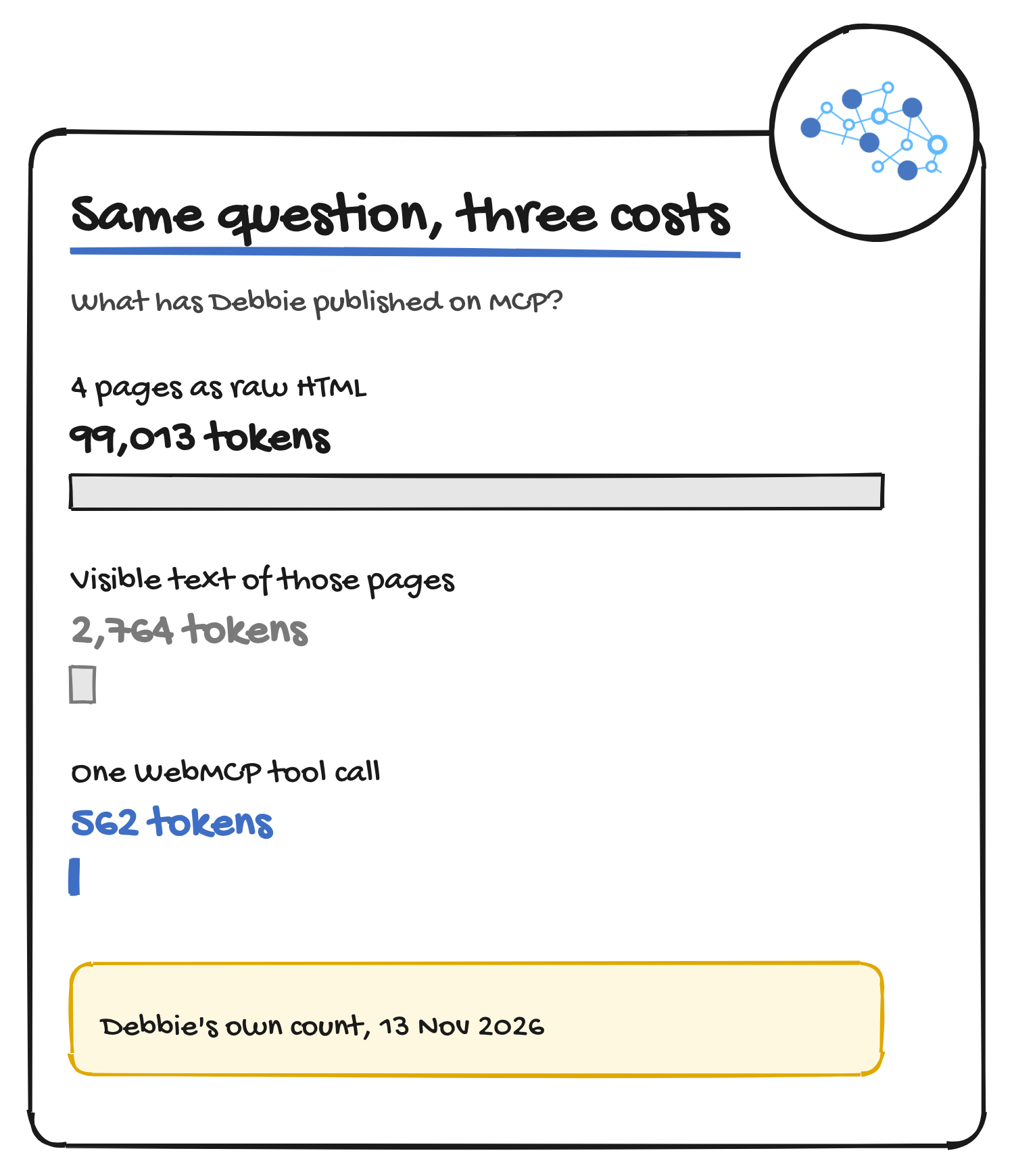
Debbie O’Brien, a developer educator and Google Developer Expert, has added WebMCP tools to her site, debbie.codes, and says one tool call now answers “what has Debbie published on MCP?” in about 562 tokens. Her measurements, published in a blog post on 13 November 2026, put the same answer at about 99,013 tokens when an agent reads the four MCP tag pages as HTML. Tokens are the units AI models count and bill by.
WebMCP is a proposed web standard that lets a page register tools in the browser. Each tool has a name, a description, a JSON Schema describing its inputs and an execute function, and an agent working in the tab can list and call the tools instead of clicking around the page. It’s a Draft Community Group Report from the W3C Web Machine Learning Community Group, edited by people from Microsoft and Google. The report says it isn’t a W3C Standard and isn’t on the W3C Standards Track.
O’Brien posted the results on X on 14 November, with a follow-up linking her YouTube walkthrough of the tools in Chrome DevTools.
What she built
The site builds one JSON index of her content when it’s generated, and five tools read from it:
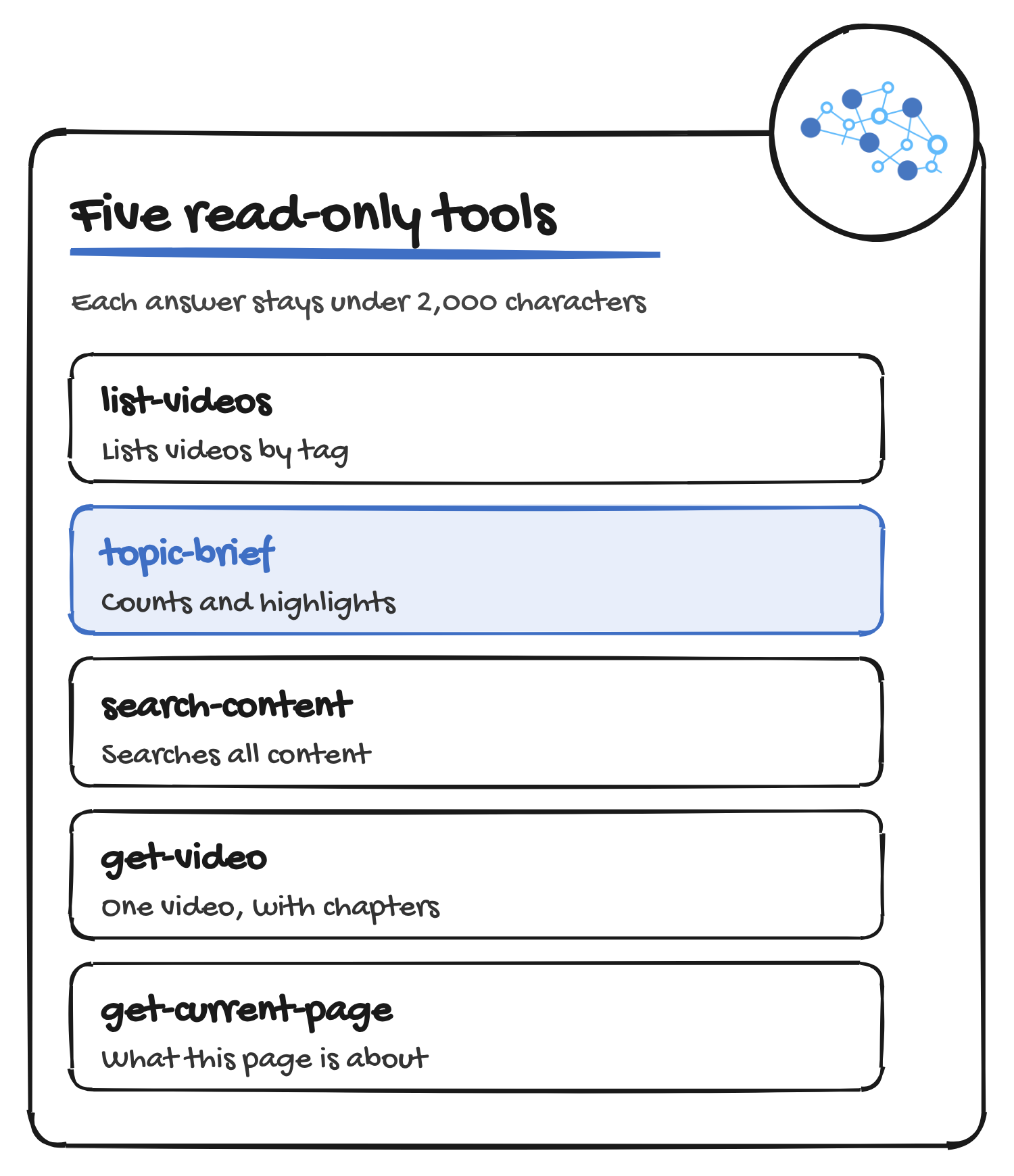
list-videoslists her videos, newest first, filtered by tag, conference or host.topic-briefsums up how much she’s published on one topic across videos, posts, podcasts and courses, with counts, dates and highlights.search-contentsearches across everything, including chapter titles.get-videoreturns one video by YouTube id, with its chapters.get-current-pagesays what the open page is about and what’s related.
All five are read-only, and each says so with WebMCP’s readOnlyHint flag. Answers stay under 2,000 characters. List, search and video results page with hasMore and nextOffset fields, and a result that’s still too big is cut and marked trimmed. Errors come back as sentences: a search for “playwrite” returns “No content matched topic ‘playwrite’. Closest tags: playwright.” Video results link to the minute a chapter starts, using the chapter markers YouTube already holds; a video needs at least two to count.
If a visitor’s browser doesn’t support WebMCP, the site checks once and loads none of the tool code or the index. Chrome runs WebMCP as an origin trial from version 149, a time-limited programme where sites opt in to an experimental feature, and Edge has its own trial from version 150. debbie.codes carries a trial tag for each in its production pages, and the keys only work on that domain. O’Brien says she checked the tools on Chrome 157 stable with no flags. The code is open source in the utils/webmcp folder of her GitHub repository. She wrote that she built it with Cursor cloud agents coordinated by her Grok Bot site lead, and reviewed and merged the changes herself.
What the numbers compare
| How an agent answers the question | Requests | What it reads |
|---|---|---|
| Read the four MCP tag pages as HTML | 4 | 256,713 bytes, about 99,013 tokens |
| Read the visible text of those pages | 4 | About 2,764 tokens |
Call topic-brief | 1 | 1,900 characters, about 562 tokens |
The 99,013 figure is the raw HTML of the four pages. Against the visible text alone, one tool call costs about a fifth as much. O’Brien says she counted with OpenAI’s o200k_base tokenizer, so other models count a little differently. The tool’s answer also carries the counts, the first and latest dates and a link to the listing page; this run returned seven of 46 highlights to fit the size limit. By her account, an agent reading the pages still has to count and sort, and gets no chapter times. She says she hasn’t measured how long a full task takes with a real agent, or how many tokens a screenshot-driven agent uses, so she makes no claim for either.
Trying the tools in DevTools and ChatGPT
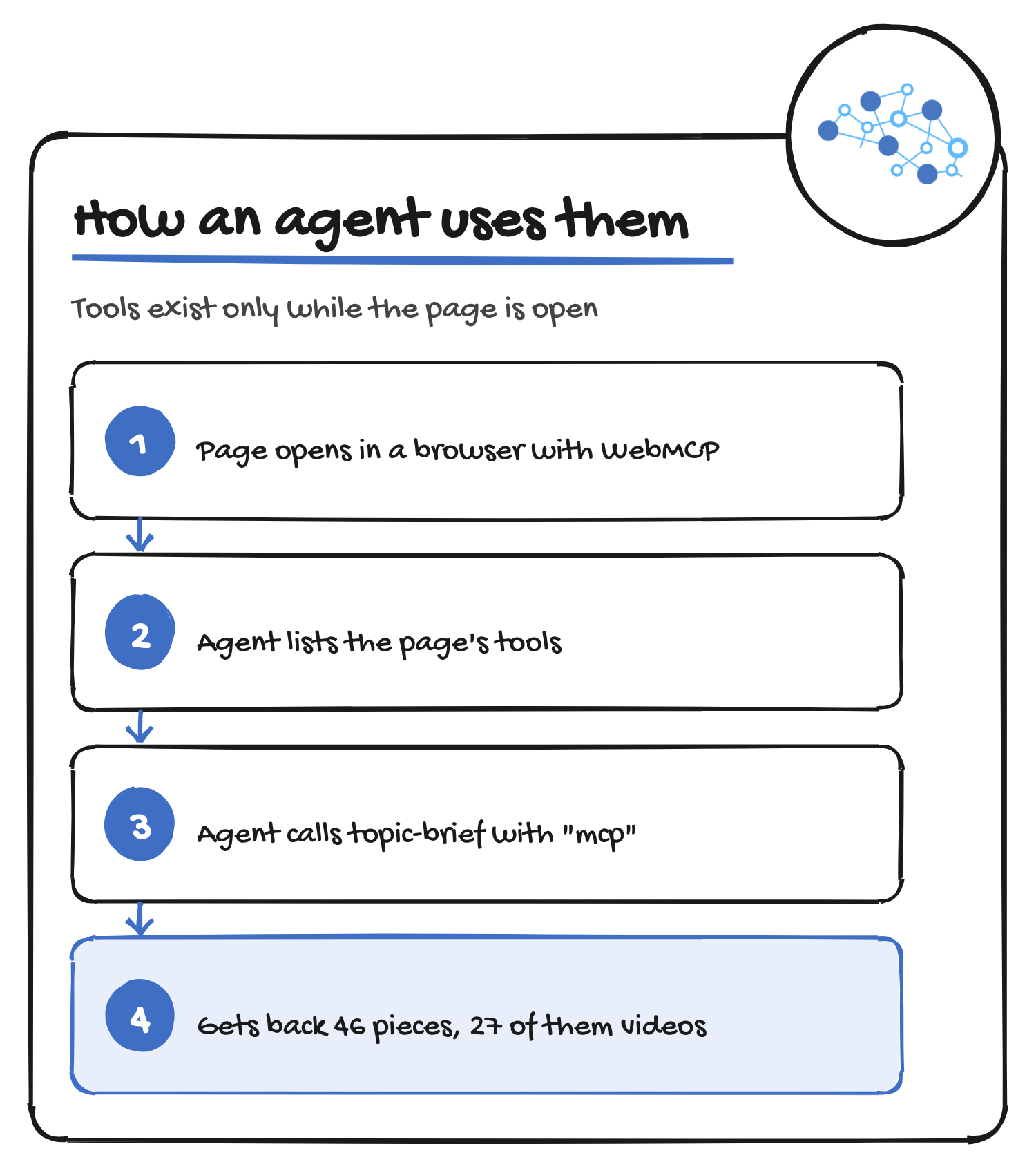
Chrome’s DevTools has a WebMCP pane under Application, where Available tools lists a page’s tools and each call shows its input and output. In her video, O’Brien runs topic-brief with “mcp” and gets back 46 pieces: 13 blog posts, 27 videos, five podcasts and one course. She also runs get-video with “MCP” as the id and shows the tool answering with an error sentence, because the input has to be a YouTube id. Her post says the call took 19 milliseconds from the DevTools console.
ChatGPT calls WebMCP tools “site tools”. OpenAI’s help page says they work in the ChatGPT desktop app’s built-in browser, not in Chrome, for accounts with access. O’Brien asked ChatGPT to open debbie.codes/videos, discover the page’s tools and use list-videos for the “mcp” tag. It found the tools and got 27 matches back. She notes that having the page open in that browser doesn’t always switch on tool discovery, and ChatGPT can click around the page instead. From code, she runs the tools with Playwright’s WebMCP API, which needs Chromium launched with --enable-features=WebMCP even on the live site, and with the experimental WebMCP tools in chrome-devtools-mcp.
Who else has added WebMCP tools
O’Brien’s tools read a content index. Commercial platforms have put WebMCP tools in front of carts and payments.
| Platform | When | What agents can do |
|---|---|---|
| Stripe | September 2026 | Use WebMCP on all Stripe Checkout pages |
| Shopify | 5 August 2026; checkout tools 28 September | Search the catalogue, manage the cart, go to checkout and place the order after the buyer confirms |
| BigCommerce, with Cloudflare | 21 October 2026 | Search products and fill a cart; the shopper finishes checkout on the storefront |
Stripe says it enabled WebMCP on all its Checkout pages and measured 42% fewer tokens, 38% fewer tool calls and 39% faster completion across 60 tests on six models, against a baseline of 1.8 million tokens per purchase. Shopify says its tools are live on every Liquid storefront. Commerce.com says its tools are on by default for eligible Stencil storefronts, and merchants can turn them off.
Paul Conroy, the chief technology officer of square1.io, wrote on X on 11 October that on one of his own sites WebMCP cut tokens by about 27 times on average and by up to 82 times. Stripe’s figure comes from agents completing a purchase against a browser-driving baseline, and O’Brien’s compares reading four pages with one lookup, so each measures a different task.
Chrome’s own documentation calls WebMCP a proposed standard. The tools on debbie.codes are live now at debbie.codes/videos.
Discover more from Sulat AI & Tech News
Subscribe to get the latest posts sent to your email.