HyperFrames, the open-source video framework from HeyGen, says the custom coding agent it built for video cost about 30% less than Claude Code across 17 tasks, with quality judged equal. The team detailed the result in an engineering post on 13 November, and says the agent runs on top of DeepSeek Harness.
The post, written by Rory Li, Wenbo Zhu, James Russo, Michael Wang and Bin Liu, is titled “Our harness beats Claude Code”. A harness is the layer around a model that runs its tools, feeds it context and keeps it working on a task. HyperFrames announced the post on X the same day and says it’s now releasing the agent inside HyperFrames Studio, its desktop app.
Our harness beats Claude Code: here’s how
— HyperFrames (@HyperFrames_) November 13, 2026
What the comparison found
HyperFrames says it ran a recent checkpoint of its harness against Claude Code on 17 video tasks: recreating a reference video, remixing, brand videos, library footage and edits. Both used the same frontier model at the same effort, with the same requests and assets.
On 78% of tasks the HyperFrames harness finished the same work with less effort, the team says. Across all 17, costs fell by about 30% and the agent needed about 35% fewer model turns. On tasks built around HyperFrames’ own workflows, such as remixing a reference video, costs fell by 40% and turns fell by more than half.
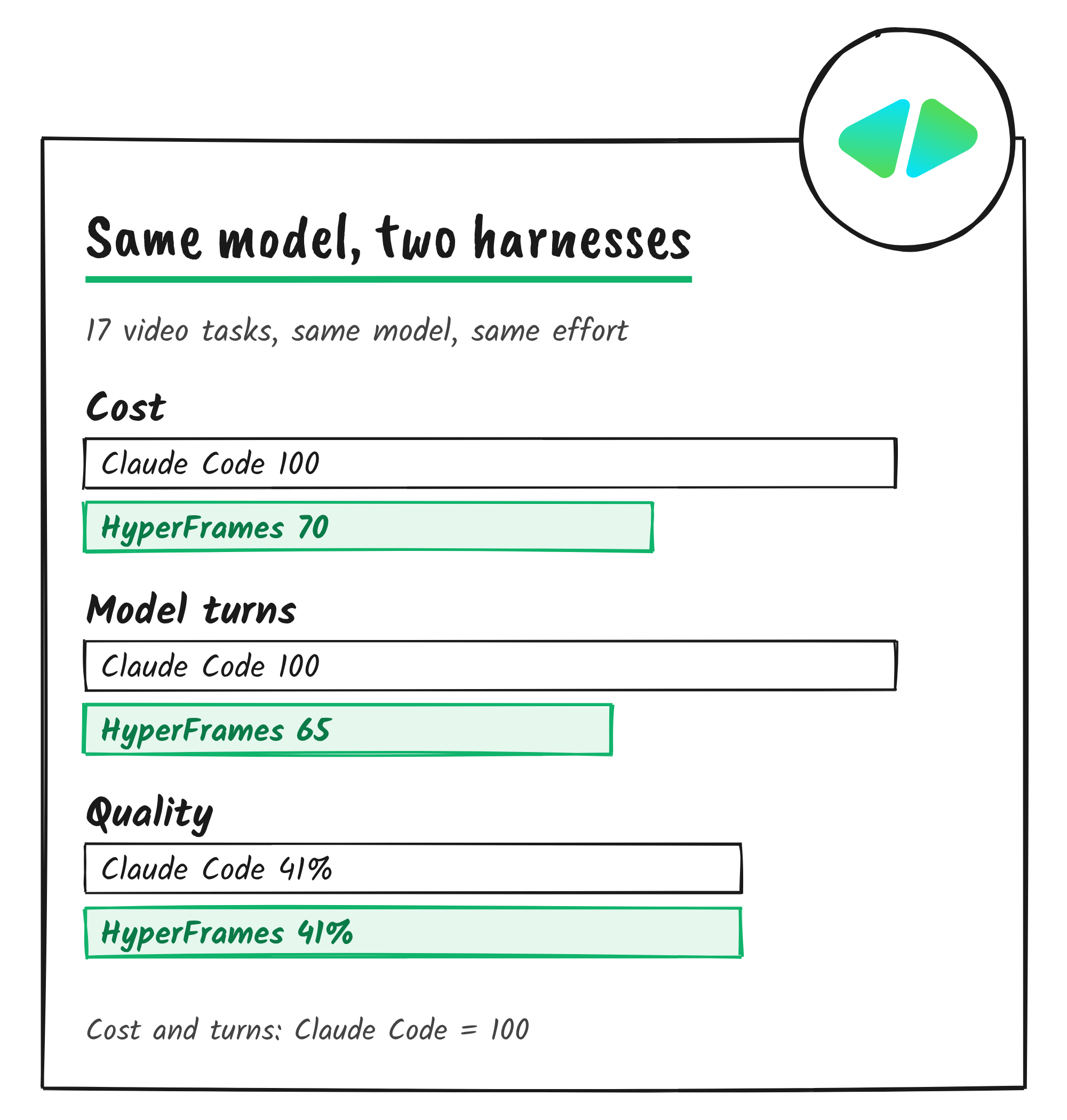
On quality, HyperFrames says a judge model rated the two harnesses equally in blind pairwise evaluations, and its chart puts both at 41%. The post doesn’t name the model both harnesses ran or the judge model, and the 17 tasks are HyperFrames’ own internal benchmark. Claude Code is the only rival it tested.
Why it’s built from plugins
HyperFrames’ pitch is that general coding agents like Claude Code and Codex lack the scaffolding video needs. After reviewing thousands of agent sessions step by step, the team says effort bunched around a few repeating patterns, such as checking changes by re-rendering, estimating audio alignment instead of measuring it, and building throwaway tools to see the result.
The team says its answer was to move each policy, feature and capability into its own standalone plugin. That mirrors DeepSeek Harness, the MIT-licensed agent runtime DeepSeek released in August, where the model adapter, tools, sessions and even the agent loop are plugins. I covered its user numbers earlier this month.
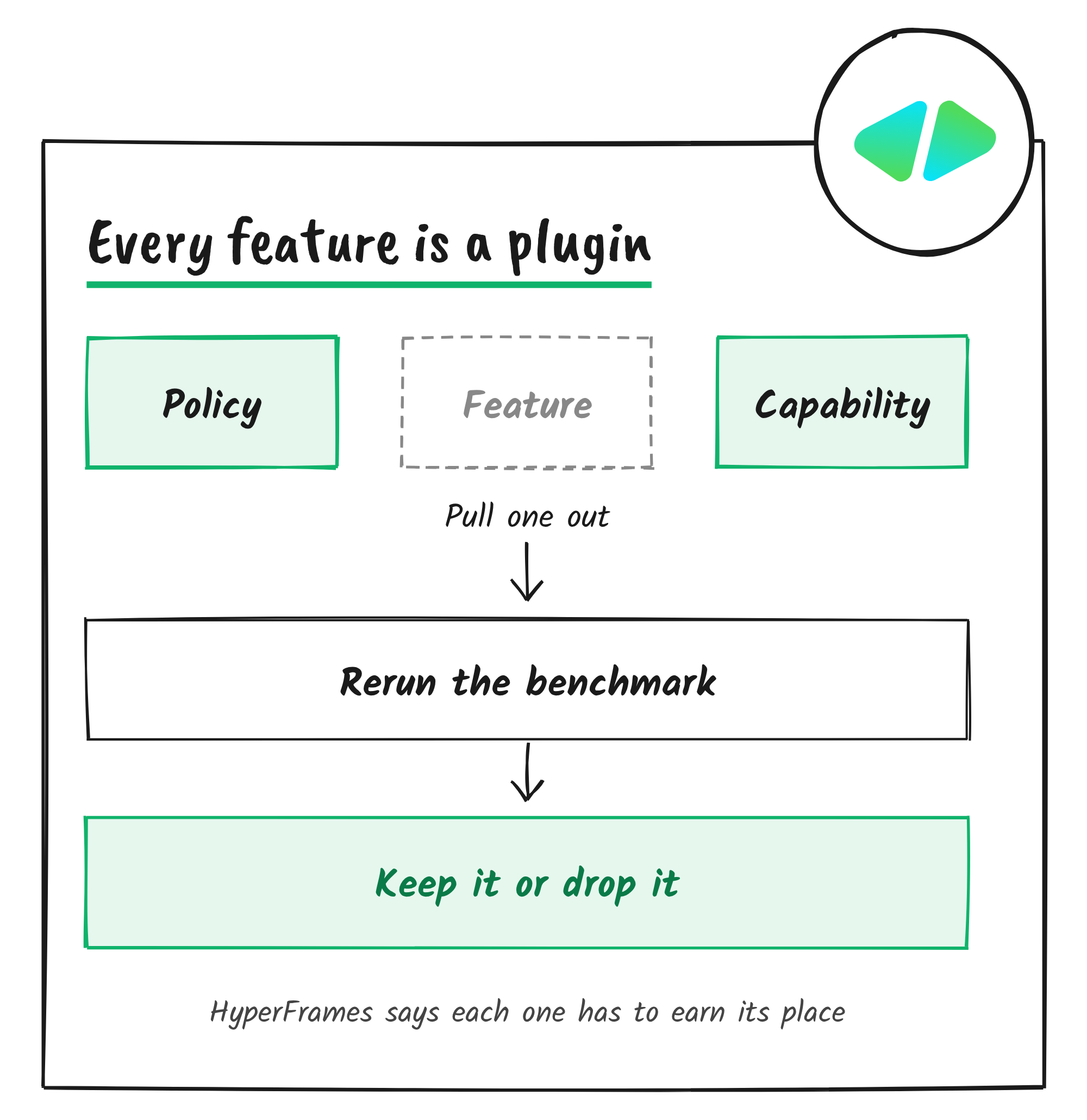
The payoff, according to HyperFrames, is testing. It can remove one or more plugins, rerun the benchmark and judge both the agent’s trace and the finished video, then keep or drop the piece. New harnesses reuse the plugins that carry over.
How the harness changes itself
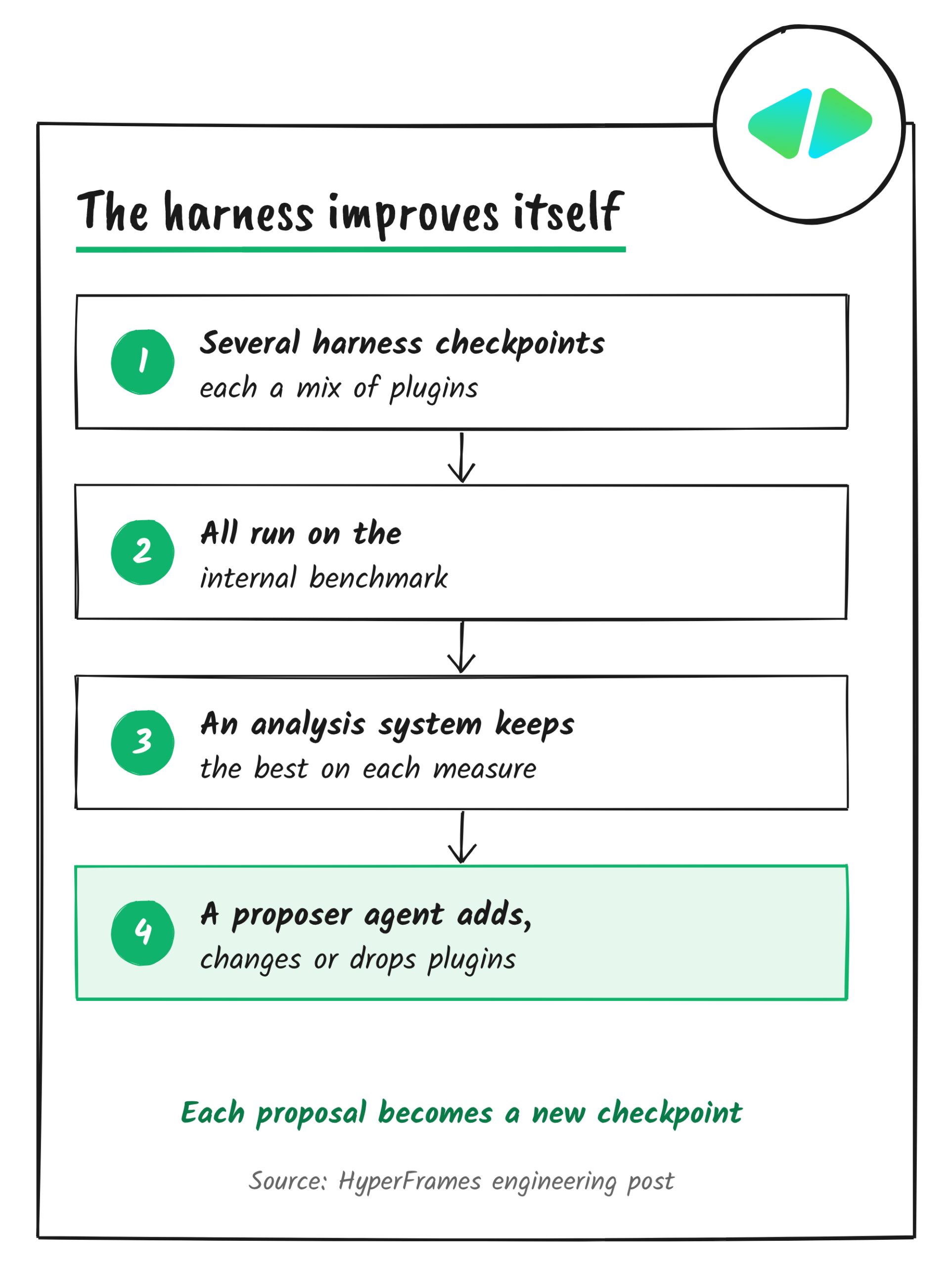
HyperFrames keeps several harness checkpoints at once, each a different mix of plugins, and runs them all against its benchmark. An analysis system reviews every run, covering the agent’s behaviour at each step and the final video, and keeps the best checkpoint on each measure rather than chasing one score.
Engineers tuned the plugins by hand at first. The team then added a proposer agent that suggests plugins to add, change or remove, and each suggestion becomes a new checkpoint tested like any other. HyperFrames says some features were proposed, evaluated and shipped entirely by agents.
Where to try it
HyperFrames itself is free and Apache 2.0 licensed: it turns HTML, CSS and animations into MP4 video, and works with Claude Code, Codex, Cursor and other coding agents through installable skills. The Studio app is free on Mac, Windows and Linux, and its US$25-a-month Pro plan adds HeyGen’s video, image, voice and music models. The team says it plans to extend the agent to 3D, agentic editing and footage search next, and posts updates on @HyperFrames_.
Discover more from Sulat AI & Tech News
Subscribe to get the latest posts sent to your email.